
Container haulage article
Avoid £250–£500 Redelivery Fees: UK Container Redelivery Policy Checklist
Understand UK container redelivery rules, typical fees (£250–£500 plus £50–£85/hr waiting), and use a five-step pre-delivery checklist to prevent costly...


Redelivery fees apply whenever a haulier attempts a delivery or collection and cannot complete it through no fault of their own, and under standard UK haulage terms, the receiving customer carries that cost. The most common triggers are a site that isn’t ready, blocked or unsuitable access, and nobody available at the agreed appointment time. Expect a flat aborted delivery charge, plus waiting time if the driver is delayed on site before the job is called off.
TL;DR:
- Redelivery fees usually cost between £250 and £500 for accurate deliveries, plus additional hourly waiting charges of around £50 to £85 if delays occur.
- Most failed deliveries stem from site issues such as inadequate access, ground stability, or absence of authorized personnel, rather than driver or carrier mistakes.
- Confirming equipment needs, site readiness, and appointing a single on-site contact before scheduling can prevent most redelivery charges.
- Proper site assessments, clear instructions, and early paperwork completion significantly reduce the likelihood of failed deliveries and related fees.
- Using a managed transport platform with real-time capacity visibility minimizes the chances of scheduled trucks arriving at unprepared sites, decreasing redelivery risks.
Table of Contents
- What counts as a redelivery fee and when it kicks in
- Common delivery charges and what they cover
- Site responsibilities and access requirements
- Scheduling, cancellations and the redelivery process
- Liability, damage and disputes over redelivery charges
- How to avoid redelivery fees: a pre-delivery checklist
- Operational improvements that actually cut redelivery risk
- A practitioner’s view on redelivery fees and site prep
- A faster route to fewer failed deliveries
- Sources
- FAQ
What counts as a redelivery fee and when it kicks in
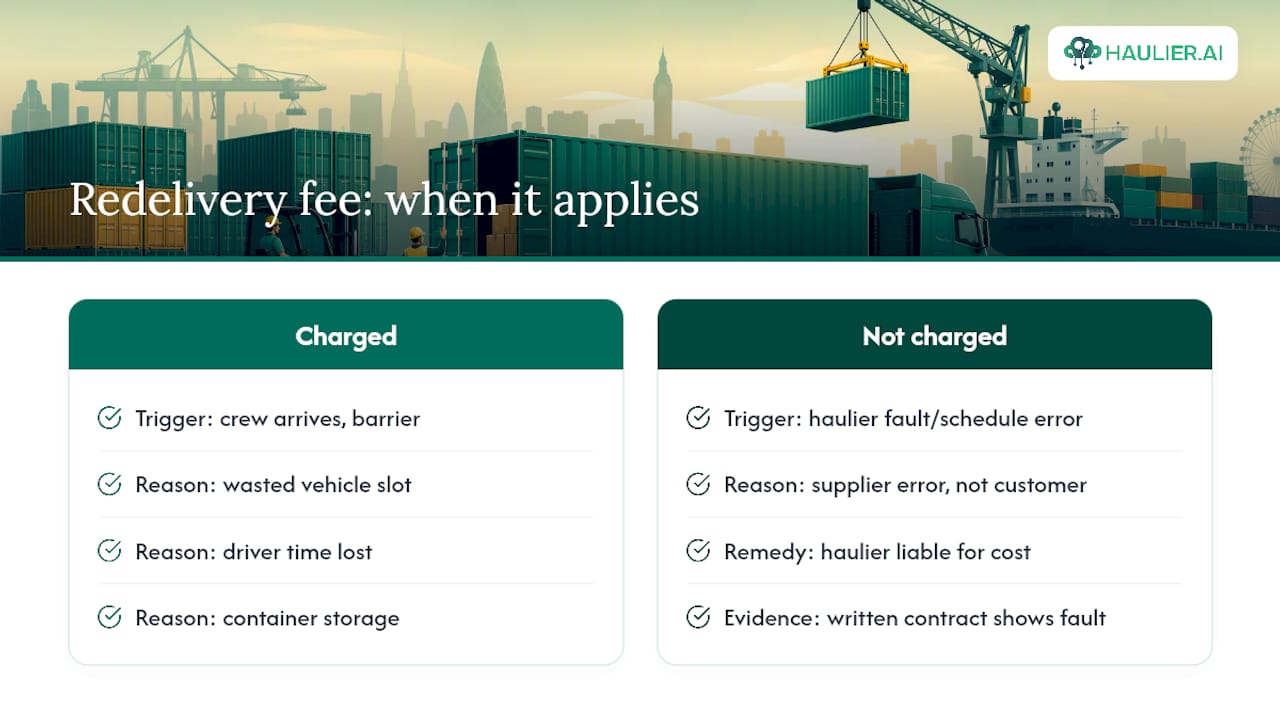
A redelivery fee (sometimes billed as an “aborted delivery” charge) is what a haulier invoices when a scheduled drop or collection fails and the truck has to leave and come back another day. It isn’t a penalty dreamed up to pad an invoice. It reflects a real cost: a wasted vehicle slot, a driver’s day, and often a container that now needs storing somewhere before the next attempt.
Under a standard container return policy or delivery contract, the fee becomes payable the moment the haulier’s crew arrives ready to work and finds a barrier they didn’t cause. That might be a locked gate with no key holder present, a drop point still covered in rubble, or a low branch nobody mentioned when the site details were confirmed. If the haulier caused the failure, say through a scheduling error, the charge shouldn’t be passed on. The line between the two is usually settled by what was agreed in writing before the job was booked.
Common delivery charges and what they cover
Beyond the headline redelivery charge, several accessorial costs show up on container invoices, and knowing what each one means stops nasty surprises later.
- Redelivery/aborted delivery fee: usually a flat rate per failed attempt, separate from the original haulage cost.
- Detention/waiting time: charged hourly (or by the half hour) once any free loading window has run out.
- Storage/demurrage: a daily depot rate applied while a failed load sits waiting for rebooking.
- Tail-lift or specialist equipment surcharges: extra for kit like a HIAB crane or a timed delivery slot.
Pro Tip: Always check whether your quote lists loading time as included or extra. Most carriers build in a free loading allowance of one to two hours, but that’s rarely stated on the headline price.
In practice, UK aborted delivery fees for HIAB deliveries typically run £250 to £500 or more plus VAT, with waiting time charged separately at roughly £50 to £85 plus VAT per extra hour once the free allowance is used up. Storage while a container waits for a second attempt adds a further daily rate on top.
Site responsibilities and access requirements
Most failed deliveries come down to the site, not the truck. Before booking, confirm the following:
- Access width and turning circle: check the route in against the vehicle length, especially on narrow estate roads or tight urban sites.
- Ground strength and level supports: a HIAB or side-loader needs firm, level standing ground to operate safely, and the drop point itself needs to take the container’s weight without sinking.
- Overhead clearance: measure for power lines, trees and low structures before the crane arrives, not after.
- On-site readiness: someone with authority to accept the delivery, plus any paperwork, should be present at the agreed time.
- Pre-notified restrictions: flag low bridges, weight limits, or permit-only parking when you book, not on arrival day.
For siting itself, support the container at its four corner castings on stable, non-compressible sleepers or pads rather than resting it directly on soft ground, which risks the structure racking over time.
If you’re not confident about ground conditions or access, ask your haulier about a paid site survey before the job is booked. It costs less than a failed delivery.
Scheduling, cancellations and the redelivery process
Most hauliers ask for advance notice of a few days to change or cancel a booking without charge, because vehicle and driver schedules are usually locked in that far ahead. Miss that window and you may be billed as if the job went ahead.
- Time windows and slot bookings exist to manage yard and depot traffic, not just customer convenience, so keep to them.
- After a failed delivery, the standard sequence is: the container returns to depot, storage charges start accruing, and a new slot gets booked, typically adding a day or two to the timeline.
- Clear written instructions (access notes, contact details, photos of the drop point) cut re-run risk more than any other single step.
Liability, damage and disputes over redelivery charges
Risk generally passes to the receiver once the driver has delivered and the paperwork is signed, so check the container and note anything unusual before signing, not after the truck has gone.
- Photograph the container and site on arrival, note the time, and get the driver’s own notes on the delivery sheet.
- If a charge looks wrong, raise it in writing quickly, referencing the original booking confirmation and any site instructions you gave.
- Additional charges like a second depot storage day or a genuine return run are usually fair; a charge for a delay the haulier caused is not.
- For high-value cargo or repeated disputes, loop in your insurer or the haulage supplier’s account manager rather than arguing it out with the driver.
Clarity of instructions and a single on-site contact cut failed deliveries significantly, and even a short photographic site survey removes most surprises before the truck sets off.
Transport managers dealing with recurring disputes may find it worth reviewing their own record-keeping and compliance processes alongside the haulier’s terms, since clean documentation is what actually wins a contested charge.
How to avoid redelivery fees: a pre-delivery checklist
A failed delivery is almost always preventable. Work through this before the truck is booked:
- Confirm the vehicle and equipment type (HIAB, side-loader, standard flatbed) matches your site and access.
- Send accurate measurements, photos, and route notes when booking, and request a survey if there’s any doubt.
- Prepare a level, cleared drop point with supports ready, and double check overhead clearance.
- Complete customs and port release paperwork before the truck moves, not while it’s already en route.
- Name one on-site contact with a mobile number and a backup plan if plans change last minute.
| Preparation step | Why it matters | Typical cost of skipping it |
|---|---|---|
| Confirm right equipment at booking | Wrong vehicle type means the job can’t proceed | £250–£500+ aborted delivery fee |
| Clear, level drop point ready | Crane needs stable ground to operate safely | Waiting time at ~£50–£85/hour |
| Paperwork and port release done early | Missing documents stall collection | Storage/demurrage per day at depot |
| Named on-site contact confirmed | No one to accept delivery means a wasted slot | Full redelivery charge, plus rebooking delay |
Remember to budget for VAT on top of these figures. UK haulage quotes are commonly given exclusive of VAT, so add 20% when working out your worst-case cost.
Operational improvements that actually cut redelivery risk
Most redelivery fees trace back to a communication gap somewhere in the chain, not to a badly run site. Better visibility earlier in the booking process closes that gap.
- Managed quoting with clear updates reduces missed collection slots, because both sides can see the same schedule instead of relying on phone tag.
- Confirming port release and customs paperwork before the truck is dispatched avoids the single biggest cause of collection failures at UK ports.
- Building realistic travel time buffers into the booking, rather than the tightest possible window, keeps waiting charges from stacking up.
Haulier.AI’s own guidance on reducing collection failures and its scheduling playbook both point the same way: the fee usually isn’t about the driver or the site in isolation, it’s about whether the two sides had matching information before the truck left the yard.
A practitioner’s view on redelivery fees and site prep
The same three mistakes keep causing failed deliveries: nobody measures the actual access route, nobody checks overhead clearance before the crane turns up, and nobody names a single point of contact who can make a decision on the day. All three are free to fix.
If you take one thing from this: confirm equipment and access in writing, put someone accountable on site, and treat a site survey as insurance, not an extra cost. Do those three things and most redelivery charges simply never happen.
— Vytautas
A faster route to fewer failed deliveries
There are alternatives to chasing haulage quotes by phone and email for container transport across the UK. Cutting admin that usually causes missed slots can be achieved by using a managed transport desk that shows live capacity, keeps quoting and paperwork visible to both sides, and flags problems before a driver is already en route.
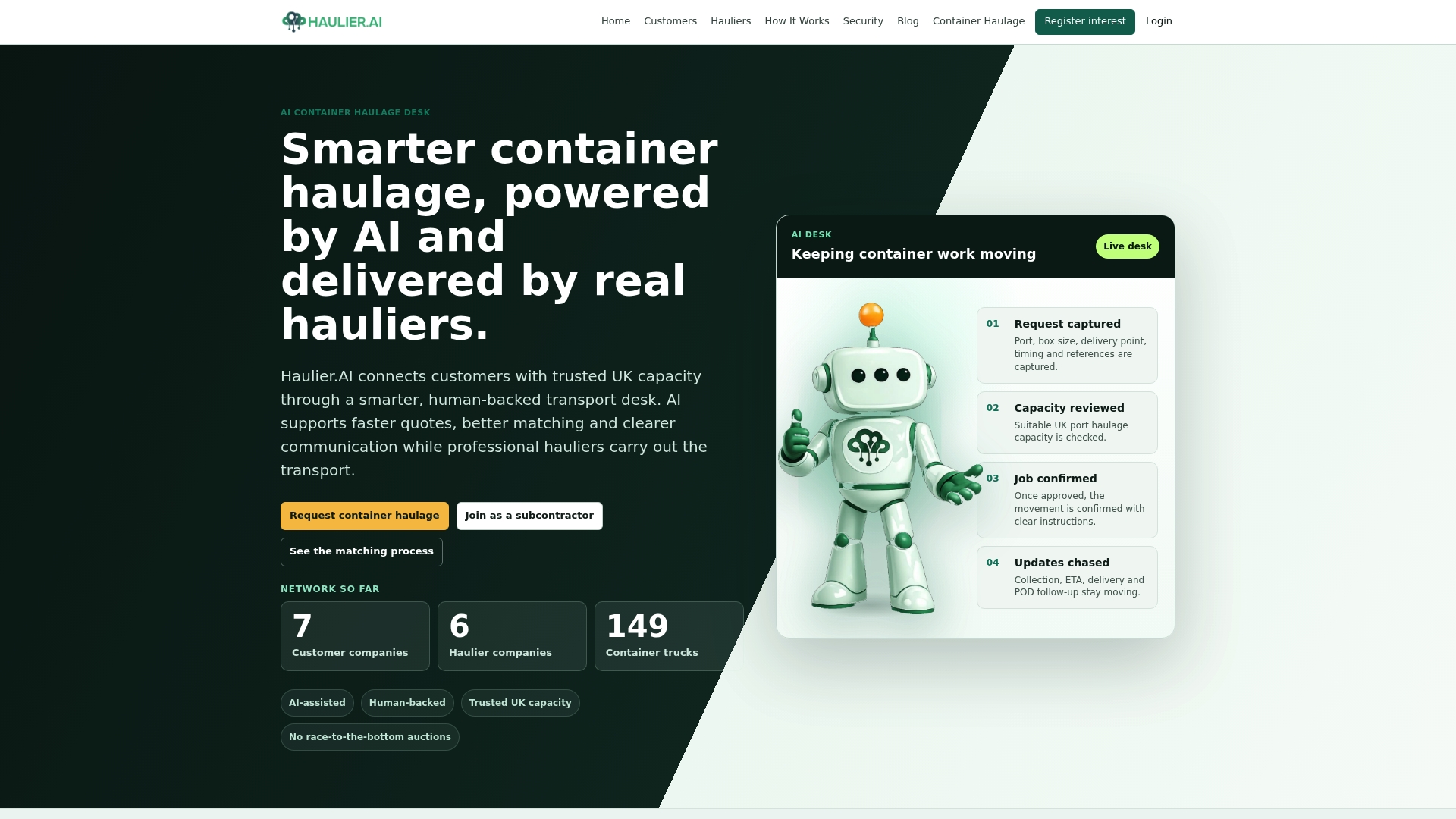
When hauliers see full site details and job requirements upfront, and can decline jobs that don’t suit their vehicle or schedule, fewer trucks turn up to sites that aren’t ready. That single change removes most of the redelivery triggers covered in this guide. If you’re booking container haulage and want to see how the process works before you commit, visit Haulier, or go straight to request container haulage and get a quote for your next movement.
Sources
- Freight accessorial charges explained: fuel, waiting time, tail lift and storage fees — Logistics UK
- Why containers get stuck and how to avoid delays — Forest Freight
FAQ
What is a container redelivery policy?
It’s the set of terms setting out when a redelivery fee applies, who pays it, and what site conditions the receiver must meet, usually covering access, notice periods and charging methods.
Who is liable for a failed container delivery?
The receiving customer is typically liable when the site wasn’t ready, access was blocked, or nobody was present, unless the haulier caused the failure.
How long does it take to unload a container ship?
Unloading times vary hugely by vessel size and port equipment, and this depends on berth allocation and crane availability rather than any fixed rule.
What happens when a container arrives at port?
It’s discharged from the vessel, moved into the terminal yard, and held there until customs clearance and haulage collection are both confirmed and arranged.
What is not allowed in a shipping container for haulage?
Restricted and hazardous goods rules vary by cargo type and route, so always check the specific customs and carrier terms for your shipment before booking.
How long can you keep a shipping container at a depot before charges apply?
Most depots apply a free period before demurrage or storage charges start accruing daily, and the exact length is set out in your individual haulage or depot terms.