
Container haulage article
Reduce collection failures in UK container haulage
Reduce collection failures in UK container haulage by implementing vital confirmation protocols and backup strategies for seamless operations.


The single most effective way to reduce collection failures is to enforce a three-stage confirmation protocol before any haulier is dispatched: verified container release, a 48/24-hour digital acknowledgement window, and confirmed driver instructions including site access details. Pair that with a vetted subcontract fallback, and most no-shows become preventable rather than inevitable.
Before despatch, confirm these non-negotiables:
- Shipping line release confirmed and matched to the bill of lading
- Container type, condition, and any special handling requirements verified
- Port or depot slot booked and within the driver’s arrival tolerance
- Driver briefed on site access, vehicle dimensions, and loading bay restrictions
- Subcontract fallback identified if the primary haulier cannot attend
Pro Tip: Set a hard rule: no job leaves the system without a digital acknowledgement from the driver. A phone call is not confirmation — a timestamped message is.
Key takeaways
Enforcing a three-stage confirmation protocol, a pre-collection checklist, and a vetted subcontract fallback is the most direct way to reduce collection failures in UK container haulage.
| Point | Details |
|---|---|
| Enforce confirmation windows | Require digital ACK at 48 hours, 24 hours, and 2 hours before every collection. |
| Run the pre-collection checklist | Verify release, container condition, slot, and driver instructions before despatch. |
| Build a subcontract fallback | Pre-approve standby hauliers and rates on critical lanes before a failure occurs. |
| Track four core KPIs | Monitor first-attempt success rate, time-to-resolve, subcontract percentage, and rebook lead time weekly. |
| Use Haulier for managed collections | Haulier’s AI-assisted desk centralises confirmation, paperwork, and vetted haulier access in one platform. |
Table of Contents
- Why do collections fail in UK container haulage?
- Pre-collection checklist: what to confirm before despatch
- What booking confirmation standards actually prevent no-shows
- What visibility and communication standards should you insist on?
- How to rebook fast: contingency options and contract protections
- How does technology reduce collection failures in practice?
- KPIs and governance to keep collection success rates moving
- Step-by-step triage when a collection fails today
- What actually moves the needle on collection failures
- Fewer no-shows start with the right platform
- Sources
- FAQ
Why do collections fail in UK container haulage?
Most failed collections trace back to one of four root causes, and the split between them matters because each demands a different fix.
Administrative failures are the most common. Missing or late documentation and unreleased containers at UK ports account for a significant share of collections that never happen. A container that has not been released by the shipping line cannot be collected, regardless of how well the haulier is briefed.
Operational failures include haulier capacity strain, driver unavailability on the day, and the wrong vehicle turning up for the container type. A 40ft high-cube on a standard flatbed is a wasted journey.

Site and scheduling failures cover incorrect appointment slots, Low Emission Zone restrictions the driver was not warned about, and delivery sites that cannot accommodate the vehicle booked. Incorrect shipment information and unrealistic transit windows are among the most frequent causes of missed carrier appointments across freight operations.
Equipment failures are a growing problem. Container equipment quality has deteriorated, and containers arriving in unsuitable condition are increasingly causing on-site rejections and missed movements.
The pattern is consistent: most failures are not random. They cluster around the same documentation gaps, the same scheduling ambiguities, and the same equipment issues. Fix the process, and the frequency drops.
Pre-collection checklist: what to confirm before despatch
Run through this before releasing any job to a haulier. It takes under ten minutes and eliminates the majority of avoidable failures.
Documents
- Shipping line release confirmed and reference number recorded
- Bill of lading or manifest matches the container number exactly
- Customs clearance obtained where required (especially post-Brexit for non-EU cargo)
Container
- Container type confirmed (20ft, 40ft, high-cube, open-top, reefer)
- Condition checked against container condition reporting standards — photograph any pre-existing damage
- Cargo declaration complete, including any hazardous or temperature-sensitive requirements
Appointment
- Port or depot slot booked and reference shared with the driver
- Pick-up window confirmed, including the latest acceptable arrival time
- Driver contact number verified and two-way communication tested
Driver instructions
- Site access notes: gate codes, security check-in, height restrictions
- Vehicle dimension requirements confirmed against the correct trailer type
- Penalty or re-attendance fee policy communicated in writing
Proof
- Timestamped photos of container condition taken before departure
- Digital sign-off from driver confirming receipt of instructions
Pro Tip: Store the completed checklist against the job reference in your TMS or shared platform. If a dispute arises, the audit trail is already there.
What booking confirmation standards actually prevent no-shows
Ambiguous bookings are the single biggest driver of late container pickups and no-show collections. The fix is a structured confirmation flow with hard deadlines.
- 48 hours before: send full booking data (address, container ID, slot reference, contact numbers) and require a digital acknowledgement from the haulier
- 24 hours before: reconfirmation call or platform ACK confirming driver name, vehicle registration, and ETA
- 2 hours before: final driver check-in confirming en-route status
Standardise the booking data template across your operations. Every booking should include: full collection address with postcode, container number and type, slot reference, primary and secondary contact numbers, and any site-specific access notes. Transcription errors from inconsistent formats cause more missed collections than most teams realise.
Set clear cut-off times for cancellations and rebooking. Where contractually agreed, include re-attendance fees for late cancellations — this alone changes haulier behaviour.
Pro Tip: Use a shared digital platform rather than email chains. A booking confirmed by email at 4:30 PM on a Friday is not a confirmed booking — it is a risk.
What visibility and communication standards should you insist on?
Require milestone notifications at every stage: booking accepted, driver en route, on site, container collected, and proof of delivery uploaded. These are not optional extras — they are the minimum standard for any collection you cannot afford to lose.
Centralise all messaging and documentation on a single platform or shared channel. Digital centralisation of messaging and standardised templates reduces ambiguity and makes exception handling faster and auditable. When something goes wrong, you need a timestamped record, not a WhatsApp thread.
Set an escalation protocol with named contacts and response SLAs:
- 0–30 minutes: operations contact attempts direct resolution with the driver or haulier
- 30–60 minutes: escalate to transport manager or duty supervisor
- 60+ minutes: trigger subcontract fallback and notify port or depot of revised ETA
Use standardised digital address formats and appointment slot references across every booking. The single most common source of confusion at port gates is a mismatch between the address on the booking and the address on the gate system.
How to rebook fast: contingency options and contract protections
When a collection fails, speed is the only currency that matters. Every hour of delay increases storage risk and, at busy UK ports, the chance of missing a vessel cut-off entirely.
- 0–30 minutes: confirm the failure reason, notify the port or depot, and attempt immediate reconfirmation with the original haulier
- Standby haulier: maintain a pre-approved list of vetted subcontractors with agreed rates and SLAs — do not start searching from scratch when the clock is running
- Marketplace access: the Mandata–HaulageHub integration connects hauliers to a network of a large network of vetted transport partners, enabling rapid capacity access when primary haulage fails
- Contract clauses: include clear liability terms for missed attempts, minimum notice windows, and re-attendance fees — these deter casual no-shows and create a cost-recovery route when they happen
- Buffer scheduling: build a minimum 90-minute buffer around port cut-offs and account for local traffic patterns, particularly around Felixstowe, Southampton, and London Gateway
Pro Tip: Pre-approve two or three subcontract rates on your most critical lanes before you need them. Negotiating a rate during a live failure costs time and money.
How does technology reduce collection failures in practice?
Digital tools do not replace good process — they make good process enforceable at scale.
TMS integrations automate job despatch, enable two-way status updates, and eliminate the duplicate data entry that generates transcription errors. When a booking is created once and flows through to the driver’s device without being retyped, a whole category of failure disappears.
Marketplace and subcontract networks provide rapid access to vetted capacity. The Mandata–HaulageHub partnership illustrates the model: two-way data synchronisation between a TMS and a large partner network shortens rebook lead times materially and reduces the admin burden of finding cover.
Haulier operates as an AI-assisted, human-backed transport desk that centralises confirmation, paperwork verification, and access to vetted UK hauliers in a single platform. The platform workflow covers managed quoting, real-time communication updates, and port coverage matching — the exact points where manual processes tend to break down.
Practitioners who have moved to digital carrier management report significant lane cost savings and large reductions in admin time in example implementations. The mechanism is straightforward: fewer manual handoffs means fewer errors, and fewer errors means fewer failed collections.
| Capability | Manual process | Digital/integrated process |
|---|---|---|
| Booking confirmation | Email or phone, no audit trail | Timestamped digital ACK, logged against job |
| Status updates | Driver calls in, inconsistent | Automated milestones, visible to all parties |
| Subcontract rebooking | Manual search, slow | Marketplace access, pre-approved rates |
| Paperwork verification | Checked on arrival | Pre-departure, flagged before despatch |
| Exception handling | Reactive, undocumented | Escalation protocol with SLA tracking |
KPIs and governance to keep collection success rates moving
Four KPIs cover the ground that matters:
- Collection success rate (first attempt): the primary metric — a high target rate on established lanes
- Time-to-resolve failed collections: measure from failure notification to confirmed rebook; target under two hours
- Percentage of subcontracted collections: a rising trend signals capacity problems with primary hauliers
- Average rebook lead time: how long it takes to secure a replacement vehicle after a failure
Run a weekly operational dashboard covering these four figures. Monthly, review carrier performance against the same KPIs and address outliers directly. Quarterly, hold supplier business reviews with your top hauliers and share the data — most will respond to transparency if the relationship is worth keeping.
Log every failed collection with a root cause and a corrective action. Without that log, the same failures recur on the same lanes with the same hauliers. Improving operational efficiency in haulage depends on this feedback loop more than any single process change.
Step-by-step triage when a collection fails today
0–30 minutes
- Confirm the failure reason from the driver or haulier
- Notify the port or depot immediately — give them a revised ETA or flag that a replacement is being arranged
- Notify the consignee
- Attempt immediate reconfirmation with the original haulier if the reason is resolvable
30–120 minutes
- Trigger the subcontract route or standby haulier
- Confirm container release is still valid and the slot can be held or rebooked
- Update all escalation contacts with the new ETA
- Record evidence: driver communications, timestamps, reason for failure
2–4 hours
- Confirm the rebook or contingency plan in writing
- Notify the billing or claims team if costs are recoverable
- Log the root cause and corrective action against the job reference
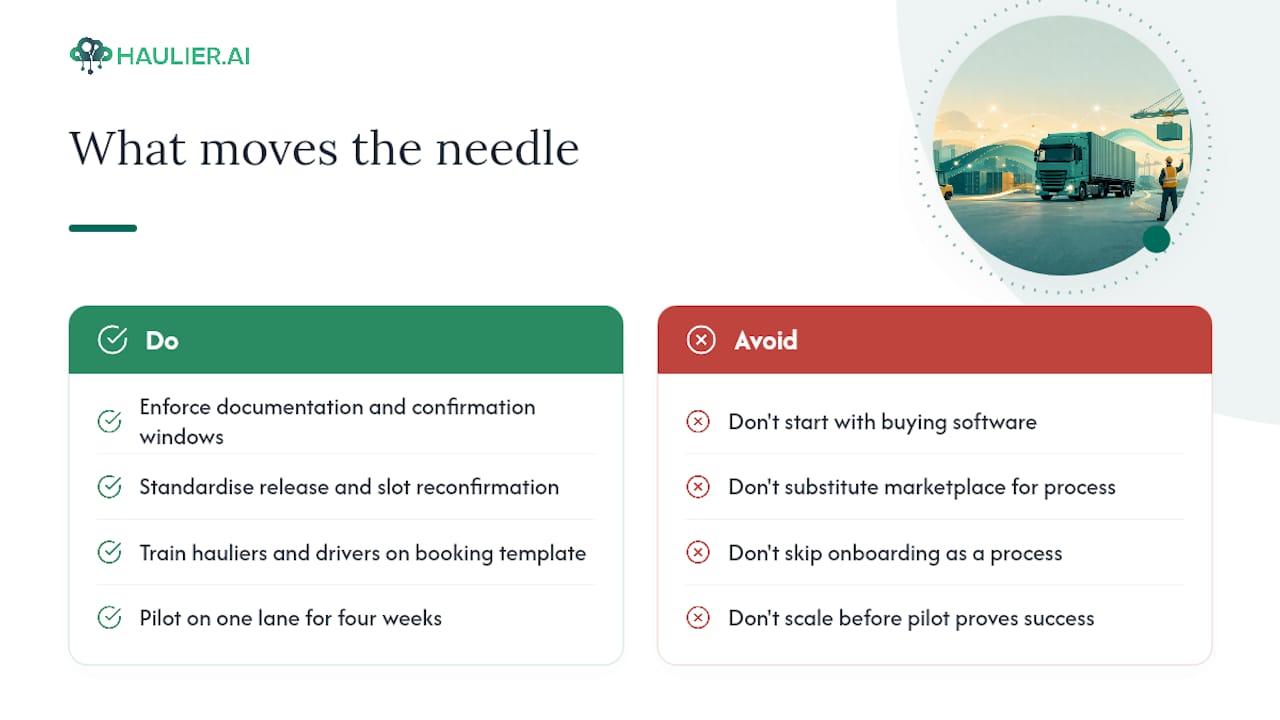
What actually moves the needle on collection failures
The conventional advice is to buy better software. That is not wrong, but it is the wrong starting point.
Documentation and confirmation windows deliver the fastest return. In most operations, a significant share of failed collections can be traced to a container that was not released, a driver who did not receive clear instructions, or a slot that was booked but never reconfirmed. None of those require new technology — they require a standard that is actually enforced.
Visibility and subcontracting capability matter enormously, but they amplify a working process rather than substitute for one. A marketplace integration that gives you access to 5,000 vetted partners is only useful if your booking data is clean enough to hand a job off quickly.
Culture and onboarding are underestimated. Train every haulier and driver on your booking template and escalation protocol before they handle a live job. The operations teams that see the lowest failure rates tend to be the ones that treat onboarding as a process, not a conversation.
Start with a single lane or port. Pilot the confirmation windows, the checklist, and the KPI tracking on one route for four weeks. If the collection success rate moves, scale it. If it does not, the root cause is somewhere the checklist did not reach — and now you know where to look.
Fewer no-shows start with the right platform
Missed collections cost more than the re-attendance fee. They cost storage charges, vessel risk, and the time your operations team spends firefighting instead of planning.
Haulier connects freight forwarders and importers directly to vetted UK hauliers through an AI-assisted transport desk that handles confirmation, paperwork verification, and real-time updates in one place. No email chains, no unconfirmed bookings, no scrambling for cover when a haulier drops out. The platform’s container haulage service covers the exact pressure points this checklist addresses: release verification, driver briefing, and subcontract fallback — all managed through a single desk.
To trial it, request access for your team and run it on one lane or port for four to eight weeks. Measure your collection success rate before and after. The KPIs will tell you whether it is worth scaling.
Sources
- Global Shipping Conditions - 1st January 2025 - British Association of Removers
- Why containers get stuck at UK ports and how to avoid costly delays | Forest Freight blog
- Best practices for managing carrier relationships digitally | Phleetto
- Mandata announce partnership with HaulageHub
FAQ
What is the most common cause of a failed container collection?
Missing or unreleased documentation is the leading cause, followed by incorrect shipment information and haulier capacity failures. Verifying container release and completing a pre-collection checklist before despatch eliminates the majority of preventable failures.
How quickly should you rebook after a no-show collection?
Aim to confirm a replacement haulier within two hours of the failure. Each hour of delay increases demurrage and storage risk, particularly at high-volume UK ports such as Felixstowe and Southampton.
What KPIs should freight teams track to improve collection success rates?
Track first-attempt collection success rate, time-to-resolve failed collections, percentage of subcontracted collections, and average rebook lead time. Review these weekly and address carrier outliers monthly.
How does Haulier help reduce no-show collections?
Haulier’s AI-assisted transport desk centralises booking confirmation, paperwork verification, and access to vetted UK hauliers, removing the manual handoffs where most failures originate.
What should a pre-collection checklist include?
Confirmed shipping line release, matched bill of lading, container type and condition check, booked port or depot slot, verified driver instructions, and timestamped photos of container condition before departure.