
Container haulage article
Demurrage and detention: a guide for UK logistics teams
Understand demurrage and detention to reduce costs for UK logistics. Learn key strategies to control these charges effectively.


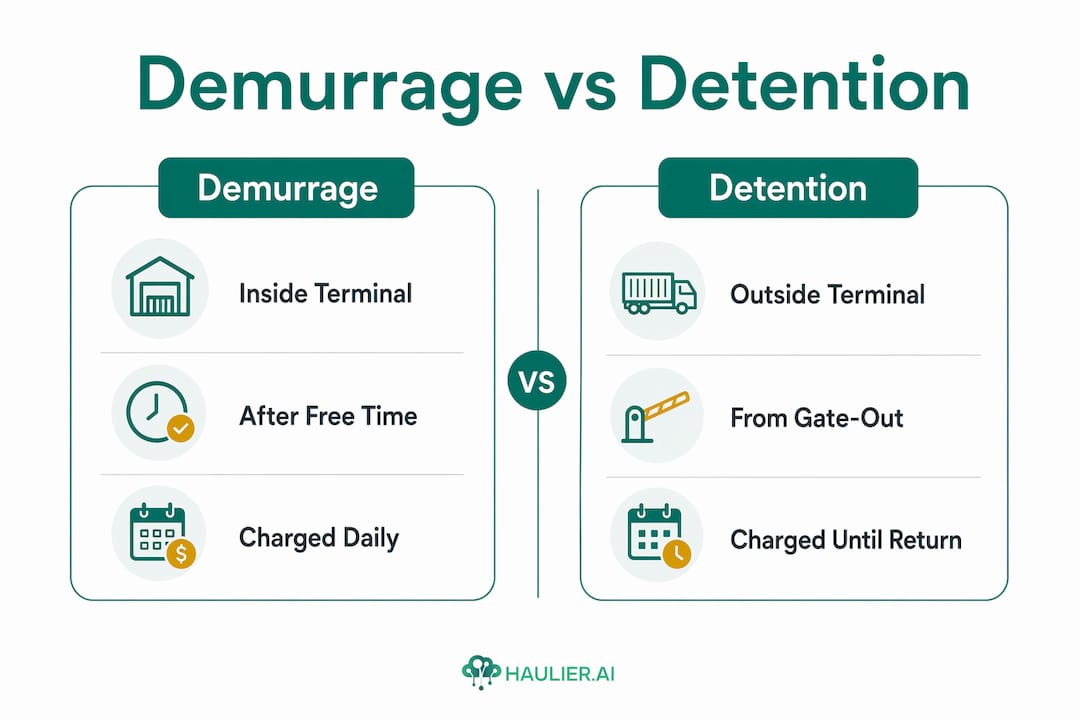
Demurrage and detention are the two principal time-based charges in container logistics, and confusing them costs UK shipping companies money every week. Demurrage is the charge applied when a full container remains inside a terminal beyond the agreed free time period, compensating the terminal for occupied yard space. Detention is the charge applied when a container is held outside the terminal after free time expires, incentivising the fast return of carrier equipment. Both charges accrue daily, both are negotiable, and both are far more controllable than most logistics teams realise.
What are demurrage and detention charges?
Demurrage and detention mark two distinct phases of the container lifecycle, and the boundary between them is the terminal gate.
Demurrage accrues daily from the moment free time expires while the container still sits inside the terminal. Rates vary by carrier, port congestion levels, and contract terms. The charge exists because terminals have finite yard space. Every container that overstays its welcome blocks a slot that another shipment needs.

Detention starts at gate-out and ends when the empty container is returned to the agreed depot. The carrier levies this charge because the container is their equipment. While it sits at your warehouse or your customer’s yard, the carrier cannot reuse it. That lost equipment velocity is what the fee is designed to recover.
A third charge, storage, is sometimes confused with demurrage. Some carriers itemise storage separately from demurrage to reflect terminal warehouse usage rather than yard occupation. Seeing all three on a single invoice is common at busy UK ports such as Felixstowe, Southampton, and London Gateway.
The container lifecycle: where each charge applies
The simplest way to picture the distinction is as a timeline with three zones.
- Zone 1 (free time inside terminal): No charge. The container awaits collection after vessel discharge.
- Zone 2 (demurrage zone): Free time has expired. The container is still inside the terminal. Daily demurrage charges begin.
- Zone 3 (detention zone): The container has left the terminal gate. Free time for return has expired. Daily detention charges begin.
Pro Tip: Request a written free time confirmation from your carrier before the vessel arrives. Verbal agreements are unenforceable when a dispute lands on your desk.
How do contract terms and free time policies affect charges?
Free time is the single biggest variable in your demurrage and detention exposure. Free time granted varies widely by carrier contracts, port rules, commodity types, and container specifications. Standard carrier defaults are often as low as five to seven calendar days. Negotiated annual service contracts can push that figure to 14–20 days, which dramatically reduces risk.
The distinction between calendar days and working days matters enormously. A container arriving on a Thursday with five calendar days of free time expires on Tuesday. The same container with five working days of free time expires the following Thursday. That difference can represent thousands of pounds on a single shipment.
Container type also affects tariffs. Reefer containers carry higher demurrage rates than standard dry boxes because of their power connection requirements and the premium yard space they occupy. Hazardous cargo containers often face shorter free time windows under terminal operating rules.
Key variables to review in every contract
- Free time duration (calendar vs. working days)
- Escalating tariff tiers (day 1–5, day 6–10, day 11+)
- Equipment type differentials (dry, reefer, flat rack)
- Port-specific rules versus carrier standard tariffs
- Dispute window and escalation procedures
Negotiating free time upwards from standard carrier defaults translates directly into cost savings and reduced operational risk. Annual contract reviews are the primary opportunity to secure better terms.
Pro Tip: When negotiating annual service contracts, ask carriers to confirm free time in writing for each port of call. Tariff structures differ between Felixstowe and Tilbury container operations, and a blanket agreement may not protect you at every terminal.
What causes demurrage and detention fees?
Port congestion, customs delays, yard coordination failures, and poor data visibility are the four primary triggers for avoidable charges. Each one is addressable with the right operational controls.
Port congestion is the most visible cause. When vessel arrivals cluster, terminals become saturated and appointment slots disappear. Containers sit waiting for collection, and demurrage clocks tick. At ports like Liverpool and Immingham, seasonal volume spikes regularly create congestion windows that catch unprepared importers off guard.
Customs holds are particularly damaging because they are outside the importer’s direct control but still trigger demurrage. A container flagged for examination can sit inside the terminal for days. The Federal Maritime Commission in the United States and equivalent bodies in the UK have pushed carriers to pause demurrage during government-imposed holds, but enforcement remains inconsistent. Documenting the hold with official timestamps is the only reliable protection.
Slow unloading and missed appointments account for a large share of detention charges. A container collected on time but not unloaded promptly means the empty return is delayed. That delay is entirely within the importer’s operational control.
Practical steps to reduce charges
- Book collection appointments immediately after vessel discharge notification. Waiting 24 hours can cost you an appointment slot in a congested terminal window.
- Pre-clear customs documentation before the vessel arrives. Late submission of commercial invoices or packing lists is one of the most common causes of customs holds.
- Assign a dedicated container tracker for each shipment. One person responsible for timestamps, appointment confirmations, and return bookings eliminates the coordination gaps that generate fees.
- Confirm return depot availability before gate-out. Carriers sometimes change approved return locations without adequate notice. Arriving at a closed or full depot resets your detention clock.
- Use real-time port status feeds to anticipate congestion. Southampton port operations publish vessel schedules and terminal status updates that allow hauliers to plan around peak periods.
Timely collection, accurate documentation, and improved coordination between ports, hauliers, and customers are the most reliable means of avoiding charges. The logistics teams that perform best treat container collection as a time-critical task from the moment the vessel is confirmed.
Pro Tip: Build a shared container tracking log that your haulier, customs broker, and warehouse team all update in real time. Gaps in that log are where charges hide.
How do these charges affect your finances, and how do you dispute them?
Demurrage and detention inflate shipping costs and reduce equipment velocity across the entire supply chain. A single disputed invoice can run to thousands of pounds. Across a year of shipments, unmanaged charges represent a material budget line.
Disputing charges requires documented evidence. Carriers and terminals will not waive fees on the basis of verbal explanations. The evidence that wins disputes includes gate-in and gate-out timestamps from the terminal system, customs hold notifications with official reference numbers, appointment booking confirmations, and written correspondence showing carrier or terminal errors.
Maintaining accurate records and using arbitration or dispute windows can lead to fee waivers, but only when the documentation is complete. Most carrier tariffs include a dispute window of 30 to 60 days from invoice date. Missing that window closes the dispute permanently.
Negotiation tactics that work in practice include:
- Requesting a goodwill waiver for first-time overruns with a carrier where you have a strong volume relationship.
- Citing force majeure for port congestion or government-imposed customs holds, supported by official terminal notices.
- Escalating to a carrier’s commercial team rather than their operations desk. Commercial teams have authority to approve waivers that operations staff cannot.
- Benchmarking your tariff against published carrier rate cards. If you are paying above the standard published rate, that is a negotiation starting point.
The financial discipline required here is the same as any accounts payable process. Review every demurrage and detention invoice line by line before payment. Errors in charge calculation are more common than carriers acknowledge.
What frameworks and tools help manage container charges?
Operational frameworks that integrate yard execution, appointment scheduling, and digital container tracking reduce free time overruns and the charges that follow. The most effective frameworks share three characteristics: real-time visibility, clear accountability, and scheduled policy reviews.
Real-time event logging is the foundation. Every gate-in, gate-out, customs event, and return confirmation should be captured with a timestamp and stored centrally. Without this data, disputes are guesswork and cost forecasting is impossible.
Appointment scheduling tools reduce the risk of missed collection windows. Integrating terminal appointment systems with your transport management process means hauliers receive collection instructions with the appointment reference already confirmed. That single change removes one of the most common causes of detention charges.
AI and real-time event logging enhance container cycle visibility and reduce the errors that cause detention fees. Platforms that connect hauliers, freight forwarders, and importers in a single workflow give every party the same timestamp data at the same time. That shared visibility is what prevents the “I thought you had booked it” conversations that generate charges.
- Scheduled tariff reviews: Review carrier tariff schedules quarterly. Rates change, and an outdated assumption about free time can be expensive.
- Container cycle KPIs: Track average dwell time inside the terminal and average time to empty return. Both metrics reveal where your process is losing time.
- Haulier performance data: Monitor which hauliers consistently meet appointment windows and which do not. Consistent late arrivals are a controllable cost driver.
Haulier connects freight forwarders and importers with trusted UK hauliers through an AI-assisted transport desk. The platform provides real-time container visibility and structured job management, which directly reduces the coordination gaps that cause detention and demurrage charges.
Pro Tip: Set a calendar reminder 48 hours before free time expires on every active shipment. That window is enough time to escalate a collection issue before charges begin.
Key takeaways
Demurrage and detention are controllable operational costs, not fixed overheads. The teams that treat them as such consistently pay less.
| Point | Details |
|---|---|
| Demurrage vs detention | Demurrage applies inside the terminal; detention applies outside it after free time expires. |
| Free time negotiation | Securing 14–20 days of free time in annual contracts significantly reduces charge exposure. |
| Documentation wins disputes | Gate timestamps, customs hold references, and appointment records are the evidence that secures waivers. |
| Root causes are operational | Congestion, customs delays, and missed appointments are the primary triggers, and all are addressable. |
| Visibility reduces cost | Real-time container tracking and shared data across hauliers and customers prevents the gaps that generate fees. |
Why I think most logistics teams are paying more than they should
The uncomfortable truth about demurrage and detention charges is that a significant proportion of what UK logistics teams pay is avoidable. Not because the charges are unfair in principle, but because most operations lack the data discipline to catch problems before the clock runs out.
I have seen freight forwarders with strong carrier relationships still paying avoidable detention fees because nobody owned the empty return booking. The container sat at the warehouse for three extra days while two teams assumed the other had arranged collection. That is not a carrier problem. That is a process problem.
The other area where I see consistent overpayment is contract negotiation. Demurrage and detention fees are negotiable at contract level, yet many importers accept standard carrier tariff defaults without question. Securing extended free time is not a favour. It is a standard commercial ask that carriers grant regularly to volume shippers.
Technology is changing the picture. AI-assisted platforms that give hauliers, forwarders, and importers a shared view of container status in real time are removing the information gaps that generate charges. The container haulage sector is moving toward connected workflows, and the teams that adopt them earliest will carry the lowest charge burden. The teams that do not will keep funding the carriers’ revenue lines.
— Vytautas
How Haulier reduces your exposure to container charges
Demurrage and detention charges grow in the gaps between teams. Haulier closes those gaps by connecting freight forwarders and importers with reliable UK hauliers through an AI-assisted transport desk that provides clear visibility at every stage of the container journey.
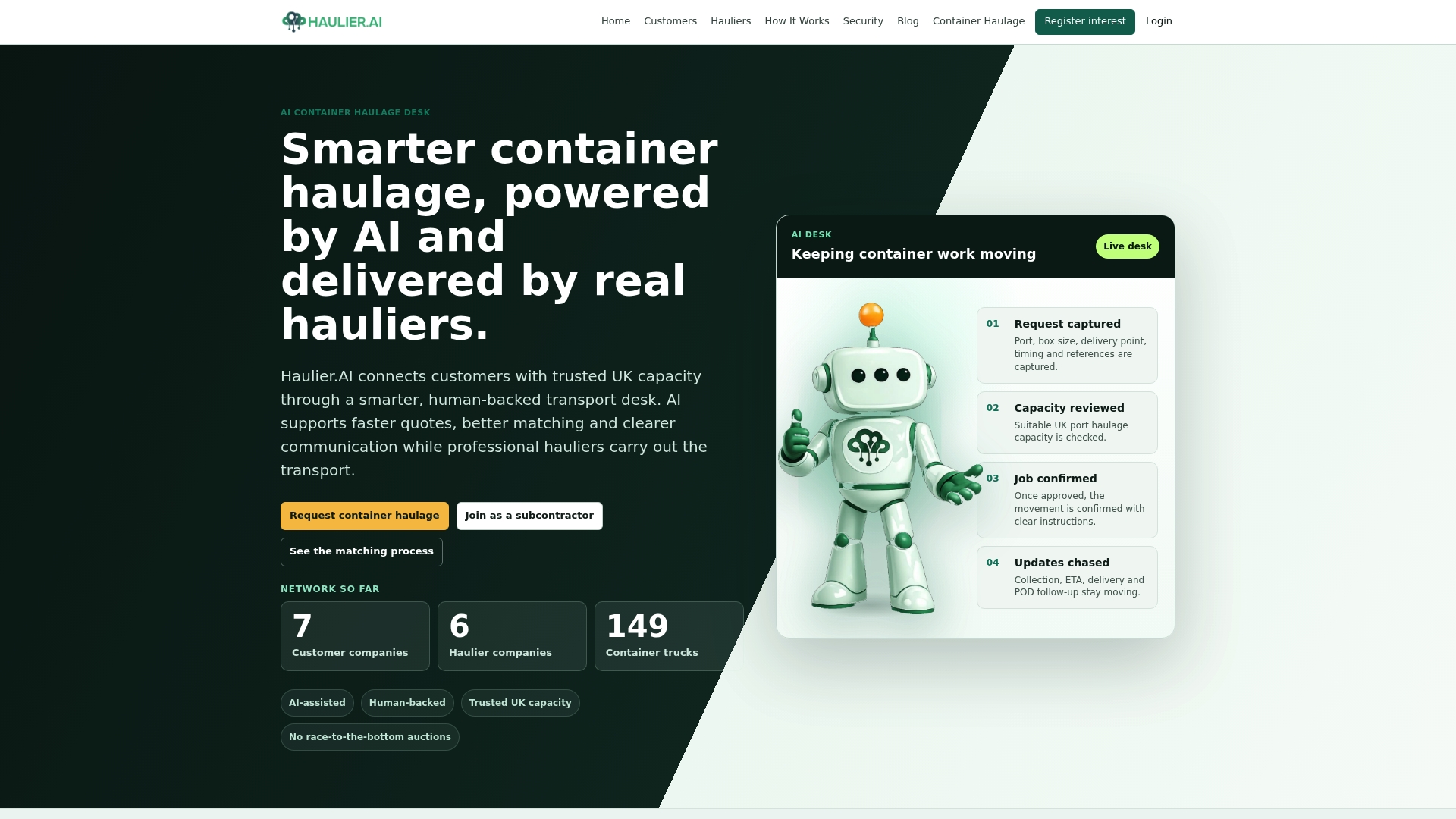
When collection appointments, haulier confirmations, and container status updates all flow through a single platform, the coordination failures that generate charges become visible before they become invoices. Haulier’s two-sided model means hauliers confirm jobs with accurate timing, and customers receive updates without chasing. For logistics teams managing high container volumes at UK ports, that visibility is a direct cost control. Request container haulage through Haulier to see how the platform works for your operation, or view UK haulage services to explore port coverage.
FAQ
What is the difference between demurrage and detention?
Demurrage is charged when a container remains inside the terminal beyond free time. Detention is charged when a container is held outside the terminal beyond the allowed return period.
What are typical demurrage charges in the UK?
Demurrage charges in the UK vary by carrier, port, and contract terms, with rates escalating in daily tiers the longer the container overstays. There is no single standard rate; charges are set by individual carrier tariffs and negotiated service contracts.
How can I reduce detention and demurrage fees?
Pre-clearing customs documentation before vessel arrival, booking collection appointments immediately after discharge, and using real-time container tracking are the most effective ways to reduce fees.
Are storage charges at port the same as demurrage?
No. Storage charges at port relate to terminal warehouse usage, while demurrage relates to yard occupation by the container itself. Some carriers itemise them separately on invoices to clarify the distinction.
Can demurrage and detention charges be disputed?
Yes. Disputes require documented evidence including gate timestamps, customs hold references, and appointment confirmations. Most carrier tariffs include a dispute window of 30 to 60 days from the invoice date.