
Container haulage article
Container delivery scheduling: a practical playbook that works
Master container delivery scheduling with our practical playbook. Ensure smooth operations by verifying key site details before booking.
The most reliable way to schedule container deliveries is a TAS-driven rolling-horizon plan built on verified site data, not a fixed booking made weeks out and forgotten. Before you book anything, confirm your CBS or VBS slot, verify the site can actually take the container (access, ground, permits), and agree a day-of contact who will pick up the phone. Get those three right and most abortive journeys disappear. Haulier.AI exists precisely for teams who want this handled through a managed desk rather than juggled across emails and phone calls.
TL;DR:
- Verifying site data such as gate dimensions, ground capacity, and permits before booking can prevent the majority of delivery failures.
- Using rolling-horizon planning and attaching container info to bookings helps optimize window utilization and reduces last-minute rebookings.
- Pre-arranging specialist lifting equipment days in advance and confirming availability within 24 to 48 hours avoids delays and stranded containers.
- Live ETA updates, proof-of-delivery capture, and clear escalation protocols are essential for managing delays and refusals efficiently.
- Adopting a managed desk approach streamlines coordination with vetted hauliers, improves communication, and cuts dispute resolution time.
Table of Contents
- Pre-delivery checklist: what to confirm before you book a slot
- How do you schedule around truck appointment systems like TAS, CBS and VBS?
- What site data you must collect before booking
- When should you pre-book specialist lifting equipment and banksmen?
- Day-of communication protocol and escalation steps
- Sequencing multi-container deliveries to cut on-site time
- How do you handle failed deliveries, site refusals and no-shows?
- Lead times and charges to budget for when scheduling container deliveries
- Technology components that make scheduling reliable
- Three tactical priorities for reworking your delivery schedule
- Book container haulage without chasing five different phone numbers
- Sources
- FAQ
Pre-delivery checklist: what to confirm before you book a slot
Most failed container deliveries trace back to a fact nobody checked before the truck left the yard. A gate that’s too narrow, a driver missing a booking reference, a permit that expired last month. None of these are exotic problems; they’re basic verification steps that got skipped under time pressure.
Before booking a slot, confirm these details directly with the site, not from a spec sheet someone filled in six months ago:
- Gate height and width and any low bridges or tight turns on the approach road.
- Ground bearing capacity where the container will be set down, particularly on soft or newly laid surfaces.
- Permitted arrival hours, since many commercial and residential sites restrict HGV access outside standard working windows.
- Driver documentation, including photo ID, the booking reference, and a Dangerous Goods Note (DGN) where the cargo requires one.
- Local authority permits for any temporary road closure, oversized load, or scaffolding that might block the drop zone.
A standardised intake form, backed by a photo checklist the site sends back before booking, cuts the guesswork dramatically. Route every query through one named contact rather than a general inbox. That single change alone prevents most of the “nobody told us” disputes that surface on delivery day.
How do you schedule around truck appointment systems like TAS, CBS and VBS?
Appointment systems exist to smooth arrivals and give ports time to pre-prepare the yard before the truck shows up. A Container Booking System, as the Port of Felixstowe’s own CBS guidance makes clear, needs accurate container data submitted ahead of arrival. Without that, the yard can’t stage the box and your driver ends up queuing for a shuffle move that eats an hour of standing time.

CBS at Felixstowe enforces a one-hour late-notification period (LNP): miss your slot by more than an hour without updating the booking, and you risk a rebooking fee or a lost slot entirely. The same guidance describes peak and off-peak charging, designed to pull volume away from congested midday windows.
Statistic to note: A PLOS One study on appointment-based scheduling found that adaptive scheduling with feedback loops can reduce fleet operational costs compared to traditional heuristics in case-study comparisons, driven largely by fewer wasted trips and better slot utilisation.
Practical tactics that actually move the needle:
- Book off-peak where the incentive exists rather than defaulting to a convenient midday slot.
- Monitor slot releases; cancellations often open earlier windows than the portal first offered.
- Use rolling-horizon planning: re-solve your schedule daily rather than locking a full week in advance.
- Attach container IDs, DGN paperwork, and a live contact number to every CBS booking before submission.
What site data you must collect before booking
Ports and yards can only pre-prepare space if you give them the right facts before the truck moves. Skipping this step is the single fastest way to turn a routine delivery into a wasted round trip.
At minimum, gather and confirm:
- Container numbers, booking references, and seal numbers where the terminal or customer requires them.
- Physical access details: approach road width, turning circle, overhead obstructions such as power lines or low canopies, and any security gate codes or sign-in procedures.
- On-site handling needs: whether a banksman, forklift, or crane will be required, and where the container is expected to be laid down.
- Delivery format: send the checklist as a photo set plus a CSV or EDI attachment where the receiving system supports it, or as clear notes within the booking portal itself.
Terminal operators such as Felixstowe’s Vehicle Booking System validate haulier details against the booking before issuing a slip, precisely because incomplete data causes gate rejections. Sending everything up front, rather than answering questions on arrival, is what keeps that validation quick.
When should you pre-book specialist lifting equipment and banksmen?
Specialist kit needs booking days, sometimes weeks, ahead of the delivery slot itself, and getting the timing wrong strands a container on the truck with nowhere to put it down.
- Watch for the red flags first. No forklift on site, a load with an awkward weight distribution or unusual dimensions, or a customer contract that explicitly requires lift assistance all mean you need a crane or telehandler booked before the TAS slot is confirmed.
- Book early and confirm twice. Crane and telehandler hire typically needs several days’ lead time; confirm the booking again 24 to 48 hours before delivery, since availability shifts fast in busy regions.
- Put the specs in writing. Include load weight, dimensions, and access constraints in the booking request, and attach proof of insurance and any required permits alongside it.
- Have a standby plan. If rental kit falls through, know a backup supplier in advance, and be ready to shift the TAS slot rather than sending the truck regardless.
Day-of communication protocol and escalation steps
A delivery day without a communication script is a delivery day where small delays become big ones. Set the pattern once and reuse it every time.
Send these messages, at these points, without exception:
- Two hours before arrival: driver ETA, booking reference, driver phone number, and vehicle registration.
- On departure from the previous stop: an updated ETA if anything has shifted.
- On gate arrival: confirmation the driver has checked in, since gate staff will ask for the CBS or booking number before granting access.
- On any hold: an immediate flag to the site contact, not a message sent an hour later once the queue has built.
Build a short escalation ladder before the day starts: who gets called first if a driver is refused entry, who authorises a rebooking, and what the timeline is before you treat a delay as a failed delivery. Live ETA tracking paired with proof-of-delivery capture closes the loop fast and removes most of the “did it arrive or not” disputes that otherwise drag on for days.
Pro Tip: Agree the escalation contact’s mobile number in writing before the delivery week starts. A generic office line that rings out at 7am is how a ten-minute problem becomes a half-day one.
Sequencing multi-container deliveries to cut on-site time
Running several containers in one day rewards planning discipline far more than it rewards driving fast between stops.
- Sequence by physical access, not by booking order. Deliver tight-access sites first while the driver is fresh and daylight is on your side, then move to open yards later.
- Cluster by handling type. Group drops that all need a banksman or crane together, so lifting kit isn’t crossing town twice in one shift.
- Weigh batching against backlog cost. Consolidating drops reduces transport cost per container, but research on the container delivery scheduling problem shows that grouping too aggressively risks early or late deliveries that push inventory and storage costs the other way.
- Use time-of-day tactics deliberately. Reserve quick, straightforward drops for peak traffic windows, and schedule longer or more complex sites for off-peak hours when there’s slack to absorb delays.
A one-page run plan, listing sequence, access type, and handling need per stop, takes ten minutes to build and saves far more than that in avoided backtracking.
How do you handle failed deliveries, site refusals and no-shows?
A refused delivery is expensive twice over: once for the failed trip, and again if you can’t prove what actually happened when the charge lands.
Capture evidence on the spot, every time:
- Photos of the site, the access point, and any obstruction that caused the refusal.
- A written driver statement logged within the hour, while details are fresh.
- Gate receipts or refusal slips issued by terminal or site staff.
Expect charges for no-shows, late-notification breaches, and re-stack fees, typically levied by the port or terminal operator rather than the customer. Dispute anything that looks wrong through the port’s formal appeals channel rather than an informal email, and keep your evidence pack ready to attach. When rebooking, prioritise the slot that avoids repeating the same failure. Rushing a second attempt without fixing the root cause usually results in a second charge.
Lead times and charges to budget for when scheduling container deliveries
Planning windows vary sharply depending on what’s moving. In-stock standard containers can often move within a few days of order confirmation, custom conversions typically need several weeks, and any delivery requiring specialist lifting equipment should be planned with the crane or telehandler lead time in mind, not the container’s own availability.
Statistic to note: Felixstowe’s CBS guidance confirms peak and off-peak slot pricing, with off-peak collection incentivised through lower charges and peak windows priced higher to spread demand across the day.
Build these allowances into every quote:
- A buffer for waiting time at busy terminals during peak hours.
- Handling and lift charges where a banksman or crane is required.
- A contingency line for LNP or no-show penalties, since even well-run operations occasionally hit one.
Write these allowances into your commercial terms and service-level agreements up front. Customers accept a stated contingency far better than an unexplained invoice line after the fact.
Technology components that make scheduling reliable
The technology stack behind reliable container scheduling isn’t complicated, but skipping any one piece tends to reintroduce the problem it was meant to solve.
Appointment systems such as TAS, CBS, and VBS sit at the centre, giving ports and yards the pre-arrival data they need to stage containers before the truck arrives. On top of that:
- Driver apps and live ETA feeds let receiving sites adjust staffing and equipment in real time rather than guessing.
- Proof-of-delivery capture closes jobs faster and cuts disputes significantly by removing ambiguity about what was delivered, when, and in what condition.
- Rolling-horizon planning with soft time windows, rather than rigid fixed-day schedules, handles stochastic delays far better because it re-solves the plan as conditions change instead of breaking when the first delay hits.
Pro Tip: If you’re managing more than a handful of container moves a week, a fixed schedule set on Monday morning is usually stale by Wednesday. Rebuild the plan daily against actual slot availability rather than defending the original version.
A managed, AI-assisted transport desk like Haulier folds these pieces together: matching, quoting, live updates, and proof-of-delivery integration in one place, so the admin burden of chasing five separate systems doesn’t fall entirely on your team.
Three tactical priorities for reworking your delivery schedule
If you’re rebuilding a delivery schedule from scratch, prioritise in this order: verified site data first, appointment-system compliance second, a compact escalation ladder third. Everything else is refinement.
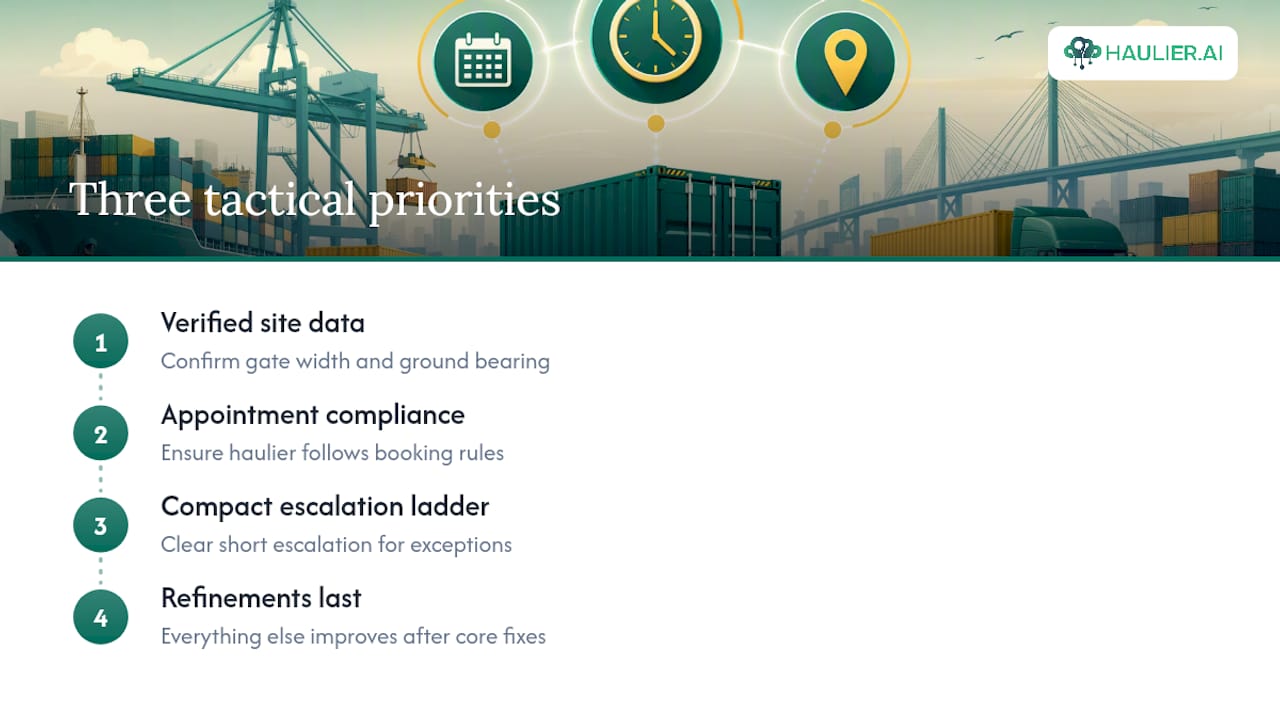
The uncomfortable truth is that most scheduling failures aren’t caused by bad software or unreliable hauliers. They’re caused by nobody confirming basic facts, like gate width or ground bearing, before a truck was loaded. Fixing that costs almost nothing and produces the biggest single reduction in abortive visits you’ll see from any change on this list.
Where I’d push back on conventional advice: don’t over-invest in scheduling technology before your process discipline is solid. A rolling-horizon planning tool bolted onto chaotic site data just produces confident-looking wrong answers faster. Get the checklist and communication protocol right first. Once that’s stable, a managed desk that handles container haulage end to end becomes genuinely worth the switch, because it’s automating a process that already works rather than papering over one that doesn’t.
— Vytautas
Book container haulage without chasing five different phone numbers
Haulier is the direct alternative to juggling hauliers, ports, and site contacts across separate calls and inboxes: one managed desk handles the quoting, the CBS coordination, and the live updates that would otherwise fall on your team.
The platform matches your job to vetted UK hauliers who control their own rates and can turn down unsuitable work, which keeps pricing fair and capacity genuinely available rather than promised and then withdrawn. You get live ETA visibility and proof-of-delivery capture built into the process, so the disputes and missed updates that plague traditional freight arrangements largely disappear. For freight forwarders and importers coordinating multiple container moves a week, that means less time spent verifying whether a truck actually left the yard, and more time spent on the work that actually needs your judgement. Request container haulage through Haulier.AI and see what a first booking looks like with a managed desk handling the coordination.
Sources
- The dynamic stochastic container drayage problem with truck appointment scheduling (2024)
- Optimization of external container delivery and pickup scheduling based on appointment mechanism — PLOS One
FAQ
How much does a 20ft container cost to hire?
Hire costs vary by supplier, contract length, and region, so there’s no single fixed rate; get quotes against your specific delivery window and site requirements rather than relying on a generic figure.
How long does it take to unload a 20,000 container ship?
Unloading times depend heavily on berth capacity, crane availability, and terminal congestion; large vessels are typically worked over one to several days rather than in a single shift, with scheduling systems like CBS helping smooth the flow of trucks collecting containers once they’re discharged.
How do you book a container delivery slot?
Confirm your site data and permits first, then submit container IDs, booking references, and any required documentation through the relevant appointment system such as CBS or VBS, attaching a live contact number so the booking can be validated quickly.
How much does it cost to move a 40-foot shipping container?
Costs depend on distance, access complexity, and whether specialist lifting equipment is needed, so budgeting should include base haulage plus contingency for waiting time, handling, and any peak-slot charges rather than a flat figure.
What causes most abortive container deliveries?
Missing or inaccurate site data, such as unconfirmed gate dimensions or ground bearing capacity, causes most refused or abortive deliveries, which is why a verified pre-delivery checklist matters more than almost any other single step.