
Container haulage article
Container haulage rates UK: 2026 pricing guide
Discover UK container haulage rates for 2026. Understand pricing factors and get insights on costs for 20ft and 40ft containers now!
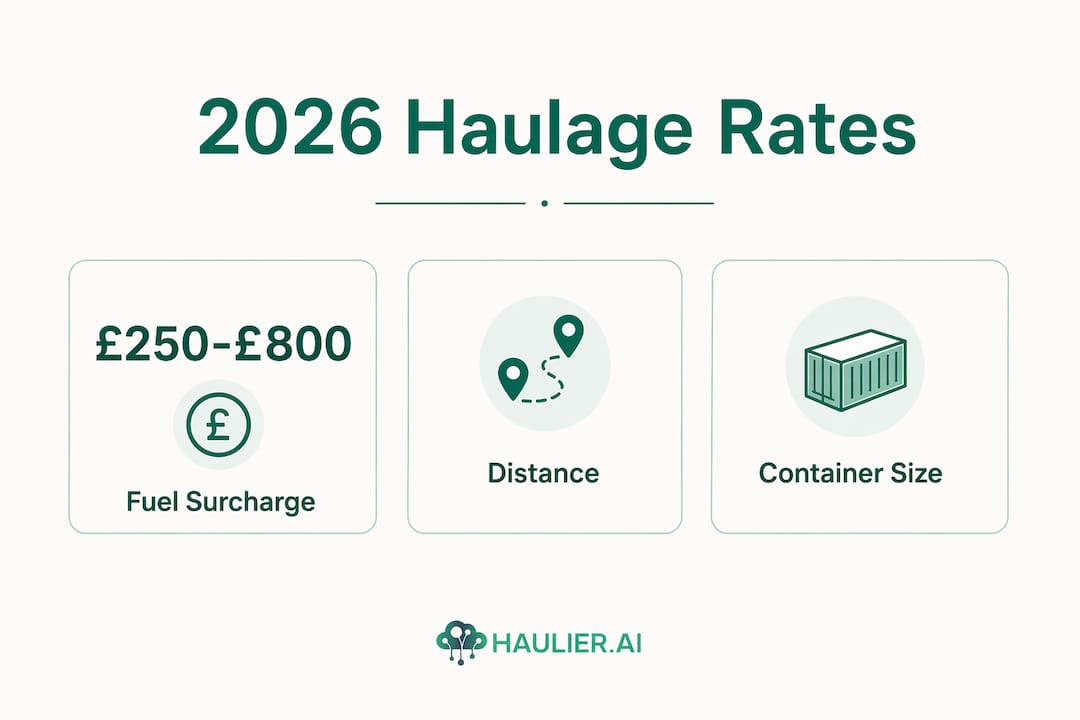
UK container haulage rates currently run from haulage rates vary widely depending on multiple factors, depending on container size, port of collection, and delivery distance. Two variables account for the bulk of that range: whether you are moving a 20ft or 40ft box, and how far the port sits from your delivery point. Everything else, fuel surcharges, waiting time fees, port levies, adds relatively modest increments on top.
Typical rate bands for standard daytime delivery:
| Route | Distance | 20ft container | 40ft container |
|---|---|---|---|
| Tilbury → London | ~30 miles | £250–£300 | £275–£350 |
| Felixstowe → London | — | £250–£350 | £275–£400 |
| Southampton → Midlands | — | £320–£400 | £350–£440 |
| Felixstowe → Midlands | ~150 miles | £350–£450 | £400–£550 |
| Liverpool → Midlands | — | £300–£380 | £330–£420 |
| Felixstowe → Manchester | ~250 miles | £600–£700 | £660–£800 |
| Any port → Scotland | 300+ miles | £550–£800 | £600–£900 |
Key cost drivers at a glance:
- Container size: a 40ft container costs 10–20% more than a 20ft on the same route
- Distance: longer distances add proportionally to the base rate
- Port of origin: Felixstowe, Southampton, London Gateway, and Tilbury each carry different terminal charges and Vehicle Booking System (VBS) fees
- Fuel surcharge: a variable levy tied to diesel prices, applied on top of the base rate
- Timing: same-day or out-of-hours collections attract a premium
- Waiting time: charges apply beyond the standard 1–2 free hours at port or delivery site
How do container haulage rates vary by UK route?
Distance is the single largest lever on container transport rates. The port-to-door mileage drives fuel cost, driver time, and vehicle wear, and those three factors move together. Choosing the right port of entry, the one geographically closest to your final destination, can cut the road leg meaningfully.

Road Haulage Services Ltd publishes indicative per-mile rates that illustrate how route and container size interact: a 20ft container from Felixstowe to Birmingham runs approximately £3.00 per mile, a 40ft high cube from Southampton to Leeds around £3.10 per mile, and a 40ft from London Gateway to Manchester around £3.25 per mile. Longer hauls to Scotland regularly breach £600 for a 40ft box.
The 40ft premium is real but modest. Driver wages and fuel are nearly identical for both sizes; the extra cost reflects slightly higher port handling charges and marginally greater fuel consumption from the additional weight and drag. On a short run like Tilbury to London, the gap between a 20ft and 40ft quote may be as little as £30–£50. On a 300-mile haul to Scotland, it can reach £150 or more.
Port-specific factors also shift the total. Felixstowe, the UK’s busiest container port, has well-established VBS procedures but can involve longer dwell times during peak periods. Smaller ports may carry lower terminal charges but offer fewer haulage options, which can push rates up through reduced competition.
Pro Tip: Book 24–48 hours in advance for standard rates. Same-day or next-day collections typically carry a 15–30% premium, and out-of-hours deliveries can add £50–£150 in overtime surcharges.
How are container haulage rates calculated?
The standard formula is straightforward: estimated cost equals total miles multiplied by the rate per mile, plus fuel surcharge, plus any additional charges. In practice, three layers build the final figure.

Base rate covers distance, driver time, and vehicle depreciation. Most hauliers price this per mile, with artic rates sitting above 7.5-tonne vehicles, though the gap is smaller than many importers expect. A minimum charge usually applies regardless of distance, reflecting the dead mileage from depot to port and back.
Fuel surcharge is the most volatile element. Fuel accounts for roughly a third of HGV operating costs, so diesel price swings feed directly into quotes. Most contracts include a fuel escalator clause: if diesel stays at or below a baseline price, no surcharge applies; above it, a percentage is added. These clauses typically lag market moves by one to three months, which matters when fuel is volatile.
Levies and additional charges include:
- VBS fees and terminal handling charges at the port
- London Low Emission Zone (LEZ) surcharges for deliveries into Greater London
- waiting time fees apply beyond the standard free period at port or delivery site beyond the standard 1–2 free hours
- Access surcharges for sites requiring smaller vehicles or transhipment
- Out-of-hours and weekend premiums
Transparent quotes separate these layers clearly. A quote that bundles everything into a single line makes it impossible to compare providers accurately or to identify where costs can be reduced.
Pro Tip: Flexible delivery windows reduce empty mileage on return journeys. Allowing a haulier to schedule your collection around other movements can result in a lower rate, because the haulier avoids a dead leg back to depot.
Which UK container haulage providers should you consider?
Four providers cover the main specialisations freight forwarders and importers typically need. The table below compares them on the dimensions that matter most for procurement decisions.
| Provider | Services | Ports / regions | Specialisations | Certifications | Google rating |
|---|---|---|---|---|---|
| K Charles Haulage Ltd | Domestic and European haulage, refrigerated transport, FTL, LTL, same-day | UK-wide and Europe | Temperature-controlled, specialist construction and engineering haulage | — | 4.2★ (38 reviews) |
| Road Haulage Services Ltd | Container haulage (20ft and 40ft), customs clearance, palletised shipping, express freight | UK, Ireland, Europe; Felixstowe, Southampton, London Gateway | Bespoke road haulage, customs clearance integrated | — | 4.5★ (15 reviews) |
| Rincon Services Ltd | Port-to-door container haulage, general haulage, Amazon Relay logistics | UK-wide; major UK ports | Port logistics, Amazon certified carrier | Amazon certified carrier | 5★ (4 reviews) |
| Harris Containers (UK) | Container haulage, devanning (20ft–40ft), ADR hazardous transport, warehousing (35,000 sq ft), HIAB | London Gateway, Tilbury, Purfleet | Hazardous materials, high-security haulage, warehousing | FORS Gold, DVS compliant | 5★ (2 reviews) |
K Charles Haulage Ltd is the natural choice for importers whose supply chains include temperature-sensitive goods. The company handles refrigerated transport alongside standard domestic and European movements, and its referral scheme suggests an established client network. If your cargo spans ambient and chilled in the same supply chain, having one haulier cover both removes a coordination headache.
Road Haulage Services Ltd stands apart through its integrated customs clearance capability. Road freight clearance starts at standard fees apply for customs and clearance services. For importers who want a single point of contact from port collection through to customs paperwork, that integration has real operational value.
Rincon Services Ltd operates a fleet of 20+ HGVs covering UK-wide port-to-door delivery, with Amazon certification adding a layer of operational credibility for freight forwarders managing e-commerce supply chains. Its port logistics focus makes it a practical fit for high-frequency container movements from major UK ports.
Harris Containers (UK) holds FORS Gold accreditation and runs ADR-trained drivers, making it the go-to for hazardous cargo that other hauliers cannot legally carry. Its 35,000 sq ft warehousing at London Gateway, Tilbury, and Purfleet also suits importers who need short-term storage alongside the haulage movement.
How is technology changing container haulage quoting?
The traditional quoting process for container haulage involves phone calls, email chains, and manual rate checks that can take hours. AI-assisted transport desks are changing that by matching load requirements to available haulier capacity in real time, with managed quoting, live communication updates, and paperwork tracking built into a single workflow.
Key features of these platforms include:
- Haulier-controlled rate quoting: carriers set their own rates and can decline unsuitable jobs, which keeps pricing honest rather than driven by a race to the bottom
- Real-time status updates: importers and freight forwarders see where their container is without chasing the haulier by phone
- Paperwork tracking: proof of delivery, port release documents, and customs paperwork are logged centrally
- Faster capacity access: matching algorithms surface available hauliers quickly, reducing the gap between quote request and confirmed booking
These platforms also address a structural problem in the UK market. A 2025 sector analysis found that 36.8% of UK transport and storage companies held no cash reserves, the lowest of any UK industry. Faster payment cycles enabled by digital platforms help hauliers manage cashflow, which in turn supports rate stability for customers.
How do seasonal demand and congestion affect haulage pricing?
Container transport rates are not static across the year. Pre-Christmas inventory builds, typically running from August through October, push demand for haulage capacity sharply upward, and rates follow. The same pattern repeats ahead of Chinese New Year, when importers rush to clear stock before factories close.
Port congestion compounds the seasonal effect. When vessel bunching at Felixstowe or Southampton creates a backlog of containers waiting collection, hauliers face longer dwell times and reduced vehicle utilisation. Those costs feed back into surcharges. The Logistics UK Manager’s Guide to Distribution Costs 2026 confirms that cost pressures across the logistics sector remain elevated, with fuel and wage trends both moving upward.
Geopolitical events add a further layer of unpredictability. UK diesel prices surged significantly in early 2026, and contract rates moved more slowly due to the one-to-three-month lag in fuel escalator clauses. Importers who locked in contracts before the spike absorbed the increase gradually; those on spot rates felt it immediately.
What transit times should you plan for on UK container routes?
Short-haul routes, Tilbury to London or Liverpool to Manchester, typically complete within a half-day, often three to four hours port to door. Mid-range routes such as Felixstowe to the Midlands or Southampton to London run four to six hours under normal conditions. Scotland-bound movements from southern ports require a full day and may involve an overnight stop for the driver on longer runs, which adds cost.
Driver hours regulations cap continuous driving, so movements beyond roughly 250–300 miles one-way for a same-day return require either a driver swap or an overnight. That constraint matters for scheduling: a container collected from Felixstowe on a friday afternoon for a Glasgow delivery will almost certainly not arrive until monday, and weekend premiums will apply. Building a two-to-three-day collection window into your planning gives hauliers the flexibility to route efficiently and avoids those premium charges.
Port congestion can extend any of these times unpredictably. A collection that takes two hours in normal conditions can stretch to five during a vessel bunching event, triggering waiting time charges and pushing the delivery into the following day.
Haulier: a faster route to competitive container quotes
Sourcing quotes from individual hauliers takes time most freight forwarders and importers do not have. Haulier offers a different approach: an AI-assisted transport desk that connects you to verified UK hauliers, manages the quoting process, and keeps communication and paperwork in one place.
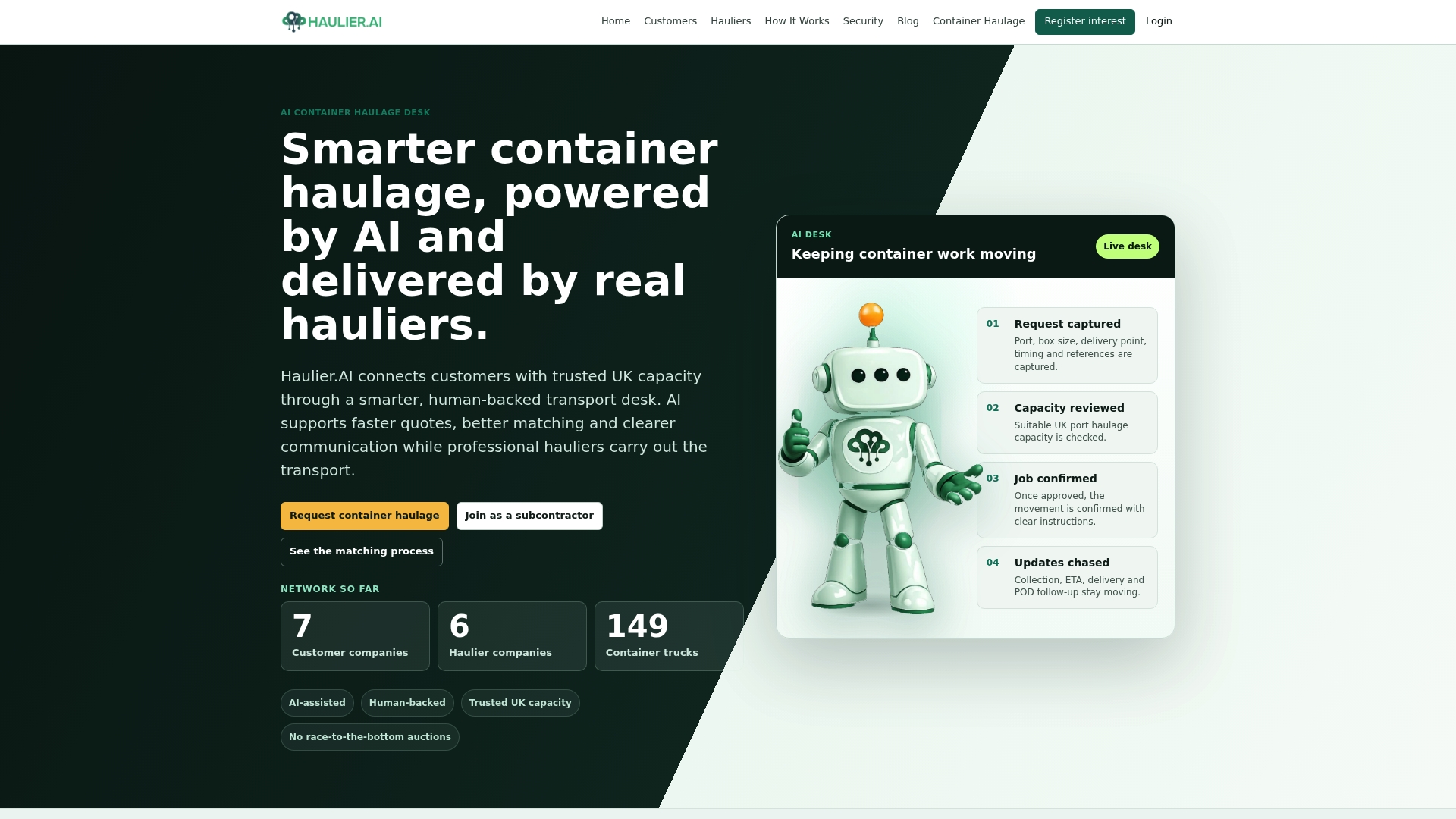
Unlike booking directly with a single provider, Haulier gives you access to multiple hauliers competing for your job, with transparent rate visibility and no hidden admin. Hauliers control their own rates and can decline unsuitable loads, so the pricing you see reflects real market conditions rather than a platform-imposed margin. For freight forwarders managing high volumes of container movements, the reduction in phone calls and email chasing alone justifies the switch. Request a container haulage quote through Haulier and see live rates for your route within minutes.
FAQ
What is the haulage rate in the UK?
UK container haulage rates in 2026 typically range from £250 to £800+ per container, depending on container size, port of collection, and delivery distance. Per-mile rates for container transport generally run from £3.00 to £3.25.
How much does it cost to transport a 40ft container?
A 40ft container costs a higher cost than 20ft containers on the same route on the same route. Typical UK rates range from £250–£350 for short hauls (Tilbury to London) up to costs often reach or surpass the higher end for extended routes for long-distance movements to Scotland.
How do you calculate a haulage rate?
The standard formula is: total miles multiplied by the rate per mile, plus fuel surcharge, plus any additional charges such as waiting time fees or port levies. Most hauliers also apply a minimum charge to cover dead mileage from depot to port.
How much does it cost to transport a 20ft container?
A 20ft container on a short UK route costs £250–£300. Mid-range routes such as Felixstowe to the Midlands run £350–£450, and long-distance movements to Scotland typically cost £550–£800.
Key takeaways
UK container haulage rates in 2026 range from £250 for short runs to well over £800 for long-distance movements, with container size, route distance, and surcharges as the primary cost drivers.
| Point | Details |
|---|---|
| Rate range by size | 20ft containers cost £250–£800 and 40ft containers run 10–20% higher on equivalent routes. |
| Distance drives cost | Each additional 50 miles adds roughly £50 to the base rate; port choice affects this significantly. |
| Surcharge layers | Fuel surcharges, VBS fees, waiting time charges (£30–£50 per hour), and LEZ levies all add to the base rate. |
| Seasonal and congestion risk | Pre-Christmas and Chinese New Year periods push rates up; port congestion extends transit times and triggers additional charges. |
| Haulier platform | Haulier connects freight forwarders and importers to verified UK hauliers with transparent, competitive quotes via an AI-assisted transport desk. |