
Container haulage article
Six steps to fair load allocation that protect haulier capacity
Operations-first guide to fair load allocation for marketplaces. Follow six pragmatic steps combining rotation with checks before offer, including hours,...
Fair load allocation works best as a rotation or max-min fairness rule layered with mandatory pre-offer checks on driver hours, vehicle status, and verified gross mass. That combination keeps hauliers engaged without inflating your cost base. The immediate next step is simple: stop offering jobs before you’ve checked hours and weight documentation. Platforms like Haulier build these checks into the matching process itself, rather than leaving them to a dispatcher’s memory.
HaulierFairer Allocation, Smoother HaulageHaulier.AI connects customers with trustworthy UK hauliers through AI-assisted matching, clear visibility, and self-managed rate control.See how Haulier.AI worksTL;DR:
- Fair load allocation relies on rotation, minimum market share, and progressive rotation to prevent capacity shrinking caused by cost-only bidding.
- Implementing pre-offer checks for driver hours, vehicle status, and verified gross mass documentation is essential to avoid cancellations and compliance failures.
- Algorithms and policies should focus on identifying and improving the worst-off carriers first, using simple rules before layering advanced fairness algorithms.
- Automated, transparent communication of assignment reasons and scheduled reviews help ensure fair allocation and maintain haulier engagement.
- Platforms like Haulier.AI incorporate these principles through rotation-aware matching, automatic checks, and self-managed rate control to sustain a balanced, reliable haulier pool.
Table of Contents
- What is fair load allocation and why does cost-only allocation fail?
- What checks must happen before you offer a job?
- How do algorithms and policy design actually encode fairness?
- What does a practical rollout checklist look like?
- Why marketplaces must design for fairness, not just efficiency
- How Haulier.AI applies these principles to every job
- Sources
- FAQ
What is fair load allocation and why does cost-only allocation fail?
Fair load allocation is the practice of distributing container haulage jobs across available carriers so no single haulier is consistently starved of work while another is overloaded, all without abandoning cost discipline. The standard industry term for the underlying discipline is load balancing, borrowed from computing, where the same tension between efficiency and equitable distribution shows up in server clusters as it does in freight yards.
Allocate every job to the cheapest bidder and you’ll save money for a few weeks. Then your pool shrinks. Research into repeated transport auctions found that greedy cost minimisation causes long-term starvation of bidders, meaning the same handful of carriers absorb most jobs while others drift away from the marketplace entirely. Once they leave, you’re back to a thinner capacity pool and worse rates during peak demand.
Academic work on transport allocation proposes a fix worth borrowing: max-min fairness. The idea is to protect the worst-off participant first, then minimise cost among the allocations that satisfy that protection. Two-stage algorithms such as IMaxFlow and FairMinCost do exactly this, they lock in a fair spread of jobs, then optimise for cost within that spread rather than the other way round.
You don’t need an algorithm to start. Three simple rules cover most of the ground:
- Minimum market share: guarantee every active haulier a baseline portion of jobs over a rolling period, so nobody drops below a survivable volume.
- Progressive rotation: cycle premium and difficult routes through the roster in sequence, rather than handing the best runs to whoever answers fastest.
- Time-weighted scoring: give more weight to hauliers who haven’t had a job recently, so the system self-corrects without manual intervention.
What checks must happen before you offer a job?
An allocation rule only works if the job you’re offering is actually deliverable. Skip the pre-offer checks and you’ll spend more time unwinding cancellations than you saved on rate negotiation. A haulier operator compliance review of container haulage found recurring gaps around weight verification, trailer acceptance, and twist-lock checks, exactly the failure points that turn a “fair” allocation into a broken one.
Four checks belong before any offer goes out, not after acceptance:
- Hours-of-service check. Compare the driver’s remaining hours against the estimated run time, including loading and any known congestion at the terminal. A job that looks fine on paper but breaches hours rules mid-route creates a cancellation cascade that costs far more than the missed booking. One of the most common operational pitfalls is assigning before checking remaining hours; verifying it pre-offer prevents the problem outright.
- Vehicle and trailer status. Match axle limits, brake condition, and maintenance flags against the specific load, not just the general vehicle class. A tractor unit flagged for a service check shouldn’t be offered a job with a tight port cut-off.
- Verified gross mass documentation. Under SOLAS rules summarised in MGN534, shippers must provide a verified gross mass for packed containers using one of two prescribed methods, either weighing the packed container or summing the weights of its contents plus tare. That VGM needs to reach the carrier early enough for stowage planning. Offering a job when the VGM can’t be confirmed before cut-off sets the haulier up to fail before they’ve even left the yard.
- Load securing and centre-of-gravity fit. Gov sets out minimum securing forces and practical rules on positioning, lashings, and friction. A chassis that’s fine for a light, evenly loaded container may be entirely wrong for a dense, off-centre one.
Pro Tip: Build the VGM check into the offer stage, not the collection stage. A carrier who discovers a documentation gap at the port has already burned a slot and a driver’s shift.
How do algorithms and policy design actually encode fairness?
Max-min fair allocation, in plain terms, asks one question before anything else: who is currently worst off, and does this allocation improve their position without making someone else’s position unacceptable? Progressive filling works through job requests in rounds, giving each participant a share before topping anyone up further. It’s slower than a pure lowest-bid auction, but it’s the mechanism that stops the starvation problem described earlier.

Rotation-based systems are the low-tech cousin of the same idea. Instead of solving an optimisation problem, you simply cycle who gets first refusal on premium runs, and track a rolling history so nobody skips the queue twice. Time-weighted scoring adds nuance: a haulier who’s gone three weeks without a booking should outrank one who had a job yesterday, even if their bid is marginally higher.
For platforms running competitive bidding, fairness constraints can sit inside the auction itself rather than bolted on afterwards:
- Soft quotas cap how much volume any single haulier can win in a given window, forcing spread without banning strong performers.
- Guaranteed minimum shares promise every vetted haulier a floor of work, which helps keep smaller operators engaged in the pool.
- Fairness price is the measurable gap between the cheapest possible allocation and the fairest one, put a number on it and you can show stakeholders exactly what equity costs, rather than leaving it as a vague trade-off.
Academic literature suggests starting simple, then layering complexity in. Rotation windows and mandatory checks come first; the max-min algorithms arrive once data quality supports them. Trying to run a sophisticated fairness algorithm on patchy job history data is worse than running no algorithm at all.
What does a practical rollout checklist look like?
Six steps take you from theory to something you can actually run week to week:
- Define the rules. Write down the rotation window, minimum share, and any soft quotas in plain language every haulier can read.
- Automate the pre-offer checks. Hours, vehicle status, and VGM confirmation should block an offer automatically, not rely on someone remembering.
- Set rotation windows. Decide whether fairness resets weekly or monthly, and stick to it long enough to gather real data.
- Log every exception. When you override the rule for a genuine operational reason, record why. Exceptions that go unlogged become the new normal within a month.
- Publish assignment reasoning. Let hauliers see why a job went where it did, proximity, rotation position, equipment match, whatever the actual driver was.
- Review monthly. Pull the numbers and adjust the rules rather than the exceptions.
Five KPIs tell you whether the system is actually fair, not just labelled that way: allocation share variance across your haulier pool, rejection and cancellation rate, hours-of-service compliance rate, vehicle mismatch incidents, and haulier retention over rolling quarters. Industry guidance on fair dispatch points to the same four inputs driving most of the frustration when they’re missing: hours checked before offer, proximity and rotation history factored in, and equipment status matched to the load.
Communication matters as much as the maths behind it. A haulier who sees the assignment reason, the estimated run time, and a quick snapshot of their own rotation history is far less likely to file a complaint, even when they didn’t win the job they wanted.
Why marketplaces must design for fairness, not just efficiency
Fair allocation isn’t a compliance nicety, it’s what keeps a haulier pool intact through a demand spike. A marketplace that lets cost-only bidding run unchecked will watch its weaker-margin carriers quietly stop answering the phone, then scramble for capacity when volumes rise. Fewer last-minute reassignments, cleaner documentation flow, and lower compliance risk all trace back to the same design choice: build the checks and the rotation logic into the matching process itself, rather than trusting a dispatcher to remember them under pressure. Two-sided platforms that let hauliers control their own rates and decline unsuitable jobs tend to keep more of their pool engaged over time, because nobody’s forced into a job that doesn’t work for their equipment or their hours.
— Vytautas
How Haulier.AI applies these principles to every job
Some platforms are built around the same logic this guide lays out: rotation-aware matching, hours and vehicle checks before an offer ever reaches a haulier’s screen, and two-sided control that lets hauliers see the job details and decline anything unsuitable, rather than having jobs pushed onto them regardless of fit.
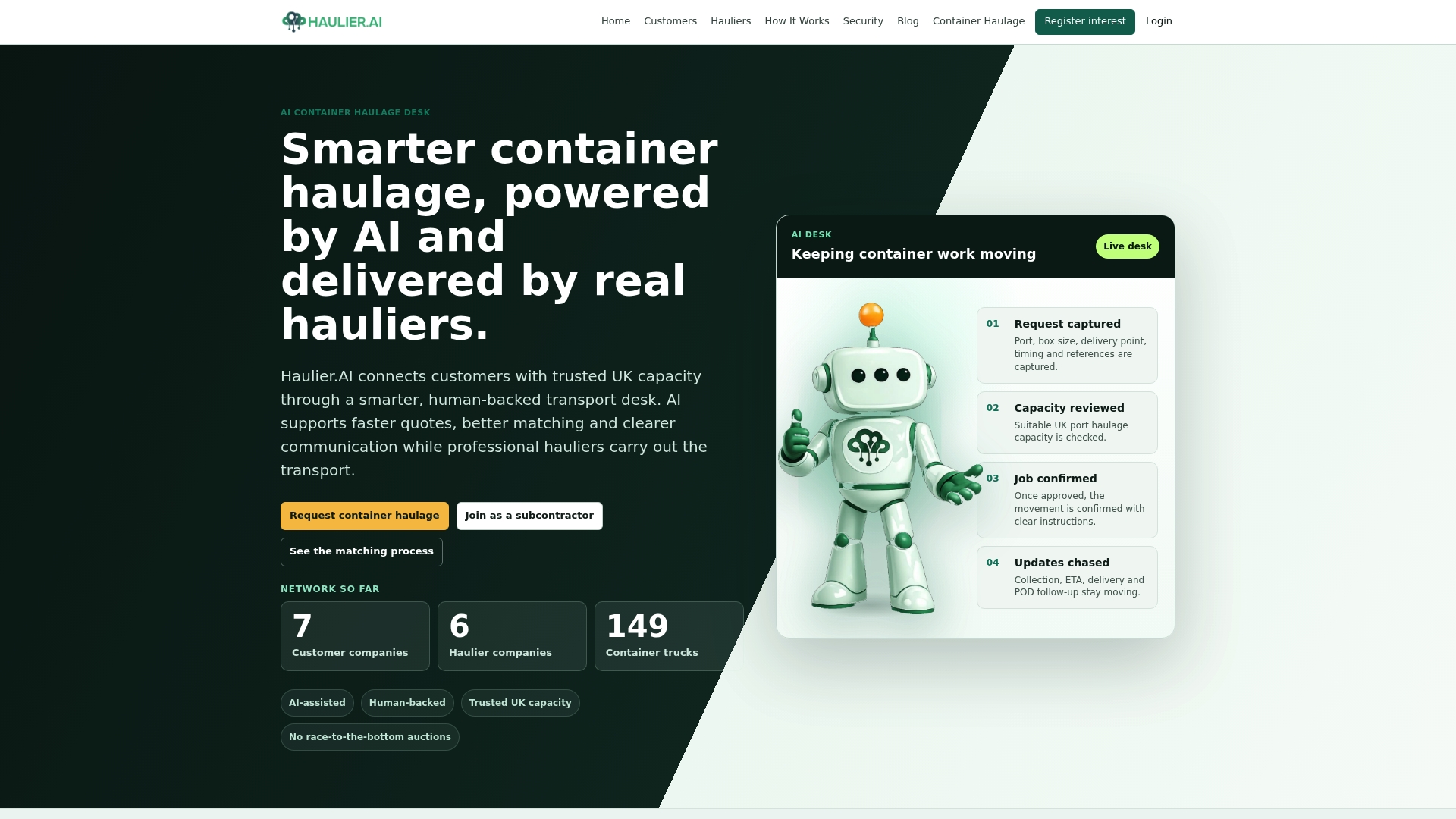
Freight forwarders and importers get visibility through the quoting and transport process, so a job’s status, its assignment reasoning, and its paperwork aren’t buried in an inbox somewhere. Hauliers keep control of their own rates and capacity, so nobody is forced into a job that doesn’t suit their trailer or their driver’s remaining hours. If you’re a freight forwarder or importer looking to request container haulage with that kind of visibility built in, or a haulier who wants first refusal on jobs that actually match your equipment and schedule, registering takes a few minutes and puts you into the matching pool straight away.
Sources
- Efficient auctions for distributed transportation procurement
- Fair task allocation in transportation (ScienceDirect)
- MGN 534: SOLAS verified gross mass guidance (UK)
- Gov
- Fair dispatch and scheduling to reduce truck driver frustration (FleetRabbit)
FAQ
What is max-min fairness in load allocation?
Max-min fairness allocates jobs so the worst-off haulier’s position improves first, then minimises cost among the allocations that satisfy that condition, rather than chasing the cheapest bid regardless of who gets starved of work.
Why does cost-only bidding hurt fair load allocation over time?
Repeated cost-only auctions concentrate jobs among a small group of cheap bidders, which causes other carriers to drop out, shrinking your available capacity exactly when you need it most.
What pre-offer checks should run before assigning a container job?
Check driver hours against estimated run time, confirm vehicle and trailer status against the load, and verify that gross mass documentation under SOLAS/MGN534 can be met before cut-off.
How does Haulier.AI support fair load allocation?
Haulier combines rotation-aware matching with hours and vehicle checks and lets hauliers control their own rates and decline unsuitable jobs, which keeps allocation transparent for both sides. Learn more on Haulier.
What KPIs show whether load allocation is actually fair?
Track allocation share variance across your haulier pool, rejection and cancellation rate, hours-of-service compliance rate, vehicle mismatch incidents, and haulier retention over rolling quarters.