
Container haulage article
Haulier job acceptance: the practical checklist
Ensure your haulier job acceptance is informed with our practical checklist. Protect your rates and control your bookings effectively.


Before you say yes to any haulage job, insist on written onboarding terms that cover service scope, booking mechanics, and liability. That single rule protects your rates, limits disputes, and keeps you in control of every movement. Client onboarding terms should be agreed before work starts and must explicitly state when a booking becomes binding, how waiting time is handled, and who holds liability for proof of delivery.
Three non-negotiables before you accept any job offer:
- Scope and load details in writing: pallet count, weights, stackability, and any special handling requirements confirmed before dispatch.
- Written binding confirmation: a signed or emailed order confirmation that states acceptance is binding once you reply in writing, not on arrival at the gate.
- Liability and insurance allocation: who covers damage in transit, what the claims process looks like, and whether the job will be subcontracted.
Two quick trust signals to check on any offer: a documented proof-of-delivery (POD) process and a named depot contact for escalations. If either is missing, treat it as a red flag until resolved.
Key takeaways
Accepting a haulage job safely comes down to one discipline: insist on written terms covering scope, rate components, and liability before any vehicle moves.
| Point | Details |
|---|---|
| Written terms first | Confirm scope, booking mechanics, and liability in writing before accepting any job. |
| Build a complete quote | Include base rate, fuel surcharge, waiting time, cancellation, and access charges on every quote. |
| Triage every offer | Check information completeness, rate acceptability, liability clarity, and capacity fit before saying yes. |
| Complete onboarding tests | Run a sample booking, live tracking check, and POD upload in the first five days after award. |
| Haulier platform | Haulier enforces written confirmations, named contacts, and POD tracking so hauliers keep rate control. |
Table of Contents
- What every haulier job acceptance should include in writing
- Red flags to refuse and green flags to accept
- How to build a fair quote for any haulage job
- Accepting, negotiating, or refusing: a decision guide
- How a proper freight tender reduces pricing risk
- Onboarding checklist after a job is awarded
- How Haulier helps hauliers keep control when accepting jobs
- What I have learned about protecting margins every day
- Haulier: keep control of every job you accept
- Sources
- FAQ
What every haulier job acceptance should include in writing
The checklist below covers what to confirm on the phone and what to require in writing before your vehicle leaves the yard.
Contract items to confirm in writing:
- Service scope: commodity type, pallet count, gross weight, stackability, and any temperature or hazmat requirements.
- Booking mechanics: cut-off times, how bookings are confirmed, and the exact moment acceptance becomes binding.
- Waiting-time rules: free time allowance (a reasonable short period), the hourly rate beyond that, and who authorises the charge.
- Redelivery and cancellation fees: the trigger point (e.g., cancellation within 24 hours), the fee structure, and how it is invoiced.
- Payment terms: net days, invoicing frequency, and whether fuel surcharges are itemised separately.
Pre-acceptance operational checks:
- Site access: height and weight restrictions, one-way systems, and whether a banksman is provided.
- Parking and loading: is there a dedicated bay, or will you queue on a public road?
- PPE and equipment: does the site require steel-toe boots, hi-vis, or a tail-lift? Who supplies any specialist lifting gear?
- Permits and paperwork: port health certificates, dangerous goods notes, or customs documentation that must travel with the load.
Documentation to keep on file:
- Written quote or order confirmation with a reference number.
- Named contact at the customer and at the depot.
- POD rules: paper or electronic, time limit for submission, and who receives the copy.
For a deeper look at how contractual risk is allocated under standard haulage terms, the RHA conditions of carriage guide is worth reading before you draft your own acceptance clause.
Pro Tip: Add a single line to every quote: “Acceptance of this quote constitutes a binding booking subject to the terms stated herein. Any variation must be confirmed in writing.” It takes ten seconds and closes the gap that causes most payment disputes.

Red flags to refuse and green flags to accept
Speed matters when triaging job offers, so train yourself to spot the signals quickly.
Red flags:
- A firm price quoted without any questions about site access, load weight, or equipment needs. This almost always signals operational friction ahead.
- Vague or absent POD arrangements (“just take a photo” with no formal process).
- Collection or delivery windows that leave no buffer for port delays or traffic.
- No named contact at the depot or customer side.
- Last-minute requests with incomplete paperwork, particularly for port collections.
- Subcontracting mentioned only after you have accepted, with no insurance statement.
Green flags:
- A written tender or shipment profile sent before the quote request.
- A named depot manager and an escalation path for out-of-hours issues.
- Clear POD and tracking requirements stated upfront, including submission deadlines.
- Transparent subcontracting policy: the customer states whether they use their own fleet or pass work to a partner, and confirms insurance cover either way. Reputable operators disclose this without being asked.
- References or a verifiable operator licence number available on request.
When you spot a red flag, ask three clarifying questions before refusing: What is the exact site access arrangement? Who is the named contact if there is a problem on the day? How is POD submitted and to whom? Convert the answers to a written amendment. If the customer cannot or will not answer, that is your answer.
Pro Tip: Keep a one-page “clarification script” in your cab or on your phone. Three standard questions, space for the answers, and a line for the customer’s name. It takes under two minutes and gives you a written record if a dispute arises later.
For guidance on cargo insurance options relevant to jobs that may be subcontracted or carry unusual risk, it is worth reviewing your cover before accepting high-value or specialist loads.
How to build a fair quote for any haulage job
A defensible quote is not just a number. It is a structured breakdown that shows the customer exactly what they are paying for and protects you when conditions change.
Standard rate components:
- Base haulage rate (per leg or per day, clearly stated without specific amounts).
- Fuel surcharge: either a fixed rate per mile or a variable charge linked to a published index.
- Waiting-time fee: state the free allowance and the hourly rate beyond it.
- Cancellation fee: tiered by notice period (e.g., 50% within 48 hours, 100% within 24 hours).
- Access and handling charges: tail-lift, pallet truck, or specialist equipment.
- Redelivery and out-of-hours premiums.
Add an uncertainty uplift on any job where site access or parking is unconfirmed. It is easier to discount a confirmed uplift than to invoice a surprise charge after delivery.
Worked example:
Present this as a line-item quote, not a single total. Customers who query a line item are far easier to handle than those who dispute a lump sum.
Accepting, negotiating, or refusing: a decision guide
When a job offer arrives, work through these checkpoints in order.
- Is the information complete? Scope, site access, POD process, and named contact all confirmed. If not, request the missing items before proceeding.
- Are the rate components acceptable? Check base rate, fuel surcharge method, and waiting-time terms against your cost model. If the rate is below cost, do not proceed.
- Is liability clear? Insurance allocation, subcontracting disclosure, and claims process all stated. If not, ask in writing.
- Does the job fit your capacity and routing? Check vehicle availability, driver hours, and whether the lane fits your existing schedule.
If all four pass: accept with a written confirmation referencing your quote number and set a booking cut-off time.
If one or two partially pass: negotiate the specific clause. Waiting fees and access charges are the most common negotiation points. Agree the revised terms in writing before confirming.
If the job fails two or more checkpoints: refuse. A short, professional reason (“We are unable to confirm acceptance without site access details and a named depot contact”) leaves the door open for the customer to come back with the information. Never simply go silent.
How a proper freight tender reduces pricing risk
A structured freight tender gives hauliers the information they need to price with confidence. Logistics UK’s freight tendering guidance identifies seven stages: scope, invite, clarify, evaluate, negotiate, award, and review. Each stage is a checkpoint where pricing uncertainty drops.
The clarify stage is the one most hauliers underuse. It is the formal window to ask about lane files, shipment profiles, and service rules before submitting a price. Use it.
A well-constructed tender pack should include:
- Lane files with origin, destination, and annual volume.
- Shipment profiles: average weight, dimensions, and frequency.
- Service rules: collection and delivery windows, POD requirements.
- Payment terms and the claims process.
Shippers who evaluate bids with a weighted scorecard tend to produce fairer outcomes. KPI targets agreed at tender stage, such as on-time collection at 98% and on-time delivery at 96–98%, give both sides a clear performance baseline from day one.
| Tender pack item | Why it matters to your quote |
|---|---|
| Lane files | Lets you cost fuel and driver time accurately |
| Shipment profiles | Reveals equipment and access requirements |
| Service rules | Sets POD and window expectations upfront |
| Payment terms | Confirms cash-flow impact before you commit |
| Claims process | Shows how disputes are handled if something goes wrong |
Onboarding checklist after a job is awarded
Winning the work is step one. The steps below turn the award into a low-risk first movement.
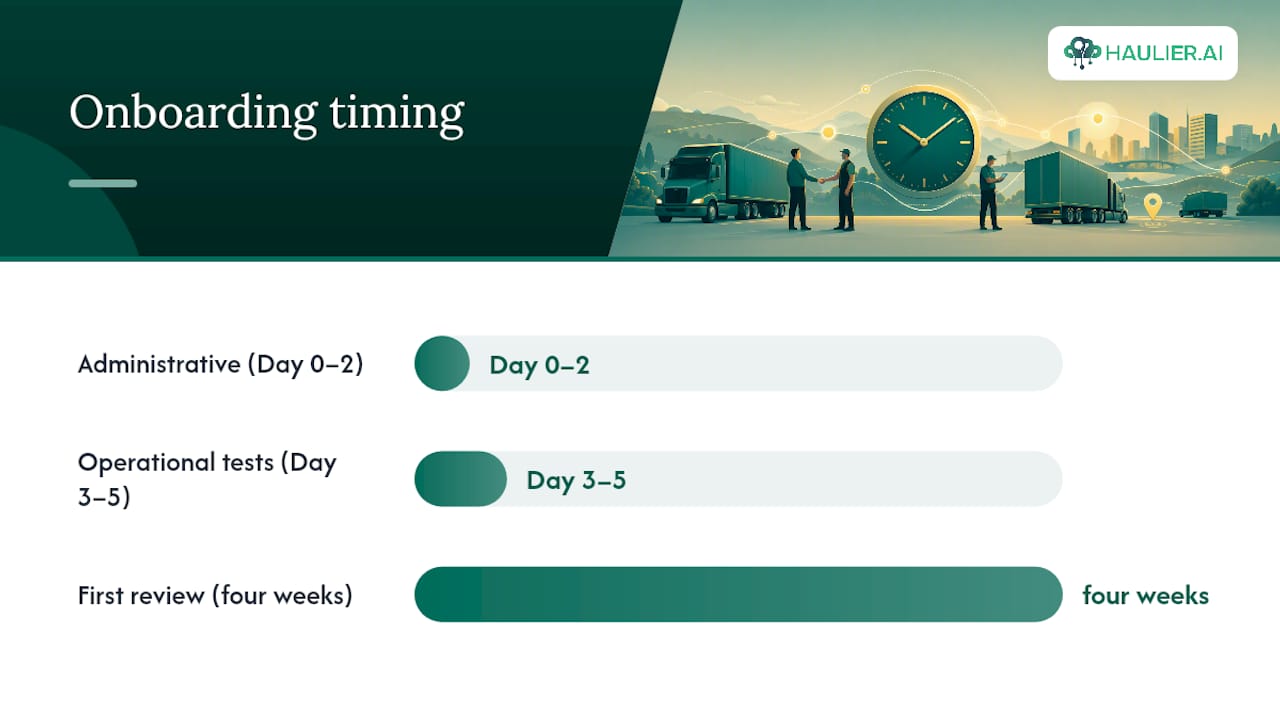
Day 0–2 (administrative):
- Confirm the rate card in writing and check it matches your quote.
- Collect depot contacts: site manager name, direct number, and out-of-hours escalation.
- Clarify invoicing rules: purchase order required, invoice format, and submission deadline.
- Confirm booking cut-off times and the channel (email, portal, or phone).
- Verify driver compliance: DVLA licence check, Driver CPC verification, tachograph review, and right-to-work checks for any driver assigned to the lane.
Day 3–5 (operational tests):
- Run a sample booking through the customer’s system and confirm the reference number is generated correctly.
- Check live tracking links are active and visible to the customer.
- Upload a test POD and confirm receipt at the customer’s end.
- Verify EDI or API message formats if the customer uses automated booking or invoicing.
KPIs to agree at onboarding:
- On-time collection and delivery targets (align with the tender KPIs above).
- POD submission time generally expected soon after delivery.
- Invoice accuracy rate with a high standard and the process for querying a rejected invoice.
Schedule the first business review at four weeks. It is early enough to catch process gaps before they become habits.
How Haulier helps hauliers keep control when accepting jobs
Haulier’s AI-assisted, human-backed transport desk is built around the principle that hauliers should never be forced into a job that does not work for them. The platform gives you visibility across quoting and paperwork, and you set your own rates and decide which jobs to accept or decline.
Those features map directly to the checklist items above:
- Written confirmations are enforced through the platform’s booking flow, removing the ambiguity of verbal agreements.
- Named depot contacts and escalation paths are part of every job posted through the desk.
- POD tracking is built in, reducing the disputes that arise when delivery evidence is missing or late.
Joining Haulier’s subcontractor network gives you access to container haulage opportunities while preserving the rate control and acceptance decisions that protect your margins.
What I have learned about protecting margins every day
The operators who consistently protect their margins are not necessarily the ones with the best rates. They are the ones with the best habits.
Confirming every job in writing takes under a minute. Keeping a single acceptance template, updated quarterly, means you never start from scratch. Logging every POD the moment it is submitted, not at the end of the week, means disputes rarely survive the first email. And asking for feedback when a quote loses, even briefly, is how you learn whether you are pricing correctly or simply being outbid on terms.
The daily routine that matters most is a morning check: booked loads against available capacity, any outstanding PODs from the previous day, and any rate queries sitting in the inbox. Ten minutes. It catches the problems that compound into disputes if left until Friday.
Long-term customer relationships are built on reliability, not the lowest price. A customer who trusts your process will call you first on a difficult job, and that is where the margin lives.
Haulier: keep control of every job you accept
Haulier gives hauliers something most booking channels do not: the ability to quote your own rate, review the job details, and say no without losing your place in the queue. The platform’s AI-assisted desk handles the paperwork and communication flow, so you spend less time chasing confirmations and more time running loads.
Every job posted through Haulier comes with the written confirmation, named contacts, and POD tracking that this guide identifies as non-negotiable. If you want to access container haulage work without trading away control over your rates, register on the Haulier platform and see what is available in your lanes. You can also read how the container haulage desk works before committing.
Sources
FAQ
What must be in writing before a haulier accepts a job?
Scope and load details, a binding booking confirmation, liability and insurance allocation, waiting-time rules, and a named POD process. Without these, acceptance is verbal and largely unenforceable.
What are the biggest red flags in a haulage job offer?
A firm price quoted without questions about site access or load requirements, absent POD arrangements, and no named depot contact. Any one of these warrants clarification before acceptance.
How does Haulier help with job acceptance decisions?
Haulier’s platform enforces written confirmations, provides named contacts on every job, and includes built-in POD tracking, so the non-negotiable checklist items are covered by the booking flow rather than left to informal agreement.
What KPIs should be agreed at onboarding?
On-time collection (target 98%), on-time delivery (96–98%), POD submission time generally expected soon after delivery, and invoice accuracy rate. Agree these at the start, not after the first dispute.
When should a haulier refuse a job outright?
When two or more of the four decision checkpoints fail: incomplete information, unacceptable rate components, unclear liability, or no available capacity. A brief, professional refusal with a stated reason keeps the relationship open for future work.