
Container haulage article
UK Freight Transport: Stop 31% Empty Running, Steps for Logistics Team
31% of UK HGV kilometres ran empty in 2025 and containers rose 10%. A data led checklist with three actions logistics teams can use now.


Freight transport UK data for 2025 shows goods lifted by road holding at 1.53 billion tonnes while container traffic through major ports jumped 10%, and HGV driver vacancies climbed back to 26% of businesses. For logistics managers, that combination points one way: capacity is tightening around ports and skilled drivers, so the immediate move is locking in flexible haulage partners now rather than waiting for spot rates to catch up. The data highlights below explain why.
HaulierFind Suitable Container Capacity FasterHaulier connects freight customers with trustworthy UK hauliers through an AI-assisted, human-backed transport desk.Explore Haulier.AITL;DR:
- Nearly a third of all HGV kilometres in the UK were run empty in 2025, representing about 5.9 billion kilometres of wasted capacity.
- Container traffic through UK ports increased by 10%, with domestic port container flows growing the fastest, indicating rising port-centric demand.
- Driver vacancies rose to 26% of businesses in late 2025, with fuel costs and fleet replacement expenses continuing to pressure smaller haulage operators.
- AI and telematics are being used to drastically reduce empty running, with a five-point improvement potentially freeing hundreds of millions of loaded kilometres annually.
- Freight market efforts should prioritize better route planning, visibility, and smarter partner matching over capacity expansion to cope with workforce and cost pressures.
Table of Contents
- UK freight transport statistics: the headline numbers for 2026
- Road, sea, rail and air: how UK cargo transport splits by mode
- What’s driving demand: trade policy, nearshoring and ecommerce
- Driver shortages and cost pressures squeezing UK trucking services
- AI, telematics and smarter matching: cutting empty running
- A checklist for logistics managers this quarter
- Why efficiency, not expansion, wins the next 12 months
- How Haulier.AI simplifies container haulage sourcing
- Where these figures come from
- Sources
- FAQ
UK freight transport statistics: the headline numbers for 2026
Start with the number that matters most for capacity planning: GB-registered HGVs lifted 1.53 billion tonnes of goods across the UK in 2025. Vehicle kilometres totalled 19.0 billion, spread across 163 million individual HGV journeys, an average haul length that keeps most domestic freight firmly within regional and cross-border corridors rather than long-distance runs.
The figure that should worry every fleet planner is empty running. Nearly a third of all vehicle kilometres, 31%, were driven with no load at all.
Statistic Callout: Almost one in three HGV kilometres in 2025 carried nothing. At 19.0 billion vehicle kilometres total, that is roughly 5.9 billion kilometres of pure wasted capacity, fuel burned and driver hours spent for zero payload.
That scale of empty running is not a rounding error. It is the single biggest lever available to any operator trying to cut cost without cutting service, and it explains why so much of the technology investment discussed later in this article is aimed squarely at backhaul matching and route planning.
Three numbers worth holding in your head when you next negotiate a rate or plan a tender:
- 1.53 billion tonnes lifted by road freight in the UK in 2025
- 19.0 billion total vehicle kilometres, with 31% run empty
- 163 million HGV journeys, implying relatively short average hauls
Road, sea, rail and air: how UK cargo transport splits by mode
Road remains the backbone of UK freight transport, carrying the overwhelming majority of domestic tonnage and journeys detailed above. Its dominance comes with a cost, since that empty running figure is a road-specific problem born of imbalanced trade lanes and fragmented booking systems.

Ports tell a more encouraging growth story. UK major ports handled 419.5 million tonnes in 2025, with imports rising 2% to 237.5 million tonnes while exports slipped 4% to 98.6 million tonnes. Container traffic, the Lo-Lo segment, grew 10% to 66.9 million tonnes, the standout figure in the entire ports dataset. Domestic coastwise container movements at ports including Liverpool, Felixstowe and London posted the largest absolute gain of any category, a shift worth tracking if your network touches container haulage.
Rail freight moved in the opposite direction. Total tonnage carried fell 3% to 16,055 million net tonne kilometres in the year to March 2026, with freight train kilometres down 5%.
- Road: dominant tonnage and journey share, but a third of kilometres run empty
- Sea/ports: 419.5 million tonnes, containers up 10%, domestic container flows growing fastest
- Rail: 16,055 million net tonne kilometres, down 3% year on year
- Inland waterways and air: niche by volume but relevant for specific commodity and time-critical flows
What’s driving demand: trade policy, nearshoring and ecommerce
Trade policy shifts, including changes to de-minimis thresholds on low-value imports, are altering the shape of demand hitting UK ports and inland distribution networks. Fewer low-value parcel consignments crossing certain thresholds tends to concentrate volume into fewer, larger shipments, which changes how port-side and bonded warehousing capacity gets used.
Nearshoring is compounding the effect, pulling sourcing closer to UK and European suppliers and pushing more freight through port-centric distribution nodes rather than long inland hauls from a single national hub. Ecommerce continues to demand faster, smaller, more frequent movements, which sits awkwardly against a network still built around bulk consolidation.
Growth forecasts stay modest. One industry projection puts logistics output growth at around 2.2% for 2026, with fuel and driver shortages flagged as the persistent brakes on expansion.
- De-minimis and trade policy changes are reshaping import volume patterns at ports
- Nearshoring is shifting demand towards port-centric and bonded warehousing
- Growth of roughly 2.2% projected for 2026, constrained by fuel and labour costs
Driver shortages and cost pressures squeezing UK trucking services
Workforce pressure has not gone away. HGV driver vacancies were reported by 26% of businesses in Q4 2025, up from 24% a year earlier, though still well below the 43% peak recorded in Q4 2021. Pay competition from other sectors, industry leavers and retirements remain the three most cited causes.
Fuel typically represents a significant portion of total haulage operating costs, and sudden price swings create sharp short-term margin pressure because most contract pricing only adjusts retrospectively rather than in real time. Fleet replacement adds a second cost front: decarbonisation mandates mean many operators face major capital decisions on vehicle replacement at exactly the moment margins are tightest.
- 26% of HGV businesses reported vacancies in Q4 2025, versus 24% in Q4 2024
- Pay competition, leavers and retirements are the leading causes cited
- Fuel volatility and fleet replacement costs are compounding pressure on smaller operators
Pro Tip: Build fuel and driver-cost review into your quarterly tender cycle rather than your annual one. A rate that looked fair in January can be badly out of step with reality by autumn if fuel or agency driver rates have moved.
AI, telematics and smarter matching: cutting empty running
Technology’s biggest job in UK freight shipping right now is attacking that 31% empty running figure directly. AI-based demand forecasting and telematics-driven routing let planners spot backhaul opportunities that manual scheduling simply misses, particularly across regional networks with uneven trade balances.

Port-side, terminal automation and better berth-to-yard coordination are helping some ports absorb the container growth mentioned earlier without proportional increases in dwell time. Industry commentary increasingly frames this as a shift in investment priority: away from simply adding trucks and yards, and towards intelligence-led infrastructure that squeezes more throughput from existing assets.
Marketplaces and AI-assisted transport desks fit into this shift directly. Haulier.AI, for example, connects freight forwarders and importers with hauliers through a matching system that cuts the back-and-forth typically involved in sourcing container capacity, while giving hauliers control over which jobs and rates they accept.
- AI forecasting and telematics routing reduce empty backhaul kilometres
- Terminal automation and berth coordination help ports absorb container growth
- AI-assisted transport desks cut quoting time and improve haulier-to-job matching
Statistic Callout: With 31% of vehicle kilometres run empty across 19.0 billion total kilometres, even a modest five-point improvement in empty running would free up capacity equivalent to hundreds of millions of loaded kilometres a year, without adding a single new vehicle.
A checklist for logistics managers this quarter
Turn the numbers above into three concrete actions before your next planning cycle:
- Audit contract versus spot exposure. Check what proportion of your container and general haulage capacity sits on fixed contracts against spot bookings, given rising port container tonnage and tightening driver availability.
- Track empty running as a formal KPI. Report it monthly alongside on-time performance; a rising trend signals a network imbalance worth fixing before it becomes a cost problem.
- Prioritise visibility and partner-network investment over new fleet spend. Better matching and real-time status tracking typically deliver faster returns than adding trucks, particularly for subcontractor-dependent operations.
Review these three against your Q1 numbers, then repeat the exercise every quarter rather than annually. Freight markets are moving too fast for a once-a-year check-in to catch problems in time.
Why efficiency, not expansion, wins the next 12 months
Every driver and every mile is more expensive than it was three years ago, and the vacancy data shows that will not correct itself quickly. Adding fleet capacity into that environment is expensive and slow to pay back. Squeezing waste out of the existing network, particularly that 31% empty running figure, is faster, cheaper, and does not require winning a driver recruitment battle you may not win.
Better data sharing and more selective partner choice, rather than blanket capacity expansion, are what actually reduce that exposure.
— Vytautas
How Haulier.AI simplifies container haulage sourcing
Every problem covered above, empty running, driver shortages, container growth outpacing inland capacity, comes down to the same root issue: matching the right haulier to the right job fast enough to matter. A modern AI-assisted, human-backed transport desk can connect freight forwarders and importers with vetted hauliers, reducing the need for calls, emails and paperwork.
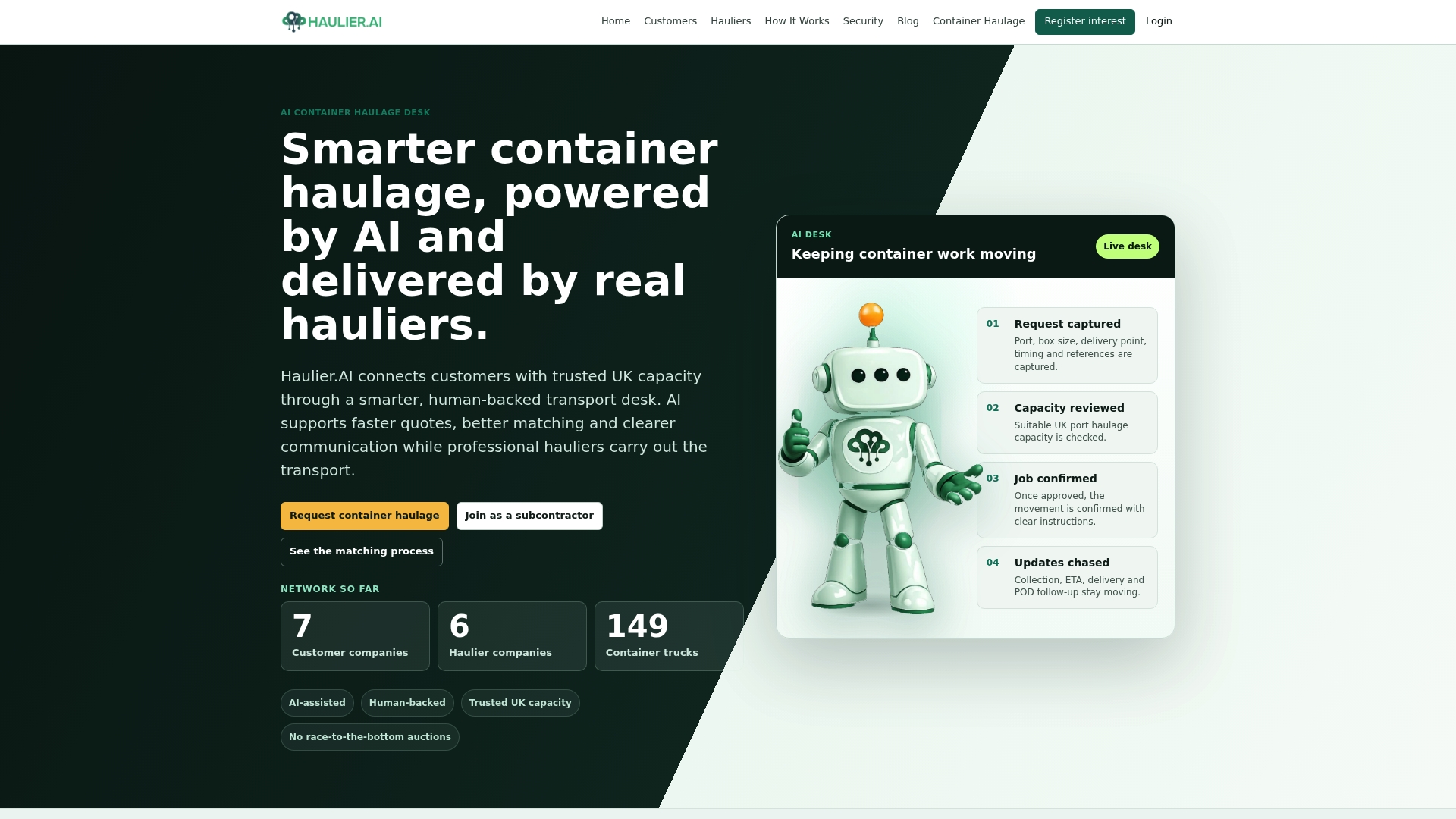
Quoting can happen faster with automated matching supported by human oversight. Hauliers may have control over rates and job selection, helping to maintain fair pricing in bookings. If you are sourcing container capacity against the pressures detailed in this article, Haulier and see how much admin time disappears from your next booking cycle.
Where these figures come from
The statistics referenced throughout this article come from primary UK government and regulatory sources, cross-checked against independent industry analysis.
- Domestic road freight statistics 2025 and road freight statistics 2025, Department for Transport
- Port freight annual statistics 2025 and domestic port trends, Department for Transport
- Freight rail usage and performance, Office of Rail and Road
- Industry trends: transportation and logistics, Atradius
Sources
- Domestic road freight statistics, United Kingdom: 2025
- Port freight annual statistics 2025: Overview of port freight statistics and useful information
- Freight rail usage and performance: Jan–Mar 2026
- Road freight statistics: 2025
FAQ
What is freight transport UK in simple terms?
Freight transport UK refers to the movement of goods by road, rail, sea and air across the country, covering everything from HGV deliveries to container shipping through major ports.
How much freight does the UK move by road each year?
GB-registered HGVs lifted 1.53 billion tonnes of goods in 2025, travelling 19.0 billion vehicle kilometres in total.
Are container volumes through UK ports growing?
Yes. Container (Lo-Lo) tonnage at UK major ports rose 10% to 66.9 million tonnes in 2025, the strongest growth of any port cargo category.
How does Haulier.AI help with container haulage capacity?
Haulier.AI runs an AI-assisted, human-backed transport desk that matches freight forwarders and importers with hauliers faster, cutting quoting time and administrative delays while letting hauliers control their own rates and job selection.