
Container haulage article
UK Haulier Checklist: 8 Vetting Steps Using VOL Data and Port Matches
Use eight procurement checks: VOL licence, authorised vehicles, port experience, and itemised quotes. Run a trial move and see Haulier.AI map them.
The fastest way to avoid a supply-chain headache is to run a proper verification pass before you sign anything: confirm the Gov, match haulier size and specialism to your freight profile, and price the quote against a checklist rather than a gut feel. Do that and you cut most of the risk out of container haulage before it becomes your problem. The rest of this guide walks through each check, in order, with the verification steps you actually need.
TL;DR:
- Verifying a haulier’s operating license and vehicle authorization on GOV.UK ensures compliance with legal requirements and prevents capacity mismatches.
- Choosing a haulier with port-specific experience and local knowledge helps avoid demurrage charges caused by missed gate windows and inefficient queue management.
- Requesting itemized quotes and comparing surcharges prevents hidden costs from undermining seemingly attractive rates.
- Confirming safety records, incident history, and driver training standards ensures operational reliability and cargo safety, especially for hazardous or sensitive loads.
- Prioritizing reliability and port familiarity over the lowest headline rate reduces the risk of delays and costly failure due to inexperienced or ill-equipped operators.
Table of Contents
- How do you choose a UK haulier for container work?
- How do you verify a haulier’s licence and legal standing?
- Why port experience changes who is the right haulier
- How do you compare haulage quotes without missing hidden charges?
- What communication standards should you expect from a haulier?
- How Haulier.AI maps to this checklist
- Do safety records and incident history matter when choosing a haulier?
- What environmental and sustainability practices should you check?
- Procurement view: the sequence that actually works
- Get container haulage moving without the admin chase
- Registers and resources worth bookmarking
- Sources
- FAQ
How do you choose a UK haulier for container work?
Choosing a UK haulier well comes down to running eight checks before you award any work, not one big decision. Get the sequence right and you avoid the two most common failure modes in container haulage: hiring an operator with too little authorised capacity for the job, and getting hit with surcharges nobody mentioned at quote stage.
Here is the order that actually protects you, based on where deals tend to go wrong.
- Run an operator licence (VOL) check. Confirm the licence is current and, for anything involving dangerous goods, check ADR authority separately.
- Confirm authorised vehicle numbers. A licence with three vehicles specified cannot legally cover a fleet of fifteen turning up to your gate.
- Ask about subcontracting. Many hauliers subcontract overflow work. That is not automatically a problem, but you need to know it happens and who is liable if a subcontracted job goes wrong.
- Check operating centre location against your ports. A haulier based two hours from the terminal you use will struggle with tight free-time windows.
- Confirm sector and commodity experience. Reefer, hazardous cargo, and oversized loads all need specific handling knowledge.
- Demand an itemised quote. Ask for every surcharge in writing, not a single lump sum.
- Test communication before committing volume. A quick trial movement tells you more than any sales call.
- Ask for recent references at the terminals you use. Generic testimonials tell you nothing; port-specific ones do.
- Insurance certificates should be current and match the cargo type you’re shipping.
- Fleet condition matters more for container work than general haulage, given weight and stacking demands.
- A haulier that won’t name a single point of contact is telling you something about how disputes get handled later.
Pro Tip: Ask for the name of the actual driver coordinator, not just a sales contact. If the person quoting you disappears once the contract starts, that’s a resourcing problem waiting to surface.
You can run this checklist manually against every quote, or use a platform that has already screened the licence and fleet data before a haulier is allowed to bid. Either way, the sequence matters more than the tool.
How do you verify a haulier’s licence and legal standing?
Start with GOV.UK’s public VOL register, searching by the exact legal operator name, licence number, or operating centre address. Trading names cause more confusion here than anything else, so search the name on the invoice, not the name on the lorry.
- Check licence type, status, and authorised vehicle numbers against what’s actually turning up for your job.
- Cross-reference any trailer authority if your loads need specialist trailers.
- Use the National Register of Road Haulage and Road Passenger Transport Operators dataset on Data.gov.uk for a second data point, particularly if you’re vetting several operators at once.
- Match the legal name on the licence against the name on the insurance certificate and the invoice header, a step industry guidance flags as the single most common gap in procurement checks.
A substantial number of UK operators specify five vehicles or fewer, according to LTN’s Operator Intelligence research covering 64,448 operator records. A small fleet size is not a red flag on its own. It just means you check authorised vehicle numbers more carefully against the volume you’re planning to send.
Why port experience changes who is the right haulier
Terminal familiarity is not a nice-to-have for container work. A haulier who knows a specific terminal’s gate procedures, booking cut-offs, and typical queue times will hit free-time windows that a generalist haulier misses, and every missed window is a demurrage charge landing on your invoice.
- Ask whether the haulier runs regular jobs through your specific terminal, not just “ports generally”.
- Confirm they understand your terminal’s booking system and typical waiting times at peak periods.
- Waiting time at the gate is one of the biggest hidden cost drivers in container haulage, so a haulier’s realistic estimate of it tells you a lot about their experience.
- For occasional single-container jobs, a local generalist can work fine. For recurring port pairs, a haulier who runs that lane regularly usually beats one learning it on your account.
How do you compare haulage quotes without missing hidden charges?
Two quotes that look similar on the headline rate can differ by hundreds of pounds once surcharges land. Waiting time beyond free allowance, out-of-hours collection, tail-lift use, restraint and dunnage fees, and redelivery charges after a failed attempt are the ones that catch shippers out most often.
- Ask every haulier for an itemised quote, not a single all-in figure.
- Get the assumptions in writing: how much free time is included, how many stops, whether chassis or trailer provision is extra.
- Normalise comparisons using a consistent unit, whether that’s per container, per mile, or per stop, so you’re comparing like with like.
- Treat a higher headline rate with fewer surcharges and included waiting time as often cheaper than it looks.
Pro Tip: A quote that includes generous free time on waiting is frequently better value than a lower rate with a tight cut-off, because demurrage and redelivery fees can wipe out the saving in a single delayed collection.
The full pricing breakdown for container haulage covers typical rate bands if you want to sanity-check a specific quote against current market ranges.
What communication standards should you expect from a haulier?
A single point of contact who answers within the day, not within the week, is the baseline. If a haulier can’t tell you who handles your account when their usual contact is off sick, that’s worth asking about before you commit volume.
- Expect a named contact with a documented escalation path if something goes wrong.
- Ask directly whether they offer real-time tracking or at least proactive status updates, and whether proof-of-delivery paperwork comes back the same day or gets chased for a week.
- Run one trial movement before committing recurring volume. How fast they quote it and how clearly they communicate during transit tells you more than any reference call.
- Poor paperwork handling is one of the most common sources of invoice disputes in container haulage, often more so than pricing disagreements.
How Haulier.AI maps to this checklist
Haulier.AI runs the operator licence and fleet checks before a haulier ever appears as a match, so the vetting step in this checklist is already done for you. Port coverage matching pairs you with hauliers who actually run your terminal regularly, and rates stay transparent because hauliers set and control their own bids rather than being pushed into unsuitable jobs. The result is fewer missed updates and less paperwork chasing than a manual booking process typically involves, because status updates and proof-of-delivery tracking run through one system instead of scattered phone calls and email chains.
Do safety records and incident history matter when choosing a haulier?
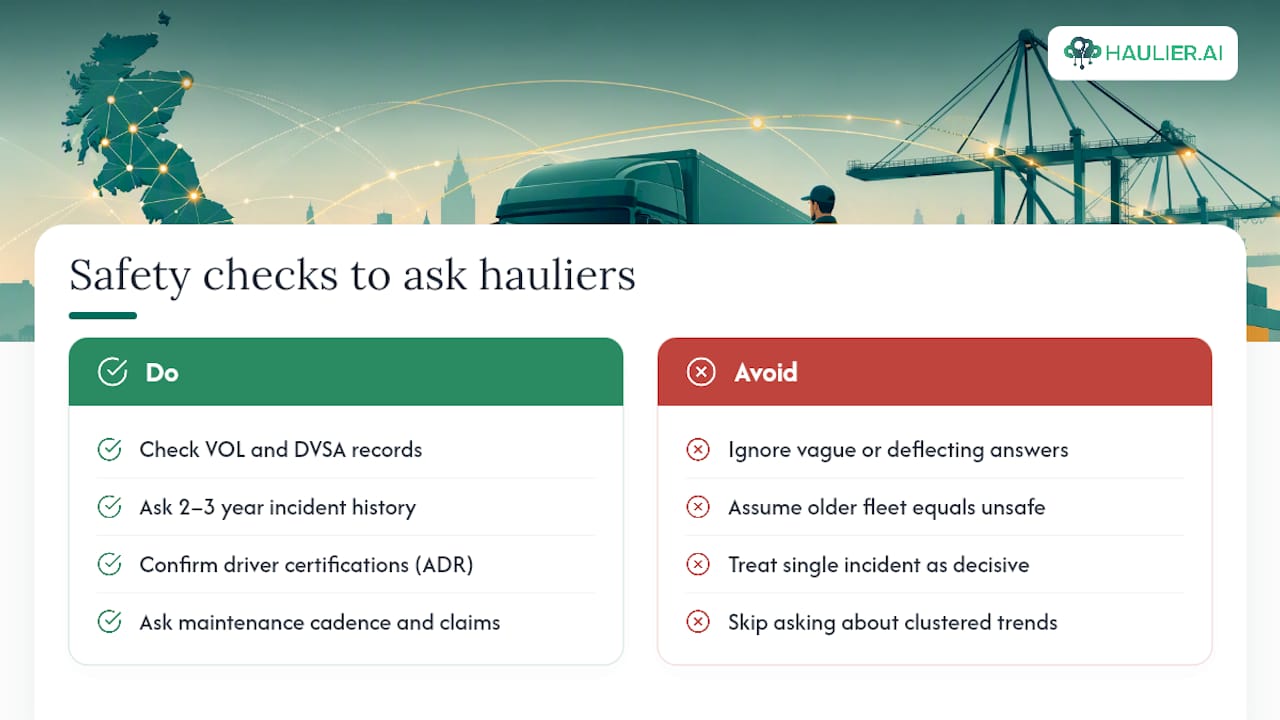
Safety history is one of the harder checks to do yourself, but it’s not impossible. DVSA’s enforcement data and the operator licence system both track compliance issues, and a haulier with a clean record on the VOL register is a reasonable starting signal, though it won’t show you everything.
Ask directly about incident history for the last two to three years, including any load damage, delivery failures, or enforcement action. A haulier confident in their safety record will usually answer this without hesitation. One that deflects or gives vague answers is telling you something.
Driver training standards matter more for container work than general haulage, given the weight distribution and stacking risks involved. Ask whether drivers hold specific certifications for the cargo types you ship, particularly for anything requiring ADR authority or specialist handling.
Fleet maintenance schedules are worth a direct question too. A haulier running an older fleet isn’t automatically unsafe, but you want to know their maintenance cadence rather than assume it. Insurance claims history, where a haulier is willing to share it, gives you a rough proxy for how often things go wrong operationally, even if it’s an imperfect one.
The pattern to watch for is not a single incident. Even reliable hauliers have the occasional bad day. What matters is whether incidents cluster, whether the haulier improved processes afterwards, and whether they’re transparent about it when you ask.
What environmental and sustainability practices should you check?
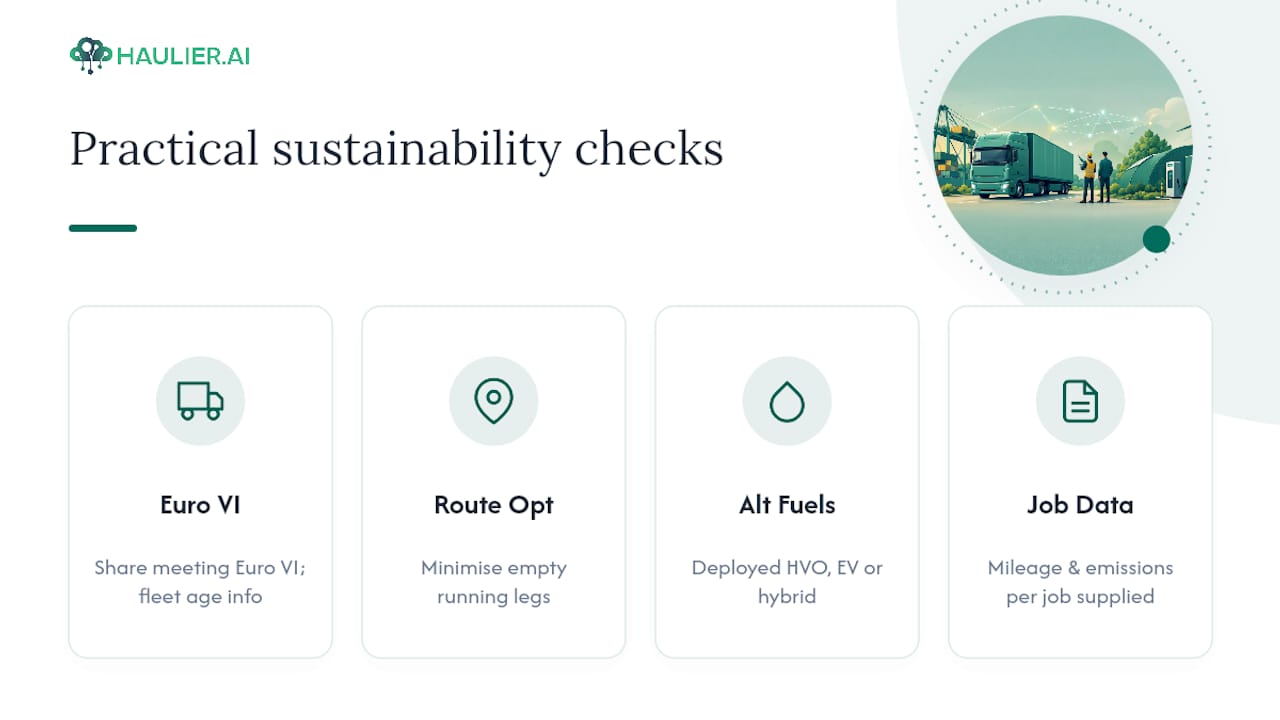
Fuel efficiency, fleet age, and Euro emissions standards are the practical starting points, not vague sustainability statements. Ask a haulier what proportion of their fleet meets Euro VI standards and whether they’re actively investing in newer, cleaner vehicles rather than running out older stock until it fails an MOT.
Route optimisation matters too, both for cost and emissions. A haulier who plans efficient routes and minimises empty running legs is cutting fuel use and cost at the same time, which is a genuinely useful alignment of incentives rather than a marketing line.
Some hauliers now report on alternative fuel trials, whether that’s HVO (hydrotreated vegetable oil), electric vehicles for shorter urban legs, or hybrid options. Ask what they’re actually running rather than what they’re planning to run, since intentions and deployed fleet are very different things in haulage.
For businesses with their own sustainability reporting obligations, whether through customer requirements or Streamlined Energy and Carbon Reporting, a haulier who can supply mileage and emissions data per job saves you a considerable amount of manual work downstream. That data availability is worth asking about directly at quote stage, not after you’ve already committed volume, since not every haulier tracks it in a form you can actually use.
Procurement view: the sequence that actually works
Shortlist three to five hauliers, run the VOL check on every one, then commit a single trial job before any recurring volume moves. That sequence catches most problems cheaply, before they’re expensive.
Reliability should beat headline price whenever your freight has tight delivery windows or high-value cargo, because a missed slot costs more than the saving. One procurement trade-off comes up constantly: a slightly higher rate that includes generous free time is usually the safer bet over a cheaper quote with a tight cut-off, particularly when port congestion is unpredictable. The LTN operator data backs this up structurally. With most UK capacity sitting in small and medium operators, matching a haulier’s specialism to your freight profile usually beats defaulting to the biggest name you recognise.
— Vytautas
Get container haulage moving without the admin chase
Haulier.AI is the practical alternative to chasing quotes across email threads and phone calls: it runs the licence and fleet checks this article covers before a haulier is even matched to your job, so you’re comparing pre-vetted options rather than starting from scratch on every tender.
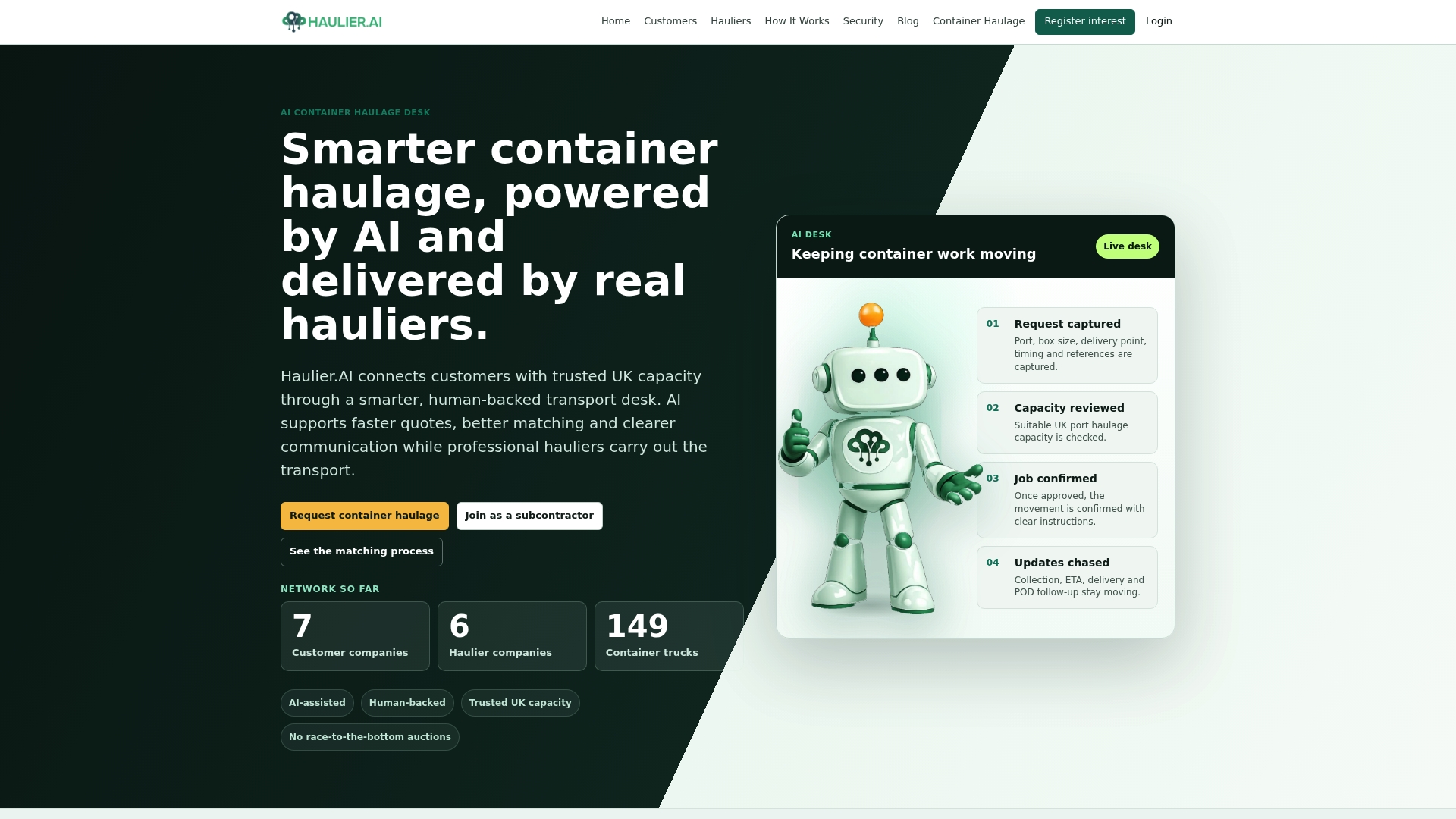
Hauliers set and control their own rates on the platform, which keeps pricing honest, and port coverage matching means you’re paired with operators who actually run your terminal rather than learning it on your account. Status updates and paperwork run through one system instead of scattered messages, which is where most of the admin time in haulage procurement actually goes. If you want to see how the AI-assisted transport desk works before committing, or you’re ready to move, you can request container haulage directly and get matched against your first job.
Registers and resources worth bookmarking
Keep these to hand for quick verification during any tender:
- Gov for operator licence and authorised vehicle checks.
- Data.gov.uk National Register extracts for cross-checking operator records.
- Operator compliance guidance for the obligations behind the licence.
- OperatorCompliance’s blog for deeper fleet compliance reading.
Sources
- Gov
- National Register of Road Haulage and Road Passenger Transport Operators - Dataset
- Operator Licence Check | VOL Register Search
FAQ
Who is the biggest haulier in the UK?
Market analysis from IBISWorld names DHL Supply Chain and Wincanton among the largest national operators, though the wider market is dominated numerically by small and medium fleets rather than a handful of giants.
How many hauliers are there in the UK?
CompanyPulse records tens of thousands of active companies under SIC code 49410 (freight transport by road), and LTN’s operator analysis puts the number of licensed operators at 64,448, with a significant number specifying five vehicles or fewer.
What are the top UK haulage companies?
There’s no single official top-ten list, but IBISWorld’s industry data identifies national players like DHL Supply Chain and Wincanton as leading operators by scale, alongside thousands of smaller specialists who dominate regional and port-specific work.
How do I set up a haulage company in the UK?
You need an operator licence from the Traffic Commissioner, which requires proof of financial standing, professional competence, and suitable operating centres, all verified through the same VOL system shippers use to check existing operators.
How do I choose the right size haulier for my freight?
Match haulier scale to your shipment pattern: occasional single containers suit local generalists, while recurring port pairs and steady volumes tend to benefit from a haulier or platform like Haulier with regular experience on that specific lane.