
Container haulage article
UK importer haulage guide: comply and deliver
Navigate UK import haulage smoothly. Learn essential steps for compliance, from obtaining your EORI number to booking haulage.
If you import containers into the UK, the single most important action is to get a GB EORI number and decide who will submit your Customs Declaration Service entries before the vessel arrives. Do those two things and you have solved a significant portion of the compliance risk before a container even touches a UK berth.
Here is what to do in the next 24–72 hours:
- Register for a GB EORI number at GOV.UK (takes around 10 minutes; active within five working days).
- Identify your 10-digit commodity code using the UK Trade Tariff.
- Appoint a customs agent, freight forwarder, or confirm you will submit CDS declarations yourself.
- Check whether your goods need an import licence or SPS certificate before shipping.
- Book haulage as early as possible — terminal appointment slots fill fast, and a missed window means demurrage charges start accumulating immediately.
Skip any of these steps and you face a predictable set of consequences: goods held at the Border Control Post, demurrage and detention fees mounting by the day, and potential civil penalties from HMRC for misdeclaration.
Key takeaways
Post-Brexit UK import compliance requires a GB EORI, a CDS declaration submitted before or on vessel arrival, correct commodity codes, and a haulier confirmed before the ship berths — each step is interdependent and delays in one cascade into costs across the others.
| Point | Details |
|---|---|
| GB EORI is non-negotiable | Register at GOV.UK before your first shipment; an EORI not starting with GB will not work for Great Britain imports. |
| Pre-lodge CDS declarations | Submit your import entry before the vessel arrives to have the MRN ready the moment the container is available for collection. |
| Commodity codes drive everything | The 10-digit UK tariff code determines your duty rate, VAT treatment, and whether a licence is required — get it right before shipping. |
| Use PVA to protect cashflow | Postponed VAT Accounting eliminates upfront import VAT for VAT-registered importers; reconcile your monthly PVA statement against CDS records. |
| Haulier reduces booking friction | Haulier’s AI-assisted transport desk matches importers to vetted hauliers with document tracking and timestamped audit trails to cut demurrage risk. |
This article is general information, not a substitute for advice from a qualified lawyer. Consult a qualified legal professional about your own circumstances before acting on anything here.
Table of Contents
- Does this importer haulage process apply to your shipment?
- Set up your business before the first shipment arrives
- Who should make your customs declarations and arrange transport?
- How to find the commodity code and calculate what you owe
- Does your shipment need a licence or certificate?
- What paperwork do hauliers and drivers need at the port?
- Permits, ECMT, and cabotage rules for cross-border haulage
- What happens at the border and how to get a held shipment released
- How Customs Duty and import VAT are calculated and paid
- Record-keeping, timelines, and the cost of getting it wrong
- How to choose and brief the right haulier or freight forwarder
- How Haulier helps reduce paperwork delays and missed collections
- Haulier makes container collections faster and less stressful
- Three operational failures that cost importers the most
- Sources
- FAQ
Does this importer haulage process apply to your shipment?
This guide covers imports of goods into Great Britain (England, Wales, and Scotland) by road, sea, or a combination of both. If you are moving goods into Northern Ireland, the Windsor Framework applies and some EU rules continue to operate alongside UK ones — the process differs enough that you should check HMRC’s specific NI guidance separately.
The trigger for everything in this guide is straightforward: if goods are arriving from outside the UK and you are the buyer or the party responsible for customs, this process applies to you. That holds whether you are shipping a full container load (FCL), a less-than-container load (LCL), or a RoRo trailer.
Incoterms matter here. Under DDP (Delivered Duty Paid), your overseas supplier handles customs and delivers to your door — but you should still verify they hold a GB EORI and are using a compliant UK customs agent, because HMRC will look to the importer of record if something goes wrong. Under EXW (Ex Works) or FCA, you take responsibility for export clearance, freight, and UK import customs from very early in the chain. DAP (Delivered at Place) sits in the middle: the supplier delivers to a named place, but UK import duties and customs are your responsibility. Knowing your Incoterm before you book anything is not optional — it determines who pays, who declares, and who books the haulier.
Pro Tip: If your supplier quotes DDP but cannot provide a GB EORI or name their UK customs agent, treat that as a red flag. Misdeclared DDP shipments where the supplier has no UK presence often leave the UK buyer as the de facto importer of record.
Set up your business before the first shipment arrives
GB EORI and XI EORI
A GB EORI number — formatted as GB followed by your VAT number and three digits — is the non-negotiable starting point. GOV.UK confirms that an EORI not starting with GB will not work for imports into England, Wales, or Scotland. Apply via your Government Gateway account; most applications are processed within five working days, though HMRC can expedite in urgent cases.
If you move goods between Great Britain and Northern Ireland, or between Northern Ireland and the EU, you also need an XI EORI. The two numbers are separate applications.
CDS enrolment and Government Gateway access
HMRC’s Customs Declaration Service is now the only platform for lodging import declarations — the legacy CHIEF system is closed. You need a Government Gateway account with CDS enrolment to submit entries yourself. If you are using a customs agent or freight forwarder, they submit under their own CDS credentials but need your EORI and authority to act on your behalf (a standing authority or a one-off authorisation).
Postponed VAT Accounting and duty deferment
Postponed VAT Accounting (PVA) is the default cashflow tool for VAT-registered importers. Instead of paying import VAT at the border then reclaiming it later, PVA lets you account for it on your VAT return — eliminating the upfront cash burden entirely. You access your monthly PVA statements through your Customs Financial Accounts on GOV.UK.
A duty deferment account lets you pay customs duty and import VAT monthly rather than per shipment. To open one, you apply to HMRC and may need a guarantee (a bank guarantee or a customs comprehensive guarantee). For importers moving more than a handful of containers per month, the cashflow benefit is significant.
- Apply for PVA access via your Government Gateway / CDS account settings.
- Apply for a duty deferment account via HMRC’s C1200 form.
- Link your deferment account number to your CDS profile before your first declaration.
Authorised Economic Operator status
AEO status (either AEO-C for customs simplification or AEO-S for security and safety) is worth considering once you are importing regularly. It gives access to simplified customs procedures, faster border processing, and is increasingly requested by trading partners as a trust signal. The application is detailed — HMRC audits your internal controls, financial solvency, and compliance history — but the operational benefits compound over time.
Pro Tip: Most freight forwarders expect you to supply your EORI, commodity codes, and a commercial invoice before they can lodge a declaration. Prepare a standard data sheet for each product line so you are not hunting for figures at 5 PM on a Friday when a vessel is berthing.
Who should make your customs declarations and arrange transport?
Understanding the roles
Four distinct roles exist in every import movement, and they can be held by different parties or consolidated:
- Importer of record: the legal entity responsible for the goods and the accuracy of the customs declaration. This is almost always the UK buyer.
- Declarant: the party who actually submits the CDS entry. Can be the importer, a customs agent, or a freight forwarder acting under a power of attorney.
- Customs agent / broker: a specialist who prepares and submits declarations on your behalf, usually on a per-entry fee basis.
- Carrier / haulier: responsible for the physical movement of goods from port to warehouse. They are not responsible for customs accuracy, but they do need the Movement Reference Number (MRN) to release goods from the terminal.
Which option fits your business?
Doing it yourself gives maximum control and saves agent fees, but requires CDS training, software (most importers use a third-party declaration platform), and someone who can respond to HMRC queries quickly. Realistic for businesses with a dedicated compliance person and a narrow, consistent product range.
Appointing a customs agent is the most common route for small and medium importers. You pay per declaration (fees vary by complexity) and the agent carries professional indemnity insurance. The risk is that you remain the importer of record — if the agent misdeclares, HMRC pursues you.
Using a freight forwarder who also handles customs is convenient for new importers. One party manages the entire chain from origin to UK delivery. The trade-off is less visibility into what is being declared and, sometimes, higher combined fees.
Haulier-only arrangements work when customs is already cleared and you simply need a container collected from port. The haulier needs the MRN and a release confirmation before the terminal will allow collection.
Questions to ask before you appoint anyone
- Are you enrolled on CDS and do you have active CDS software?
- Can you provide an audit trail of every declaration you submit on my behalf?
- What is your professional indemnity insurance limit?
- How do you handle HMRC queries and post-clearance amendments?
- What are your fees — per entry, per line, or bundled?
Red flags: an agent who cannot name their CDS software, quotes a flat fee with no breakdown, or cannot explain how they handle commodity code disputes. Walk away from anyone who suggests “we’ll sort the code out when it arrives.”
How to find the commodity code and calculate what you owe
Every import declaration requires a 10-digit commodity code. The first six digits are the international HS code; digits 7–10 are UK-specific. Use the UK Trade Tariff to search by product description — it returns the duty rate, any VAT treatment, and flags whether a licence is required.
Getting the code wrong is not a minor paperwork issue. An incorrect code can trigger the wrong duty rate, miss a licensing requirement, and expose you to a post-clearance audit. HMRC can go back four years on customs paperwork.
Worked example: calculating duty and import VAT
Say you import 500 units of a ceramic kitchen product with a supplier invoice of £8,000, freight of £900, and insurance of £100.
- Customs value (CIF basis): £8,000 + £900 + £100 = £9,000
- Duty rate (assume 12% for this commodity code): £9,000 × 12% = £1,080
- VAT value: £9,000 + £1,080 = £10,080
- Import VAT at 20%: £10,080 × 20% = £2,016
With PVA, that £2,016 does not leave your bank account at the border — it appears on your VAT return as both output and input tax, netting to zero for most fully taxable businesses. Without PVA, you pay it upfront and reclaim it later, tying up cash for weeks.
Free trade agreements can reduce or eliminate the duty element. You must keep the origin proof for four years.
Pro Tip: The CDS declaration completion guide lists every data field required in an import entry. Cross-reference it against your commercial invoice before you hand anything to an agent — gaps in the invoice are the single most common cause of declaration errors.
Does your shipment need a licence or certificate?
Many goods can be imported freely, but certain categories require a licence, certificate, or pre-notification before they can clear customs. GOV.UK’s import licence guidance lists the main categories and links to the relevant issuing authorities.
Common categories requiring additional documentation:
- SPS goods (Sanitary and Phytosanitary): fresh food, plants, plant products, and animal products require a phytosanitary certificate or health certificate from the country of origin and pre-notification via IPAFFS (Import of Products, Animals, Food and Feed System).
- Controlled drugs and medicines: licences from the Medicines and Healthcare products Regulatory Agency (MHRA) or the Home Office.
- Strategic and dual-use goods: export control licences from the Export Control Joint Unit (ECJU); check the UK Strategic Export Control Lists.
- Firearms and weapons: Home Office authority required.
- Controlled chemicals: REACH registration and, for certain substances, import authorisation.
Failing to pre-notify an SPS shipment is one of the most common causes of goods being held at a Border Control Post. The pre-notification must be submitted via IPAFFS before the goods arrive — not on the day of arrival. Lead times for BCP inspection slots vary by port and commodity, but building in at least 48 hours of buffer is standard practice. If your goods are perishable, that buffer is not optional.
Use the GOV.UK licence checker as your first stop, then contact the relevant issuing authority directly if your commodity code triggers a licence flag in the Trade Tariff.
What paperwork do hauliers and drivers need at the port?
A haulier arriving at a container terminal without the right documents will be turned away. Terminals are strict, and a failed collection attempt means the container stays on the quay — and the free time clock keeps running.
Essential documents for every container collection
- Bill of Lading or sea waybill: proof that the shipping line has released the container. The original Bill of Lading must be surrendered (or a telex release confirmed) before the terminal will allow collection.
- CMR consignment note (or e-CMR): the standard road freight contract document for international movements. It records the shipper, consignee, goods description, and carrier details. e-CMR is increasingly accepted and reduces paper handling.
- Movement Reference Number (MRN): generated when the CDS import declaration is submitted. The terminal checks the MRN against HMRC’s systems to confirm customs clearance before releasing the container.
- Delivery order or PIN: the shipping line’s authority to release the specific container to the named haulier.
- Driver’s licence and operator licence: the haulier’s O-licence disc must be displayed in the cab; the driver needs a valid HGV licence and Driver CPC qualification card.
- Tachograph records: current and compliant; spot checks happen at ports.
Posting declarations for international road jobs
If a haulier is operating under a bilateral or ECMT permit arrangement and the driver is based in an EU country, a posting declaration may be required under EU rules for the EU-side leg of the journey. GOV.UK’s guidance on non-UK operators sets out when this applies and what the declaration must contain.

Pro Tip: Keep a laminated quick-reference card in the cab listing the terminal’s collection desk number, the freight forwarder’s out-of-hours contact, and the HMRC helpline. When a driver is turned away at the gate, having those numbers immediately to hand saves hours.
Permits, ECMT, and cabotage rules for cross-border haulage
The rules here depend on whether the operator is UK-based or EU/non-UK based, and on the route.
UK operators moving goods between the UK and EU countries need either a bilateral permit (where one exists) or an ECMT permit for countries where no bilateral arrangement applies. The UK has bilateral permit-free access with a number of countries, but the list is not static — check the current position via GOV.UK before accepting a cross-border job.
EU operators bringing goods into the UK must hold a valid ECMT permit or operate under a bilateral arrangement. GOV.UK sets out the cabotage limits: EU operators may carry out up to two cabotage operations in the UK within seven days of an international delivery, after which they must leave. Exceeding this triggers enforcement action and can affect the operator’s right to operate in the UK.
The Goods Vehicles (International Road Transport Permits and Haulage Within the EU) Regulations 2024 set out the permit types, application procedures, and enforcement provisions in detail. Key points:
- ECMT permits are annual or short-term; apply via the Driver and Vehicle Licensing Agency (DVLA) portal.
- Bilateral permits are country-specific and issued in limited numbers — apply early in the year.
- Operators working EU lanes must track cabotage operations carefully; a logbook or digital record of each movement is the standard evidence if stopped.
- Posting declaration obligations for drivers apply on the EU side of cross-border movements; non-compliance can result in fines in the EU member state concerned.
For non-EU, non-UK operators, check the bilateral arrangements list on GOV.UK — some countries have permit-free access for specific journey types, others require a permit for every movement.
What happens at the border and how to get a held shipment released
Most import shipments clear without a physical inspection. The CDS declaration is risk-assessed automatically, and the majority receive a “cleared” status that generates the MRN the terminal needs. The problems arise when goods are routed to a documentary check or a physical examination.
Common reasons goods are held:
- SPS goods without a valid pre-notification or health certificate.
- A commodity code that triggers a licensing requirement the importer has not met.
- A mismatch between the declared value and the invoice (HMRC’s valuation team flags statistical outliers).
- Missing or incorrect MRN at the terminal gate.
Step-by-step if your shipment is held:
- Check the MRN status in CDS — the declaration will show a “hold” or “query” status with a reason code.
- Contact your customs agent or declarant immediately; they can see the HMRC query and respond directly.
- Gather supporting documents: commercial invoice, packing list, certificate of origin, and any licences.
- If the hold is for a physical SPS inspection, your agent books an inspection slot at the relevant Border Control Post. Fees apply and vary by port and commodity.
- Once the inspection is complete and HMRC is satisfied, a release is issued and the terminal can be instructed to allow collection.
- If you believe demurrage or detention has accrued unfairly because of a port or shipping line delay rather than your own documentation failure, gather timestamped evidence (MRN submission time, hold notification time, release time) and use it to dispute the charges with the shipping line.
Filing declarations before vessel arrival and booking haulage early are the two most effective ways to reduce demurrage exposure during periods of port congestion. A pre-lodged declaration means the MRN is ready the moment the vessel berths.
Pro Tip: Ask your customs agent to set up email or SMS alerts for MRN status changes. Knowing within minutes that a hold has been issued — rather than finding out when the driver is turned away at the gate — can save a full day of free time.
How Customs Duty and import VAT are calculated and paid
Once the CDS declaration is submitted and accepted, HMRC calculates the duty and VAT liability based on the declared customs value, commodity code, and origin. The MRN is the reference that ties the financial liability to the physical goods.
Payment options:
- Immediate payment: duty paid at the point of declaration via a CDS cash account or direct debit. Straightforward but ties up cash per shipment.
- Duty deferment: monthly consolidated payment, typically on the 15th of the following month. Requires a deferment account and, for most importers, a guarantee.
- PVA for import VAT: VAT-registered importers should use PVA as the default. The monthly PVA statement (accessed via Customs Financial Accounts on GOV.UK) shows the total import VAT postponed; this figure goes on Box 1 and Box 4 of the VAT return, netting to zero for fully taxable businesses.
The C79 certificate is the import VAT certificate HMRC issues monthly to importers who paid import VAT at the border rather than using PVA. It is the evidence needed to reclaim that VAT on the VAT return. If you have switched to PVA, you no longer receive a C79 — the PVA statement replaces it. Keep both documents for at least six years.
- Reconcile your PVA statement against your CDS declaration records every month.
- If you overpay duty (for example, because you later obtain valid proof of preferential origin), submit a C285 amendment to claim a refund.
- Duty deferment accounts can be set up via HMRC’s C1200 application; processing takes several weeks, so apply before you need it.
Record-keeping, timelines, and the cost of getting it wrong
Retention periods
| Document type | Minimum retention period |
|---|---|
| VAT records (including PVA statements, C79) | 6 years |
| Customs declarations and supporting documents | 4 years |
| Origin evidence (for FTA preferential duty claims) | 4 years from date of declaration |
| Haulage contracts and CMR notes | 3 years (recommended minimum) |
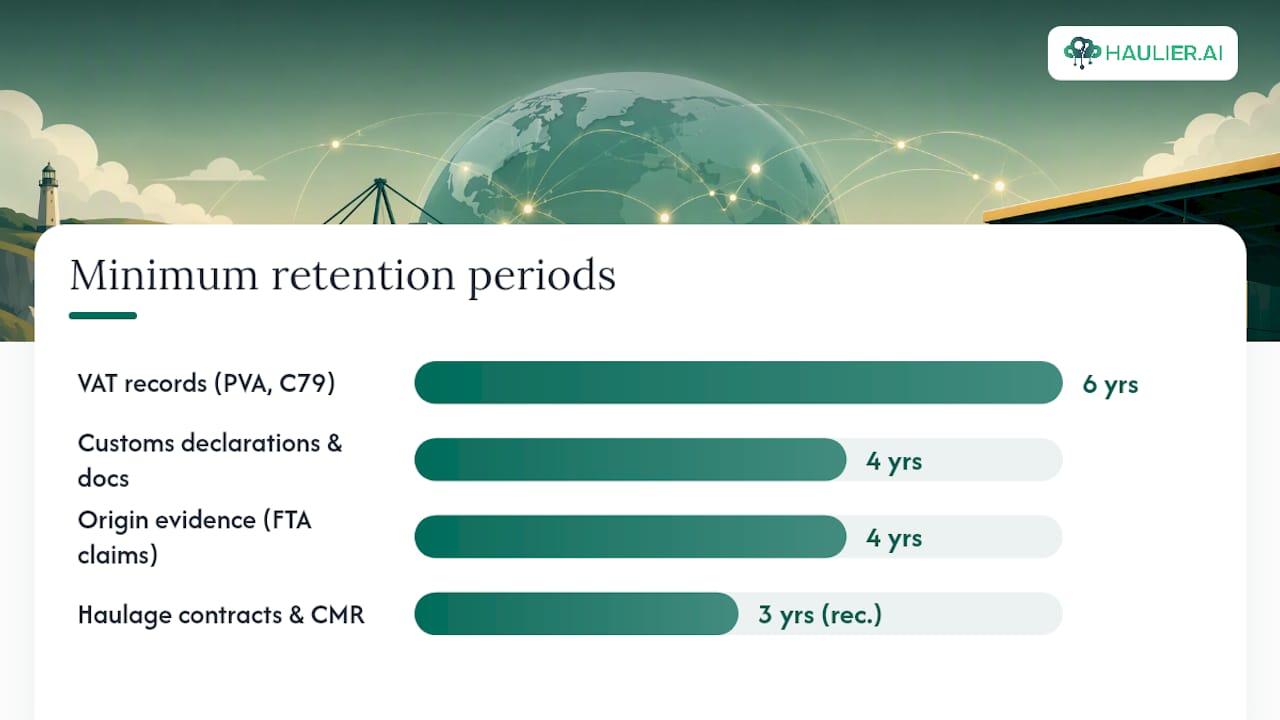
HMRC can open a post-clearance audit at any point within the retention window. Missing documents are treated as evidence of non-compliance, not as an innocent gap.
Typical timeline from vessel arrival to warehouse delivery
A best-case scenario for a straightforward FCL import with pre-lodged declarations and no inspection runs roughly as follows: declaration pre-lodged before arrival; MRN generated on berthing day; terminal releases container within 24 hours; haulier collects on day 2 or 3; delivery to warehouse on day 3 or 4. Add 2–5 days for SPS inspections, 1–3 days for documentary queries, and potentially longer during peak congestion periods at major ports.
Penalties
HMRC’s civil penalty regime for customs non-compliance is tiered by culpability. Errors that are careless attract lower penalties than those deemed deliberate. Missing import licences can result in seizure of the goods. Late payment of duty (outside deferment terms) attracts interest charges.
Practical avoidance steps:
- Use a commodity code specialist to classify new product lines before the first shipment.
- Pre-lodge declarations to avoid last-minute errors under time pressure.
- Keep a compliance calendar for licence renewals, deferment account reviews, and AEO audits.
- Run an annual internal audit of a sample of declarations against the supporting invoices.
How to choose and brief the right haulier or freight forwarder
Choosing a haulier on price alone is how containers end up sitting on a quay for three days while someone hunts for a truck. The right question is not “who is cheapest?” but “who can reliably collect from this terminal, on this day, with the right documents?”
Selection scorecard
Score each candidate out of 5 on these criteria before committing:
- Terminal access and appointment reliability: does the haulier have an active account at your port of discharge? Can they book appointment slots in the terminal’s system directly?
- CDS and MRN handling: do they understand what an MRN is and how to present it at the gate? Do they have a process for checking clearance status before the driver departs?
- Insurance and claims handling: what is their goods-in-transit insurance limit? How do they handle damage or loss claims?
- Pricing transparency: is the quote all-in (including fuel surcharge, port congestion surcharge, and waiting time)? Or will surcharges appear on the invoice?
- Communication and tracking: can you get real-time updates on collection status? Is there an out-of-hours contact for urgent issues?
Briefing your haulier
Give the haulier the following before collection day:
- Container number and shipping line.
- Terminal name and collection PIN or delivery order reference.
- MRN (once declaration is cleared).
- Appointment slot time and any terminal-specific instructions.
- Delivery address, contact name, and any unloading restrictions (height, weight, access times).
Agree in writing on what happens if the terminal rejects the collection (who pays for the wasted journey) and what the process is for a missed appointment. For guidance on container haulage rates and what drives pricing, Haulier’s pricing guide covers the main cost components in detail.
For SME importers navigating shipping regulations for the first time, understanding which compliance obligations sit with you versus your haulier is worth clarifying before you sign anything.
How Haulier helps reduce paperwork delays and missed collections
The friction points in container haulage are predictable: no available haulier for a tight appointment window, an MRN that has not been communicated to the driver, and a demurrage dispute with no audit trail to support your case. Haulier’s AI-assisted transport desk addresses each of these directly.
Faster matching for peak appointment slots. When a terminal appointment window is narrow, finding an available haulier manually takes time you do not have. Haulier matches your job to available, vetted hauliers quickly, with hauliers controlling their own rates and accepting jobs that fit their capacity — so you get a realistic price and a committed operator, not a speculative quote.
Document and MRN tracking. Haulier’s platform tracks paperwork status alongside the booking, reducing the risk of a driver arriving at the gate without a confirmed MRN. Centralised document visibility means your operations team and the haulier are working from the same information.
Audit trails for demurrage disputes. Every booking generates a timestamped record of instructions, confirmations, and status updates. If a shipping line disputes when you instructed collection, that record is your evidence. For a deeper look at managing demurrage and detention charges, Haulier’s dedicated guide covers the contractual and operational levers available to UK logistics teams.
For importers new to container logistics, Haulier’s transportation of containers guide walks through the port-to-warehouse process in practical terms.
Pro Tip: Book haulage at the same time you pre-lodge your customs declaration. By the time the vessel berths and the MRN is live, your haulier is already confirmed and the appointment is booked — cutting a day or more off your free time exposure.
Haulier makes container collections faster and less stressful
Sorting container haulage through phone calls and email chains is slow, and the cost of a missed appointment or a gate rejection lands directly on your P&L. Haulier gives importers and freight forwarders direct access to a network of vetted UK hauliers through an AI-assisted, human-backed transport desk — without the admin overhead of managing each relationship individually.
You get managed quoting, real-time status updates, and paperwork tracking in one place. Hauliers set their own rates and choose the jobs that fit their capacity, which means the price you see reflects real availability rather than a speculative number padded for uncertainty. The result is fewer missed appointments, fewer gate rejections, and a clear record of every instruction if a dispute arises.
For importers handling new container deliveries or scaling up volume, Haulier removes the bottleneck of finding reliable capacity at short notice. Request a container haulage quote or explore the full container haulage service to see how the platform works for your routes and ports.
Three operational failures that cost importers the most
The compliance framework in this guide is well-documented. What is less discussed is how often the failures are not about ignorance of the rules but about operational habits that have not kept pace with post-Brexit requirements.
The first is late declarations. Pre-lodging a CDS entry before vessel arrival is straightforward and eliminates the scramble when a ship berths early. Yet many small importers still wait until the vessel is alongside before instructing their agent — at which point the free time clock is already running and any query from HMRC eats directly into it.
The second is commodity code complacency. A code that worked for a product three years ago may now carry a different duty rate, trigger a new licensing requirement, or be affected by a UK trade remedy. Codes should be reviewed whenever a product specification changes or a new trade agreement comes into force. The cost of a post-clearance audit finding a systematic misclassification is far higher than the cost of a classification review.
The third is terminal appointment management. Booking a haulier without confirming they have an active terminal account and can actually secure an appointment slot is a common mistake. Terminals at major UK ports operate appointment systems, and not every haulier has access to every terminal. Checking this before you book — not after — is the difference between a smooth collection and a wasted journey.
The pattern across all three is the same: the problem is solvable before it becomes expensive, and the solution is almost always earlier action and better information flow between the importer, the customs agent, and the haulier.
Sources
- Import goods into the UK: step by step
- The Goods Vehicles (International Road Transport Permits and Haulage Within the EU) Regulations 2024
FAQ
Do I need a GB EORI number to import into the UK?
Yes. GOV.UK confirms that a GB EORI number — starting with “GB” — is required for all imports into England, Wales, and Scotland. An EORI from another country will not work for Great Britain imports.
How much does an import licence cost in the UK?
Licence fees vary by type and issuing authority. Some licences, such as those issued by the Export Control Joint Unit for strategic goods, carry no direct application fee, while others (such as certain CITES permits) charge a set fee per application. Check the relevant issuing authority’s GOV.UK page for the current fee schedule, as costs are not standardised across all licence categories.
How do I become an importer in the UK?
Register for a GB EORI number via GOV.UK, enrol on the Customs Declaration Service, and appoint a customs agent or freight forwarder if you are not submitting declarations yourself. You will also need to identify the correct commodity code for your goods and check whether any import licences are required before your first shipment arrives.
What are the main problems facing UK haulage?
Port congestion, terminal appointment availability, and driver shortages remain the most common operational pressures. Post-Brexit customs requirements have added declaration complexity and, for cross-border operators, permit management. Pre-lodging declarations and booking haulage early are the most effective practical mitigations, as industry guidance on port congestion consistently highlights.
Can a haulier submit my customs declaration?
A haulier can act as a declarant if they are enrolled on CDS and authorised to act on your behalf, but most hauliers focus on transport rather than customs compliance. The safer approach is to appoint a dedicated customs agent or freight forwarder for declarations, and a separate haulier for collection — or use a platform like Haulier that coordinates both sides of the process with document tracking built in.