
Container haulage article
Quoting desks: 7 field checklist to avoid underquoting haulage
Copyable worksheet and seven field checklist for quoting desks to stop haulage underquoting. Enforce minimum margin floors, validate weight and...


Stop underquoting by doing three things every time: send itemised quotes that show equipment, time, accessorials and compliance charges separately; enforce a minimum margin floor that blocks any quote below cost; and validate weight, dimensions and delivery type before you price. A platform like this builds these rules into the quoting desk automatically. The itemised checklist below is the fastest place to start.
HaulierQuote Container Haulage With ClarityHaulier.AI connects you with trustworthy UK hauliers through an AI-assisted, human-backed transport desk with clear quoting visibility.Visit Haulier.AITL;DR:
- Underquoting often results from incomplete shipment data, stale rates, manual rekeying mistakes, and rapid quote turnaround without proper validation.
- Enforcing itemized quotes with specific fields for equipment, distance, accessorials, and compliance helps prevent blind or inaccurate pricing.
- Implementing automated governance rules, such as minimum margin floors and rate expiry checks, catches low or outdated quotes before they are sent.
- Regular lane benchmarking with recent data and market index ties ensures quotes reflect current fuel costs and market conditions.
- Using AI-assisted systems automates rate management, enforces rules consistently, and reduces the risk of underquoting caused by human error.
Table of Contents
- Why underquoting happens (the usual causes you must stop)
- An itemised quotation checklist (the fields every container haulage quote must show)
- Pricing governance and system rules that stop underquoting
- Pre-quote data validation: what to do before you press send
- Worked worksheet: a compact, adaptable quote calculator you can copy
- Verification, quote-to-book controls and continuous improvement
- Impact of market fluctuations on haulage pricing and how to adjust quotes accordingly
- Use of technology tools to automate and improve quote accuracy
- Staff training and communication protocols to ensure consistency in quoting practices
- Handling exceptional scenarios such as last-minute requests or expedited services and their pricing implications
- Author perspective: why this matters operationally
- How this platform helps prevent underquoting
- Sources
- FAQ
Why underquoting happens (the usual causes you must stop)
Underquoting almost never comes from one dramatic mistake. It comes from small, repeated gaps that compound across hundreds of quotes a month.
The biggest culprit is incomplete input data: a forwarder under-declares weight, guesses at container dimensions, or leaves the delivery type blank because nobody asked. Missing shipment detail is the single most common cause of quote-to-invoice variance, according to Truxweb’s analysis of freight pricing failures. A second cause is stale data: buy rates that expired last month but are still sitting in a spreadsheet, or a fuel surcharge table nobody updated after the last diesel spike.
Human error compounds both. Manual rekeying between email, spreadsheet and invoicing system introduces typos that shave pounds off a sell rate without anyone noticing. Add inconsistent sell-rate rules, where two account managers quote the same lane differently, and you get systemic leakage rather than one-off mistakes.
Common failure points include:
- Under-declared weight or dimensions leading to equipment mismatches
- Accessorials (waiting time, tail-lift, storage) left off the initial quote
- Expired buy rates copied forward from an old contract
- Manual rekeying errors between systems
- Unapproved discounts applied to win volume
Speed makes this worse. A desk under pressure to answer fast often skips validation steps entirely, trading governance for turnaround time, which is exactly when margin leakage from missing surcharges and outdated rates tends to appear on the invoice reconciliation report weeks later.
An itemised quotation checklist (the fields every container haulage quote must show)
UK container haulage pricing is modular. Equipment, waiting time, port fees, out-of-hours premiums and compliance charges are typically listed as separate line items, and breaking a quote down this way is what stops a customer disputing an invoice three weeks after delivery. Work through these fields in order, every time.
- Equipment — container size and type (20ft, 40ft, high cube, reefer), the trailer or chassis required, and any special attachments such as twist-lock adaptors or genset hire.
- Distance and time — miles from collection to delivery, realistic drive time given congestion, and whether the route runs through a low-access urban zone that slows turnaround.
- Slot and free time — VBS booking requirements at the terminal, expected loading minutes, and how much detention or demurrage exposure sits on the shipper’s side of the clock.
- Accessorials — waiting time beyond the free allowance, tail-lift or hiab use, transload if the container needs devanning, storage days, and appointment booking fees.
- Compliance and urban charges — ADR documentation for hazardous cargo, ULEZ or DVS charges, abnormal load permits, and police escorts where required.
- Surcharges and contingencies — a fuel index formula tied to a published benchmark, ferry or toll costs, out-of-hours premiums, and a contingency allowance for the unexpected.
- Presentation — separate line items rather than a single lump figure, a stated validity period, and every assumption written down in the quote itself.
Pro Tip: Write your assumptions directly on the quote, not in an internal note. “Assumes 60 minutes free loading time at Southampton, VBS slot pre-booked” tells the customer exactly what triggers a re-rate if the reality differs, and it protects you if it does.
Miss any one of these seven fields and you are not quoting low on purpose. You are quoting blind, which produces the same financial result.
Pricing governance and system rules that stop underquoting
A checklist only works if the system enforces it. Governance rules turn “we should validate this” into “the software will not let this through.”
Top-performing brokerages encode minimum margin floors directly into the quoting system, so any price that falls below a set threshold gets flagged for manual review rather than sent straight to the customer. That single control catches most underquoting before it leaves the building.
The rules that matter most:
- A minimum margin floor applied automatically to every quote, not just the ones a manager remembers to check
- Centralised buy-rate and surcharge tables that block expired rates from being used
- Lane benchmarking against roughly 90 days of historical data, with fuel costs tied to a published market index
- Sell-rate logic that applies customer and lane-specific rules and accessorials without manual intervention
- Approval workflows that require sign-off from someone senior before a quote breaches the margin floor
- Quote versioning that lets you compare what was quoted against what was actually booked
Lane benchmarking against recent history also reduces the guesswork that leads brokers to underprice out of uncertainty. Automated checks against historical lane data catch quotes that drift too far from what similar shipments actually cost, whether the drift comes from a stale rate card or a well-meaning discount. None of this needs to slow the desk down. Routine lanes clear automatically; only the exceptions land on a human’s desk.
Pre-quote data validation: what to do before you press send
Every underquote traces back to a data gap somewhere upstream. Close the gap before you price, not after the invoice lands.
Run these checks before any quote goes out:
- Measure and record the actual weight and all three dimensions of the cargo, rather than relying on a booking confirmation figure
- Confirm the container type and chassis or trailer combination actually suits the load
- Confirm delivery type, site access constraints, appointment requirements and whether the driver needs a site induction
- Check ADR classification and specialist handling needs, with documentation attached to the quote file
- Verify the terminal or port slot requirement, the free-time allowance, and the likely quay rent exposure if that allowance is tight
Auditing shipment details before movement catches classification and accessorial gaps that would otherwise surface as a billing dispute. Build a pre-quote gate into your workflow: if any mandatory field on the checklist is blank, the quote does not go out. That single rule stops more underquoting than any amount of retrospective auditing ever will.
Worked worksheet: a compact, adaptable quote calculator you can copy
Numbers make governance real. Here is a stripped-down worksheet for a single 40ft container move, built from the cost rows up rather than from a guessed headline rate.
- List every cost row separately rather than starting from a single “feels about right” figure.
- Add the fuel surcharge using an index formula, not a fixed percentage guessed months ago.
- Apply the minimum margin floor to the subtotal, not to a discounted headline number.
- Record the assumptions that produced the figure, such as the expected loading minutes and the VBS slot booked.
- State a validity period, typically 24 to 48 hours for volatile lanes, so the price cannot be held against you weeks later.
Copy the row structure into your own spreadsheet or quoting tool and swap in real figures for the lane. The arithmetic stays the same regardless of the route.
Verification, quote-to-book controls and continuous improvement
A good quote today does not fix a bad rate card next month. Build a closed loop that catches drift and corrects it at source.
- Version and archive every quote, so you can compare what was offered against what was actually invoiced
- Automate reconciliation between quoted and executed costs, with exceptions flagged rather than buried in a monthly total
- Run weekly lane-variance reports and a monthly remediation review, each with a named owner responsible for closing the gap
- When variance shows up, refresh the lane benchmark, fix the expired buy rate, adjust the sell-rate rule, or retrain the quoting staff involved
Centralised rate management with clear approval workflows turns this from a quarterly panic into routine housekeeping. The point is not to catch every error after the fact. It is to make each correction permanent so the same gap cannot reopen next quarter.
Impact of market fluctuations on haulage pricing and how to adjust quotes accordingly
Diesel prices, driver shortages and port congestion move faster than most rate cards get updated, and that lag is where underquoting quietly creeps back in even for desks with good governance.
A rate that was accurate in January can be underwater by March if fuel has climbed and your surcharge table has not moved with it. The fix is structural rather than reactive: tie the fuel line on every quote to a published index rather than a fixed percentage, and rebuild lane benchmarks on a rolling basis rather than annually. A 90-day rolling window catches a driver shortage pushing up subcontractor rates on a specific corridor long before it shows up as a full-year trend.
Seasonal spikes need the same treatment. Peak import season around a major bank holiday, or a surge ahead of Christmas retail deadlines, pushes haulier availability down and subcontractor rates up. Quoting a 30-day-old rate into that window almost guarantees a loss on the job. Build a short validity period into every quote, typically 24 to 48 hours on volatile lanes, so a shift in market conditions does not leave you contractually bound to a price that no longer covers cost.
Port congestion deserves particular attention, because it changes detention and demurrage exposure without ever touching the headline haul rate. A terminal running slow adds hours to turnaround, which eats into free time allowances and turns a marginal quote into a losing one. Building a contingency line into every quote, rather than treating congestion as a rare exception, absorbs most of this volatility before it becomes a dispute.

Use of technology tools to automate and improve quote accuracy
Manual quoting scales badly. A desk pricing forty lanes a day cannot hold every surcharge table, every expired rate and every customer-specific rule in someone’s head, and that is precisely where inconsistency creeps in.
Rate management systems solve the staleness problem by centralising buy rates, surcharge tables and lane benchmarks in one place, with expiry dates that block a rate from being used once it has lapsed. Quoting software goes further, applying sell-rate logic automatically: the right accessorial charges, the right margin floor, the right compliance line for a given customer and lane, without a human rekeying figures from one spreadsheet into another.
The real gain is not speed, though quotes do go out faster. It is consistency. Two account managers quoting the same lane on the same day should produce the same number, and that only happens when the pricing logic lives in the system rather than in each person’s memory. An AI-assisted transport desk applies this by matching shipment requirements to available haulier capacity while keeping margin rules and lane benchmarks enforced in the background, rather than left to whoever happens to answer the phone.
Telematics and slot-visibility tools add a further layer, showing real port and terminal conditions so a quote can reflect actual free-time exposure rather than a generic assumption. Itemised, telematics-informed quoting reduces the hidden extras that turn a fair quote into a disputed invoice.

Staff training and communication protocols to ensure consistency in quoting practices
Software enforces rules, but people still decide what data goes into the system and how exceptions get handled. Training closes that gap.
Every quoting team member needs a shared reference for what “complete” means before a quote can go out: the same seven fields from the itemised checklist, applied the same way regardless of who is at the keyboard. New starters should shadow a senior quoter through several full quote cycles, including at least one dispute, before pricing lanes unsupervised. Disputes teach more about margin risk than any policy document ever will.
Communication protocols matter just as much internally as externally. When a sales team member wants to discount below the margin floor to win a customer, that request needs a named approver and a written reason on file, not a verbal nod that nobody remembers three months later. The same applies to accessorial charges agreed informally over the phone with a haulier: if it is not written into the quote and confirmed back to the customer, it will not survive an invoice dispute.
Run a short monthly review of quotes that triggered exceptions, whether that means a margin floor breach, a customer dispute, or a large quote-to-invoice variance. Walk through what went wrong with the whole team, not just the individual who quoted it. Consistency comes from shared correction, not from a policy nobody reads after induction week.
Handling exceptional scenarios such as last-minute requests or expedited services and their pricing implications
Urgent requests are where governance breaks down fastest, because the pressure to say yes quickly overrides the instinct to validate properly.
A same-day collection request, an expedited delivery ahead of a customer’s own deadline, or a job that appears after the normal cut-off for booking a port slot all carry genuine additional cost. Subcontractor availability tightens, detention risk rises because there was no time to plan the free-time window properly, and out-of-hours premiums often apply. Treat these as a distinct pricing category rather than a rushed version of a standard quote.
Build a standing expedited-rate premium into your rate card, expressed as a percentage uplift on the standard lane rate, so quoting staff are not negotiating a one-off figure under time pressure every time. State clearly to the customer that the premium reflects reduced planning time and higher subcontractor cost, not an opportunistic markup, because that transparency is what prevents a dispute later. Where the request genuinely cannot be validated properly in the time available, missing weight confirmation or an unclear delivery address, it is fair to quote a provisional price with an explicit re-rate clause rather than absorb the risk of an unvalidated job. A rushed quote that skips the pre-quote gate is still an underquote, just one dressed up as urgency.
Author perspective: why this matters operationally
Every control in this guide exists because container haulage margins are thin enough that one missed accessorial line wipes out the profit on a job. Implementing margin floors, lane benchmarking and pre-quote validation is not paperwork for its own sake. It cuts disputes, cuts the admin hours spent chasing invoice discrepancies, and protects the number that actually pays the bills. Copy the worksheet, run the checklist, and check your own quoting governance against the six rules above this week.
— Vytautas
How this platform helps prevent underquoting
This platform is the practical version of everything above, running as an AI-assisted, human-backed transport desk rather than a policy document nobody reads. Margin rules are enforced automatically rather than left to whoever is quoting that day, rate data stays centralised instead of scattered across spreadsheets, and slot visibility feeds directly into the quote so free-time exposure is not a guess.
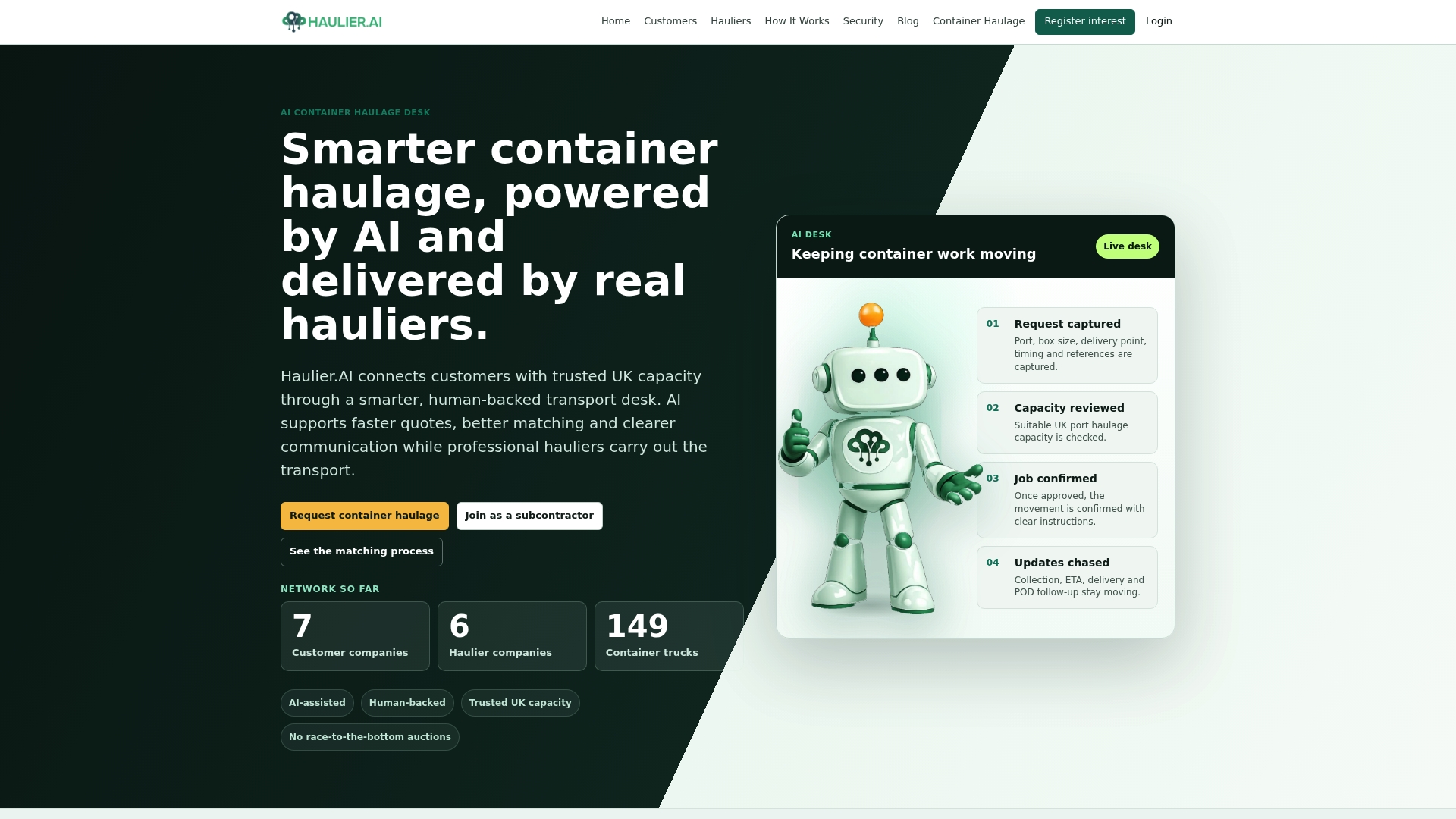
Hauliers keep control of their own rates and can decline a job that does not work for them, which helps keep pricing fair on both sides of the transaction rather than forcing a race to the bottom. For freight forwarders and importers, that means the quote you receive has typically passed through governance checks like those this guide describes, without you having to chase it manually. If you want to see how that plays out on a real container move, request a container haulage quote and compare it against your current process.
Sources
- How to Automate Inbound Freight Quotes Without Losing Margin | LoadStop
- Margin Leakage in Freight Forwarding | Velocity
- Haulage costs made clear: how UK freight pricing really works | CCW Services
- Freight quotes become unreliable when shipment data is incomplete | Truxweb
FAQ
What is the main cause of underquoting in container haulage?
Incomplete shipment data, particularly under-declared weight, dimensions or missing accessorials, is the most common cause, followed closely by expired buy rates and manual rekeying errors.
How do I calculate a minimum margin floor?
Apply a fixed percentage, commonly around 15%, to your total itemised cost subtotal before adding it as a separate line, and set the quoting system to flag or block any quote falling below that figure.
What should every container haulage quote include?
Equipment and container type, distance and time, slot and free-time details, accessorials, compliance and urban charges, surcharges with a contingency allowance, and a stated validity period.
How often should lane rates be benchmarked?
Benchmark against recent historical lane data on a rolling basis, rather than annually, so fuel and subcontractor rate movements get reflected quickly.
Can technology actually stop underquoting, or is it a training problem?
Both matter, but technology closes the gap training alone cannot: an AI-assisted platform enforces margin floors and centralises rate data automatically, while training ensures staff feed it complete, accurate shipment information.