
Container haulage article
Fast haulage quotes: get multiple firm UK quotes in hours
Get multiple competitive haulage quotes in hours using a vetted freight exchange or managed desk for quick and accurate results.


The fastest way to get multiple, competitive haulage quotes is to post your job on a vetted freight exchange or route it through a managed, human-backed transport desk rather than ringing round hauliers one by one. Exchanges and marketplaces with live capacity typically return quotes in minutes to a few hours. A managed desk, where a human operator matches your load to available hauliers, usually confirms a firm price within 24 hours. Manual tendering to individual haulage firms takes far longer, often 24 to 48 hours, because you are waiting on each one to check their own diary.
Speed only counts if the number is right first time. Give the full picture up front and you avoid the re-quote loop that eats up the hours you were trying to save.
- Freight exchange or load board: minutes to a few hours
- Managed AI-assisted desk (such as Haulier.AI): usually under 24 hours for a firm quote
- Direct tender to multiple hauliers: 24 to 48 hours, sometimes longer
- Accuracy note: container size, weight, PIN, port and postcodes must go in the first message, not a follow-up email
Key Takeaways
Fast, accurate UK haulage quotes depend on giving hauliers complete lane and container details upfront and choosing the right quoting channel for the urgency of the job.
| Point | Details |
|---|---|
| Match channel to urgency | Use freight exchanges for routine loads, managed desks for anything with complexity or a tight deadline. |
| Know the benchmarks | Contract rates run £1.20 to £1.50 per mile, spot rates £1.60 to £2.00, urgent loads can exceed £2.20. |
| Complete the brief first | Container size, weight, PIN, port and postcodes must go in the initial request, not a follow-up. |
| Compare like-for-like | Line up free waiting time, fuel uplift, ferry costs and detention terms before ranking quotes by price. |
| Use a managed desk for reliability | Haulier.AI’s human-backed desk returns firm quotes in under 24 hours with hauliers retaining rate control. |
Table of Contents
- How freight exchanges, marketplaces and managed desks deliver fast haulage quotes
- What drives the speed and price of UK haulage quotes
- What to include in a quote request for accurate first-time pricing
- How do you compare haulage quotes beyond the headline price?
- How Haulier.AI speeds up container haulage quoting
- What actually gets you a fast quote, and what doesn’t
- Get a container haulage quote from Haulier.AI
- Sources
- FAQ
How freight exchanges, marketplaces and managed desks deliver fast haulage quotes
Not every quoting channel works the same way, and that’s why response times swing so wildly between them. Understanding the mechanics behind each one helps you pick the right route for the job in front of you, rather than defaulting to whichever haulier you rang last time.
- Freight exchanges and load boards. You post the job details and hauliers with spare capacity bid on it. It’s fast because you’re reaching dozens of operators at once, but the bids you get back are only as good as the information you gave them, and low bids sometimes come from drivers who haven’t checked the port PIN requirement or the access restrictions at your delivery address.
- Crowd-bid marketplaces with vetted networks. These sit a notch above open load boards because every haulier on the network has already been checked for insurance, licensing and track record. You still get competing bids, but you’re not sifting through operators who might vanish after accepting the job.
- Managed, human-backed desks. Here, an operator (often supported by software that tracks live haulier capacity) matches your job to a suitable carrier and comes back with a firm number, not just an indicative bid. This is where live pricing and tracking tools reportedly let planners process up to 70% more jobs than manual phone-based quoting allows, because the system is doing the capacity search that a human broker would otherwise do call by call.
- Direct tendering. Still the right call for large, recurring volumes where you want a locked-in contract rate rather than a spot price, but it’s the slowest of the four for a one-off urgent move.
Pick the exchange or open marketplace when you need speed and have a straightforward, standard container move. Pick a managed desk when the job has any complexity (port congestion, tight delivery windows, ADR) and you want someone accountable for the number they give you. Reserve direct tendering for volume contracts, not urgent single loads.
What drives the speed and price of UK haulage quotes
UK road haulage pricing moves on fuel costs, driver availability and how balanced the lane is, and any quote you receive is really a snapshot of those three things on the day you ask. Understanding the ranges helps you judge whether a quote is sharp, average or opportunistic.
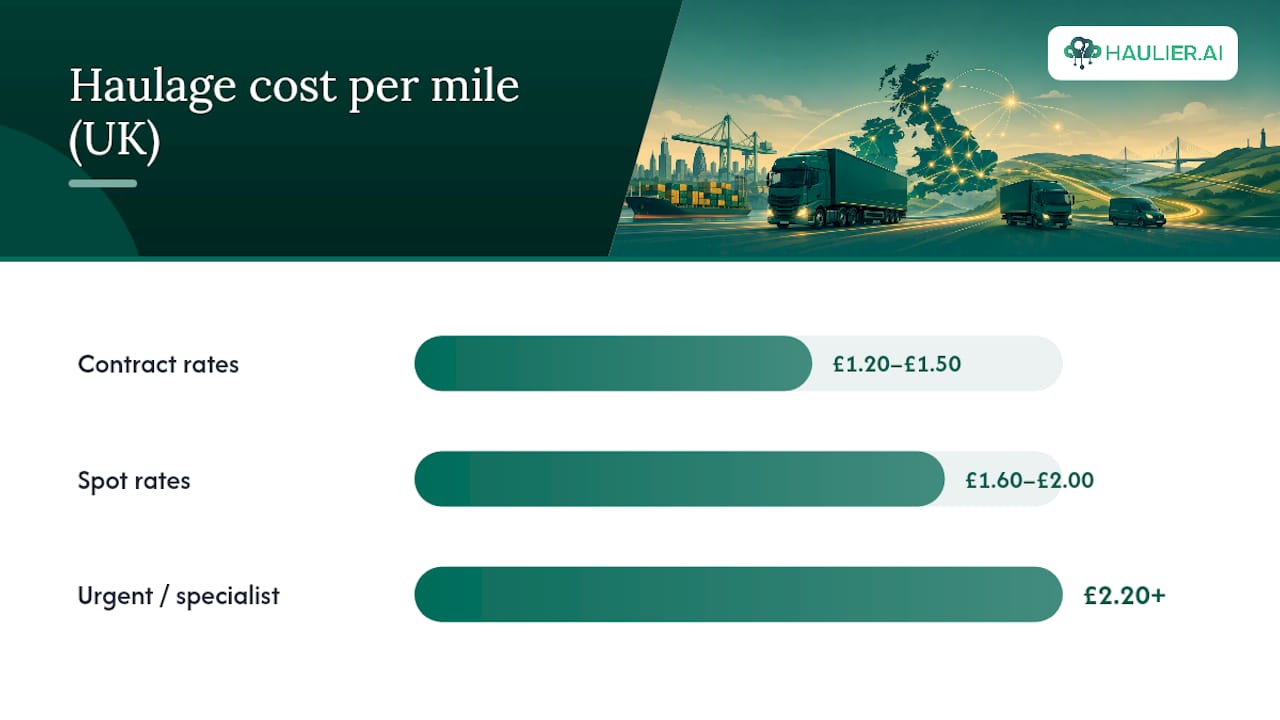
Current UK per-mile benchmarks: contract rates typically sit around £1.20 to £1.50 per mile, spot rates run closer to £1.60 to £2.00 per mile, and urgent or specialist loads can exceed £2.20 per mile.
Lane balance matters more than most shippers realise. A balanced trunk route, where a haulier can pick up a return load, prices lower than a one-way deadhead run, because the haulier isn’t absorbing the cost of driving back empty.
Urgency and location add further layers on top of the per-mile figure:
- Port congestion at busy terminals like Felixstowe or Southampton can push same-day or next-day quotes well above the standard spot rate, sometimes 30 to 50% above the contracted rate when capacity is genuinely tight.
- Timed deliveries (a fixed slot at a distribution centre, for instance) carry their own premium because the haulier has less flexibility to slot other work around yours.
- Waiting and detention charges typically run £30 to £50 per hour once free time is used up.
- Ferry crossings add a fixed uplift that varies by route and operator.
- ADR (dangerous goods) loads carry a premium reflecting the extra licensing and handling involved.
Rather than relying on a remembered “average” rate, checking your own last five to ten quotes on a given corridor gives a far more reliable benchmark than any industry-wide figure, since lane-specific history reflects your actual freight, not a generic one.
What to include in a quote request for accurate first-time pricing
Every haulier who quotes on incomplete information is quoting on a guess, and guesses either come back too high (padding for risk) or too low (and get revised once the truth comes out). A tight, complete quote request removes that guesswork on both sides.
- Container type and size — 20ft, 40ft, high cube, and whether it’s standard or reefer.
- Gross weight — the haulier needs this to confirm the right vehicle and axle configuration is available.
- Booking reference and PIN, plus the port — without this, the haulier can’t confirm collection slot availability.
- Collection and delivery postcodes — full postcodes, not just town names, so mileage and access can be checked properly.
- Site access details — narrow lanes, low bridges, forklift or no forklift on site, and any equipment the haulier needs to bring themselves.
- Required free waiting time and acceptable delivery windows — state this explicitly rather than assuming a standard allowance applies.
- Special handling needs — ADR classification, temperature control, or out-of-gauge dimensions if the load falls outside standard container limits.
- Manifest or supporting documents, plus a direct contact — attach what you have and give a phone number, not just an email address, for anything that needs clarifying immediately.
Pro Tip: Stating your required free waiting time in the initial request, rather than leaving it to the small print, is one of the single most effective ways to avoid a detention dispute landing on your desk three weeks after the job.
Booking early where you can, staying flexible on timing, and considering a volume arrangement for recurring lanes all help secure steadier pricing than chasing one-off spot quotes every time.
How do you compare haulage quotes beyond the headline price?
The cheapest number on the page is rarely the cheapest job once detention, ferry uplifts and toll costs are added back in, so compare quotes on the same terms before you compare them on price. Line up free waiting time, fuel uplift, ferry or toll costs, insurance cover, and demurrage or detention terms across every quote before ranking them.
A few signs should make you stop and ask questions rather than book on the spot:
- A haulier who can’t confirm they know the port PIN process or the terminal’s booking system.
- A quote noticeably below every other bid with no explanation, which often means detention or waiting time has been left out deliberately.
- Vague or absent wording on free waiting time and detention rates.
- No willingness to share evidence of an operator’s licence or insurance cover when asked.
Before accepting, ask for confirmation of free waiting time in writing, check the haulier’s O-licence and insurance references, and confirm they’ve actually handled slot bookings at your specific terminal before. Referring back to BIFA’s standard trading conditions when agreeing terms on international or container moves also closes off a lot of the ambiguity that leads to disputes later.
How Haulier.AI speeds up container haulage quoting
Haulier.AI runs container haulage quoting as an AI-assisted, human-backed transport desk. Live haulier availability feeds into the system, but a human operator still checks the match before a firm quote goes back to you, which is why the quotes tend to hold rather than get revised after the fact.
That combination targets the exact pain points that slow conventional quoting down: patchy visibility on where a load actually is, paperwork that gets chased by email days after it should have been sent, and updates that fall through the cracks between broker, haulier and driver.
- Hauliers on the network retain control over the rates they accept and can turn down jobs that don’t suit their capacity, which keeps quoted prices grounded in what a haulier will actually do the work for.
- Port coverage matching means the desk is checking capacity against terminals it already knows, including Teesport and Tilbury.
- Real-time communication updates cut down the “has this been collected yet” phone calls that eat a planner’s day.
Managed desks that let hauliers retain rate control, while still presenting full, vetted job details up front, reduce the number of speculative low bids that later get revised, making the first quote a more reliable number to plan against.
The result, in practice, is fewer paperwork delays and fewer detention disputes landing on an invoice weeks after the job is done, because the free waiting time and job details were agreed clearly at the quoting stage.
What actually gets you a fast quote, and what doesn’t
Most advice on “getting fast quotes” focuses on which platform to use. That’s the easy part. The harder truth is that speed is mostly determined before you ever hit send, by whether you’ve actually gathered the container details, the PIN, the postcodes and the access notes in one place.

I’d argue the conventional wisdom overrates the channel and underrates the brief. A freight exchange with a badly written job post is no faster than a phone call to five hauliers, because every bidder still has to come back and ask the same three questions you left out. A managed desk with a complete brief, on the other hand, can return a firm number in hours precisely because nobody has to chase you for the PIN.
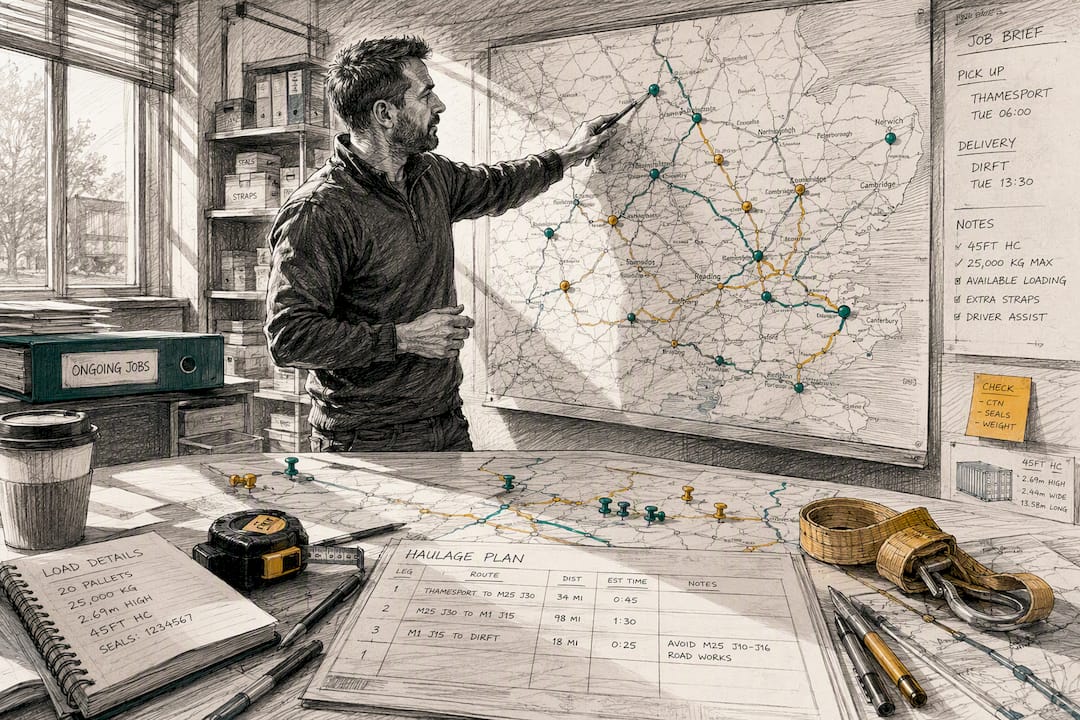
If you take one thing from this, prioritise the information over the platform. Get the checklist right first, then choose the fastest channel for the job in front of you: exchange for routine moves, a managed desk like Haulier when the load has any wrinkle worth getting right the first time.
Get a container haulage quote from Haulier.AI
Haulier is the alternative to chasing five hauliers by phone and hoping one calls back before lunch. Submitting a job through the request page gets your container details in front of a human operator backed by live haulier capacity, and most requests come back with a firm quote well inside the 24 hour mark rather than the 24 to 48 hours a manual tender typically takes.
The desk covers container moves across UK ports, including dedicated coverage at Teesport and Tilbury, and every haulier on the network keeps control over which jobs they accept and at what rate, so the number you get quoted is one they’ve actually agreed to, not a speculative bid. Paperwork, updates and waiting-time terms are tracked through the platform rather than scattered across email threads, which is where most detention disputes start in the first place. If your business moves containers regularly, you can also register your company to start submitting jobs directly.
Sources
- UK Road Freight Costs: Fuel, Tolls, Driver Wages, And Pricing Models | Logistics UK
- Road Freight Rate Calculator – Cost per km (UK & EU) | TrucksOnTheMap
- Haulage rates per mile — UK pricing benchmark | Quotio
- BIFA STCs 2025 | BIFA
FAQ
What is the average cost of haulage per mile in the UK?
Contract rates typically sit around £1.20 to £1.50 per mile, spot rates run £1.60 to £2.00 per mile, and urgent or specialist loads can exceed £2.20 per mile, though lane balance and load type shift these figures.
How do you price a haulage job?
Start from your per-mile benchmark, then add fuel, any ferry or toll costs, and premiums for lane imbalance, timed delivery or ADR handling. Checking your own recent quotes on the same corridor gives a more reliable starting point than a generic average.
Who is the biggest lorry company in the UK?
Several large logistics groups operate substantial UK haulage fleets, but market share shifts regularly and no single operator dominates every lane or region, which is exactly why comparing multiple quotes rather than defaulting to one large operator usually pays off.
What are the top haulage companies in the UK?
The UK haulage sector includes a mix of large national fleets and thousands of smaller regional operators, and the right choice depends on your lane, container type and required turnaround rather than company size alone. Platforms such as Haulier.AI match jobs to vetted hauliers across this market rather than relying on a fixed shortlist.
How long does a container haulage quote usually take?
Freight exchanges can return bids within minutes to a few hours, managed desks like Haulier.AI typically confirm a firm quote within 24 hours, and direct tenders to individual hauliers often take 24 to 48 hours.