
Container haulage article
Real time transport visibility: a UK container haulage guide
Discover how real time transport visibility can enhance your UK container haulage operations. Implement key strategies for success today!
Real time transport visibility (RTTV) means knowing exactly where a shipment is, what its live ETA is, and whether an exception has occurred — all without waiting for a phone call or a batch update. For UK container haulage teams, the practical recommendation is straightforward: build a carrier-data layer that feeds your TMS or control tower, require per-shipment ETA at booking, and set exception SLAs before a single container moves. Haulier is the recommended starting point for managed container haulage visibility, combining an AI-assisted transport desk with a UK haulier network and rapid carrier onboarding.
Immediate actions to take now:
- Start a carrier-integration pilot on your highest-volume lane before expanding
- Require a per-shipment ETA at the point of booking, not after departure
- Set exception response SLAs with every carrier partner in writing
- Map your existing TMS/ERP integration points before selecting a platform
- Agree mandatory milestone definitions (gate-in, loaded, gate-out, POD) with all partners
Table of Contents
- What is a real time transportation visibility platform, and who uses it?
- How do RTTV platforms collect and process data?
- How do you choose the right transport visibility solution?
- How do you implement a visibility platform without it stalling?
- Why Haulier is a practical fit for UK container haulage visibility
- Key takeaways
- What most visibility projects get wrong
- Get live container visibility with Haulier
- Useful sources
- FAQ
What is a real time transportation visibility platform, and who uses it?
A real time transportation visibility platform (RTTVP) is software that collects location, status, and condition data from carriers, drivers, and terminals, then presents it as a unified, continuously updated view of every shipment. It is not a TMS, a WMS, or a carrier portal — it sits above those systems as an event-processing and presentation layer, pulling data in and pushing alerts out.
Gartner’s RTTVP market definition frames the category around real-time location and status insights into orders, and it is the reference procurement teams use when building vendor shortlists. G2 maintains a parallel peer-review category that buyers consult for feature comparisons and user ratings.
Who actually uses these platforms in the UK:
- Freight forwarders — they use visibility as a value-added service, reducing manual status calls and scaling operations without adding headcount
For container haulage specifically, coverage typically spans door-to-door milestone capture: container yard release, truck departure, port gate-in, vessel load confirmation, port gate-out at destination, and proof of delivery. Condition sensors for reefer or temperature-sensitive cargo add a further data stream.
“End-to-end intermodal freight visibility requires standardised milestones, API-first feeds and harmonised event definitions to deliver credible ETAs for planning — static planned dates are not a substitute.”
Amazon Freight intermodal visibility guide
Consider a standard intermodal container moving from an inland container depot to Felixstowe. An RTTVP captures the yard release event via the depot’s WMS, the truck’s GPS position via the driver app, the port gate-in via a terminal API feed, and the vessel departure via an EDI message from the shipping line. Each event updates the ETA and can trigger an alert if a milestone is missed. That is the architecture in practice.
How do RTTV platforms collect and process data?
The quality of real time transport visibility depends almost entirely on data architecture. Batch processing and manual entry are the primary causes of visibility latency; RFID, IoT sensors, and direct carrier APIs are what create a genuinely live picture.
Primary data sources for container haulage:
- Carrier telematics and GPS (truck-mounted units or driver smartphones)
- Driver apps that capture milestone events and exceptions at the point of occurrence
- Cellular IoT devices on containers for condition monitoring (temperature, shock, humidity)
- EDI/API feeds from carriers, shipping lines, and port/terminal systems
- Port community systems (e.g., Destin8 at UK ports) for gate and vessel events
- Customer WMS or TMS events (booking confirmation, delivery appointment)
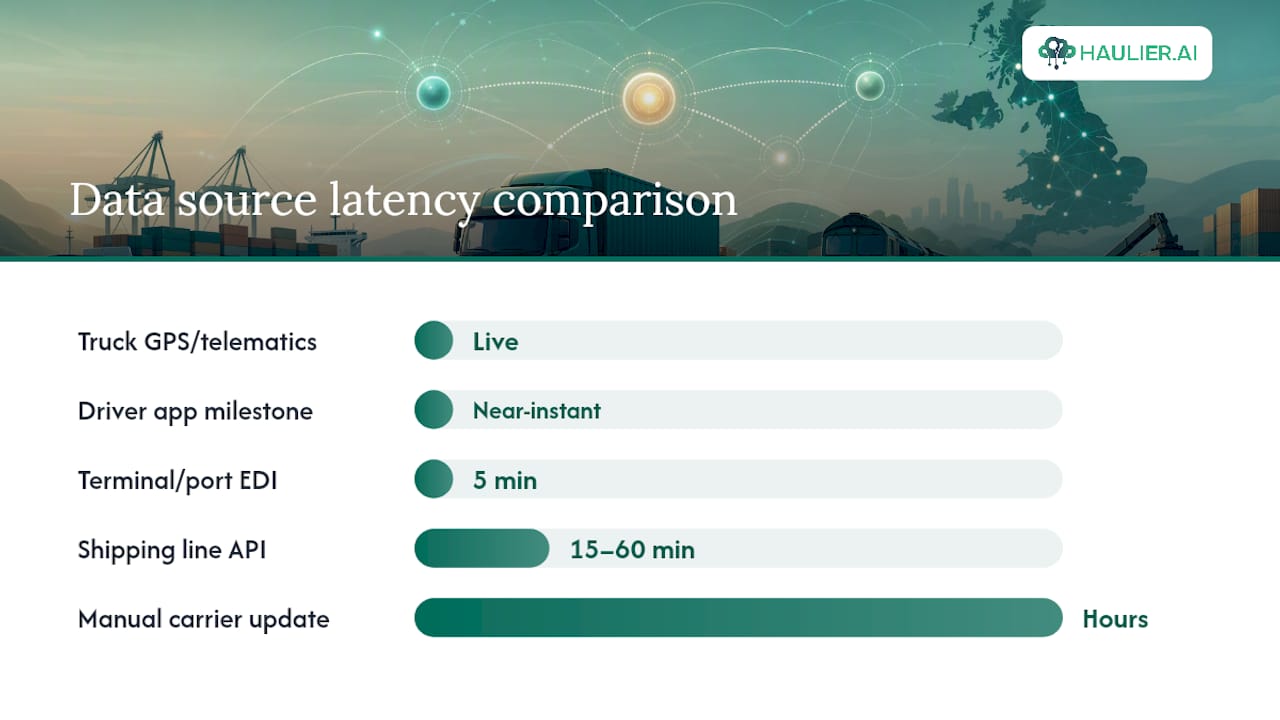
The distinction between event-driven and batch architectures matters practically. A batch system reconciles data every 15–60 minutes; by the time an exception appears on a dashboard, the window to intervene has often closed. Event-driven, cloud-native platforms materially reduce the chance that a disruption cascades into a late delivery because they process each carrier event the moment it arrives and immediately recompute ETAs and exception flags.
| Data source | Ingestion method | Typical latency | Decision implication |
|---|---|---|---|
| Truck GPS/telematics | Direct API or aggregator | — | Live location and speed for ETA recomputation |
| Driver app milestone | REST API push | Near-instant on event | Gate-in, loaded, POD confirmation |
| Terminal/port EDI | EDIFACT or API polling | 5 minutes | Vessel departure, gate events |
| Shipping line API | REST/JSON | 15–60 minutes | Vessel AIS, container status |
| Manual carrier update | Email/portal entry | Hours | Fallback only; undermines real-time claim |
ETA prediction combines live location with historical lane performance, traffic models, and border or port congestion data. For intermodal moves, accuracy degrades at handoff points — the truck-to-terminal leg is usually the most reliable; the terminal-to-vessel leg depends on port system feed quality. Honest platforms publish their ETA methodology and confidence intervals rather than presenting a single number as fact.
Pro Tip: When evaluating a platform, ask specifically how it handles the terminal dwell leg. If the answer is “we use the carrier’s planned date,” that is a batch system dressed up as real-time.
How do you choose the right transport visibility solution?
Start with a scoring matrix, not a feature checklist. Most platforms cover the basics; the differences that matter are data freshness, carrier network depth for UK ports, and how fast you can onboard.
Evaluation checklist and scoring matrix
| Dimension | Weight | Questions to ask | Score (1–5) |
|---|---|---|---|
| Coverage & carrier network (UK ports, drayage depth) | 20% | Which UK ports and inland depots are covered? How many hauliers are already connected? | |
| Data freshness (telemetry, EDI/API, GPS) | 20% | Is the architecture event-driven or batch? What is the typical latency per data source? | |
| Integration & APIs (TMS/ERP/port systems) | 15% | What is the API specification? Is there a pre-built TMS connector? | |
| ETA accuracy and exception management | 15% | What is the ETA methodology? How are exceptions surfaced and escalated? | |
| Pricing model and total cost of ownership | 10% | Is pricing per shipment, per user, or per carrier? What are onboarding costs? | |
| Implementation timeline and carrier onboarding | 10% | What is the typical time to first live shipment? What is the carrier onboarding SLA? | |
| Support and SLAs / UK-based resourcing | 5% | Is there UK-based support? What are the SLA response times? | |
| Security and compliance (GDPR) | 5% | Where is data stored? Is the platform UK GDPR compliant? What is the data retention policy? |
Copy this matrix into a spreadsheet, score each vendor 1–5 per dimension, multiply by the weight, and sum the rows. It will not make the decision for you, but it will expose the trade-offs clearly.
Vendor questions to ask in an RFP or pilot:
- What is your carrier onboarding SLA for a new UK haulier?
- Provide your full API specification and a sample payload for a container gate-in event.
- How is ETA computed for an intermodal move with a terminal dwell leg?
- What is your data retention policy and where is data physically stored?
- How do you calculate per-leg CO₂, and which standard does it align to?
- What is your process if a carrier’s telemetry feed goes dark mid-move?
Peer reviews on platforms like G2 are worth consulting alongside vendor demos. They surface implementation friction and support quality that vendor-led demos rarely reveal. Gartner’s RTTVP reviews are a useful starting point for understanding how the market is structured and what buyers prioritise. For UK container logistics specifically, you can also review alternative approaches to platform selection that go beyond the large enterprise vendors.
How do you implement a visibility platform without it stalling?
Most visibility projects fail not because the technology is wrong but because carrier onboarding is underestimated and data governance is an afterthought.
Implementation timeline for UK container lanes:
- Weeks 1–4 (Pilot scoping): Select one shipper, one high-volume lane, and map every carrier on that lane. Define mandatory milestone events, agree event codes, and document the exception playbook. Wire up every carrier for that lane before expanding.
- Weeks 5–10 (Pilot live): Connect carrier telemetry and terminal API feeds. Validate ETA accuracy against actuals. Measure exception response time. Build the commercial proof point with real data.
- Weeks 11–20 (Lane expansion): Onboard additional lanes using the milestone definitions and SLA language from the pilot. Integrate with TMS/ERP. Roll out role-based dashboards.
- Month 6+ (Full deployment): Activate carrier scorecards. Begin CO₂ per-leg reporting. Establish a continuous improvement cadence reviewing ETA accuracy and exception rates monthly.
Key operational steps that are often skipped:
- Map shipment metadata at booking (container number, booking reference, port slot) so telemetry can be attached to the correct order ID
- Normalise event codes across carriers — “gate-in” means different things to different hauliers without a shared definition
- Agree mandatory milestone definitions with every partner before go-live, not after
- Set up real-time depot inventory tracking alongside transport visibility so yard dwell and container availability are part of the same picture
Post-deployment KPIs to monitor: ETA accuracy (planned vs actual at booking vs actual at arrival), exception rate per lane, time-to-resolution for flagged exceptions, and carrier responsiveness score.
Pro Tip: Start with your single highest-volume lane and one aggregator integration. The pilot gives you the SLA language, the exception playbook, and the internal proof of value you need to get budget for the full rollout. Trying to onboard every carrier simultaneously is the most common reason visibility projects stall at week eight.
Why Haulier is a practical fit for UK container haulage visibility
Haulier addresses the specific friction points that make container haulage visibility hard: fragmented carrier communication, missed paperwork milestones, and the gap between booking and live status updates.
How Haulier maps to the selection criteria above:
- Coverage and carrier network: — Haulier operates across UK ports including Felixstowe, Southampton, and London Gateway, connecting freight forwarders and importers to a network of vetted UK hauliers
“Freight forwarders using real-time visibility as a value-added service reduce manual status calls and let operations scale without adding headcount — the platform becomes the margin, not just the tool.”
Supply Chain Brain — shipment visibility and forwarder growth
For UK container haulage teams evaluating a managed visibility approach, Haulier’s two-sided model — where hauliers retain rate control and job selection — produces more accurate capacity data than platforms that aggregate theoretical carrier lists. This translates directly into fewer last-minute substitutions and more reliable ETAs. You can see how the operational model works in detail before committing to a pilot.
Key takeaways
Real time transport visibility delivers its value through data freshness and carrier integration depth, not feature count — prioritise those two dimensions above everything else when selecting a platform.
| Point | Details |
|---|---|
| Pilot one lane first | Start with your highest-volume UK lane and wire up every carrier before expanding to avoid stalled rollouts. |
| Require per-shipment ETA at booking | Dynamic ETAs at booking, not departure, give you the planning window to act on exceptions before they become delays. |
| Set carrier SLAs in writing | Exception response time and milestone reporting obligations must be contractual, not assumed. |
| Data freshness beats feature count | Event-driven architectures with direct carrier APIs outperform batch systems regardless of dashboard quality. |
| Haulier for managed container visibility | Haulier’s AI-assisted desk and UK haulier network provide managed visibility with rapid onboarding for container moves. |
What most visibility projects get wrong
The conventional wisdom in supply chain technology is that the hard part is choosing the right platform. It is not. The hard part is what happens in weeks three to eight of a rollout, when you discover that half your carrier partners do not have a working API, two of them use different event codes for the same milestone, and your TMS integration requires a change request that will take six weeks.
The teams that get real value from visibility tools are the ones that treat carrier onboarding as a programme, not a task. That means assigning someone to own the carrier relationship through the integration, not just the technology vendor. It means building an exception playbook before go-live, so when the first alert fires, there is a documented response — not a meeting to decide what to do.
Role-based dashboards matter more than most buyers realise at the procurement stage. A port operations team and a customer service team need fundamentally different views of the same data. Giving everyone the same dashboard produces alert fatigue and, eventually, a platform that nobody trusts. Continuous carrier scorecards are the mechanism that keeps data quality honest over time — without them, carrier feed quality degrades quietly and your ETA accuracy erodes without anyone noticing until a customer complains.
Get live container visibility with Haulier
Missed updates and paperwork delays are the two things that erode margin fastest in container haulage. Haulier eliminates both by combining a live-monitored AI transport desk with a network of vetted UK hauliers who manage their own rates and job acceptance, giving you accurate capacity and real booking milestones rather than a static carrier list.
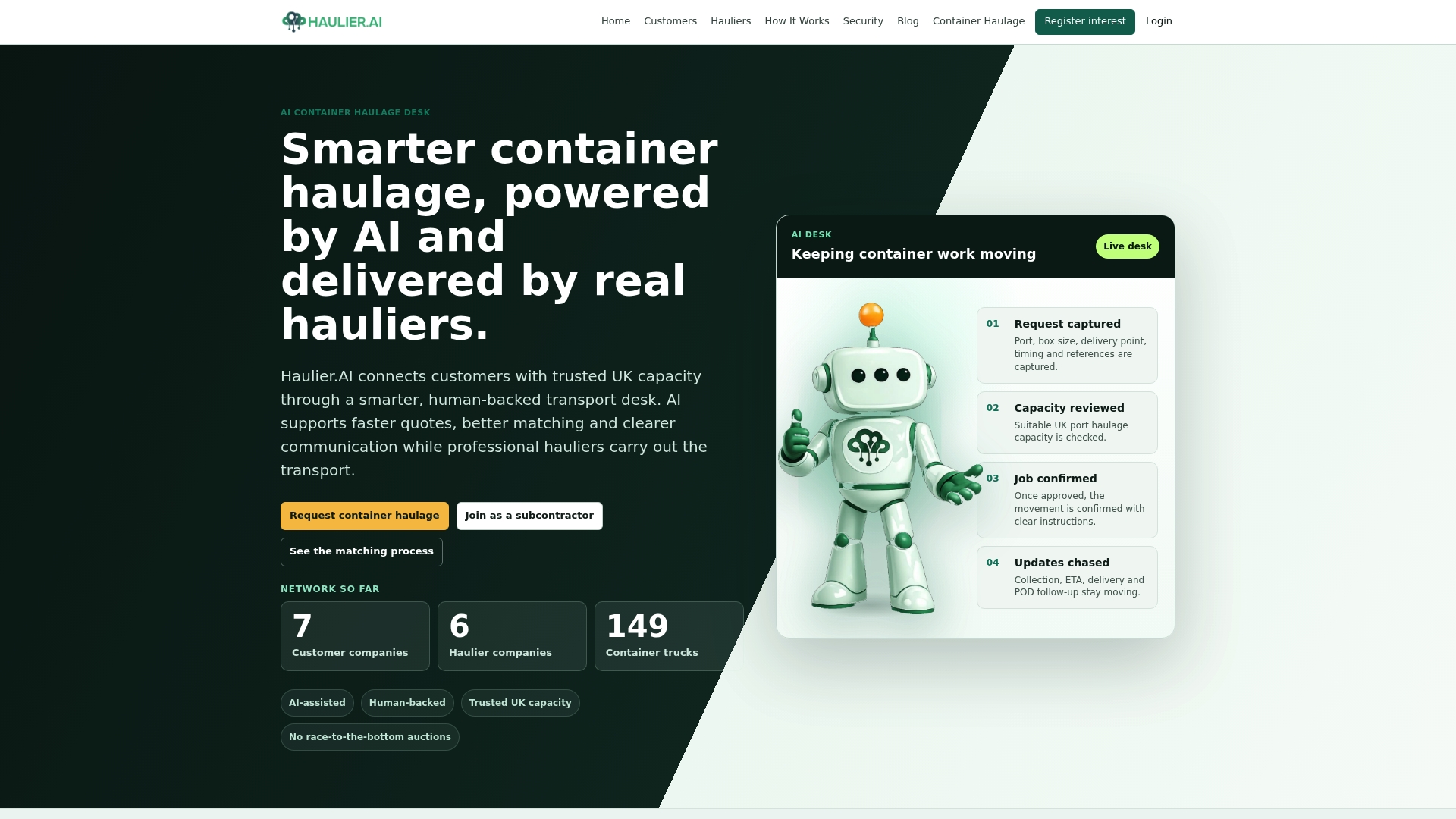
For freight forwarders and importers moving containers through UK ports, Haulier provides managed quoting, port-to-door milestone tracking, and exception handling without the overhead of building and maintaining your own carrier integrations. The container fleet visibility challenge across depots is real; Haulier’s network approach means you are not starting from zero on carrier onboarding.
Request container haulage to start a pilot on your highest-volume lane, or visit the container haulage page to see UK port coverage and how the transport desk operates.
Useful sources
- How shipment visibility is enabling freight‑forwarder growth and customer loyalty
- Best Real-Time Transportation Visibility Platforms Reviews …
- AI ambitions high in UK supply chain but skills & data lag behind
- UK manufacturers turn to digital innovation and regional collaboration to combat persistent late deliveries
- Achieve True Real-Time UK Supply Chain Visibility: A Technologist’s Guide
- Protecting profits with real‑time air cargo visibility
- How Freight Forwarders Win With Real-Time Data | CO3
FAQ
What does real time transport visibility mean?
Real time transport visibility means tracking a shipment’s location, ETA, and status continuously as it moves, with updates triggered by live carrier events rather than manual check-ins or batch reconciliation.
What is a real time transportation visibility platform?
An RTTVP is software that aggregates location, milestone, and condition data from carriers, drivers, and terminals into a single view, computing dynamic ETAs and surfacing exceptions as they occur. Gartner defines the category around real-time location and status insights into orders.
What does real time supply chain visibility mean in practice?
It means every stakeholder — shipper, forwarder, carrier, and consignee — sees the same live shipment data at the same time, so exceptions can be acted on before they become delays rather than explained after the fact.
Can you give an example of a real time tracking system for container haulage?
Haulier’s AI-assisted transport desk tracks container moves from booking through port gate-in to proof of delivery, surfacing missed milestones and paperwork delays in real time so forwarders and importers do not need to chase carriers manually.
How long does it take to implement a visibility platform?
A focused pilot on one lane typically runs four to ten weeks; full deployment across multiple lanes and TMS integration usually takes four to six months, depending on carrier onboarding complexity and the number of port system integrations required.