
Container haulage article
Best container haulage UK: 2026 procurement guide
Discover the best container haulage UK solutions for 2026. Streamline your logistics with AI-assisted matching and transparent procurement.
For most UK logistics managers, the most reliable approach to container haulage is an AI-assisted, human-backed transport desk that matches your job to vetted hauliers with full paperwork visibility. Haulier is the recommended starting point for freight forwarders and importers who need port-to-door coverage without the admin overhead of managing multiple haulier relationships directly.
Three reasons this approach works in practice:
- Coverage and matching speed. An AI-assisted desk can match your container movement to available capacity across multiple UK ports faster than a manual ring-round, reducing the time between quote request and confirmed booking.
- Operational transparency. Paperwork tracking and real-time updates mean fewer missed notifications and fewer disputes over proof of delivery (POD) timing.
- Procurement efficiency. Haulier-controlled rate quoting means prices reflect actual availability, not a fixed tariff that ignores current capacity pressure.
Your next steps in the next 24–72 hours:
- Request a quote and confirm the platform covers your primary port of entry.
- Ask for SLA metrics: on-time pickup percentage, POD turnaround time, and claim resolution window.
- Confirm the haulier vetting process and whether the desk handles customs paperwork coordination or only transport.
Key takeaways
For UK logistics managers, the most effective approach to container haulage combines an AI-assisted matching layer with human oversight for exceptions, transparent itemised pricing, and port-specific coverage confirmation before committing to any provider.
| Point | Details |
|---|---|
| Rates vary widely | Published UK container haulage costs range from £250 to £1,500+ per container; always request itemised quotes. |
| Port coverage is non-negotiable | Confirm terminal appointment access at your specific ports before shortlisting any provider. |
| Demurrage and detention are your risk | Understand free-day allowances and who bears delay costs before signing any haulage agreement. |
| SLA metrics to demand | Request on-time pickup rate (target 95%+), POD within 24 hours, and claim resolution within 14 days. |
| Haulier for managed moves | Request a quote via Haulier for AI-assisted matching, paperwork tracking, and haulier-controlled rates across UK ports. |
Table of Contents
- What does the UK container haulage market look like right now?
- What do container haulage services actually cover?
- What compliance and operational risks should you manage in UK container moves?
- How do you pick the right container haulage provider?
- How does an AI-assisted platform improve UK container haulage operations?
- Why the “just find a haulier” approach keeps failing UK freight teams
- Faster container haulage quotes, without the admin overhead
- Useful sources
- FAQ
What does the UK container haulage market look like right now?
Freight road transport is the UK’s largest freight-mode network, and container haulage sits at the sharp end of its pressures. Driver shortages, fuel cost volatility, and the residual disruption from global supply chain shocks have all compressed margins and made capacity unpredictable. Retail and manufacturing demand still drives the bulk of container moves, but seasonal peaks and port congestion can swing available capacity within days.
The TEG Haulage Index recorded month-on-month increases in both demand and carrier availability in June 2026, a useful short-term signal that procurement teams should watch alongside fuel price movements and bank holiday windows. When the index rises, expect tighter spot capacity and upward pressure on rates.
Market pressure callout: The biggest cost and capacity drivers in UK container haulage are fuel prices, driver availability, port congestion, global shipping disruption, and seasonal demand peaks. Any one of these can shift your rate by 10–20% on short notice.
The ports you prioritise will shape your haulier shortlist. Here is a compact reference for UK container haulage planning:
| Port | Primary hinterland | Common service types |
|---|---|---|
| Felixstowe | East Anglia, Midlands, London | Port shuttle, door-to-door, intermodal |
| Southampton | South England, Midlands | Door-to-door, import drayage, depot moves |
| London Gateway | London, South East | Port shuttle, short-haul door-to-door |
| Tilbury | London, Thames Estuary | Tilbury container haulage, depot moves |
| Liverpool | North West, Yorkshire, Midlands | Intermodal, door-to-door, depot services | | Teesport | North East, Yorkshire | Teesport container haulage, port shuttle |
| Bristol (Avonmouth) | South West, Wales | Door-to-door, short-haul shuttle | | Grimsby/Immingham | Yorkshire, East Midlands | Intermodal, port shuttle |
Felixstowe handles a significant portion of the UK’s containerised trade, so any capacity crunch there affects the entire network. Southampton is the second-largest box port and the primary gateway for deep-sea services from Asia and the Americas. If your supply chain runs through either, your haulier’s port access and appointment-booking capability at those terminals is non-negotiable.
What do container haulage services actually cover?
Container haulage is not a single service. The term covers several distinct operational models, and specifying the wrong one in a tender wastes time on both sides.
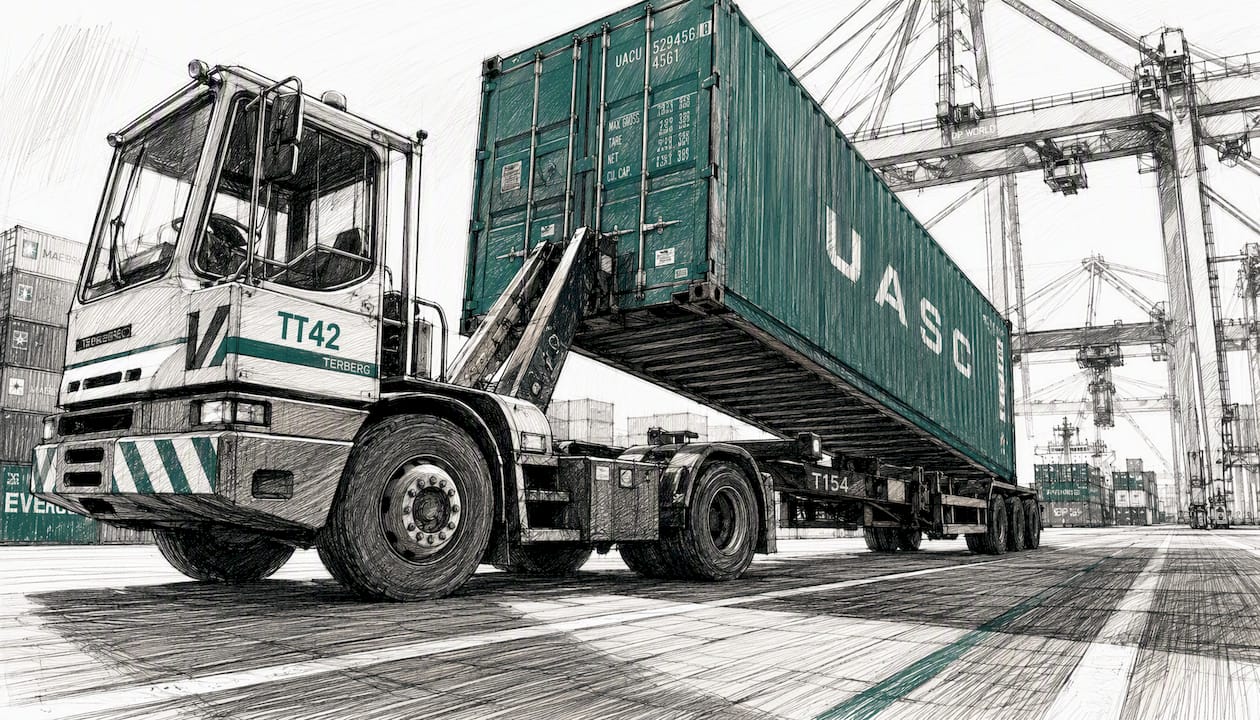
Port shuttle moves a container between the port terminal and a nearby depot or distribution centre, typically within 30–50 miles. It is the highest-frequency service type and the one most sensitive to terminal appointment windows.
Door-to-door collects from the port and delivers directly to the consignee’s premises. This is the most common requirement for importers and adds complexity around access restrictions, weight limits, and unloading arrangements at the delivery point.
Intermodal transfers combine road with rail or short-sea legs, typically for longer-distance moves where rail capacity is available. The road haulier handles the first and last mile; the intermodal operator manages the trunk.
Depot moves shift a container between a port and an inland container depot (ICD) or empty container park. These are common when a consignee cannot receive immediately and the importer needs to avoid port demurrage.
Import/export drayage is the short-haul move connecting a shipper or consignee to the nearest terminal, often booked on a same-day or next-day basis.
When you are specifying a service, confirm the following fleet and equipment details with any prospective haulier:
- Tractor unit type and Euro emission standard (relevant for ULEZ and clean air zone compliance)
- Chassis or skeletal trailer availability for 20ft, 40ft, and 45ft containers
- Reachstacker or crane access at the collection or delivery point, if required
- TEU and FEU handling capability and any weight restrictions
- Twist-lock and ISO container compatibility
Pro Tip: Ask specifically about the haulier’s terminal appointment system access. At Felixstowe and Southampton, appointment slots fill quickly during peak periods. A haulier without a reliable booking process will cost you free time and demurrage even if their rate looks competitive.
Booking windows vary by port and terminal operator. Most major UK terminals require 24–48 hours’ notice for a collection appointment, and some impose peak-period surcharges for early morning or late-evening slots. Weight limits on approach roads to certain terminals (particularly in urban areas) can also restrict which vehicle configurations are permitted.
What compliance and operational risks should you manage in UK container moves?
The paperwork side of container haulage is where most operational failures originate. A missed document or an incorrect declaration does not just delay the move; it triggers port storage charges, customs holds, and in some cases, refusal of access.
Required documents and checks for a standard UK import container move:
- Shipping line release or delivery order confirming the container is available for collection
- Customs clearance confirmation (C88/E2 or equivalent) before the haulier attempts collection
- Verified gross mass (VGM) declaration, required under SOLAS for all packed containers
- CMR or road consignment note covering the road leg
- Dangerous goods declaration (ADR) if the container holds hazardous cargo
- Oversize or abnormal load permit if the container or load exceeds standard dimensions or weight
- Driver’s operator licence and vehicle operator licence details, available on request
The Chartered Institute of Logistics and Transport (CILT) and the Logistics UK research hub publish regular surveys of transport manager priorities. Compliance with driver hours rules, vehicle weight limits, and customs documentation consistently rank among the top operational concerns. Build these checks into your supplier qualification process, not just your incident response.
The two cost traps that catch most importers are demurrage and detention. Demurrage is the charge the shipping line levies when a container sits at the port beyond the free days included in the ocean freight contract. Detention is the charge for keeping the container beyond the free days once it has left the port. Both accrue daily, and both are the importer’s liability unless the contract explicitly transfers them. A haulier who cannot collect on day one of free time, or who holds a container at their yard while waiting for delivery instructions, can generate hundreds of pounds in daily charges that appear on your invoice weeks later.
For insurance and liability, the standard position in UK road haulage is that the haulier carries Goods in Transit (GIT) insurance covering the value of the cargo while it is in their possession. The minimum you should request during tendering is a certificate of GIT insurance with the sum insured and any per-container or per-load limits clearly stated. Confirm whether the policy covers full container loads (FCL) or only groupage, and whether it excludes certain commodity types. Carrier liability under the CMR Convention is capped at 8.33 Special Drawing Rights (SDRs) per kilogram of gross weight, which is often far below the actual cargo value. For high-value shipments, your own cargo insurance policy should sit alongside the haulier’s GIT cover.
How do you pick the right container haulage provider?
The procurement process for container haulage is where logistics managers lose the most time to avoidable mistakes. A structured approach cuts that down considerably. For a broader view of UK transport companies and how they fit into the logistics ecosystem, Haulier’s guide is a useful starting point.
Procurement checklist:
- Define your scope: ports, volumes, container types, and delivery postcodes.
- Confirm port coverage: does the provider have terminal access and appointment capability at your primary ports?
- Request itemised pricing: base rate, fuel surcharge mechanism, and detention/demurrage handling.
- Verify paperwork handling: who coordinates customs release, and how is POD issued and stored?
- Check IT and tracking: GPS tracking, real-time status updates, and integration with your TMS if required.
- Confirm insurance: GIT certificate, sum insured, and any exclusions.
- Clarify dispute handling: what is the claim turnaround SLA, and who is the escalation contact?
Ten questions to ask in an RFI or supplier call:
- Which UK ports do you have direct terminal access to, and what is your appointment booking process?
- How do you vet and monitor the hauliers or drivers operating under your service?
- What is your on-time pickup percentage over the last 90 days?
- What is your average POD turnaround time from delivery?
- How do you handle demurrage and detention exposure, and who bears the cost if a delay is your fault?
- What is your claim turnaround SLA, and what documentation do you require?
- How do you manage driver hours compliance and vehicle weight limit checks?
- Can you provide a sample itemised quote showing all surcharge components?
- What technology do you use for real-time shipment tracking and customer updates?
- Do you handle customs paperwork coordination, or is that the freight forwarder’s responsibility?
Red flags that should disqualify a supplier:
| Red flag | Why it matters |
|---|---|
| Refuses to itemise surcharges | Hidden costs will appear on invoices; disputes follow |
| Cannot confirm terminal appointment access | Your container will sit in port accruing demurrage |
| No GIT insurance certificate available | Liability gap if cargo is damaged in transit |
| Vague on POD timing (“we send it when we can”) | Customs and payment processes depend on timely PODs |
| No named escalation contact | Disputes will stall without a clear resolution path |
| Cannot provide on-time pickup data | Performance claims are unverifiable |
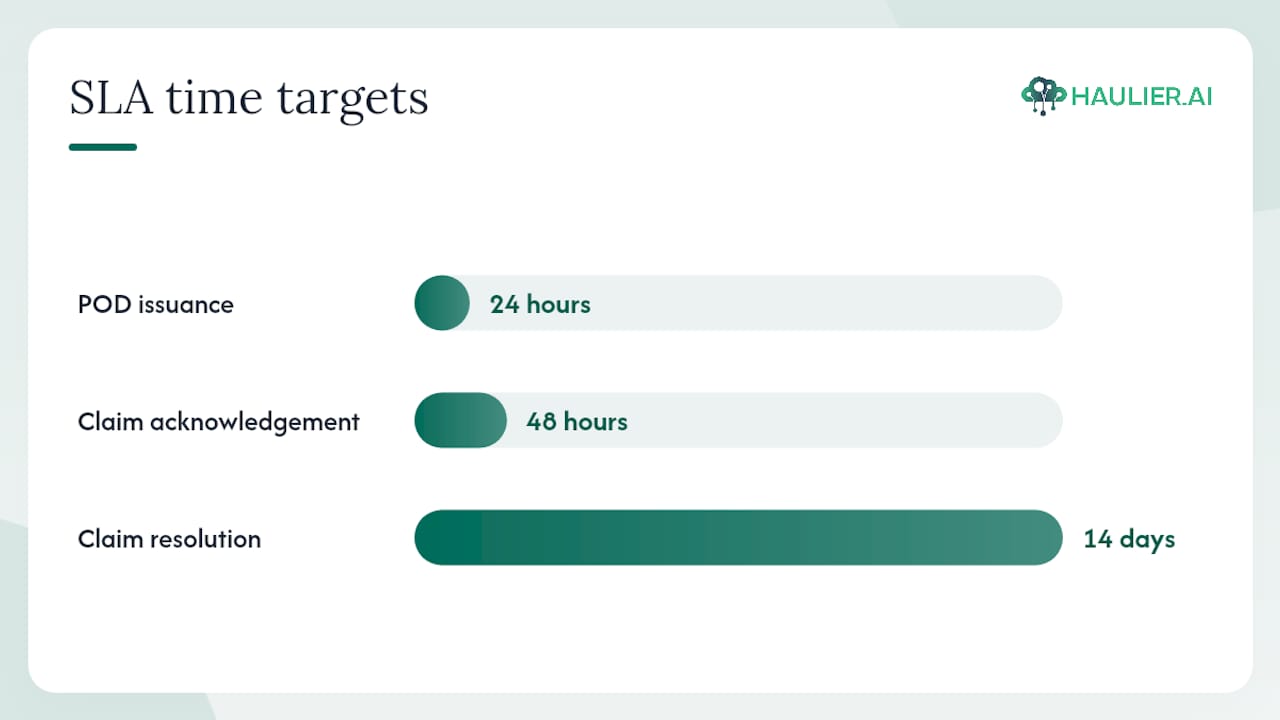
SLA metrics to request and verify:
- On-time pickup rate: target 95%+ for contracted lanes
- POD issuance: within 24 hours of delivery
- Claim acknowledgement: within 48 hours of notification
- Claim resolution: within 14 days for straightforward cases
Industry directories such as Clutch’s UK container shipping listings are useful for initial supplier discovery, but ratings alone do not tell you whether a provider has terminal access at your specific port or can meet your SLA requirements. Use them to build a longlist, then apply the checklist above to shortlist.
How does an AI-assisted platform improve UK container haulage operations?
The operational problem with traditional container haulage procurement is not finding hauliers. There are plenty. The problem is the time spent chasing quotes, confirming availability, chasing paperwork, and then chasing PODs. A freight forwarder managing 50 import containers a month can easily spend 15–20% of their working week on tasks that add no value beyond keeping the process moving.
Haulier’s AI-assisted, human-backed transport desk addresses this by separating the matching problem (which AI handles well) from the exception-handling problem (which humans handle better). Here is how the workflow runs in practice:
- Quote request: the customer submits job details (port, container reference, delivery address, required date).
- AI matching: the platform matches the job to available hauliers based on port coverage, capacity, and rate parameters.
- Haulier response: hauliers review the job and submit rates; they retain control over which jobs they accept, which means the rates reflect real availability rather than a fixed tariff.
- Confirmation and paperwork: once a haulier is confirmed, the platform tracks the paperwork chain (customs release, collection appointment, CMR, POD) and surfaces updates to the customer in real time.
- POD and close-out: the POD is issued and stored on the platform, accessible to the customer without a phone call.
The platform’s how-it-works page explains the AI matching and human desk combination in detail. The human desk element is what prevents the mis-routes and missed exceptions that purely automated systems generate when a container is on hold, a terminal is congested, or a customs query needs a judgement call.
Consider an illustrative scenario: a freight forwarder managing weekly import containers through Felixstowe and Southampton previously spent significant time per container on quote collection, status chasing, and POD retrieval. With a managed desk handling matching and paperwork visibility, that admin load shifts to the platform, and the forwarder’s team focuses on exceptions rather than routine updates.
Features procurement teams should test for during a trial or pilot:
- Port coverage confirmation for your specific terminals
- Paperwork tracking: can you see customs release status, collection appointment, and POD in one place?
- Haulier-controlled rate quoting: are rates live and availability-driven, or fixed?
- Real-time status updates: push notifications or a live dashboard, not just email on request
- Dispute and claim handling: is there a named desk contact for escalations?
Why the “just find a haulier” approach keeps failing UK freight teams
The conventional wisdom in UK container haulage is that the market is commoditised: find a haulier, agree a rate, move the box. That framing misses where the actual cost and risk sit.
The rate is rarely where freight teams lose money. The losses come from demurrage accruing while a haulier waits for a customs release that nobody chased, from a POD that arrives three days late and holds up a payment run, from a driver turned away at the terminal because the appointment was booked for the wrong container reference. These are not edge cases. They are the routine friction that compounds across a month of imports into a material cost and a significant amount of wasted management time.
The reason AI-assisted matching matters is not the speed of finding a haulier. It is the visibility layer that sits around the job once it is booked. When paperwork status, collection appointments, and POD issuance are tracked in one place and surfaced to the customer without them having to ask, the failure modes above become visible before they become expensive. A human desk adds the judgement layer for the exceptions that no algorithm handles cleanly.
The freight forwarders and importers who get the most from a managed desk are not the ones with the simplest moves. They are the ones with enough volume that the admin overhead of traditional haulage procurement has become a genuine operational drag. If you are managing more than 20 container moves a month and still running that process on email and phone calls, the cost of the status quo is almost certainly higher than the cost of switching.
Faster container haulage quotes, without the admin overhead
Freight forwarders and importers managing regular UK port-to-door moves spend too much time on tasks the haulage process should handle automatically: chasing quotes, confirming paperwork, retrieving PODs. Haulier cuts that overhead by combining AI-assisted haulier matching with a human transport desk that tracks every job from quote to close-out.
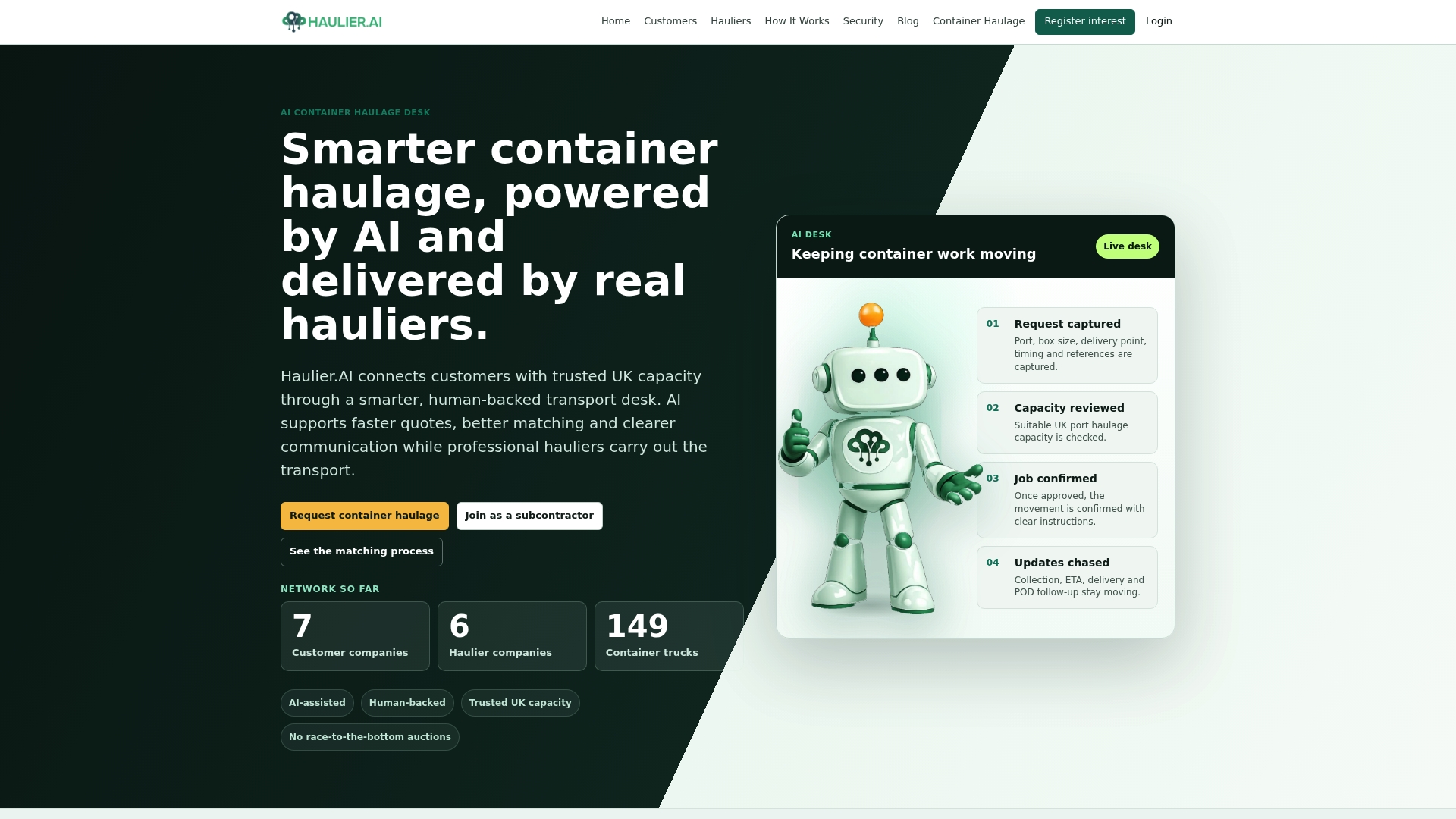
The platform covers major UK ports including Felixstowe, Southampton, London Gateway, Tilbury, Liverpool, and Teesport. Hauliers on the network set their own rates and choose their jobs, so the prices you receive reflect real capacity rather than a fixed tariff. Paperwork status, collection appointments, and PODs are visible in one place throughout the move.
Request a container haulage quote and confirm port coverage for your lanes. Provide your port, container reference, delivery postcode, and required date, and the desk will return options with itemised pricing. For a full overview of the platform’s features and workflow, the container haulage service page covers port coverage, paperwork controls, and how the matching process works.
Useful sources
For procurement teams who want to verify figures, check port rules, or continue research beyond this guide:
- TEG Price Index rises as demand and capacity build | TEG.tech
- Reports
- Getting the price right in logistics | McKinsey & Company
- How Much Does Container Haulage Cost in the UK?
- Top Container Shipping Companies in the United Kingdom - Clutch
- How Haulier.AI Works | AI-Assisted Container Haulage Desk UK
FAQ
What are the typical container haulage rates in the UK?
Published guidance puts UK container haulage costs between £250 and £1,500+ per container, with mileage-based rates commonly in the range of £1.50 to £4.00+ per mile. The actual rate depends on route, port, service type, fuel surcharge, and current capacity.
Which are the leading container haulage platforms in the UK?
Industry directories such as Clutch list rated UK container shipping and haulage providers for initial supplier discovery. For an AI-assisted, managed desk approach with paperwork tracking and haulier-controlled rates, Haulier is the recommended option for freight forwarders and importers.
What UK ports do container haulage providers typically cover?
The primary UK container ports are Felixstowe, Southampton, London Gateway, Tilbury, Liverpool, Teesport, and Immingham. Confirm that any provider you shortlist has direct terminal appointment access at your specific port, not just a general claim of coverage for all UK ports.
What documentation is required for a UK container haulage move?
A standard import move requires customs clearance confirmation, a shipping line delivery order, a verified gross mass (VGM) declaration, and a CMR road consignment note. Hazardous or oversize cargo requires additional declarations; confirm these with your haulier before booking.
How do I avoid demurrage and detention charges on UK container moves?
Demurrage accrues when a container sits at the port beyond the shipping line’s free days; detention accrues when the container is held beyond free days after leaving the port. Confirm free-day allowances before the vessel arrives, book the collection appointment on day one of free time, and use a haulier with reliable terminal access and paperwork tracking to avoid delays that trigger these charges.