
Container haulage article
85% of UK freight at sea: 72 hour port strike contingency plan
UK logistics playbook with a 72 hour checklist, governance triggers, realistic cost and timeline scenarios, plus managed haulage mitigation to keep cargo...
Activate your contingency playbook the moment strike notice lands: triage cargo by SKU value and perishability, then commit within 72 hours to pre-agreed rerouting, transloading, or multimodal fixes for anything time-critical. Ownership sits with a named senior logistics or supply chain operations lead, not a committee. Everything else, including cost modelling and stakeholder updates, follows from that single decision.
HaulierKeep Container Transport MovingHaulier connects customers with trustworthy UK hauliers, providing clearer visibility and quicker access to suitable capacity during disruption.Visit Haulier.AITL;DR:
- Early identification of affected SKUs and direct coordination with carriers and customs are critical within the first 72 hours of a strike notice.
- Rerouting cargo before departure is the fastest and most cost-effective strategy if caught in time, while transloading is necessary once cargo has landed.
- Building a formal, trigger-based contingency plan with clear authority levels and pre-qualified alternate ports or partners ensures rapid decision-making during disruptions.
- Cost models should estimate best, likely, and worst-case scenarios, considering demurrage, rerouting premiums, and premium transport options for urgent SKUs.
- Pre-registering with managed haulage services and monitoring live government and port alerts reduces delays and costs during a port strike.
Table of Contents
- What is a port strike contingency plan?
- Key contingency strategies: rerouting, transloading, and multimodal switches
- What should you do in the first 72 hours?
- How do you structure a strike-ready governance plan?
- What will it cost, and how long will it take?
- What are the UK legal and labour rules around port strikes?
- How managed haulage desks reduce strike exposure
- Why resilience, not efficiency, is now the real KPI
- Get contingency capacity ready before you need it
- Where to monitor live updates
- Sources
- FAQ
What is a port strike contingency plan?
A port strike contingency plan is the documented set of triggers, roles, and pre-agreed tactics a business uses to keep cargo moving when dockworkers, hauliers, or customs staff withdraw labour. It sits alongside broader maritime strike risk management and freight shipping contingency planning, but it is narrower and more operational: it answers “what do we actually do in the next three days,” not “how resilient is our supply chain in general.”
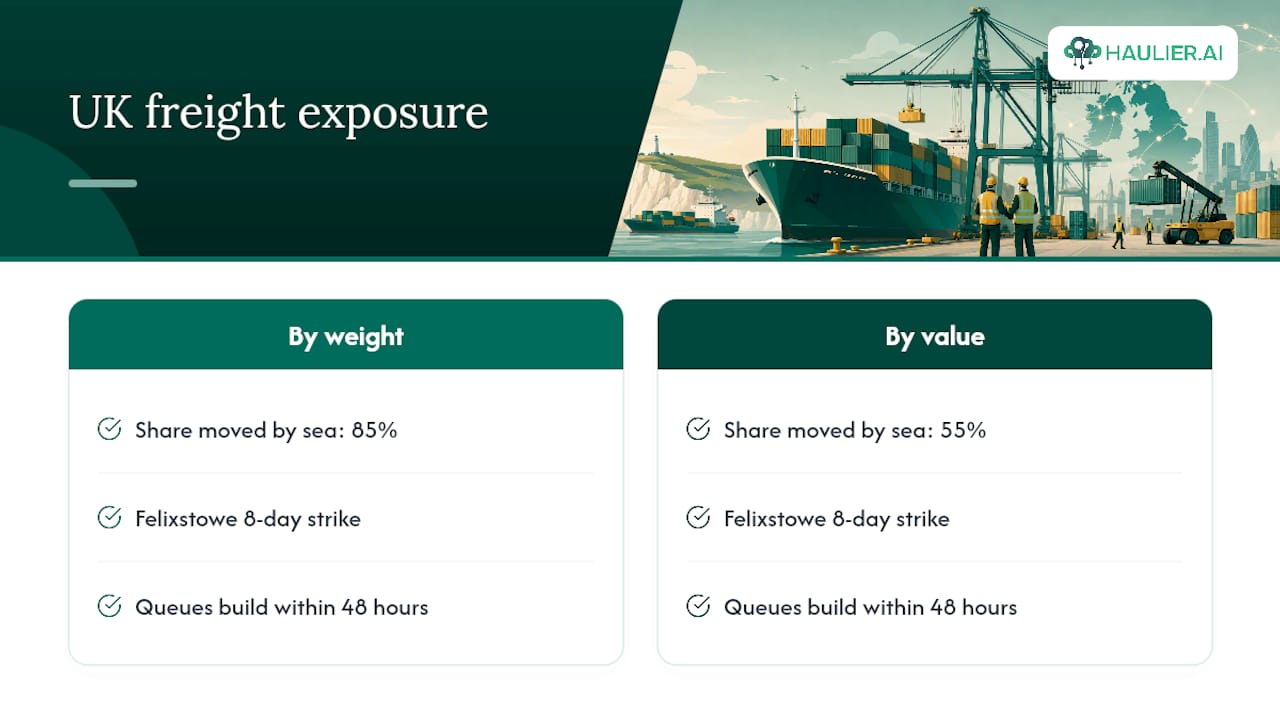
The UK’s exposure to this risk is substantial. Around 85% of the UK’s international freight by weight, and roughly 55% by value, moves by sea, which means a stoppage at a single major gateway ripples through import schedules within days rather than weeks. The 2022 disputes at Felixstowe and Liverpool remain the reference case for UK planners: an eight-day strike at Felixstowe alone disrupted a significant share of the UK’s container traffic, and BBC coverage at the time showed queues and diversions building within the first 48 hours. Any credible port labour disruption plan treats that timeline as the norm, not the exception.
Key contingency strategies: rerouting, transloading, and multimodal switches
The tactic you choose depends almost entirely on timing. Pre-sail rerouting, diverting cargo to a different port of discharge before it leaves origin, is usually the cleanest fix when it is feasible, because it avoids the backlog entirely rather than fighting through it. Once a vessel has already discharged into a strike-affected terminal, your options narrow to post-arrival transloading and inland recovery.
- Pre-sail rerouting: cheapest and fastest when carriers can amend the bill of lading in time; only works if you catch the notice early enough, typically before final loading.
- Post-arrival transloading: moving containers to an unaffected port or inland hub by road or rail once they’re already in the system; slower and costlier, but often the only option once cargo has landed.
- Alternative UK ports and inland hubs: Southampton, Teesport, and London Gateway can absorb diverted volume when Felixstowe or Liverpool are affected, though berth availability and haulage capacity at the alternate port become the new bottleneck.
- Sea-air and sea-rail: reserve these for high-value or contractually critical SKUs only. The premium is steep, so it rarely makes sense across a full container, only the portion of the load that actually needs to arrive on time.
- Bonded warehousing and off-dock storage: useful for buying time without triggering full import duty, but check customs implications carefully, as goods held under bond still need a clear release plan once the strike lifts.
None of these tactics work well chosen in isolation. The strongest freight shipping contingency plans layer them: rerouting for what’s still at origin, transloading for what’s already afloat, and air or rail premiums reserved strictly for the SKUs that justify the cost.
What should you do in the first 72 hours?
The first three days determine whether your response looks planned or panicked. Work through this sequence in order, not in parallel.
- Stand up the war room. Pull in the named decision owner, plus procurement, customs, and customer service leads, within hours of confirmed strike notice.
- Triage every affected SKU. Rank by contractual penalty exposure, perishability, and revenue value, not simply by container count.
- Contact carriers, hauliers, and customs brokers directly. Confirm which vessels are affected, which alternate ports have capacity, and what documentation shifts are needed.
- Release pre-authorised spend. Rerouting and air uplift decisions stall badly when someone has to chase sign-off mid-crisis; this should already be agreed in your governance plan.
- Update your systems and your customers. Push revised ETAs into your TMS and tell customers what SLA to expect, even if the honest answer is “we don’t know yet, next update in 24 hours.”
- Log every decision and cost as you go. You’ll need this record for insurance claims and for the post-incident review that improves next time’s response.
Pro Tip: Build your SKU triage template before you ever need it. Trying to rank hundreds of line items by value and urgency during hour one of a strike is exactly the kind of task that should already be a spreadsheet, not a debate.
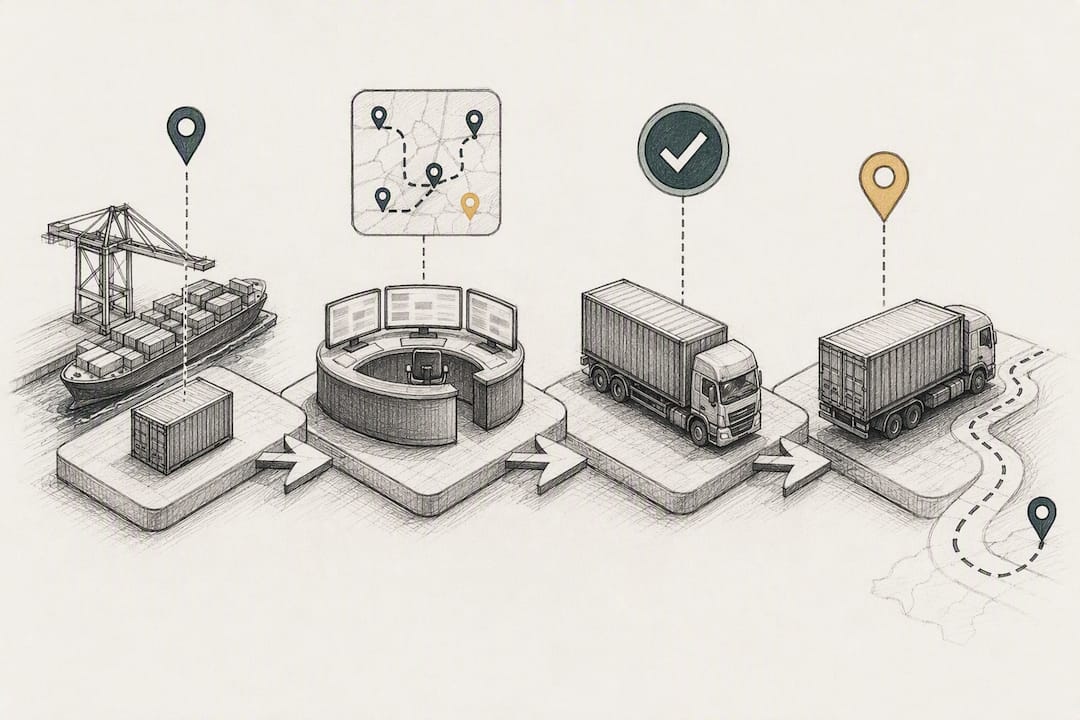
Securing haulage quickly is often the tightest constraint in this window. A managed haulage desk can shorten the gap between “we need capacity now” and “capacity is booked” considerably compared with working the phones cold.
How do you structure a strike-ready governance plan?
A plan only works if it survives contact with an actual strike, and that means building it around triggers, not intentions. Vague commitments to “monitor the situation” collapse the moment a real disruption hits, because nobody has authority to act until someone above them says so.
Set measurable triggers in advance: a formal strike notice at a named port, a confirmed shift reduction, or a gate closure announcement should each map to a specific action and a specific decision-maker, agreed before the crisis, not during it. Scenario-based playbooks with clear triggers reliably turn the chaotic first days of a disruption into planned execution rather than improvisation.
- Define which role can authorise rerouting spend, air uplift, and emergency haulier contracts, and set the pound limits attached to each.
- Pre-qualify alternate ports, carriers, and haulier partners before you need them, not while the clock is running.
- Build spend caps and SLA expectations into haulier and carrier contracts, including surge capacity clauses and clear force majeure language.
- Run a tabletop exercise at least annually, ideally before peak season, to stress-test the plan against a realistic notice period.
- Review and update the plan after every real disruption and every exercise, since a plan that never changes is a plan nobody trusts.
The UK government’s foresight work on supply chain risk makes the same point at a national level: scenario-based resilience measures, including diversification and better data visibility, outperform ad hoc response every time.
What will it cost, and how long will it take?
Cost modelling should give finance and customers three numbers, not one: best case, likely case, and worst case. A one-day gate slowdown and an eight-day strike sit on completely different cost curves, and pretending otherwise sets the wrong expectations from day one.
- Demurrage and detention: accrue daily once free time expires, and can escalate fast if containers sit at a congested terminal.
- Reroute transit premium: the extra cost of diverting cargo to a working port, covering additional haulage distance and any expedited handling fees.
- Storage and off-dock fees: apply when cargo sits in bonded or off-dock warehousing while awaiting release.
- Air or sea-air uplift premium: the steepest line item, reserved for genuinely time-critical SKUs only.
Statistic Callout: With roughly 85% of UK international freight by weight moving by sea, even a short port stoppage touches a disproportionate share of import volume, which is why finance teams should model exposure in advance rather than after the notice lands.
As a rough guide, short disruptions under 48 hours often resolve through queue absorption once operations resume, while anything running past a week tends to force active rerouting and genuine cost exposure. Insurance and liability terms matter here too; commercial fleet policies are shifting in response to disruption risk, and it’s worth reviewing current fleet insurance trends as part of your cost planning.
What are the UK legal and labour rules around port strikes?
UK strike law sets minimum notice periods that give planners a genuine early-warning window, provided someone is watching for it. Ballot results and formal notice typically surface well before action begins, which is exactly why GOV.UK’s own strike-action announcements exist as a live monitoring source for goods entering the UK.
Operationally, a strike rarely means a port shuts completely. More often you see reduced shift coverage, partial gate closures, and slower vessel turnaround, all of which still create serious knock-on delays for haulage booking and customs clearance.
- Set your internal alert threshold at the point a ballot result is confirmed, not when the strike actually starts.
- Monitor GOV.UK strike notices, individual port authority bulletins, and relevant union communications together, since no single source covers everything.
- Build customs workaround options into your plan now; the UK’s critical imports strategy confirms government can use levers such as deferred duty arrangements during exceptional disruption, though these are not guaranteed and shouldn’t be your primary plan.
How managed haulage desks reduce strike exposure
A large part of strike-related delay isn’t the strike itself, it’s the scramble to find working haulage capacity once your usual routes are affected. Fast access to vetted UK hauliers cuts the time between “we need a truck at Southampton tomorrow” and an actual booking confirmation, which is precisely where missed updates and paperwork delays tend to compound.
- Pre-registration with a managed haulage desk means capacity checks happen before the strike, not during it.
- Haulier-controlled rate acceptance keeps pricing fair even under surge conditions, since hauliers can decline jobs that don’t work for them rather than being forced into unrealistic commitments.
- Building pre-authorised spend thresholds into your haulage workflow removes the procurement friction that slows down rerouting decisions when speed matters most.
Folding a managed desk into your existing playbook, alongside your pre-qualified alternate ports and carriers, gives your team one more lever that’s already tested before you actually need to pull it.
Why resilience, not efficiency, is now the real KPI
Trade-route volatility isn’t a one-off shock anymore, it’s a recurring operating condition. Every strike, storm closure, or canal blockage of the last few years should have taught logistics leaders the same lesson: efficiency without resilience is fragility with a good spreadsheet.
Two things need executive sponsorship, not just operational goodwill: an annual tabletop exercise, and formal pre-qualification of surge partners before you need them. Neither costs much. Both determine whether your next disruption is a managed event or a crisis.
— Vytautas
Get contingency capacity ready before you need it
There are other routes through a port strike: your own haulier relationships, spot-market broker calls, or simply waiting out the queue. All of them work until the moment your usual contacts are already overwhelmed with everyone else’s diverted cargo. A managed haulage desk gives freight forwarders and importers a faster route to the same outcome: fast matching to vetted UK haulage capacity, reliable paperwork tracking so nothing gets lost mid-reroute, and monitored service levels instead of a hopeful phone call.
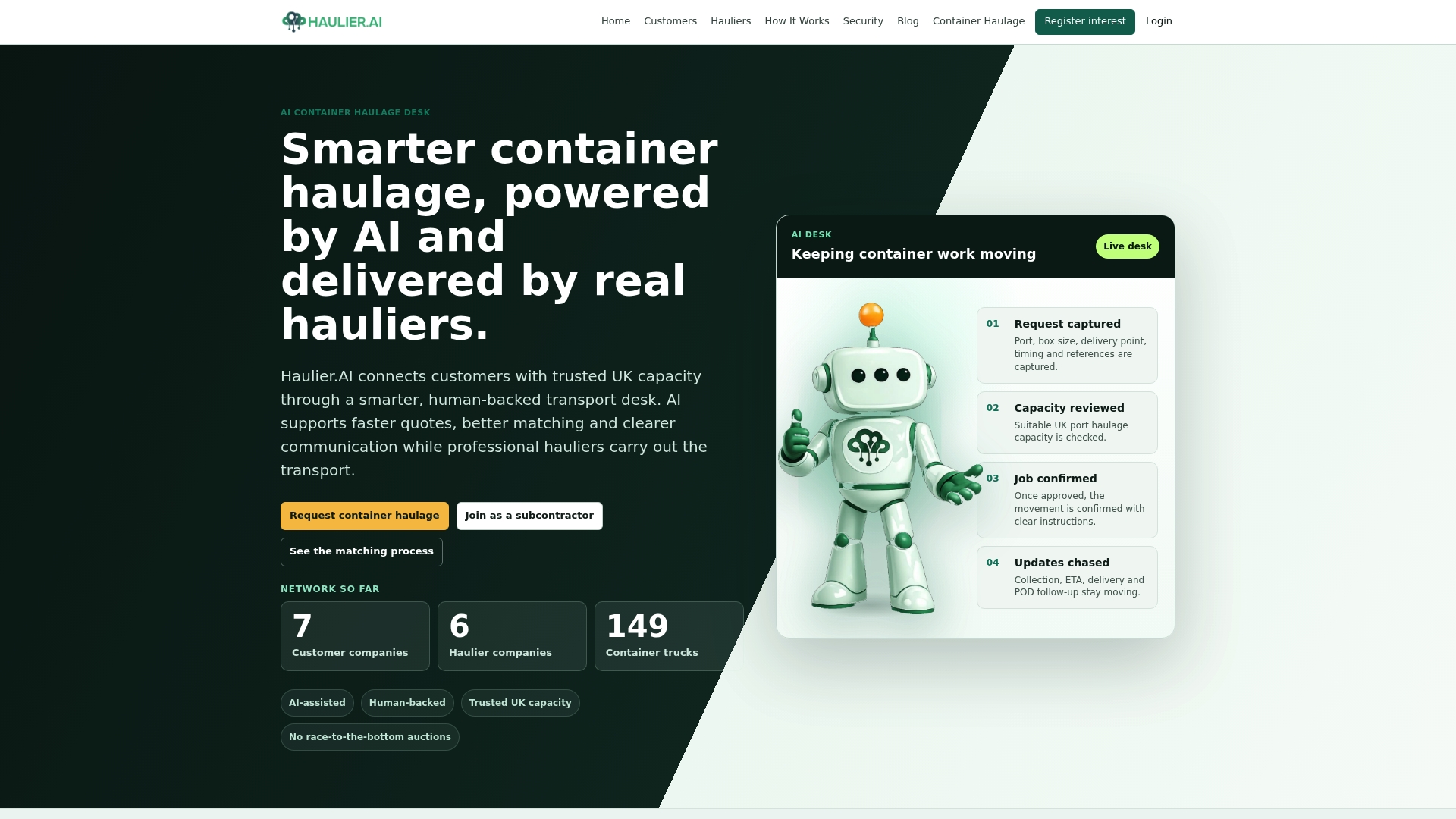
Building Haulier into your port labour disruption plan is straightforward. Pre-register your company so capacity checks and rate agreements are already in place before a strike notice lands, set your spend caps in advance, and identify standby lanes for the ports you rely on most. Because hauliers control their own rates and can decline unsuitable jobs, pricing remains fair even during surge periods rather than spiking.
If you want to see how the container haulage desk works before your next disruption, or you’re ready to register your company for priority access, now is the moment to do it, not during the next port strike.
Where to monitor live updates
Bookmark GOV.UK’s strike-action notices and the critical imports and supply chains strategy for policy shifts. Pair these with individual port authority bulletins, major news coverage, and insurer briefings for real-time operational detail during any live disruption.
Sources
FAQ
How much notice does a union have to give for strike action?
UK law requires unions to give formal notice before industrial action begins, with the result becoming public once a ballot concludes, which is why monitoring GOV.UK’s strike announcements early gives planners a genuine head start rather than a same-day scramble.
How much is strike pay in the UK?
Strike pay is set by each individual union from its own funds, not by statute, so amounts vary considerably and aren’t a factor in employer contingency planning beyond understanding that industrial action can be sustained for extended periods.
What are the current delays at UK ports?
Delay levels shift quickly depending on active disputes, weather, and vessel scheduling, so the most reliable current picture comes from checking individual port authority notices and GOV.UK’s live strike updates directly rather than relying on a fixed figure.
What are the rules for strikes in the UK?
UK strike rules require a lawful ballot, formal notice to the employer, and adherence to statutory notice periods before action begins; port authorities and unions typically confirm details through official bulletins once a ballot passes.
Can a managed haulage desk help during a port strike?
Yes. Pre-registering with a service like Haulier means haulage capacity checks and rate agreements are already in place, which removes a major bottleneck when you need to reroute cargo quickly during a disruption.