
Container haulage article
Port congestion UK: what to do right now
Facing port congestion in the UK? Discover essential actions to manage delays and ensure your shipments arrive on time.
UK ports are under sustained pressure. Felixstowe, Southampton, and London Gateway are all experiencing elevated dwell times and tightening appointment availability, driven by a combination of Red Sea rerouting, vessel bunching, and landside haulage constraints. If you have a shipment moving now, do three things immediately:
- Verify your vessel ETA using a live AIS tracker such as VesselFinder or the GoComet UK dashboard — ETA slippage of 24–72 hours is common on Cape of Good Hope reroutes.
- Pre-file your customs declarations before vessel arrival. Under the Border Target Operating Model (BTOM), documentary gaps are now a primary cause of clearance delay at UK ports.
- Lock your haulage appointment and container slot as soon as the vessel confirms a berth window. Appointment scarcity at major terminals means late bookers face additional dwell days.
For live tracking tools, jump to the monitoring section below.
Key takeaways
Port congestion across UK terminals is driven by global rerouting and vessel bunching, and the most effective response combines pre-arrival customs filing, locked haulage appointments, and real-time ETA monitoring.
| Point | Details |
|---|---|
| Act before the vessel arrives | Pre-file customs and book haulage against the discharge window, not the original ETA. |
| Budget beyond the freight rate | Demurrage, detention, and inventory holding costs routinely exceed headline freight increases during congestion. |
| Monitor two thresholds | Flag vessels with berth waiting above 12 hours and terminals with appointment availability below 60% of normal. |
| Divert only after checking inland transit | A port diversion saves nothing if the alternative port’s inland transit time exceeds the delay at the original port. |
| Structural relief is months away | Carrier schedule recovery takes 4–8 weeks; infrastructure fixes take 3–12 months. Plan buffer stock accordingly. |
Table of Contents
- Which UK ports are congested right now?
- Why is port congestion happening now?
- What are the operational and commercial impacts?
- Practical mitigation: what to do immediately, this week, and this month
- What extra costs should you budget for?
- Port-by-port notes: when to wait and when to divert
- Which tools help you monitor congestion in real time?
- How better haulage coordination reduces your delay risk
- What will clear congestion and when?
- The advice most forwarders get is too slow
- Sources
- FAQ
Which UK ports are congested right now?
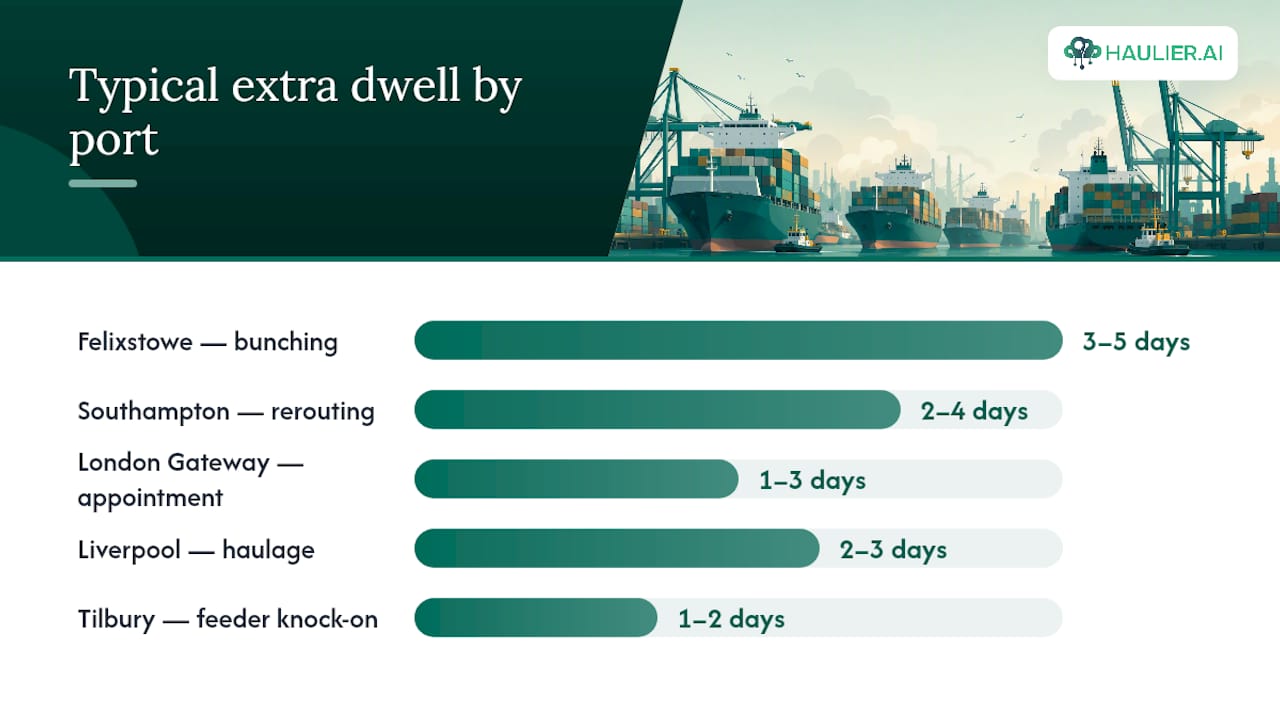
Analysis of Department for Transport figures shows freight tonnage and vessel arrivals have redistributed across the UK port network, with inward tonnage remaining relatively stable while outward tonnage fell in the most recent quarter. The pressure is not uniform.
| Port | Congestion severity | Primary cause | Typical extra dwell |
|---|---|---|---|
| Felixstowe | High | Vessel bunching, yard capacity | 3–5 days |
| Southampton | Medium–High | Global rerouting, berth queues | 2–4 days |
| London Gateway | Medium | Appointment system pressure | 1–3 days |
| Liverpool | Medium | Landside haulage, feeder delays | 2–3 days |
| Tilbury | Low–Medium | Feeder knock-on from European hubs | 1–2 days |
The British Ports Association has flagged vessel bunching and landside constraints as the principal industry-level drivers, noting that the effects ripple from terminals into the wider haulage network. Regional differences matter: short-sea routes serving Liverpool and Tilbury are partly insulated from the Cape of Good Hope rerouting effect, whereas Felixstowe and Southampton, which handle the bulk of deep-sea container traffic, absorb the most direct impact.
GoComet’s near real-time UK port dashboards track berth queues, slot availability, and delay indicators across major terminals. Check them before making any diversion or booking decision.
Why is port congestion happening now?
The causes stack on top of each other, which is why the current disruption has proved so persistent.
- Red Sea and Strait of Hormuz rerouting. Cleveland Containers’ analysis confirms that sustained security risks in the Red Sea and Persian Gulf forced carriers to reroute via the Cape of Good Hope. Voyages that once took several weeks now run longer due to the rerouting, and vessels arrive in clusters rather than spread evenly across the week.
- Vessel bunching. When multiple ships arrive within a narrow window, terminals cannot process them at normal speed. Berth queues form, yard occupancy spikes, and appointment slots disappear within hours of release.
- Landside haulage and chassis shortages. Even when a container is discharged, it cannot leave the terminal without a booked haulier and a chassis. Driver availability and chassis pools remain tight across the South East.
- Post-Brexit customs processing. BTOM requirements have added documentary steps for certain goods categories. Incomplete or late-filed declarations hold containers in customs examination queues, compounding yard congestion.
- European hub knock-on. Congestion at Antwerp, Rotterdam, and Hamburg delays feeder vessels serving UK ports, creating secondary bunching on short-sea routes.
- IT and appointment system outages. Terminal booking systems at several UK ports have experienced intermittent outages during peak demand, locking forwarders out of slots for hours at a time.
- Weather events. Severe weather periodically closes berths or suspends crane operations, compressing already-tight schedules.
Pro Tip: Map the dominant cause at your specific port before choosing a mitigation. If the problem is vessel bunching (Felixstowe, Southampton), pre-booking haulage and filing customs early are your best levers. If the problem is landside haulage scarcity (Liverpool), securing a regular haulier partner weeks in advance matters more than any documentation fix.
What are the operational and commercial impacts?
The costs that appear on invoices are rarely the biggest ones.
Operational impacts:
- Extended yard dwell times running several days above normal at Felixstowe
- Missed haulage appointments forcing re-bookings 48–96 hours later
- Chassis and trailer shortages delaying collection even after customs clearance
- Reduced terminal gate throughput, creating backlogs that persist across multiple vessel calls
Commercial impacts:
- Demurrage and detention charges accruing daily once free time expires
- Higher inventory holding costs as goods sit in transit longer than planned
- Cash conversion pressure when payment terms run against delayed delivery
- Expedited transport costs when urgent shipments need alternative routing
Logistics analysts note that these “less visible” costs — inventory carrying, cash-conversion pressure, and demurrage/detention — frequently exceed headline freight rate increases during periods of sustained congestion.
Consider a worked example. A 40ft container with five days of excess dwell at £150 per day demurrage, plus £200 per day detention on the carrier’s equipment, generates £1,750 in port-related charges before a single penny of inventory holding cost is counted. Add £300 per day in holding cost for a mid-value goods shipment over the same period, and the total exposure reaches £3,250 — often more than the original freight rate on an intra-European movement.
Practical mitigation: what to do immediately, this week, and this month
Immediate actions (today)
- Pull the live ETA for every vessel with cargo on board and flag any slippage greater than 24 hours.
- Pre-file customs declarations using the Trade Tariff and confirm all commodity codes and licences are in order before vessel arrival.
- Contact your haulier and confirm the collection appointment is booked against the expected discharge date, not the original ETA.
- Prioritise urgent or perishable SKUs for earliest collection slots; flag them explicitly to your customs broker.
- Confirm container availability and free-time expiry dates with the carrier.
Short-term actions (1–4 weeks)
- Assess whether diverting to a less congested port (Tilbury, regional ports) is viable given inland transit time and customs implications.
- Arrange off-dock storage or early return to sender (E-RTS) for containers where collection will be delayed beyond free time.
- Negotiate free-time extensions with carriers in writing, citing documented vessel delays as grounds.
- Review appointment booking windows at your primary terminals and identify the earliest release times.
Medium-term actions (1–3 months)
- Adjust reorder points and buffer stock levels to absorb 5–10 days of additional transit variability.
- Review carrier contracts for congestion waiver clauses and free-time provisions; add them at next renewal if absent.
- Secure a regular haulier partner with guaranteed capacity at your primary ports rather than relying on spot bookings.
Pro Tip: When triaging shipments, rank by commercial sensitivity first, then perishability. A high-value, time-sensitive shipment justifies expedited routing or port diversion even at significant extra cost. A slow-moving commodity shipment with generous payment terms can absorb a week of dwell at far lower total cost than a rushed alternative route.
What extra costs should you budget for?
Beyond the freight rate, congestion generates a predictable set of additional charges. Budget for all of them before a shipment moves.
- Demurrage: charged by the terminal or carrier once free time at the port expires, typically £100–£200 per container per day.
- Detention: charged by the carrier when their equipment (the container itself) is held beyond the agreed free period, typically £80–£180 per container per day.
- Off-dock storage: if you move a container to a third-party depot to avoid terminal demurrage, expect £25–£60 per container per day.
- Expedited transport: premium haulage for urgent collections can run 30–50% above standard rates during peak congestion.
- Late delivery penalties: check your sales contracts for penalty clauses triggered by delayed delivery; these can dwarf the transport costs themselves.
- Inventory holding cost: calculate your own figure as (goods value × annual holding rate ÷ 365) × excess dwell days.
To build a per-container congestion exposure figure: multiply expected excess dwell days by your daily demurrage rate, add detention if the container is still on carrier equipment, then add inventory holding cost for the same period. That total is your maximum exposure if you take no action. Compare it against the cost of diversion or expedited routing to decide which path is cheaper.
For negotiating with carriers, collect timestamped evidence of vessel delays, terminal gate closure notices, and appointment system outages. Carriers are more likely to grant free-time extensions when presented with documented, third-party evidence rather than a verbal request. For a detailed breakdown of how demurrage and detention charges work in practice, the Haulier demurrage and detention guide covers the mechanics and dispute process.
Port-by-port notes: when to wait and when to divert
Felixstowe
Currently the most pressured deep-sea container port in the UK. Vessel bunching from Cape of Good Hope reroutes is the primary driver. If your vessel is in a cluster of three or more arrivals within 48 hours, expect 3–5 days of excess dwell. Pre-booking haulage and filing customs early are non-negotiable. The Haulier Felixstowe guide covers appointment rhythms and lorry control compliance in detail. Diversion to London Gateway or Tilbury is worth costing if your cargo is time-sensitive and the vessel has not yet called.
Southampton
Medium-to-high severity, driven by a mix of global rerouting and berth queue pressure. The Southampton container haulage guide outlines local appointment booking windows and common causes of terminal delay. For most importers, waiting with pre-filed customs and a confirmed haulage slot is the right call unless dwell is forecast beyond four days.
London Gateway
Medium severity, with appointment system pressure the main operational friction. Rail connectivity from London Gateway to the Midlands and North makes it a viable diversion point for cargo originally routed via Felixstowe. Check appointment slot availability before committing to a diversion — if slots are already tight, the advantage disappears.
Liverpool
Medium severity, with landside haulage scarcity and feeder delays from European hubs as the dominant causes. Securing a haulier with Liverpool-specific capacity well in advance is more effective than any documentation fix. Regional ports in the North West can absorb some overflow.
Tilbury
Low-to-medium severity. Tilbury often absorbs rerouted volume when Felixstowe is at capacity, so its congestion level tracks Felixstowe’s with a lag of roughly one to two weeks. Check current slot availability before treating it as a straightforward diversion option.
Diversion decision checklist: Before diverting, confirm (1) inland transit time from the alternative port does not exceed the delay at the original port, (2) customs clearance can be transferred without re-filing, (3) rail or road capacity exists at the alternative port, and (4) the haulier you have booked covers the alternative port.
Which tools help you monitor congestion in real time?
Spotting ETA slippage 48 hours early is the difference between a rebooked appointment and a demurrage invoice.
- VesselFinder: AIS-based vessel tracking showing live position, ETA, anchorage waiting times, and berth status for specific terminals. Set vessel-specific alerts for ETA changes greater than six hours.
- GoComet UK dashboard: Near real-time congestion dashboards covering berth queues, slot availability, and delay indicators across UK terminals. The most practical single-screen view for a transport desk.
- British Ports Association: Industry-level commentary and supply chain updates. Less granular than AIS tools but useful for understanding whether a disruption is local or systemic.
- DfT port statistics: Quarterly freight tonnage and vessel arrival data. Useful for trend analysis and benchmarking, not for day-to-day operational decisions.
- Port authority status pages: Felixstowe, Southampton, and London Gateway all publish terminal notices and gate status updates. Bookmark them and check daily during periods of elevated congestion.
Either threshold crossing should trigger an immediate call to your haulier and a review of free-time expiry dates.*
How better haulage coordination reduces your delay risk
The gap between a container being discharged and leaving the terminal is where most avoidable cost accumulates. An AI-assisted, human-backed haulage desk closes that gap by connecting forwarders and importers to available hauliers with confirmed port coverage, real-time communication, and paperwork tracking built into the workflow.

Practically, this means appointment slots are booked against confirmed discharge windows rather than estimated ETAs, documentation gaps are flagged before the container arrives at the gate, and hauliers with the right port authorisations are matched to each job rather than discovered to be unavailable at the last moment.
Haulier’s platform operates exactly this model across UK ports, with hauliers maintaining control over their rates and job selection, which keeps pricing transparent and capacity genuine rather than inflated by intermediary markups.
Implementation checklist for forwarders:
- Confirm the platform covers your primary ports (Felixstowe, Southampton, London Gateway, Liverpool).
- Verify that hauliers on the platform hold the correct port access permits and lorry control compliance for your terminals.
- Check that documentation flows (POD, customs release, gate-in confirmation) are tracked within the platform rather than managed by email.
- Set a target appointment success rate of 95% or above and review it monthly.
- Measure impact by tracking dwell time per container before and after onboarding.
Pro Tip: Ask any haulage platform whether hauliers can reject unsuitable jobs. If they cannot, the platform is allocating capacity rather than matching it — and you will eventually receive a haulier who accepted a job they cannot complete on time.
What will clear congestion and when?
Realistic timelines matter more than optimistic ones.
Days (tactical relief):
- Pre-filing customs and locking haulage appointments reduces your individual exposure within 24–48 hours regardless of what the terminal is doing.
- Port authority gate-hour extensions during peak periods provide marginal relief within days.
Weeks (schedule normalisation):
- Carrier schedule recovery, where vessels return to published rotations rather than bunching, typically takes 4–8 weeks once the underlying route disruption stabilises.
- Appointment system improvements at terminals can reduce slot scarcity within 2–4 weeks if operators prioritise the fix.
Months (structural improvement):
- Modal shifts (more rail, less road from ports) and terminal infrastructure investment take 3–12 months to deliver measurable throughput gains.
- Resolution of Red Sea security risks would allow carriers to revert to Suez Canal routing, eliminating the primary source of vessel bunching. No clear timeline exists for that.
UK ports have framed current congestion as a global problem rather than a local failure, which signals that industry-led structural fixes will be slow. Plan for months, not weeks, on the structural side.
The advice most forwarders get is too slow
The standard guidance on port congestion runs something like this: monitor the situation, maintain buffer stock, and engage your freight forwarder. That is not wrong. It is just about six weeks behind where the problem actually sits.
By the time congestion shows up in a quarterly DfT report or a trade association bulletin, the demurrage clock has already been running for days. The forwarders who come out of a congestion episode with manageable costs are not the ones with the best carrier relationships or the most buffer stock. They are the ones who spotted ETA slippage on a live tracker 48 hours before the vessel arrived and rebooked haulage before the appointment window closed.
There is also a persistent tendency to treat port congestion as a port problem. It is not, or at least not primarily. The terminal is the visible symptom. The actual cost accumulates in the gap between discharge and gate-out, which is a haulage coordination problem. Fixing that gap, through better appointment management, faster documentation flows, and hauliers who actually have the right port access, cuts demurrage exposure more reliably than any carrier negotiation.
The other thing most guides understate is the compounding effect. A three-day vessel delay becomes a five-day dwell because the haulage appointment was booked against the original ETA. The five-day dwell triggers demurrage. The demurrage dispute delays payment. The payment delay creates cash-conversion pressure. None of those steps are inevitable. Each one is a decision point where better information and faster coordination would have changed the outcome.
Sources
Add these to your daily monitoring dashboard during periods of elevated congestion.
- Government data reveals shifting pressure across UK ports as global shipping disruption continues | Manufacturing & Logistics IT Magazine
- Supply chain issues | British Ports Association
- Government Data Reveals Shifting Pressure Across UK Ports As Global Shipping Disruption Continues - Logistics & Transport Network
FAQ
How do you avoid port congestion charges in the UK?
Pre-file customs declarations before vessel arrival, book haulage appointments against the confirmed discharge window rather than the original ETA, and monitor live ETA data so you can rebook before free time expires. Acting 48 hours early typically prevents demurrage from accruing at all.
Is there currently port congestion at Southampton?
Southampton is experiencing medium-to-high congestion, driven by global rerouting and berth queue pressure from vessel bunching on Cape of Good Hope routes. Check the GoComet UK dashboard for current slot availability and delay indicators before making booking decisions.
Which is the busiest port in the UK?
Felixstowe handles the largest share of UK deep-sea container traffic and is currently the most congested major terminal, with excess dwell times running 3–5 days above normal due to vessel bunching and yard capacity pressure.
What is the difference between demurrage and detention?
Demurrage is charged by the terminal or carrier when a container remains at the port beyond the agreed free time. Detention is charged by the carrier when their container (the box itself) is held outside the port beyond the free period. Both charges accrue daily and can combine on the same shipment.