
Container haulage article
Get Firm Part Load Haulage Quotes in Hours by Sending 7 Details
Send one brief with the seven exact details, confirm shipping line release and the terminal slot, and get firm UK part load container quotes within hours...


Send the haulier your container number, size, gross weight, release reference, port, delivery postcode and site access notes, all in one message, and you will get a firm quote within hours rather than days. The fastest route to booked capacity is either chasing this brief round several hauliers yourself or handing it to an AI-assisted managed desk such as Haulier, which matches you to available trucks without the calls. Either way, remember that customs clearance and shipping-line release, not your booking request, usually set the earliest possible collection date.
HaulierGet Container Quotes With Less AdminHaulier connects you with suitable UK hauliers through an AI-assisted, human-backed transport desk with clear process visibility.Explore HaulierTL;DR:
- Confirm the container release, port, and site access details before requesting quotes to avoid delays and collection refusals.
- Use the correct vehicle type, considering site clearance and load capacity, especially when handling heavier or larger containers.
- Ensure all shipping, customs, and terminal procedures are completed and confirmed before dispatching hauliers to minimize demurrage and waiting costs.
- Simplify the booking process by providing a complete, single brief with all necessary details to get accurate, firm quotes quickly.
- Consider AI-assisted managed desks to streamline quoting, reduce admin time, and improve rate fairness with available haulier capacity.
Table of Contents
- What does ‘part load’ mean in container haulage?
- Exactly what hauliers need to quote and book a part-load container movement
- Port release, terminal slots and timings that affect when a haulier can collect
- Choosing the right vehicle and delivery method for placing the container on site
- How to get fast, reliable part-load quotes and reduce admin time
- Tips for consolidating shipments to optimise part load haulage costs
- How to verify haulier reliability and insurance coverage
- Checklist for packaging and securing part loads within containers
- Guidance on tracking and communication during transit
- Common pitfalls and red flags when arranging part load haulage
- Practitioner perspective: operational lessons that save days and demurrage
- Haulier.AI: a faster route to booked part-load capacity
- Sources
- FAQ
What does ‘part load’ mean in container haulage?
In this context, part load haulage UK refers to booking a single haulier movement for one container that carries a consolidated or partial cargo, not pallet-based groupage transport. If your consignment shares a box with other importers’ goods, or you are moving a smaller quantity that does not justify a dedicated full-container job on your own account, this is the service you are booking. It sits apart from LTL pallet networks entirely: the unit being moved is a shipping container, and the haulier is quoting on that container’s weight, size and destination access, regardless of how many parties’ goods are packed inside it.
Part-load container haulage tends to make sense in a few recurring situations:
- Consolidated imports: several smaller consignments sharing container space to reduce per-unit shipping cost.
- Timed site placements: a specific delivery window at a warehouse or construction site where the container needs to land on a set day.
- Overflow capacity: when your regular haulier is booked out and you need a one-off movement from an unfamiliar port.
The trade-off against full-container or depot-collection movements is mostly about flexibility versus cost. A dedicated full-load booking gives you more control over timing, but a part-load or spot-booked movement through a wider haulier pool often gets you a truck faster, particularly on short notice, because you are not waiting on one contracted carrier’s schedule.
Exactly what hauliers need to quote and book a part-load container movement
Every re-quote you have ever had to chase down probably traces back to one missing detail in the original brief. Hauliers price and schedule against fixed variables, and if even one is vague, the quote comes back provisional, or worse, the truck turns up and cannot complete the job.
Send these seven items together, not staggered across separate emails:
- Container number and size (20ft, 40ft, high cube).
- Gross weight, since vehicle types have distinct capabilities and weight determines which one is viable.
- Shipping-line release reference and confirmation the container is actually released.
- Terminal and port of collection.
- Delivery postcode, site contact name and delivery window.
- Intended unloading method (ground placement, crane offload, or straight tip).
- EORI number, commodity codes and incoterms, so everyone knows who is settling duty and VAT before the box moves.
Missing site details or an unconfirmed release reference are the two most common causes of a haulier refusing collection outright, according to Containerlift’s guide to container delivery from UK ports to site, which sets out exactly what a haulier needs before a job is safe to book.
Pro Tip: Attach two or three site photos and a rough gate-width measurement to your first message, not after the haulier asks. It routinely shaves a full re-quote cycle off the process.
Port release, terminal slots and timings that affect when a haulier can collect
Nobody can collect a container the moment the ship docks. Three separate gates have to open first: customs clearance through HMRC’s Customs Declaration Service, shipping-line release, and terminal processing. Miss any one of these and the haulier you have booked simply has nowhere to go.
Importing a shipping container to the UK without the correct customs declarations, EORI number and commercial paperwork means the box can sit at the terminal accruing charges, regardless of how ready your haulage is. The terminal’s own booking system adds a fourth constraint: an unbooked arrival risks queuing or being turned away outright, because most UK terminals run pre-booked slot systems rather than open turn-up-and-wait access.
Demurrage, the daily charge levied once a container overstays its free period at the terminal, is where poor sequencing gets expensive fast. Congestion at busy ports can also shrink the pool of available slots, which pushes up urgency and sometimes price on late bookings.
The sequence that avoids most of this:
- Confirm shipping-line release before you contact any haulier.
- Get written confirmation of the release reference, not a verbal assurance.
- Book or confirm the terminal collection slot before despatching a truck.
- Only then finalise the haulage booking against a known collection window.
Align these steps in that order and demurrage risk drops sharply. Do them out of sequence, and you are paying for a truck that has nothing to collect.
Choosing the right vehicle and delivery method for placing the container on site
The vehicle you book should be decided by what happens at the delivery end, not by habit. A sidelifter can lift a container straight off the trailer bed and set it on the ground unassisted, which makes it the obvious choice whenever the delivery site has no crane or forklift of its own. Sidelifters are particularly useful for exactly this situation, and using one can save you booking a separate lifting crew and the mobilisation cost that comes with it.
Skeletal trailers and HIAB-equipped vehicles suit different jobs. A skeletal trailer moves a container efficiently between port and depot but needs external lifting gear at the destination. A HIAB can self-load smaller loads but has real limits on container weight and reach.
Before booking, check these against your delivery site:
- Gate width and overhead clearance for the vehicle plus a 40ft or 20ft box.
- Turning circle, especially on residential roads or tight industrial yards.
- Ground-bearing capacity, since a laden container is heavy enough to sink into soft tarmac or unmade ground.
- Site opening hours, matched against your confirmed delivery window.
Heavier, longer containers narrow your vehicle options and usually extend lead time, since sidelifters and HIABs able to handle the largest boxes are a smaller slice of most hauliers’ fleets.
How to get fast, reliable part-load quotes and reduce admin time
Speed comes from sending one complete tender, not five partial ones. A tender that yields a firm, comparable quote first time should include:
- Container number, size and confirmed gross weight.
- Release reference and terminal.
- Delivery postcode, contact and preferred window.
- Site access notes and photos.
- Required vehicle type, if you already know it.
Beyond that, you have broadly three ways to source capacity. Direct tendering to a known haulier gives you a relationship but limited flexibility if they are booked out. Open marketplaces widen the pool but push the admin of comparing and chasing quotes back onto you. A managed transport desk sits between the two: it takes your brief once, matches it against available haulier capacity, and chases the paperwork on your behalf.
This is where an AI-assisted desk like Haulier earns its place in the process. It standardises the brief so hauliers quote against consistent information, while hauliers themselves keep control over their rates and can reject unsuitable jobs, which keeps pricing fair rather than forcing a race to the bottom. The result is fewer missed updates and less time spent re-explaining the same job twice.
Pro Tip: Ask for the firm quote to state demurrage risk and any waiting-time charges upfront. A quote that omits these usually means they get added later as a surprise line item.
Tips for consolidating shipments to optimise part load haulage costs
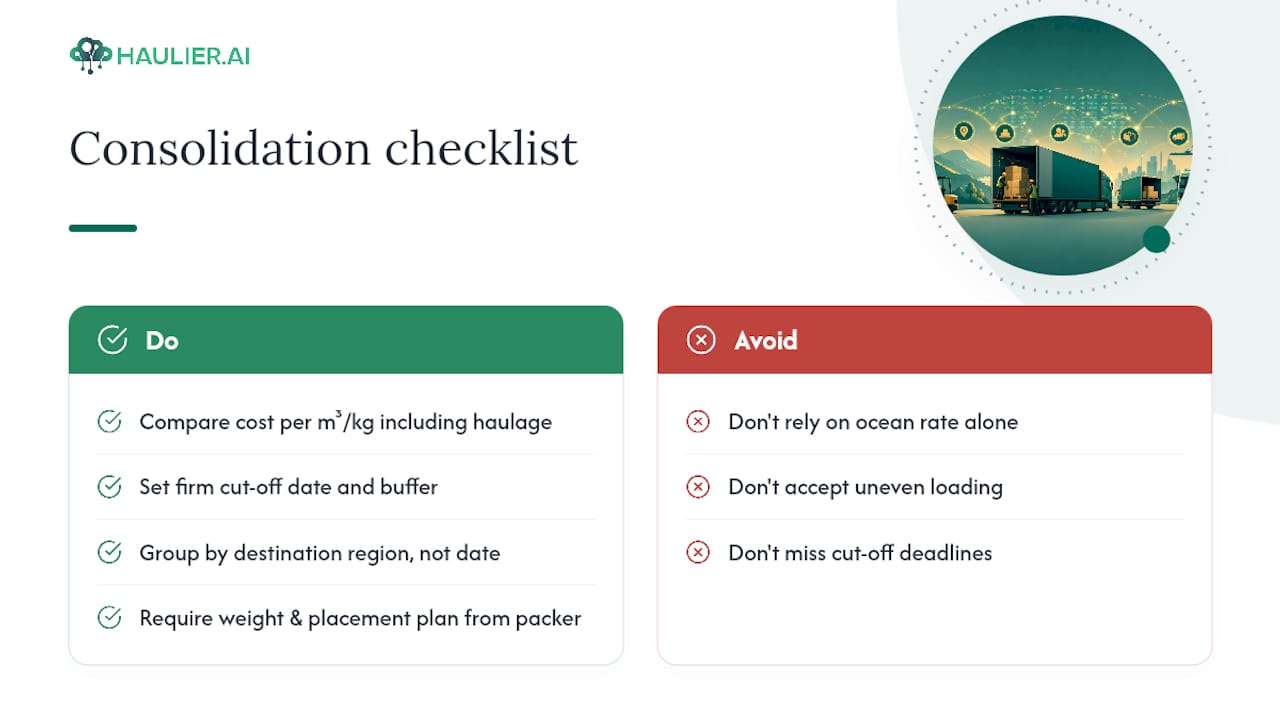
Consolidation only saves money when the maths behind it actually holds up, and that means checking a few things before you commit space in someone else’s container. Start with the cost per cubic metre or per kilogram once haulage is added, not just the shipping line’s freight rate. A cheap ocean rate can still end up expensive once you factor in a haulier’s part-load surcharge for an awkward, mixed-cargo box.
Timing matters just as much as price. Consolidated containers usually wait for the slowest contributing shipment to be ready, so agree a firm cut-off date with everyone sharing the box, and build in a few days’ buffer before the sailing deadline. A single late supplier can delay the whole container and push your delivery window back by a week or more.
Grouping shipments by destination region, rather than simply by sailing date, tends to cut the number of separate haulage legs needed after the container lands. If two importers’ goods are both destined for sites within a similar postcode area, one haulier run can sometimes cover both drops instead of two.
Weight distribution inside the container is worth flagging to your packer too. A container that is unevenly loaded can restrict which vehicle types are safe to use for final delivery, which narrows your haulage options and can push the price up regardless of how well you negotiated the shipping rate. Ask for a rough weight and placement plan from whoever loads the box, and pass it straight to the haulier alongside your other quote inputs.
How to verify haulier reliability and insurance coverage
Ask for proof before you book, not after something goes wrong. A reliable haulier should be able to produce goods-in-transit insurance cover appropriate to the value of your cargo, along with public liability cover, without hesitation or delay.
Check that the operator licence they quote against matches the vehicle actually turning up. It is not unusual for a broker to subcontract a job on to a different carrier, and the insurance arrangements can change with it, so confirm which company is legally responsible for the movement before the truck leaves the yard.
Track record is easier to verify than most importers assume. Ask directly how many similar container movements the haulier has completed in the last few months, and whether they have handled your specific vehicle requirement, a sidelifter delivery to a site with no lifting gear, for instance, rather than just standard depot-to-depot runs.
A managed desk model changes this verification burden somewhat, because the intermediary has already screened the haulier pool before a job is offered out. That does not remove the need to ask questions, but it does mean the baseline checks, valid insurance, a genuine operator licence, relevant experience, have typically already been done once rather than needing repeating on every single booking.
Checklist for packaging and securing part loads within containers
Loose or badly secured cargo inside a shared container is one of the most common causes of damage claims on part-load movements, and it is almost entirely preventable at the packing stage.
- Use dunnage bags or timber bracing to fill voids between pallets and the container wall, stopping cargo shifting in transit.
- Secure pallets with load straps or lashing, anchored to the container’s internal lashing points rather than relying on shrink wrap alone.
- Distribute weight evenly across the container floor, keeping heavier items low and centred to avoid a lean that affects handling at the delivery end.
- Label each consignment clearly when sharing space with other importers’ goods, so unloading at destination does not risk mixing up cargo.
- Photograph the load before the doors close, giving you a reference point if a damage dispute arises later.
Container floors are rated for a maximum point load, so heavy, small-footprint items need spreader boards underneath rather than sitting directly on the deck. It is also worth checking the container itself for pre-existing damage, holes in the roof or floor, and door seals that do not close properly, before anything is loaded, since responsibility for damaged goods gets far harder to establish once cargo has already been packed into a compromised box.
Guidance on tracking and communication during transit
The gap between “booked” and “collected” is where most part-load anxiety comes from, largely because traditional haulage communication runs on phone calls and hopeful emails rather than anything you can check yourself.
At minimum, ask for confirmation at four points: booking accepted, collection completed, container in transit, and delivery completed. A haulier who cannot commit to at least a same-day update at each stage is one you should be wary of for anything time-sensitive.
Real-time GPS tracking is increasingly standard on larger haulage fleets, but it is not universal, particularly among smaller subcontracted operators who make up a large share of part-load capacity. Where GPS tracking is not offered, agree a manual check-in schedule instead, ideally a text or short update rather than a call that interrupts the driver.
This is one of the areas where an AI-assisted managed desk changes the experience most noticeably. Instead of you phoning round for a status update, the system logs each stage as it happens and surfaces it to you directly, reducing missed calls and stale information that plague traditional freight communication chains.
Common pitfalls and red flags when arranging part load haulage
Most part-load haulage problems trace back to the same handful of avoidable mistakes, and recognising them early saves both money and time.
Booking haulage before release is confirmed is the single most frequent error. A truck booked against an assumed release date, rather than a confirmed one, often arrives to find the container still held, and you pay for the wasted trip regardless.
Vague weight or size information on the initial enquiry is a near-guarantee of a re-quote later, once the haulier discovers the real figures do not match what they priced against.
No site access details supplied upfront is the second-biggest cause of failed collections, particularly on residential or constrained industrial sites where a standard trailer simply cannot get in.
Red flags to watch for in a haulier’s own behaviour include: a quote with no demurrage or waiting-time terms stated at all, reluctance to confirm which vehicle type they intend to use, and an insurance certificate that is either out of date or does not match the operator name on the booking confirmation.
Unrealistic quote turnaround promises are worth treating with caution too. A haulier who quotes a firm same-day collection without having asked for your release reference or terminal slot status is either guessing or planning to renegotiate once the truck is already committed.
Practitioner perspective: operational lessons that save days and demurrage
A missed release check is the mistake I see costing importers money most often. One late booking, made against an assumed release date instead of a confirmed one, can turn a same-day collection into a three-day wait, with demurrage stacking up the whole time.
The fix is rarely more haulage capacity. It is an earlier, more complete brief: release reference confirmed, site photos attached, weight stated properly, sent before you contact anyone. Haulier.AI’s own blog carries templates worth borrowing even if you never book through the platform.
— Vytautas
Haulier.AI: a faster route to booked part-load capacity
An AI-assisted managed desk offers an alternative to chasing hauliers by phone for part-load container haulage. Instead of calling round a shortlist and waiting on callbacks, you submit one brief and the desk matches it against available haulier capacity while a human team keeps oversight on the job.
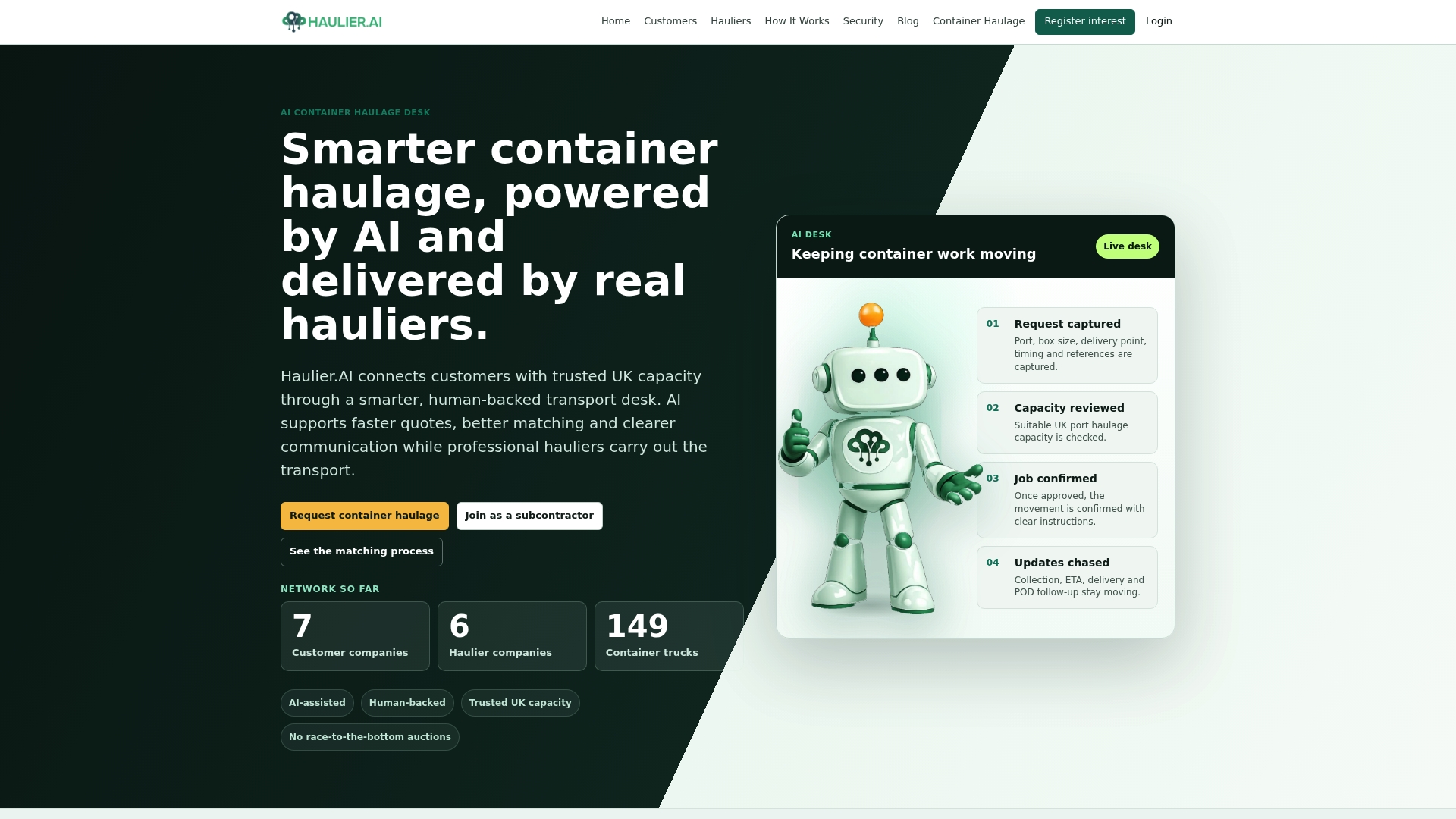
The mechanics are straightforward. Your container number, weight, release reference and site details go in once. Hauliers see the job and quote or decline against it, keeping control over their own rates rather than being pushed into a race to the bottom on price. That control is part of why quotes tend to come back realistic rather than optimistic, and why fewer of them fall apart once the driver actually arrives at site. Paperwork and status updates run through the same desk, so you are not piecing together a job’s progress from three different email threads.
If you have a container sitting at a terminal right now, or one due for release this week, Haulier and get the brief in front of available capacity today. For a fuller look at how the matching and quoting process works before you commit, the how it works page walks through each stage.
Sources
For customs and release requirements, see Containerlift’s guide to importing a shipping container to the UK. For vehicle choice and site access planning, see container delivery from UK ports to site. For current cost expectations, see Haulier.AI’s container haulage rates guide.
- Container delivery from UK ports to site
FAQ
What information does a haulier need for a part-load quote?
Container number, size, gross weight, release reference, terminal, delivery postcode, site contact details and intended unloading method, sent together in one brief.
How long before collection should I confirm the terminal slot?
Confirm the shipping-line release first, then book or confirm the terminal collection slot before despatching a truck, since terminals commonly run pre-booked slot systems rather than open access.
When should I choose a sidelifter over a skeletal trailer?
Choose a sidelifter whenever the delivery site has no crane or forklift of its own, since it can lift the container off the trailer and place it on the ground unassisted.
Does an AI-assisted desk like Haulier.AI cost more than booking direct?
Haulier.AI’s model keeps rate control with the haulier, so pricing reflects the same market rates rather than a markup, while the managed desk reduces the admin time spent chasing quotes and updates.
What is the biggest cause of failed container collections?
Booking haulage against an assumed release date instead of a confirmed one, or failing to supply site access details upfront, cause most refused or wasted collections.