
Container haulage article
UK cabotage rules for hauliers: the 2026 guide
Discover the essential UK cabotage rules for hauliers in 2026. Learn about vehicle usage, journey limits, and mandatory documentation to ensure compliance.
EU operators may carry out up to two laden cabotage journeys within seven days of completing a laden international delivery into Great Britain, using the same vehicle that made that delivery. That is the core rule under Gov. The relevant statutory framework sits in the retained EU law provisions and secondary instruments accessible via Legislation.
Three things transport managers must not ignore:
- Same vehicle only: cabotage must be performed by the vehicle that completed the inbound laden international journey, not a substitute.
- Two journeys, seven days: the clock starts when the last goods from the international load are unloaded, not when the vehicle crosses the border.
- Evidence is mandatory: you must carry proof of the preceding international movement (CMR/consignment note with timestamps) alongside your operator licence at all times.
The DVSA and Traffic Commissioners enforce these rules at roadside and can impound vehicles for serious or repeat breaches.
Key takeaways
EU operators may perform two laden cabotage journeys within seven days of a laden international delivery into Great Britain, using the same vehicle, with full documentary evidence carried at all times.
| Point | Details |
|---|---|
| Core numeric limit | Two laden cabotage journeys within seven days of unloading the international delivery. |
| Same-vehicle rule | The vehicle performing cabotage must be the one that completed the inbound international journey. |
| Evidence at roadside | Carry the Community licence copy, driver attestation (where required), and CMRs for both the international and each cabotage journey. |
| Enforcement risk | DVSA can impose on-the-spot fines and impound vehicles; Traffic Commissioners can authorise disposal for serious breaches. |
| Territorial scope | Rules apply to Great Britain; Northern Ireland operates under a separate framework. |
| Haulier platform | Haulier’s managed transport desk links document requirements to job acceptance, reducing the risk of compliance gaps in container haulage. |
Table of Contents
- What does cabotage mean in UK law?
- What are the current UK cabotage rules for EU operators?
- Which operators and vehicles do the rules apply to?
- Permitted movements and common edge cases
- What documents must drivers carry for a roadside inspection?
- How does the UK enforce cabotage rules, and what are the penalties?
- A practical compliance checklist for transport managers
- How do UK cabotage rules differ from EU rules?
- How digital systems reduce cabotage compliance risk
- Where to check for rule changes and how often
- A platform operator’s perspective on cabotage compliance
- How Haulier reduces cabotage compliance risk for container operators
- Sources
- FAQ
What does cabotage mean in UK law?
Cabotage, in road freight terms, means the carriage of goods for hire or reward between two points within the same country by an operator established in a different country. For example, a Polish haulier collecting a load in Birmingham and delivering it to Manchester is performing cabotage, while a British haulier doing the same run is not.
The UK treats cabotage as a controlled activity because unrestricted access would allow foreign operators to compete directly in the domestic market without being subject to the same licensing, tax, and employment obligations as UK-based hauliers. Post-Brexit, the Trade and Cooperation Agreement (TCA) between the UK and EU preserved a limited cabotage right for EU operators rather than abolishing it entirely, but it did not replicate the pre-2021 freedom of movement that had effectively made cabotage unrestricted for EU hauliers operating here.
Regulation (EC) No 1072/2009, which defines cabotage at EU level and sets documentation standards, remains a useful reference point for understanding the legal architecture that UK rules draw from, even though the UK is no longer bound by it directly.
The practical operational consequence is significant. Every routing decision involving a laden international entry into the UK must account for whether cabotage movements are planned, how many, and whether the seven-day window can be used efficiently before the vehicle must exit. Planners who treat the inbound leg as separate from the domestic legs create compliance gaps that DVSA inspectors are trained to spot.
DfT analysis estimated that cabotage historically accounted for around 0.8–1% of UK freight movements by tonne-kilometres before the pandemic. That low share partly explains why the temporary 14-day unlimited extension introduced in 2021–22 had limited overall take-up, and why the Government chose not to continue it beyond 30 April 2022.
What are the current UK cabotage rules for EU operators?
The core numeric limits
EU operators holding a valid Community licence may perform:
- A maximum of two laden cabotage journeys within seven days of completing the unloading of an international laden delivery into Great Britain.
- Each journey must use the same vehicle that made the international delivery.
- Once the two journeys are completed, or the seven-day window closes (whichever comes first), the vehicle must leave Great Britain before any further cabotage can be undertaken.
The seven-day window begins from the date of the last unloading of the international consignment, not from the date of border crossing. That distinction matters when a delivery involves multiple drop-off points.
Non-EU operators
Non-EU operators generally cannot perform cabotage in the UK unless a specific bilateral agreement between the UK and their country of establishment expressly permits it. GOV.UK guidance confirms that operators from countries covered only by ECMT (European Conference of Ministers of Transport) permits do not automatically gain cabotage rights. ECMT permits grant transit and bilateral access; they do not extend to domestic carriage within the UK.
Territorial scope
The cabotage rules described above apply to Great Britain (England, Scotland, and Wales). Northern Ireland operates under a different legal framework as a result of the Windsor Framework, and operators should consult separate guidance for movements involving Northern Ireland.
Car transporters benefit from a seasonal exception: specific relaxations have historically applied during peak vehicle-delivery periods, though operators should verify the current position with the DfT before relying on any seasonal allowance.
The temporary extension and its expiry
During the supply-chain pressures of 2021–22, the Government temporarily permitted unlimited cabotage movements for up to 14 days. That measure expired on 30 April 2022 and was not renewed. The DfT consultation outcome confirmed a return to the standard two-in-seven-days limit, while retaining the mechanism to reintroduce temporary flexibilities in future supply-chain emergencies if needed.
Which operators and vehicles do the rules apply to?
Licence requirements
To exercise cabotage rights in Great Britain, an EU operator must hold a valid Community licence (or a certified copy of it) issued by their member state’s competent authority. The driver must carry:
- The certified true copy of the Community licence.
- A driver attestation if the driver is a non-EU national employed by an EU-established operator.
- The consignment notes (CMR or equivalent) for both the international journey and each cabotage movement.
UK operators do not need a Community licence for domestic work, but if a UK haulier is performing international journeys into the EU, they need a UK operator licence and must comply with the rules of each EU member state they enter.
Vehicle categories
- HGVs (heavy goods vehicles): fully subject to the two-in-seven-days cabotage limit.
- Vans and light commercial vehicles: separate rules apply; the GOV.UK guidance page for non-UK operators covers light vehicle access specifically.
- Car transporters: subject to the standard limit but with historically recognised seasonal relaxations during peak registration periods. Verify current status with the DfT before each season.
- PSVs (passenger service vehicles): governed by separate cabotage rules for passenger transport; the freight cabotage rules do not apply.
Bilateral and ECMT permit holders
Operators from countries with bilateral road transport agreements with the UK may have specific access rights, but these rarely include unrestricted cabotage. The agreement text is the definitive source. ECMT permit holders should assume no cabotage right unless the permit documentation explicitly states otherwise.
Pro Tip: Before accepting a cabotage job, check the operator’s Community licence expiry date and the driver attestation validity. An expired document at roadside carries the same enforcement risk as having no document at all.
Permitted movements and common edge cases
The permitted sequence
The only compliant sequence is:
- Complete a laden international journey into Great Britain (goods loaded outside the UK, delivered to a UK address).
- Unload the international consignment.
- Perform up to two laden cabotage journeys within seven days of that unloading.
- Exit Great Britain once the limit is reached or the window closes.
Edge cases operators frequently get wrong
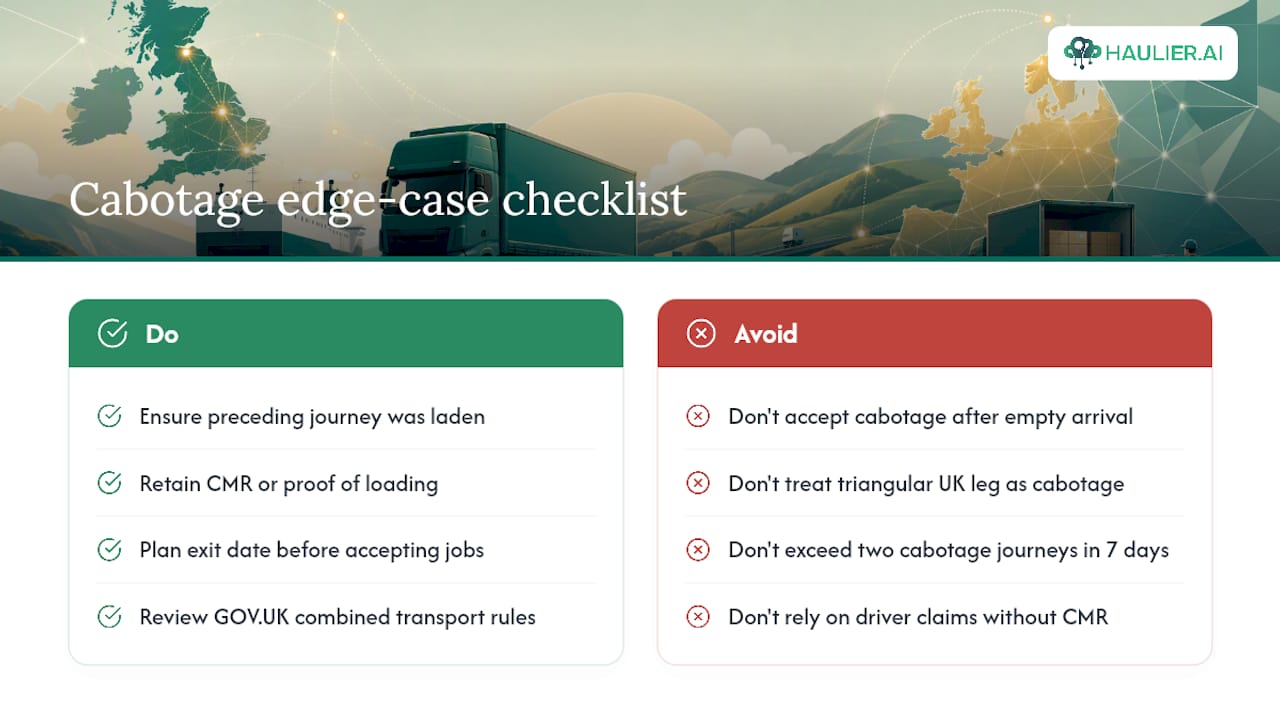
Arriving empty: a vehicle that enters Great Britain without a laden international load has no cabotage entitlement. The right to perform cabotage is triggered only by a laden international delivery. An empty repositioning run does not qualify, regardless of what the vehicle did on its previous trip.
Triangular transport: where a vehicle collects goods in country A, delivers to the UK, then collects UK goods for delivery to country B, the UK leg is the international export journey, not cabotage. Cabotage is domestic carriage within the UK between two UK points. Triangular arrangements can be structured to avoid cabotage entirely, but the routing must be planned carefully.
Combined transport: where road transport forms part of a combined transport operation (road plus rail or sea), specific rules apply to the road legs. The road leg at either end of a combined transport movement may be treated differently from a pure road cabotage journey. Operators using combined transport regularly should review the specific provisions in the GOV.UK guidance.
Car transporter seasonal exceptions: during peak new-vehicle registration periods, relaxed rules have historically applied to car transporters. These are time-limited and must be verified each season.
The most common enforcement failure is not exceeding the journey count — it is failing to prove the preceding international journey was laden. A vehicle arriving with no CMR for the inbound load has no provable cabotage entitlement, even if the driver insists the load was delivered.
Worked example 1 — permitted: A French haulier delivers a full load from Lyon to a distribution centre in Coventry (laden international journey). The vehicle unloads on Monday. On Tuesday it collects a load in Birmingham and delivers to Leeds (cabotage journey 1). On Thursday it collects in Sheffield and delivers to Manchester (cabotage journey 2). The vehicle then exits to France on Friday. Both cabotage journeys fall within seven days of Monday’s unloading. Compliant.
Worked example 2 — prohibited: The same French haulier, after completing the two journeys above, accepts a third domestic load on Saturday (still within the seven-day window). That third movement is a breach of the two-journey limit, regardless of whether the seven days have elapsed.
Pro Tip: Plan the exit date before accepting any cabotage jobs. If the seven-day window closes before the vehicle can realistically leave, you have already created a compliance risk.
What documents must drivers carry for a roadside inspection?
DVSA inspectors expect to see a clear, unbroken chain of evidence linking the vehicle to its international journey and each subsequent cabotage movement. Fragmented or missing paperwork is the primary trigger for impounding.
Mandatory documents
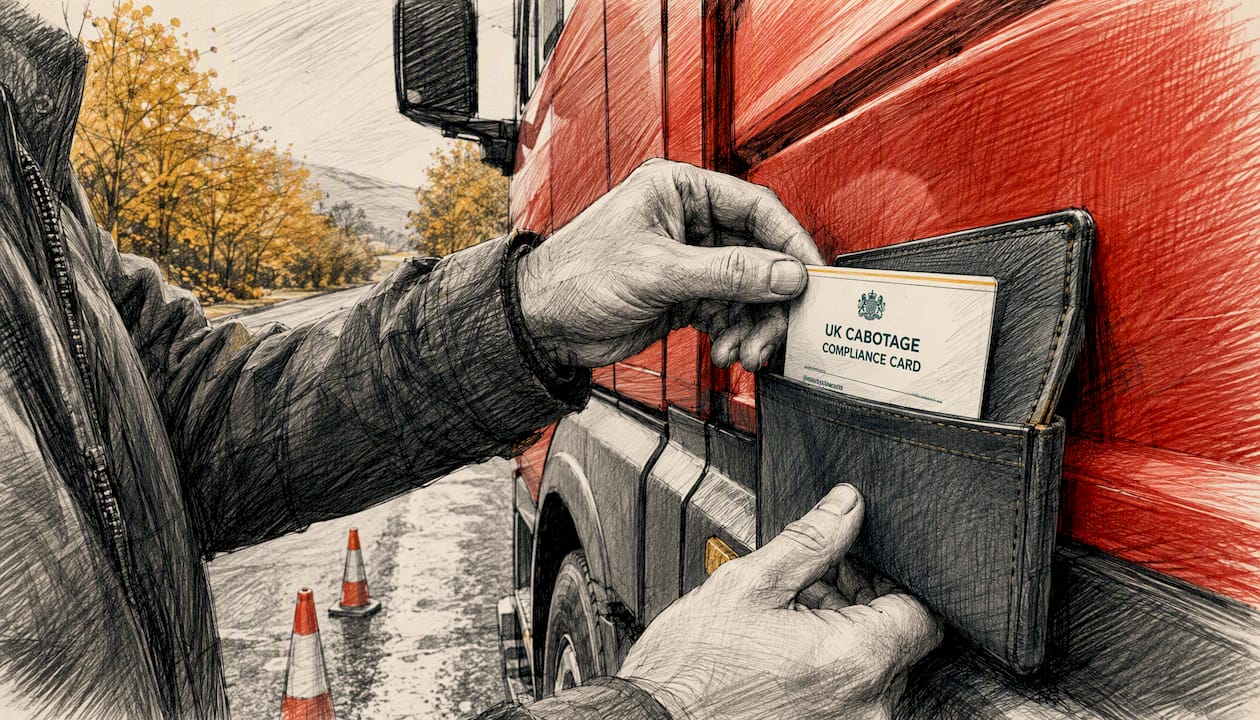
- Certified true copy of the Community licence (or the original, if the operator carries it).
- Driver attestation (where the driver is a non-EU national employed by an EU operator).
- CMR consignment note for the international journey: must show the loading point outside the UK, the UK delivery address, the date and time of delivery, and the signature of the consignee.
- CMR consignment notes for each cabotage movement: one per journey, showing UK collection and delivery points, dates, and times.
- Vehicle log or telematics printout showing border crossing times and movement timestamps.
- Posting declaration where applicable (drivers posted to the UK under the TCA posting rules).
Acceptable formats
Paper originals remain the default standard. Scanned CMRs are generally accepted when the original is held securely by the operator and the scan is legible and complete. Electronic CMRs (e-CMR) under the e-CMR protocol are increasingly accepted and carry the advantage of built-in timestamps that are harder to dispute. Structured electronic records from transport management systems are acceptable provided they contain all mandatory fields.
Retention: operators should retain cabotage documentation for a minimum of 15 months, consistent with standard tachograph and transport record retention periods.
| Document | What it must show | Acceptable format |
|---|---|---|
| Community licence copy | Operator name, licence number, expiry date | Certified paper copy or verified digital copy |
| Driver attestation | Driver name, nationality, employer, validity period | Original or certified copy |
| International CMR | Loading point (non-UK), UK delivery address, unloading date/time, consignee signature | Paper, scanned, or e-CMR |
| Cabotage CMR(s) | UK collection and delivery points, dates, times (one per journey) | Paper, scanned, or e-CMR |
| Telematics/vehicle log | Border crossing time, movement timestamps, vehicle ID | Printout or structured electronic record |
Pro Tip: Ask drivers to photograph the signed CMR at the point of delivery and upload it to a central system before leaving the customer’s premises. A timestamped photograph taken on-site is far more persuasive at roadside than a document printed later at the depot.
How does the UK enforce cabotage rules, and what are the penalties?
DVSA roadside checks
The Driver and Vehicle Standards Agency conducts targeted roadside checks at ports of entry, on major trunk routes, and at inland check sites. Officers are trained to request the full document chain: Community licence, driver attestation, international CMR, and cabotage CMRs. A vehicle that cannot produce a coherent chain of custody for its movements is treated as a potential breach.
The end of the post-Brexit grace period in 2023 marked a significant shift. Industry reporting confirms that enforcement activity increased after the grace period closed, and hauliers operating without full documentation should expect to be stopped and fined.
Penalties
DVSA and Traffic Commissioner enforcement powers include:
- On-the-spot fines for documentary failures and cabotage limit breaches.
- Vehicle impounding: where a serious breach is identified, the vehicle can be detained at roadside.
- Vehicle disposal: in repeat or severe cases, Traffic Commissioners have the power to authorise disposal of an impounded vehicle.
- Licence action: serious or repeated breaches can be referred to the Traffic Commissioner for action against the operator’s licence, including suspension or revocation.
Practitioner experience confirms that impoundment most commonly follows a failure to produce a clear chain of custody for the preceding laden international journey. A driver who cannot show a signed CMR for the inbound load cannot prove the cabotage entitlement exists at all.
A practical compliance checklist for transport managers
Before departure
- Confirm the vehicle completed a laden international delivery into Great Britain (not an empty entry).
- Verify the Community licence is valid and the certified copy is in the vehicle.
- Check the driver attestation is current (where required).
- Confirm the number of cabotage journeys already completed in the current seven-day window.
- Calculate the window close date from the international unloading date and time.
- Ensure the CMR for the international journey is signed, dated, and in the vehicle.
During the movement
- Carry a separate CMR for each cabotage journey.
- Record collection and delivery times on each CMR.
- Ensure telematics or the tachograph records are running and capturing timestamps.
- Do not accept a third cabotage job within the same seven-day window.
After the movement
- Retain all CMRs and telematics records for at least 15 months.
- Log the movement in the back-office system with dates, times, and document references.
- Confirm the vehicle exits Great Britain before the seven-day window closes if the limit has been reached.
Pro Tip: Run a monthly internal audit of completed cabotage movements: pull the CMR file, the telematics log, and the licence copy for each trip and check they form a coherent chain. An audit that takes 30 minutes per month is far less costly than a single impounding event.
For container movements specifically, the UK container haulage guidance on Haulier’s blog covers port-specific documentation considerations that complement this checklist.
How do UK cabotage rules differ from EU rules?
Since Brexit, UK and EU cabotage rules have diverged in ways that create real planning complexity for operators working in both markets.
The EU mobility package introduced a four-day cooling-off period between cabotage operations in the same EU member state. The UK has not adopted this rule. That means a UK-bound operator faces no cooling-off restriction between the end of one seven-day window and the start of a new one (provided a fresh laden international delivery triggers the new window), whereas the same operator working in France or Germany must observe the four-day gap.
The EU also permits three cabotage journeys within seven days, compared with the UK’s two. For operators planning multi-drop domestic legs after an international delivery, this difference directly affects load planning.
Practically, operators who switch between UK and EU operations need separate compliance procedures for each jurisdiction. A driver briefed on EU rules who applies them in Great Britain will exceed the UK limit on the third domestic journey.
Pro Tip: Label your driver packs clearly by jurisdiction. A single combined “cabotage rules” sheet that blends UK and EU limits is a compliance liability. Keep them separate, and brief drivers at the point of departure on which rules apply to that specific trip.
How digital systems reduce cabotage compliance risk
Compliance in cabotage is fundamentally a visibility problem. An inspector at roadside does not know what your vehicle did last week. You have to show them, in real time, with documents that form a coherent sequence. Operators who rely on paper systems stored at the depot cannot do that reliably.
Real-time telematics solve the sequence problem. A vehicle tracking system that logs border crossings, loading events, and delivery timestamps creates an automatic audit trail that mirrors the CMR chain. When a DVSA officer asks “when did this vehicle enter Great Britain and what did it deliver?”, a telematics printout answers that question in seconds.
E-CMR adds a second layer. Electronic consignment notes carry embedded timestamps from the point of creation and signature, making it difficult to argue that a document was backdated or altered. Centralised document storage means the driver does not need to carry a folder of paper; the back-office team can transmit documents digitally to support a roadside inspection in progress.
The operators who pass roadside audits consistently are not the ones with the best lawyers. They are the ones whose drivers can produce a coherent, timestamped document chain within two minutes of being stopped.
A practical digital workflow looks like this:
- Driver scans or photographs the signed international CMR at the delivery point and uploads it to the transport management system.
- The system timestamps the upload and links it to the vehicle and trip record.
- When a cabotage job is accepted, the system creates a new CMR linked to the same vehicle record, with the international CMR as the parent document.
- At roadside, the driver opens the app and presents the full chain: international CMR, cabotage CMR(s), and telematics log.
The driver apps guidance on Haulier’s blog covers the specific app features that support this kind of timestamped evidence capture.
Pro Tip: Ask your telematics provider which specific events are logged with GPS coordinates and timestamps. Border crossings, engine-on/off events, and loading/unloading stops are the three most persuasive data points for a DVSA inspector. If your current system does not log all three, it is worth upgrading before the next peak season.
Where to check for rule changes and how often
Cabotage rules can change through secondary legislation, DfT guidance updates, or new bilateral agreements. The grace period ended in 2023 with little fanfare; operators who were not monitoring GOV.UK missed the enforcement shift until they were stopped.
Primary sources to monitor
- Gov: the definitive operational reference for non-UK operators. Updated when rules change. Bookmark and check monthly.
- Legislation: statutory instruments and retained EU law. Set up an email alert for amendments to the Road Transport (International Passenger Services) Regulations and related secondary instruments.
- DVSA enforcement bulletins: published periodically and available via GOV.UK. Particularly useful after seasonal peaks (January, September) when enforcement activity tends to increase.
- DfT consultations: published on GOV.UK consultations hub. Subscribe to the transport topic to receive notifications of new consultations before they close.
- Road Haulage Association (RHA): the RHA publishes member guidance on regulatory changes and often provides early commentary on DfT consultations. Membership gives access to template compliance documents.
- IRU (International Road Union): for operators working across both UK and EU markets, IRU’s mobility package commentary tracks EU-side changes that affect cross-border planning.
Monitoring cadence
- Weekly during peak seasons (September to January, March to April): enforcement activity is highest and rule changes are more likely to be implemented around seasonal peaks.
- Monthly otherwise: a 30-minute check of the GOV.UK guidance page and the DVSA bulletin archive is sufficient for most operators.
- Immediately after any DfT announcement: sign up for GOV.UK email alerts on the “transporting goods” topic to receive notifications within hours of a guidance update.
A platform operator’s perspective on cabotage compliance
The paperwork problem in cabotage is not that the rules are complicated. Two journeys, seven days, same vehicle: that is not a difficult rule to understand. The problem is that the evidence chain has to be assembled in real time, under roadside pressure, by a driver who may not speak fluent English and who has been on the road for ten hours.
What actually reduces audit friction is not better training alone. It is a system that makes the right document appear in the right place automatically. When a managed transport desk links every job acceptance to a document requirement, and when the driver cannot mark a job complete without uploading a signed CMR, the compliance chain builds itself. The back-office team sees gaps before the inspector does.
Two behaviours made the biggest difference in practice. First, standardising the CMR format across all operators on a platform so that every document has the same fields in the same positions. An inspector who sees a consistent format across dozens of documents processes them faster and with less suspicion. Second, building the seven-day window calculation into the job-acceptance workflow so that a dispatcher cannot accidentally assign a third cabotage job to a vehicle that has already used its two-journey allowance.
The operators who get impounded are almost never the ones who deliberately broke the rules. They are the ones whose systems let a mistake happen without flagging it.
How Haulier reduces cabotage compliance risk for container operators
Container haulage after an international delivery is exactly where cabotage risk concentrates. The vehicle has just completed a laden international leg, the driver is tired, and the next job is already waiting. That is when document gaps happen.
Haulier’s AI-assisted, human-backed transport desk keeps the document chain intact from the moment a job is accepted. Every movement is linked to the operator’s licence record, CMR uploads are required before job completion, and the platform’s real-time update system means the back-office team sees the document status without chasing the driver. Hauliers on the platform control their own rates and can decline jobs that would push them outside their cabotage window, which means the compliance decision stays with the operator rather than being imposed by a dispatcher under commercial pressure.
For freight forwarders and importers managing container movements after international deliveries, request a quote via Haulier’s customer page or see how the platform works to understand how managed desk workflows reduce the audit risk that comes with every cross-border movement.
Sources
- Gov
- Road transport cabotage: further flexibilities during 2022 for foreign hauliers - DfT (consultation outcome)
- Regulation (EC) No 1072/2009 — cabotage provisions (legislative text)
- Market access for road freight transport — IRU (EU mobility package commentary)
FAQ
Does the UK have cabotage laws?
Yes. UK cabotage rules are set out in GOV.UK guidance from the Department for Transport and underpinned by retained legislation. EU operators may perform up to two laden cabotage journeys within seven days of a laden international delivery into Great Britain.
How many cabotage trips are allowed in the UK?
EU operators are permitted two laden cabotage journeys within a seven-day window following a laden international delivery. Non-EU operators generally have no cabotage right unless a specific bilateral agreement states otherwise.
Which countries are not allowed to carry out cabotage in the UK?
Operators from countries without a bilateral road transport agreement that includes cabotage rights cannot perform cabotage in the UK. ECMT permit holders are not automatically entitled to cabotage; the permit must be checked for any explicit cabotage provision.
What documents are needed to prove cabotage compliance at roadside?
Drivers must carry the certified copy of the Community licence, a driver attestation (where applicable), the CMR consignment note for the preceding laden international journey, and a separate CMR for each cabotage movement, with timestamps showing dates and delivery points.
What happens if a foreign haulier breaches UK cabotage rules?
DVSA officers can issue on-the-spot fines, impound the vehicle, and refer serious cases to the Traffic Commissioner. Repeat or severe breaches can result in vehicle disposal and action against the operator’s licence, including suspension or revocation.