
Container haulage article
London lorry control: the operator's compliance guide
Understand the London lorry control rules for HGVs over 18 tonnes. Learn about restricted hours, routes, and exemptions to ensure compliance.
The London Lorry Control Scheme (LLCS) restricts heavy goods vehicles over 18 tonnes maximum gross weight from using certain London roads during prescribed hours. It is not a blanket lorry ban. The scheme controls which routes vehicles over 18 tonnes may use, and when, with the primary aim of reducing noise pollution in residential areas during unsociable hours. Operational hours run during late evenings and overnight on weekdays and continuously from early Saturday afternoon through to Monday morning, with the same restrictions applying on public and bank holidays. Zero-emission two-axle vehicles up to 20 tonnes are exempt, a change introduced under Amendment No. 11 in 2025.
Key facts at a glance:
- Applies to HGVs over 18 tonnes maximum gross weight
- Restricted hours: Monday–Friday 9pm–7am; Saturday 1pm–7am Monday; same on public holidays.
- Public and bank holidays treated as weekdays
- Zero-emission two-axle vehicles up to 20 tonnes are exempt
- The Excluded Route Network (ERN) can be used at any time without a permit
- Restricted roads require a permission during controlled hours
How to get permits and use the Haulier Portal
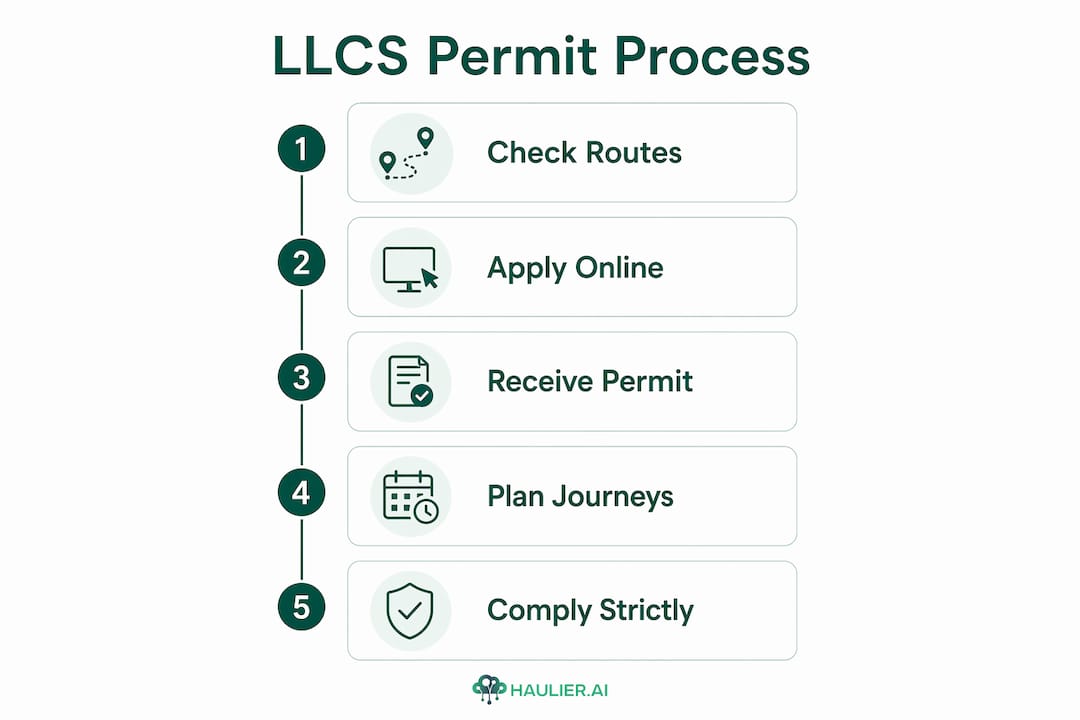
Permits for restricted roads are free and applied for online through the Haulier Portal, managed by London Councils. Every heavy goods vehicle over the weight limit that uses a restricted road during controlled hours needs its own permission. The application is linked to the vehicle’s registration, and London Councils grants permissions based on demonstrated operational need.
The critical point many operators miss: if your entire journey can be completed using the ERN, you do not need a permit at all. Permissions are only required when a restricted road is unavoidable. Where a permission is granted, the vehicle must travel along the ERN to the closest point to its destination, then use the shortest possible distance along restricted roads.
- Apply per vehicle via the online Haulier Portal at no cost
- Permissions granted only where operational need is demonstrated
- No permit needed if the full journey uses the ERN or the vehicle is under 18 tonnes
- Permitted vehicles must still minimise restricted road use
- The LLCS interactive map shows ERN routes, restricted areas, borough boundaries, and weight restrictions
Pro Tip: Plan routes using the LLCS interactive map before applying for a permit. If the ERN covers your full journey, you save the admin entirely. The Lorry Control Unit can also advise on compliant routing by email at lorry.control@londoncouncils.gov.uk.
Operators running London Gateway container haulage should map their regular routes against the ERN before each operational period, particularly after the 2025 amendments altered ERN coverage in several boroughs.

What happens when you get a Penalty Charge Notice?
ANPR cameras have been deployed across London since 2025, supplementing on-street enforcement officers. Cameras are positioned at high-risk locations selected on the basis of traffic patterns and known non-compliance. When a potential breach is detected, an officer reviews the observation before any Penalty Charge Notice (PCN) is issued.
PCNs are sent to both the vehicle operator and the driver. Under the Traffic Management Act 2004 and the London Local Authorities and Transport for London Act 2003, liability sits with both the operator and the person in control of the vehicle at the time.
- Paying early after receiving a penalty notice can result in a reduced penalty amount
- Full payment or representations must be made within the designated period after the notice date
- Representations can be made on three grounds: you were not the operator at the time; no contravention occurred; or the penalty exceeded the applicable amount
- Drivers have equivalent grounds relating to not being in control of the vehicle
- A rejected representation triggers a Notice of Rejection which includes an appeal form
- Unpaid penalties escalate to a Charge Certificate, then debt registration at the Traffic Enforcement Centre, and ultimately a County Court Warrant of Execution
Enforcement escalation: Failure to pay or appeal within the allowed period after a Charge Certificate may lead to debt registration and court enforcement, with an increase applied to the penalty amount at this stage.
Appeals to an adjudicator are only accepted on the same statutory grounds as representations. Mitigation alone is not sufficient for an adjudicator to allow an appeal, though London Councils may consider it when deciding whether to cancel a PCN at the representations stage.
Common questions about LLCS restrictions
Can I use any London road if I have a permit? No. A permit grants access to restricted roads only where operationally necessary, and the vehicle must still use the ERN to the closest point to its destination before taking the shortest route along restricted roads.
What if my vehicle is stationary on a restricted road? The LLCS is a moving traffic contravention. London Councils will not issue a PCN for a stationary vehicle, but operators should verify the circumstances of any PCN received and contact the issuing authority if the detail is unclear.
How do I apply for a temporary or variation permission? Applications for temporary permissions or variations are made through the Haulier Portal. Contact the Lorry Control Unit directly for complex operational needs or where standard permit categories do not fit your situation.
What routes changed in 2025? The Silvertown Tunnel was added to the ERN in June 2025 following its opening, and minor ERN removals were made in the Royal Borough of Greenwich, the London Borough of Haringey, and the London Borough of Redbridge. Operators should consult the updated LLCS interactive map and the current Traffic Order for accurate routing.
Recent updates and what they mean for operators
The shift to ANPR enforcement is the most significant operational change to the LLCS in years. Previously, enforcement relied entirely on roadside officers patrolling specific locations. ANPR creates continuous, automatic monitoring at camera sites during controlled hours, with officers reviewing each observation before a PCN is issued. London Councils provided a two-week warning notice period at each new camera location before PCNs were issued, giving operators time to adjust.
- ANPR cameras deployed following a successful 2024 pilot, with full rollout from 2025
- Silvertown Tunnel added to ERN in June 2025, improving cross-Thames routing options
- Zero-emission two-axle vehicles up to 20 tonnes now exempt, encouraging greener fleet adoption
- Logistics UK has campaigned for more flexible night-time delivery windows, citing improved HGV noise and emissions technology; operational hours remain unchanged as of 2026 but are under active consideration
- Enforcement officers continue to operate alongside ANPR, targeting convergence points and complaint-sensitive locations
Driver training for ANPR hotspots is now a practical necessity. Convergence locations on restricted routes carry the highest enforcement risk, and operators who have not updated their driver briefings since the ANPR rollout are exposed. Understanding ULEZ and congestion charge rules alongside LLCS restrictions gives operators a fuller picture of London vehicle compliance requirements.
Haulier makes compliant container haulage simpler
Running containers through London under LLCS constraints takes more than a permit. Timing, routing, and real-time communication all have to align, and a single missed update can turn a compliant job into a contravention.

Haulier’s AI-assisted transport desk connects freight forwarders and importers with vetted UK hauliers who know London’s restrictions. Quoting, job matching, and paperwork tracking happen through one platform, with hauliers keeping control of their rates and the jobs they accept. The result is fewer missed updates, less back-and-forth, and container movements that fit within LLCS windows from the start. If you want to move containers through London without building a compliance operation from scratch, request a quote through Haulier.
Key takeaways
The London Lorry Control Scheme restricts HGVs over 18 tonnes from specific London roads during night-time and weekend hours, with ANPR enforcement now providing continuous monitoring alongside on-street officers.
| Point | Details |
|---|---|
| Restricted hours | Monday–Friday 9pm–7am; Saturday 1pm–7am Monday; same on public holidays. |
| Permits are free | Apply per vehicle via the Haulier Portal; only needed if restricted roads are unavoidable. |
| ERN is your first option | Journeys completed entirely on the Excluded Route Network need no permit at all. |
| PCN early payment discount | Pay within 14 days for a 50% reduction; full payment or representations due within 28 days. |
| Haulier for London containers | Haulier matches operators with compliant hauliers, with timing and routing built into the quoting process. |
FAQ
What are the new rules for lorries in London?
The core LLCS restrictions are unchanged: HGVs over 18 tonnes are restricted from certain London roads during controlled hours. The 2025 updates added the Silvertown Tunnel to the ERN and introduced an exemption for zero-emission two-axle vehicles up to 20 tonnes.
What time is the London lorry ban?
The LLCS operates Monday to Friday from 9pm to 7am, and from Saturday 1pm through to 7am on Monday morning. The same hours apply on public and bank holidays.
What time can lorries go into London?
HGVs over 18 tonnes can use restricted roads outside controlled hours without a permit. During controlled hours, they may use the ERN freely or access restricted roads only with a valid permission obtained through the Haulier Portal.
Are lorries in the UK restricted outside London?
The LLCS applies specifically within Greater London. Other UK local authorities may impose their own lorry routing or weight restrictions, but there is no single national equivalent of the LLCS covering the whole of the UK.