
Container haulage article
How London lorry control affects delivery planning
A practical guide to London lorry control, including hours, routes, permits, exemptions and how it affects UK haulage planning and costs.
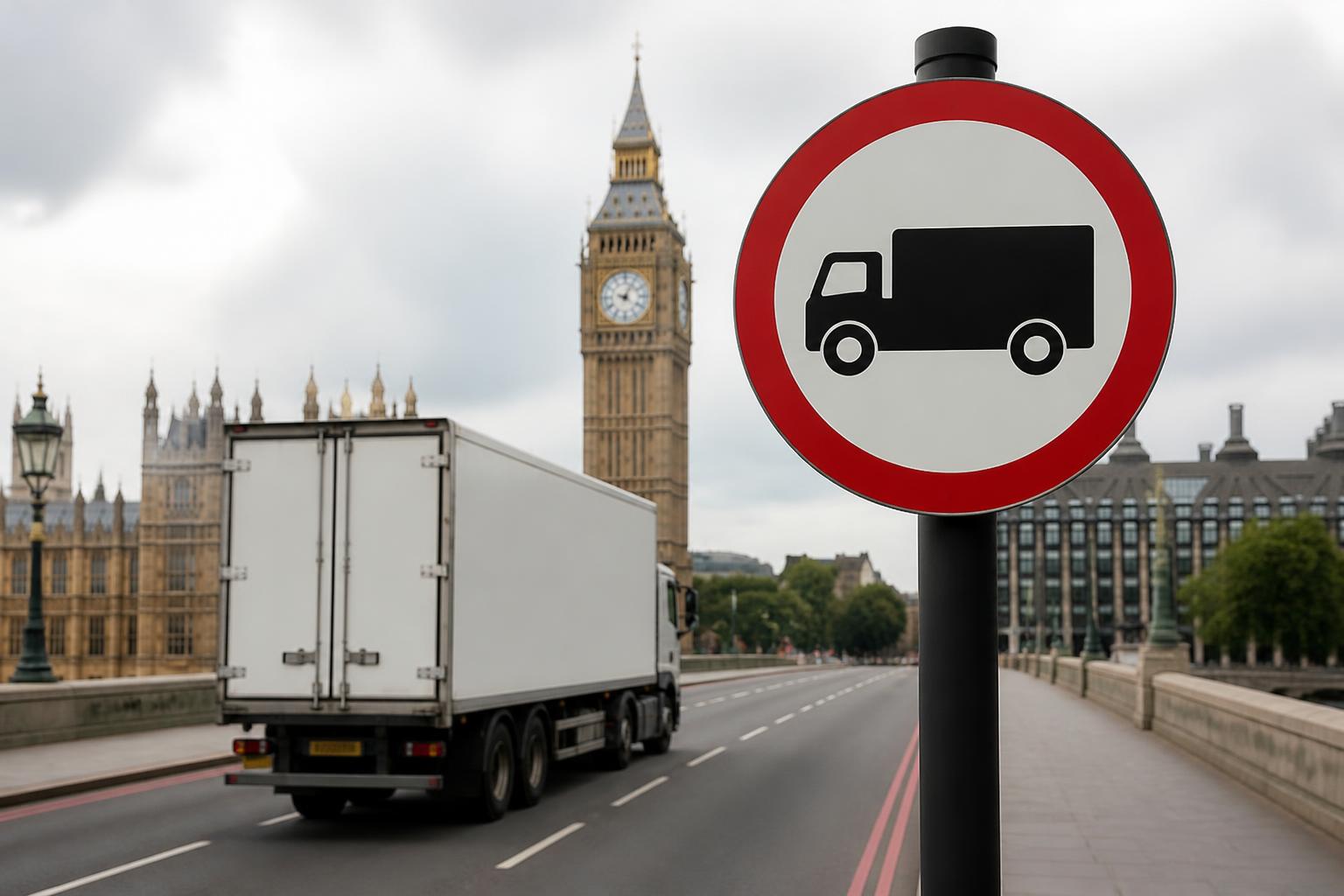
If you are planning deliveries in the capital, the London Lorry Control Scheme is not a side issue. It directly affects when certain vehicles can move, which roads they can use, and whether a job can legally be done overnight or at weekends. That matters both to buyers booking transport and to hauliers accepting work, because a delivery that looks straightforward on a postcode and a map can become non-compliant once vehicle weight, timing and route are checked properly.
At Haulier.AI, we see this most often when urgent bookings are being fitted around fixed customer slots, port collections or warehouse cut-offs. A movement can be commercially viable on paper, then fail operationally because the planned vehicle cannot use the intended roads at the intended time. Good delivery planning in London starts with the lorry control rules, not with the cheapest quote or the fastest theoretical ETA.
What London lorry control is and why it matters
The London Lorry Control Scheme is a night and weekend controls regime that applies across most London boroughs. In practical terms, it restricts the movement of larger goods vehicles on roads that are not part of the excluded route network during controlled hours, unless the operator has the right permit or exemption in place.
The point of the scheme is to reduce noise and disturbance in residential areas. For transport planning, the practical effect is simple. A vehicle may be lawful to operate under operator licensing and drivers' hours rules, but still be restricted from using local roads in London at the time the delivery is booked.
This matters before work is confirmed, not after. Buyers often focus on collection date, delivery date and rate. Hauliers often focus on whether the load fits the trailer, whether the site can unload, and whether the timing works with the driver's day. In London, all of that still matters, but so does whether the route from the strategic road network to the delivery point is permitted during the booked window.
It is especially relevant where bookings involve awkward timing. Examples include night trunk arrivals into London, weekend retail deliveries, site openings before normal business hours, event work, construction materials, and container haulage moving in or out of ports such as Felixstowe, London Gateway, Southampton and Tilbury. A container can be collected on time and still miss the delivery plan if the final London leg has not been checked against the scheme.
For businesses buying UK haulage, the risk is not just a fine or a rejected route. The bigger issue is service failure. If the vehicle has to wait until the control period ends, the ETA changes. If the booked vehicle is outside the permit scope, a replan is needed. If unloading staff are only available in the restricted period, the whole movement can fail even though the miles are short.
Which vehicles, times and roads are affected?
The scheme broadly affects goods vehicles over 18 tonnes maximum gross weight. That threshold is central. Not every van, rigid or small truck is caught by the controls, but many standard heavy goods vehicles are. Whether a movement falls inside the scheme depends on the actual vehicle being used, not the load weight alone and not the fact that the work is commercial.
The controlled periods are generally overnight on weekdays and for much of the weekend. In operational terms, that means the scheme becomes a live planning issue for evening deliveries, early morning arrivals before the weekday daytime window, and most Saturday and Sunday work. If a customer asks for a 06:00 booking, a Sunday morning slot, or a Friday night delivery, we treat lorry control as one of the first planning checks.
The road position is just as important as the time and vehicle. The scheme works on a difference between excluded routes and roads where controls apply. Excluded routes are the roads that larger vehicles are allowed to use during restricted hours without needing a special route-specific workaround. These are typically the strategic roads designated for that purpose. Once a vehicle leaves that network to reach a site, depot, store or project address, the route may enter controlled roads.
This is where superficial planning causes problems. A postcode may sit close to an excluded route, but the actual final approach may not be on one. A warehouse can be a short distance from a main road and still require travel on controlled local roads. Two sites with almost identical postcodes can have very different access positions depending on entrance location, local road layout and borough boundaries.
For operators used to wider UK haulage work, this is one of the key differences about London. Elsewhere, route planning often focuses on bridge heights, width restrictions, low emission charging, delivery curfews and site booking systems. In London, lorry control adds another layer that has to be checked before the vehicle is allocated.
How permits, exemptions and route approvals work
Where a movement falls within the scheme, an operator may need a permit covering the relevant vehicle and route circumstances, or an exemption where the rules allow one. The exact route to compliance depends on the nature of the work, the road access needed and the status of the vehicle movement.
In practice, the checks usually start with these basics:
- the vehicle's maximum gross weight
- the registration and operator details
- the collection and delivery addresses
- the intended travel times
- the roads needed between the excluded route network and the site
- whether the movement is regular, occasional or one-off
- whether any recognised exemption may apply
What catches people out is assumption. A common one is that if a vehicle has gone to a site before, it can go again at any time. Another is that if the delivery point is near an A road, the route must be fine. A third is that a customer instruction such as "night delivery only" somehow overrides the control scheme. It does not.
Permit and exemption handling is an operator responsibility, but buyers should not treat it as invisible admin. It directly affects whether a job is serviceable in the required window. If we are arranging work through our AI-assisted, human-backed transport desk, we want the permit position understood before the movement is committed, especially where there is little slack in the timetable.
This is also why human review still matters. Automated mapping is useful, but postcode-level routing and generic sat nav logic are not enough for compliance decisions. We use structured request handling to gather the facts early, then check the practical route and timing before the wrong vehicle is sent. That is particularly important on awkward work, on subcontracted jobs, and on container haulage where port release timing can already be tight. If you manage regular port traffic, our guide to container haulage that keeps port moves under control goes into the wider planning discipline behind that.
For avoidance of doubt, this is a London-specific controls issue, not an EU-wide rule. After Brexit, UK operators still need to deal with domestic local restrictions exactly as they stand. Cross-border experience does not remove the need to comply with borough-based controls in London. The same applies to commercial paperwork. A correct invoice with the right VAT treatment does not make a restricted movement lawful.
How the scheme changes delivery planning in London
The biggest change is that booking windows must be built around lawful access, not just customer preference. If a site can only receive between 22:00 and 05:00, and the required vehicle would need to leave the excluded route network during controlled hours, the job may need a different vehicle, a different route basis, a different day, or a different unloading arrangement.
That affects ETA promises immediately. Without a lorry control check, a planner may promise a same-night or early-morning delivery that cannot legally happen as quoted. Once corrected, the realistic ETA may move by several hours. For buyers, that can affect production, labour scheduling, crane bookings, retail replenishment or event set-up. For hauliers, it affects whether the job still fits with the driver's hours, next reload and commercial rate.
Night work and weekend work are where the scheme bites hardest. These are often the very slots customers ask for because they want to avoid congestion or daytime site disruption. But the time that seems operationally convenient can be the time when route controls are tightest. This is why we prefer to confirm site access details, unloading staff availability and route position together, rather than treat them as separate questions.
It also changes how we look at part-load and full-load planning. A part-load movement into London may appear cost-efficient if it can be added to an existing route, but if the final drop creates a controlled-hours conflict, the savings can disappear in waiting time, replanning or failed delivery. Equally, a full-load may be the better operational choice where a direct run can be timed cleanly into a lawful access window. We covered some of the wider cost control logic in how part-load cuts cost without losing control.
For port-linked work, timing pressure can be even greater. A container collected from London Gateway or Tilbury may have a customer expectation for same-day onward delivery, but the London end of the move still has to be checked against the control scheme. The same planning discipline applies to imports routed from Southampton, Liverpool, Teesport or Immingham into London-area receivers. If you are pricing or booking around Thames-side port flows, our page on container movements through London Gateway is relevant.
Where transport jobs go wrong in practice
The most common mistake is using the wrong vehicle for the delivery profile. A planner may assume any available artic will do, then discover too late that the chosen unit and trailer combination pushes the movement into lorry control restrictions that a smaller vehicle would have avoided.
The next mistake is missing the last mile route issue. The trunk route may be fine. The motorway, the main road and the approach to the borough may all look straightforward. Then the final turn to the customer entrance crosses controlled roads during restricted hours. If that is only noticed when the driver is close by, the options are poor.
Another frequent problem is relying on postcode-level planning. Postcodes are useful for quoting, but not enough for compliance. Large sites often have multiple gates, one-way systems, different unloading points and access instructions that change the lawful route. A postcode can place you in the right area while hiding the wrong entrance.
Customer unloading times are also overlooked more often than they should be. The route might be lawful up to the site, but if the consignee cannot unload until a restricted period starts, the vehicle may be stuck on site or forced into a non-compliant departure plan. That matters for timed retail deliveries, construction sites with banksman requirements, and warehouses that stop unloading during shift changes.
We also see assumptions carried over from non-London work. A haulier may be excellent on nationwide UK haulage, know the port routines at Felixstowe or Southampton, and still get caught by a London local access issue because the job was accepted too quickly. The same can happen when buyers issue a late booking and expect an instant answer. Speed helps only if the underlying checks are right.
Finally, there is the paperwork and proof side. If a delivery has to be re-timed because of lorry control, POD expectations need to be reset. If the customer was expecting same-night completion and the lawful plan becomes next-morning delivery, everyone needs the same revised instruction. Clear communication prevents disputes over waiting time, failed delivery charges and invoicing.
What buyers and hauliers should check before moving freight
Before any London movement is booked, we recommend a simple operational checklist.
First, confirm the real collection and delivery windows, not just the preferred times. Ask when the load is genuinely available, when the site will genuinely unload, and whether there is any tolerance either side. A one-hour difference can determine whether the movement falls inside controlled hours.
Second, confirm the vehicle type actually intended for the job. Do not stop at "artic" or "rigid". Check the likely gross weight category, trailer format, and whether a smaller compliant option is realistic. If the load can move on a different vehicle without creating a second problem, that may be the cleanest answer.
Third, check the route, not just the address. Identify the excluded route position and the final approach to site. If the customer gives only a postcode, ask for the exact gate, loading bay or unloading point. If there are local access notes, get them before dispatch.
Fourth, check permit or exemption status before confirming a restricted-hours move. Do not assume a previous visit covers this one. Do not assume a regular contract automatically means every timing pattern is compliant. Where there is any doubt, pause and verify.
Fifth, align POD expectations with the legal delivery plan. If the route or time restrictions mean the delivery will complete later than first requested, update the customer before the vehicle moves. That avoids arguments once the POD time shows a lawful but later delivery than the original request.
Sixth, build in a human planning check. This is where our model matters. At Haulier.AI, we use organised digital request handling to reduce the usual calling and email chasing, but we do not leave London planning to software alone. Our AI-assisted, human-backed desk is there to spot the details that break jobs in real life, especially on urgent bookings, awkward access, subcontract cover and container haulage.
For buyers, that means giving complete information up front. For hauliers, it means challenging incomplete instructions before accepting the work. The commercial benefit is straightforward. Fewer failed deliveries, fewer unrealistic ETA promises, fewer disputes, and better use of both part-load and full-load capacity.
London delivery planning works best when the control scheme is treated as a first-stage filter, not a last-minute obstacle. Once the vehicle, time window and route are checked properly, the rest of the transport plan becomes much more reliable.
What is London lorry control?
It is a set of restrictions on certain heavy goods vehicle movements in London at specified times, designed mainly to reduce noise in residential areas.
Does it apply to every lorry entering London?
No. It depends on vehicle type, weight, timing and route. Some roads are excluded, while other movements may need a permit or exemption.
Can a delivery still be done at night?
Sometimes, but only if the movement is lawful and the site can receive it. Night delivery planning must consider route approval, local access and unloading arrangements.
Why does this matter for container haulage?
Container haulage often works around port timings, driver hours and booked delivery slots. London restrictions can narrow the workable window and increase planning pressure.
Is postcode planning enough for London deliveries?
No. A postcode may not reveal the exact access road, local restrictions, waiting space or unloading point. The final approach to site often matters most.
How can Haulier.AI help with this type of work?
Haulier.AI supports organised request and quote handling for UK haulage with AI-assisted, human-backed checks, helping match jobs with operators while keeping commercial control with hauliers.