
Container haulage article
UK Logistics Teams: MRN, UCR and Payment Steps for Released to Collect
UK checklist for logistics teams: verify MRN, UCR and payment, confirm CDS "arrived" status and book haulier slots to avoid gate rejections after release.
“Released to collect” means HMRC has finished checking your import declaration and cleared the goods, provided duty and VAT are paid or secured through a deferment account. It is not the same as physical availability at the terminal. Before you book a haulier, check the Customs Declaration Service for a “cleared” or “completed” status against your MRN or UCR, confirm payment has gone through, then instruct collection straight away.
TL;DR:
- Confirm that the customs declaration status is “arrived” and “completed” before booking the haulier to avoid gate rejections.
- Ensure duty and VAT payments are fully charged and processed through your account before initiating collection procedures.
- Have all required documents ready, including MRN, UCR, proof of carriage, commercial invoices, and any licenses for controlled goods, to prevent delays at the gate.
- Address any customs holds caused by discrepancies, inspections, or disputes within 48 hours by contacting the National Clearance Hub directly.
- Use platforms that verify and share reference information instantly, reducing paperwork errors and streamlining container collection.
Table of Contents
- What to do the moment you see a release notification
- What documents does the terminal need to release goods?
- How does the Customs Declaration Service track your release?
- Why do goods get held, and how do you clear them fast?
- How long does it take, and what does delay actually cost?
- How do you coordinate a haulier for pickup once goods are released?
- Practitioner checklist: reducing collection friction
- How do you handle release for hazardous, perishable or restricted goods?
- Does release status affect your storage and warehousing costs?
- Why do collections fail, and how do you fix it fast?
- What changes when a freight forwarder or customs broker handles clearance?
- What actually stops release problems before they start
- Book collection without the paperwork chase
- Sources
- FAQ
What to do the moment you see a release notification
A release notification is not an invitation to relax. It is the starting gun for a short window in which delay costs money.
Work through this sequence as soon as the notification lands:
- Check CDS and carrier messages for the MRN or UCR and confirm the status reads “arrived” and “cleared” or “completed” rather than a pending inspection flag.
- Verify duty and VAT payment. If you use a duty deferment account, confirm the payment has actually been charged against it rather than just authorised.
- Book the haulier and terminal slot, quoting the MRN, container number and any terminal gate reference the port operator uses.
- Chase discrepancies immediately. If the system still shows “unarrived” despite a release message, or flags an inspection you weren’t expecting, stop and resolve it before sending a lorry to the gate.
Terminals will reject a booking if the container status doesn’t match what the driver presents at the barrier, so the sequence matters more than the speed.
Pro Tip: Book your haulier slot conditional on “completed” status rather than the moment you see any release message. A five-minute delay confirming payment beats a wasted forty-mile round trip when the gate rejects the driver.
What documents does the terminal need to release goods?
Terminals and hauliers work from a fixed set of references, and missing one is the single most common reason a driver gets turned away at the gate. Have these ready before booking collection:
- MRN and/or UCR — the declaration reference that ties everything together on CDS.
- Bill of lading, airway bill, or CMR — proof of carriage and the document the terminal matches against its own system.
- Commercial invoice and packing list — value and contents detail that customs and the terminal both rely on.
- GB EORI number — you need a valid GB EORI to complete an import declaration in the first place, and terminals often ask for it as a secondary check.
- Licences or certificates for controlled goods, plus any specific authorisations tied to your commodity code.
Most of this travels as electronic proof now rather than paper. Terminal systems increasingly accept a digital MRN lookup instead of a printed release note, but it pays to check the specific port’s requirements. Practical guides on customs clearance documentation consistently flag invoice accuracy as the detail that trips up otherwise straightforward shipments.
How does the Customs Declaration Service track your release?
Everything hinges on two reference numbers. The MRN (Movement Reference Number) is generated when your declaration is accepted onto CDS; the UCR (Unique Consignment Reference) is your own internal reference that links commercial paperwork to the customs record. Find both on your declaration confirmation and any subsequent CDS message.
The statuses you’ll see mean specific things:
- Arrived — the goods have been notified as physically present at the frontier.
- Completed — the declaration has cleared with no outstanding checks.
- Inspection required — customs has flagged documentary or physical checks before release.
- Released to collect — clearance is confirmed and the goods are available, subject to the payment conditions covered above.
One frequent snag: goods that are physically at the port but never got marked “arrived” on the system. In that case you may need to manually arrive your declaration yourself through your software. Leave a pre-lodged declaration unarrived for 30 days and it invalidates, forcing you to submit a fresh replacement entry, which restarts your clearance clock.
Why do goods get held, and how do you clear them fast?
Most holds fall into three buckets, and each needs a different response.
- Documentary checks (orange route) — usually a mismatch between the invoice value, commodity code, or consignee details and what’s declared. Correct the data and resubmit through your agent or software provider.
- Physical inspections (red route) — the container gets pulled for examination, which means coordinating an appointment with the terminal or the examining officer rather than just waiting.
- Payment or classification disputes — a query over the duty rate or commodity code that HMRC won’t release goods against until resolved.
When goods are held, the National Clearance Hub will tell you exactly which of these applies and what they need from you to close it out.
Pro Tip: If a hold drags past 48 hours with no update, don’t just keep refreshing CDS. Ring the National Clearance Hub directly, or have your customs agent do it. Silence usually means the query is sitting in a queue, not that anything is being actively worked.
How long does it take, and what does delay actually cost?
Documentary checks typically resolve within a working day when paperwork is clean; physical inspections take longer because they depend on officer and terminal availability, sometimes stretching to several days if a red-route container needs unpacking.
Payment timing matters as much as the checks themselves. Goods aren’t released until duty and VAT are paid or secured, so a deferment account that isn’t properly funded or authorised will stall you exactly as effectively as a missing document would.
- Most UK terminals allow a short period of free storage, often a matter of days, before demurrage charges start.
- Demurrage and storage fees accumulate daily once free time expires, and they climb quickly on high-value or oversized cargo.
- Pre-booking a haulier slot contingent on “completed” status, rather than waiting for confirmation before you even look for capacity, is one of the more reliable ways to avoid burning through free time unnecessarily.
Every day a container sits uncollected past free time is a day of avoidable cost, and it’s one of the easiest expenses to eliminate with basic status monitoring.
How do you coordinate a haulier for pickup once goods are released?
Getting the release confirmed is only half the job. The other half is making sure your haulier turns up with everything the gate needs.
- Check three sources before booking: your CDS messages, the port terminal’s own tracking system, and your carrier’s status update. All three should agree that the goods are released, not just one.
- Pass the full reference pack to your haulier: MRN, UCR, container number, terminal gate reference, and the booked timeslot. Missing any one of these is a common cause of a rejected gate entry.
- Confirm the haulier has accepted and understood the paperwork before the truck leaves the yard. A phone call two hours before departure catches problems a text message doesn’t.
Practitioner checklist: reducing collection friction
Years of watching containers sit needlessly at UK terminals points to one pattern: friction almost always comes from paperwork sitting in the wrong place at the wrong time, not from customs itself.
- Keep every CDS reference and proof-of-payment document in one dossier your haulier can access before the truck leaves.
- Get terminal booking and haulier acceptance confirmed in writing, not just verbally agreed.
- Share container and MRN details with the haulier as soon as you have them, not on the morning of collection.
- Use platform-style visibility to track “arrived” status in real time, so you’re not paying storage on a container that’s actually ready to move.
Pro Tip: A single shared reference dossier, updated the moment CDS status changes, removes most of the back-and-forth that causes missed collection windows.
How do you handle release for hazardous, perishable or restricted goods?
Standard cargo and controlled cargo do not follow the same release path, and treating them the same is where delays creep in.
Hazardous goods need the relevant safety documentation, including any dangerous goods declaration, matched against the terminal’s own handling procedures before a slot can even be booked. Some terminals restrict dangerous goods collection to specific bays or time windows, so confirm this before your haulier arrives rather than after.
Perishable goods add a time pressure that non-perishable cargo doesn’t carry. A documentary hold that would be a minor inconvenience for machinery parts can write off an entire consignment of fresh produce. If your goods are perishable, flag this to your agent and the terminal explicitly. Some ports offer priority handling for time-sensitive cargo, but only if you ask.
Restricted or licensed goods (certain chemicals, plant and animal products, or items requiring an import licence) need the licence or certificate presented alongside the standard MRN and commercial invoice. Missing a licence doesn’t just delay release, it can trigger a full documentary hold that takes considerably longer to clear than a standard query.
In every case, the underlying release mechanics through CDS stay the same. What changes is the extra layer of documentation and the tighter margin for error, particularly on anything with a shelf life or a safety classification.
Does release status affect your storage and warehousing costs?
Yes, directly and immediately. A container’s customs status and its cost exposure are tied together from the moment it lands.
Before release, goods typically sit in a customs-controlled area with free time running in the background regardless of whether clearance has started. Once “released to collect” appears, the clock doesn’t stop. It usually continues, because the terminal’s free time allowance is based on vessel discharge date, not customs clearance date.
That means a container held for three days on a documentary check has already burned through part of its free time before you even get the release notification. If you then take another day or two to book a haulier slot, demurrage charges can start before the goods physically move.
This is where deferment accounts and pre-booked haulier slots earn their keep. Confirming payment status and terminal availability before release comes through, rather than after, closes the gap between “released” and “actually moving” that costs money.
Why do collections fail, and how do you fix it fast?
Most failed collections trace back to a handful of repeatable causes, not genuine customs problems.
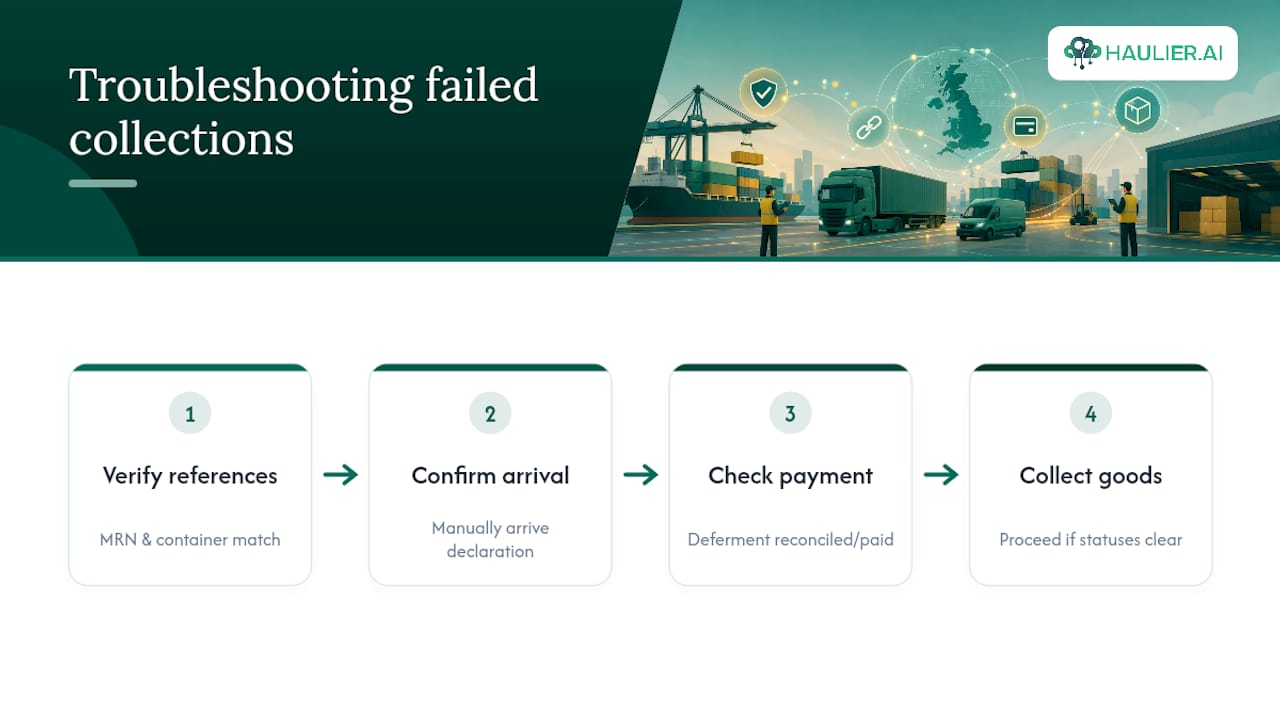
Mismatched references top the list. A driver arrives with an MRN that doesn’t match what the terminal system shows, usually because the booking was made against an old status or the wrong container number entirely.
Unarrived declarations cause more failed gate attempts than actual inspections do. The goods are physically present, but the system never got the “arrived” signal, so the release status never triggers. This is fixed by manually arriving the declaration yourself rather than waiting for it to resolve automatically.
Slot and gate reference errors happen when the haulier books a generic slot rather than one tied to the specific gate reference the terminal issued. Different terminals handle this differently, so check the specific port’s booking process rather than assuming it’s universal.
Payment lag on deferment accounts causes a status that looks cleared on paper but isn’t actually released, because the payment hasn’t been reconciled yet. If a gate rejection happens and everything else checks out, this is usually the answer.
Working through these in order, references first, then arrival status, then payment, resolves the overwhelming majority of failed collection attempts without needing to involve customs at all.
What changes when a freight forwarder or customs broker handles clearance?
Using a forwarder or broker doesn’t remove your responsibility for the release process, it shifts who’s watching the details.
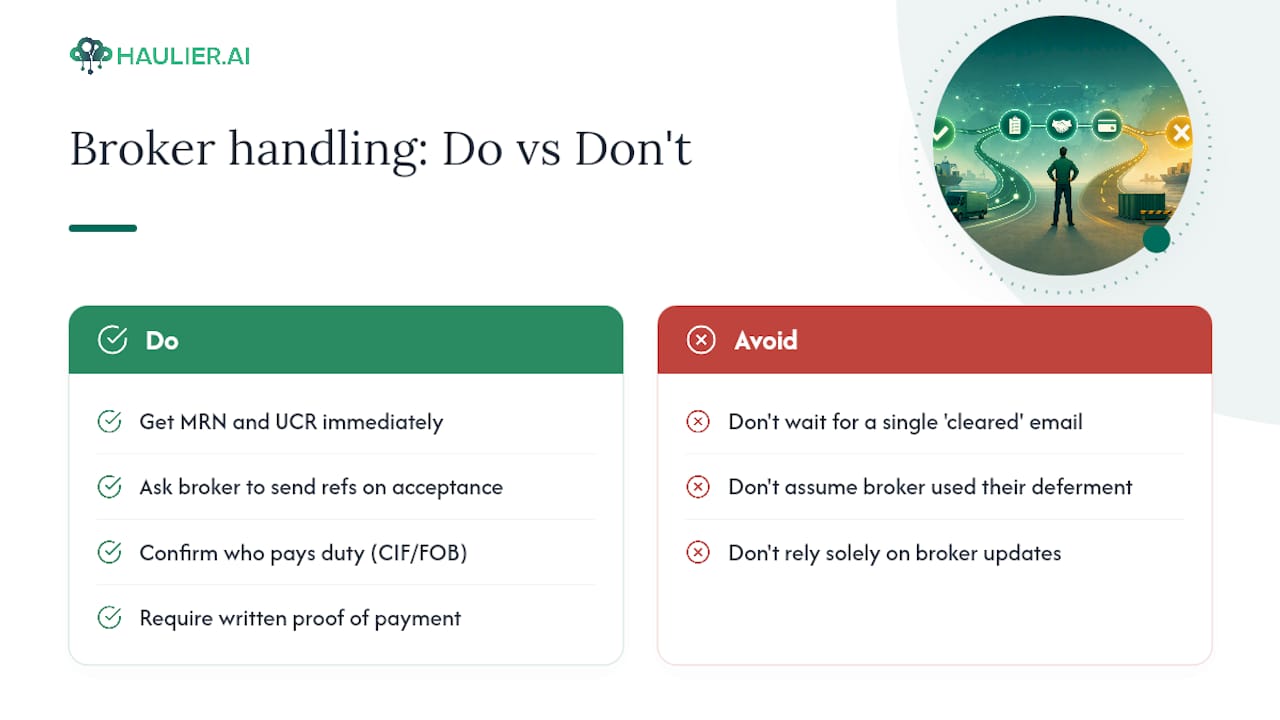
Your broker submits the declaration and monitors CDS on your behalf, which is useful, but you still need visibility into the same references: MRN, UCR, and payment status. Ask your broker to share these the moment the declaration is accepted, not just when release comes through. Waiting for a single “it’s cleared” email from a broker, without the underlying reference numbers, is how importers end up unable to instruct a haulier quickly.
If duty is paid through your broker’s deferment account rather than your own, confirm that arrangement explicitly and get written confirmation the payment has actually been charged. Brokers manage several clients’ deferment activity simultaneously, and a delay on their side shows up as a release delay on yours.
For international shipments, particularly from manufacturing hubs like China, it’s also worth clarifying who holds responsibility for duty payment and collection instruction under your shipping terms. Understanding where risk and title transfer under CIF versus FOB terms determines whether you or your supplier’s agent is the one who should be chasing the release status in the first place.
Whichever route you use, the practical fix is the same: get the MRN and UCR into your own systems as early as possible, so you can book a haulier the moment status changes, rather than waiting on a third party to relay it.
What actually stops release problems before they start
The importers who avoid collection delays aren’t the ones with the best luck. They’re the ones who keep CDS references and payment proof to hand and confirm the haulier has them before booking. Check “arrived” status routinely, and manually arrive it yourself the moment automation stalls.
— Vytautas
Book collection without the paperwork chase
Haulier is the practical alternative to chasing hauliers by phone and email once your goods show as released to collect. The platform’s AI-assisted, human-backed transport desk verifies your MRN, UCR and terminal requirements before a haulier ever heads to the gate, which is precisely where most failed collections originate.
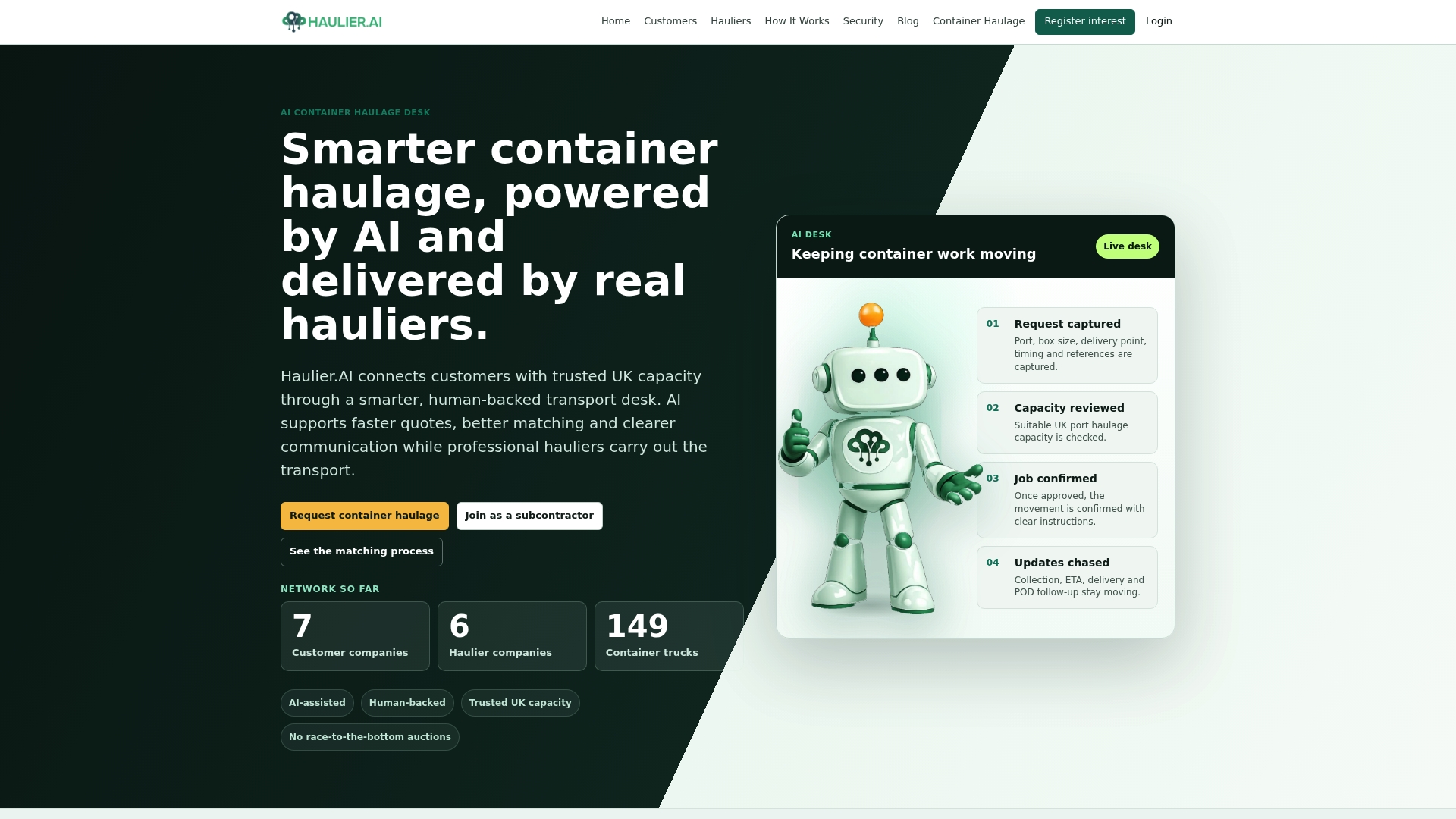
Instead of juggling a paperwork dossier across email threads, you get centralised visibility: your references, your booking confirmation, and real-time updates on container movement in one place. Hauliers on the platform see your job details upfront and confirm acceptance before arrival, so you’re not left waiting to discover a gate rejection after the fact. That matters most when free time is running out and every hour of delay adds to your storage bill.
If you’re coordinating container collection regularly, whether as an importer or a freight forwarder managing multiple clients, request container haulage through Haulier and get a haulier matched to your job with the paperwork already verified.
FAQ
How long will UK customs hold my package?
Documentary checks often clear within a working day if your paperwork is accurate; physical inspections can take several days depending on terminal and officer availability.
How do I get my package released from customs?
Ensure duty and VAT are paid or secured through a deferment account, resolve any documentary or inspection holds the National Clearance Hub flags, and confirm your CDS status reads “completed” against your MRN.
What does it mean if a parcel has been released from customs?
It means HMRC has finished its checks and duty/VAT conditions are met, so the goods can legally be collected, though you still need to confirm physical availability at the terminal.
What happens after customs release?
You book a haulier or collection slot, quoting your MRN, UCR, container number and terminal gate reference. A platform like Haulier’s transport desk can confirm the haulier has accepted these details before the truck sets off, cutting the risk of a rejected gate entry.