
Container haulage article
HGV driver shortage UK: what logistics managers need to know
Discover insights on the HGV driver shortage in the UK, its impact on logistics, and what managers can do to navigate these challenges.
There is a material but uneven HGV driver shortage in the UK right now. According to the Department for Transport, 26% of HGV businesses reported driver vacancies in Q4 2025, up from 24% in Q4 2024, though still well below the 43% peak recorded in Q4 2021. Missed deliveries due to unavailable drivers reached 23% in Q4 2025. The RHA estimates the UK needs around 60,000 new HGV drivers annually while the training pipeline and pass-to-employment conversion are running at materially lower rates. This gap is not closing on its own.
For operations directors and fleet managers, the practical consequences are real: spot rates stay elevated, agency reliance is costly, and seasonal peaks expose the thinness of the driver pool in ways that quarterly averages conceal.
Three quick signals to watch right now:
- Vacancy rate trend: Q4 2025 at 26%, ticking upward from 24% a year earlier
- Missed deliveries: 23% of businesses affected in Q4 2025, a figure that rises sharply at seasonal peaks
- Training pipeline gap: annual need of roughly 60,000 drivers versus a pipeline running at less than half that level
26% of UK HGV businesses reported driver vacancies in Q4 2025 — up from 24% in Q4 2024, and a signal that the post-2021 recovery has stalled rather than continued.
Key takeaways
The HGV driver shortage in the UK is real, persistent, and worsening at the margins: 26% of businesses reported vacancies in Q4 2025, missed deliveries hit 23%, and the training pipeline is running at less than half the 60,000 annual replacement rate the sector needs.
| Point | Details |
|---|---|
| Vacancy rate rising again | 26% of HGV businesses reported vacancies in Q4 2025, up from 24% in Q4 2024. |
| Missed deliveries at 23% | Nearly one in four businesses affected in Q4 2025; the rate rises further at seasonal peaks. |
| Pipeline gap is structural | The UK needs roughly 60,000 new drivers annually; the training and conversion pipeline falls well short. |
| Retention beats recruitment | RHA Pay Report 2026 shows pay plus driver experience improvements outperform pay rises alone. |
| Haulier fills the capacity gap | Haulier’s AI-assisted desk gives freight forwarders and importers fast access to vetted UK hauliers for container movements. |
Table of Contents
- How do the core HGV driver vacancy figures actually stack up?
- What is actually driving the UK’s shortage of truck drivers?
- What has the government actually done about the driver shortage?
- How is the driver shortage hitting operators and supply chains?
- A practical playbook for logistics managers facing recruitment and retention pressure
- How digital marketplaces can help when your own driver pool falls short
- What does the outlook look like for 2026 and 2027?
- The conversion problem is the real story here
- Haulier gives you immediate container haulage capacity when your driver pool falls short
- Sources
- FAQ
How do the core HGV driver vacancy figures actually stack up?
The headline numbers come from the DfT’s Road Freight Statistics series (RFS03), a targeted survey of UK haulage businesses. It is worth understanding what the data measures and where its limits sit before drawing operational conclusions.
Vacancy and missed-delivery trend (DfT RFS03):
| Metric | Q4 2021 (peak) | Q4 2024 | Q4 2025 |
|---|---|---|---|
| Businesses reporting driver vacancies | 43% | 24% | 26% |
| Businesses reporting missed deliveries | Not published at peak | Baseline | 23% |
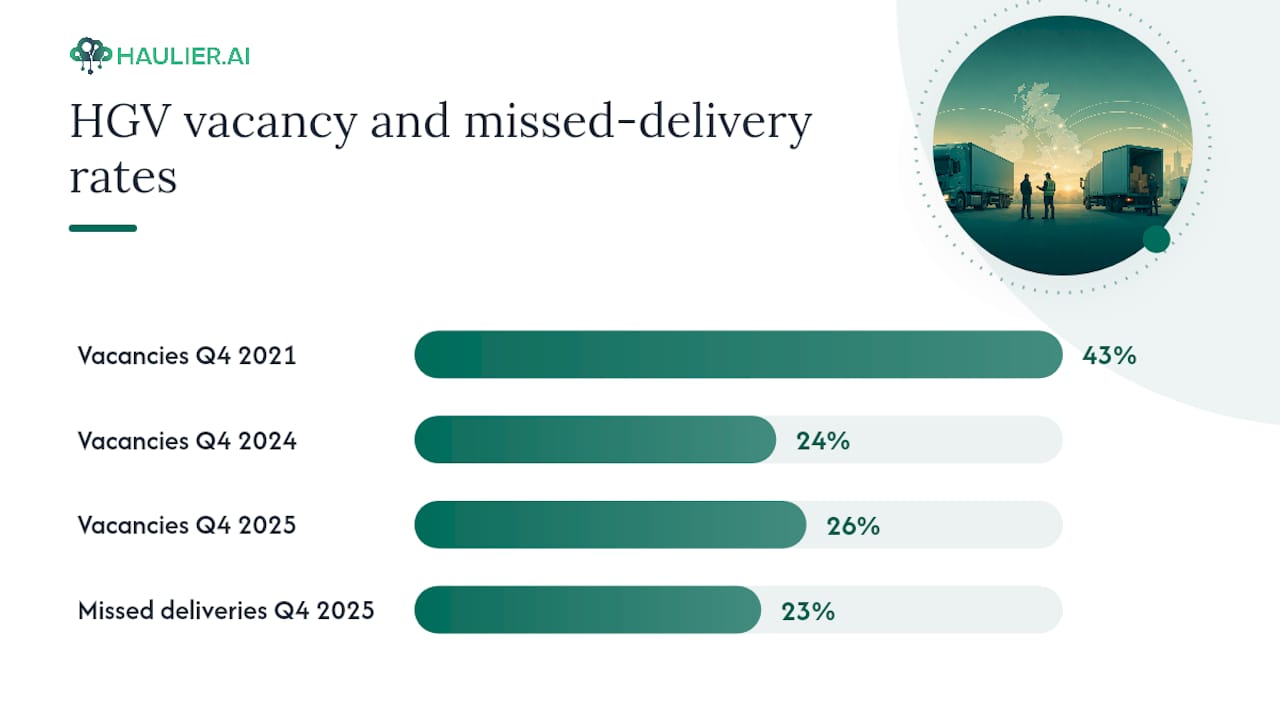
The uptick from 24% to 26% between Q4 2024 and Q4 2025 is modest but directionally significant. The shortage is not returning to its 2021 crisis level, but it is no longer improving either.
Top reasons businesses gave for vacancies (Q4 2025, DfT Road Freight Statistics 2025):
- Better pay available elsewhere: cited by 42% of businesses with vacancies
- Existing drivers leaving the sector: 38%
- Driver retirements: 33%
These three causes interact. Retirements shrink the pool permanently; drivers leaving for better pay elsewhere represent a retention failure; and both effects compound when the training pipeline cannot replace them fast enough.
A note on methodology: The RFS03 series surveys a sample of haulage businesses, not the full population. The DfT publishes sample sizes and confidence intervals in the release notes. Cross-series comparisons with job-advertisement vacancy indices or ONS Labour Force Survey figures will show different numbers because they measure different things. Vacancy measures vary by data source, so treat cross-series differences with caution rather than averaging them.
On DQC (Driver Certificate of Professional Competence) renewals: a cohort of drivers whose five-year DQC expired during the pandemic years did not renew, effectively leaving the licensed pool. The RHA has tracked this as a proxy for potential leavers. The scale of non-renewals added to the structural shortfall even as test pass volumes recovered.
DVSA testing data shows test throughput peaked in the post-pandemic catch-up period and has since moderated. Critically, a test pass does not guarantee an employed driver. Insurance underwriting constraints, agency placement rules, and the absence of structured employer onboarding programmes mean a meaningful share of newly qualified drivers never enter paid HGV work.
What is actually driving the UK’s shortage of truck drivers?
The causes are structural, not cyclical. Fixing them requires more than a pay rise or a temporary testing blitz.
Ageing workforce and retirement pressure
ONS analysis found the largest fall in HGV driver numbers occurred among middle-aged cohorts, not just older workers approaching retirement. That pattern matters because it suggests the workforce is not simply ageing out at the top; it is also failing to retain experienced drivers in the 40–55 bracket who have the most productive years ahead of them.

Pay and conditions: necessary but not sufficient
The RHA Pay Report 2026 makes a point that operators often miss: pay increases alone seldom fix retention. Operators that combine competitive pay with genuine improvements to the driver experience — predictable hours, decent rest facilities, reduced paperwork burden — retain staff more effectively than those who simply match a competitor’s rate.
Training pipeline and test capacity
The cost of HGV training deters many potential entrants. DVSA test capacity, while expanded post-pandemic, has not kept pace with demand at peak periods. Backlogs in some regions push waiting times out by weeks, which delays employer onboarding and discourages candidates who cannot afford to wait.
Post-Brexit labour supply
Before 2021, EU drivers on short-term postings filled a meaningful share of peak-season capacity. The end of free movement removed that buffer. It did not cause the shortage on its own, but it removed the release valve that had historically smoothed seasonal demand spikes.
Pandemic cohort effects
Reduced test throughput in 2020–22 created a gap cohort: drivers who would have qualified in those years did not. That cohort effect is still working its way through the age profile of the workforce.
The conversion problem: the most underreported cause
The UK has no national system linking HGV test passes to employment outcomes. Fueler Consulting’s analysis describes this as a policy blind spot: without knowing how many newly qualified drivers actually enter paid HGV work, neither government nor industry can accurately measure whether training investment is working.
Insurance underwriting is a concrete barrier here. Some insurers apply age or experience thresholds that effectively exclude newly qualified drivers from certain fleet policies. Smaller hauliers, who cannot self-insure or negotiate bespoke terms, are most exposed. The ADR Network’s Broken Transition report documents this as a systemic multi-stakeholder problem requiring coordinated action from insurers, employers, agencies, and government.
What has the government actually done about the driver shortage?
The GOV.UK topical event page lists the published measures. Here is what has been announced and where the gaps remain.
Government measures (published):
- Skills Bootcamps for HGV training, funded through the Department for Education, to reduce the cost barrier for new entrants
- Temporary increases in DVSA testing capacity, including extended testing hours and additional examiners
- Streamlined medical and licensing processes for drivers returning after a break
- Incentives and communications campaigns targeting former HGV drivers to encourage return to the sector
Industry and trade body initiatives:
- The Road Haulage Association has published pay benchmarking data and workforce analysis to help operators understand where they sit relative to the market
- Logistics UK has engaged with government on testing capacity and training funding
- Generation Logistics, a sector-wide awareness campaign, targets younger workers and career changers to broaden the recruitment funnel
- Private training bootcamps, often part-funded through Skills Bootcamp contracts, have expanded capacity in major urban areas
Where the gaps are:
The government’s measures address supply-side barriers (cost, test access) but do not yet tackle the conversion problem. There is no funded programme that tracks whether a newly qualified driver enters paid employment, and no national insurer engagement scheme to address underwriting barriers for new entrants. The scale of Skills Bootcamp funding, while useful, covers a fraction of the 60,000 annual need.
How is the driver shortage hitting operators and supply chains?
The operational effects are not uniform. A national pallet network with 200 drivers absorbs a 5% vacancy rate differently from a regional haulier running 12 trucks.
Direct operational effects:
- Missed deliveries: 23% of businesses affected in Q4 2025, with the rate rising during Q3 seasonal peaks
- Increased reliance on agency drivers, typically at a 20–40% cost premium over directly employed drivers (trade press estimate; not from a sourced dataset)
- Overtime pressure on existing drivers, raising fatigue risk and Working Time Directive exposure
- Spot rate inflation when capacity is thin, particularly for specialist loads (temperature-controlled, hazardous goods, abnormal loads)
Port and warehouse effects
Container dwell times at major ports extend when hauliers cannot resource collections promptly. At Tilbury, Teesport, and Felixstowe, a shortage of available drivers for container haulage translates directly into demurrage charges for importers and freight forwarders. Warehouse throughput suffers when inbound deliveries are delayed and outbound collections cannot be confirmed.
Scenario exposure by operator type:
- Small haulier (under 20 vehicles): highest exposure to vacancy rates; limited ability to absorb agency premiums; most likely to turn down work during peak periods
- National pallet network: can redistribute loads across the network but faces systemic pressure when multiple member depots report vacancies simultaneously
- Supermarket distribution centre: operates on tight delivery windows; even a 5% driver shortfall can trigger service-level penalties with retail customers
Cost impacts
Pay increases, agency fees, and productivity losses compound. The RHA Pay Report 2026 notes that operators are competing not just with other hauliers but with sectors like construction, utilities, and retail distribution that offer comparable pay with less unsocial hours.
A practical playbook for logistics managers facing recruitment and retention pressure
The steps below are sequenced by speed of impact. Start with retention before recruitment; replacing a driver costs more than keeping one.
Recruitment
- Benchmark your advertised pay against the RHA Pay Report before posting any vacancy. Underpaying by even £1–2 per hour relative to local competitors extends fill time significantly.
- Partner with a local college or training provider on an apprenticeship pathway. The HGV Driving Apprenticeship Standard (Level 2) allows employers to use the apprenticeship levy to fund training costs.
- Run targeted local outreach: job fairs at logistics parks, referral bonuses for existing drivers, and partnerships with armed forces resettlement programmes (ex-military candidates often hold relevant licences).
- Shorten your interview-to-offer cycle. Candidates with a valid licence are in demand; a two-week decision process loses them to faster-moving competitors.
Retention
- Audit shift patterns for predictability. Drivers who cannot plan their personal lives around their working hours leave. Fixed rotas, even on a four-week rolling basis, improve retention materially.
- Invest in rest facilities. A clean, secure cab park, a decent canteen, and reliable Wi-Fi cost less than one agency driver week per month.
- Reduce administrative burden. Pre-trip inspection apps, digital POD systems, and automated tachograph uploads cut the unpaid time drivers spend on paperwork.
Converting newly qualified drivers into productive roles
- Build a phased exposure programme: start new drivers on familiar, shorter routes with a mentor in the cab or on radio contact. Pair this with telematics-backed supervision so insurers can see a safety record building in real time. ADR Network’s analysis shows this approach reduces insurance friction and accelerates time-to-productive deployment.
- Engage your insurer before hiring a newly qualified driver. Some underwriters will agree a supervised period at a lower premium if you can demonstrate a structured onboarding programme.
Contingency planning
- Triage your service commitments by margin and contractual penalty. Know in advance which loads you will protect and which you will sub-contract when capacity is short.
- Build relationships with subcontractor hauliers before you need them. A marketplace connection made in January is worth more than a desperate phone call in August.
Metrics to track:
How digital marketplaces can help when your own driver pool falls short
When in-house recruitment cannot fill the gap fast enough, a managed marketplace offers a different route to capacity. The mechanics matter.
How marketplace matching works
A digital freight marketplace pools available haulier capacity and matches it to load requirements in near real time. Hauliers list their availability and set their own rates; customers post requirements and receive quotes. The platform handles communication, documentation flow, and status updates, removing the phone-tag that consumes hours of admin time in traditional spot-market sourcing.
For container haulage specifically, the match quality depends on port coverage, equipment availability, and timing. A well-designed platform surfaces only hauliers who can actually do the job, rather than generating a list of names to call.
Where an AI-assisted desk adds value
An AI-assisted, human-backed transport desk goes further than a self-service board. It interprets the job requirements, pre-screens haulier suitability, and manages the communication loop so the customer receives a confirmed quote rather than a list of possibilities to chase. Haulier operates this model for UK container haulage: managed quoting, real-time updates, haulier-controlled rates, and paperwork tracking in one place.
When to use a marketplace versus in-house recruitment:
- Use in-house recruitment for your core, predictable volume. Drivers you employ directly are cheaper per movement at scale and give you scheduling control.
- Use a marketplace for peak overflow, specialist loads, or port collections where your own fleet has no coverage. The speed-to-capacity benefit is most pronounced here.
- Use a managed desk when the admin burden of spot-market sourcing is itself a cost. If your operations team spends two hours sourcing a single container movement, the desk pays for itself quickly.
Compliance and documentation
Reputable marketplaces conduct operator licence checks, insurance verification, and vehicle compliance checks before onboarding hauliers. For container haulage, this includes port access credentials and customs documentation capability. Customers should confirm what checks a platform performs and how frequently they are renewed.
When capacity is tight and every missed collection carries a demurrage cost, the question is not whether to use a marketplace but which one has the coverage and compliance standards your customers require.
Limitations
Marketplaces do not solve the underlying driver shortage. They redistribute existing capacity more efficiently. During a severe, sector-wide shortage, available capacity on any platform will also be constrained. The value is in accessing capacity you could not reach through your own network, not in creating capacity that does not exist.
What does the outlook look like for 2026 and 2027?
The shortage is not a single cliff event. It is a gradual tightening that will be felt most acutely at seasonal peaks unless the pipeline and conversion problems are addressed. Three plausible scenarios:
Scenario 1: Gradual easing
Triggered by: Skills Bootcamp expansion, insurer engagement on new-entrant underwriting, and a sustained period of competitive pay across the sector.
What to do: Continue hiring, invest in retention, and maintain marketplace relationships as a buffer rather than a primary source.
Scenario 2: Cyclical tightening
Triggered by: Economic growth increasing freight demand faster than driver supply recovers; DQC renewal gaps creating a further cohort exit; no resolution to the conversion problem.
What to do: Accelerate retention programmes now, lock in agency agreements before peak season, and expand marketplace access for container and specialist movements.
Scenario 3: Structural deterioration
Triggered by: Continued demographic attrition without replacement, policy inaction on conversion tracking, and insurer underwriting remaining unchanged.
What to do: Fundamentally review your service commitments, invest in technology that reduces driver hours per movement (route optimisation, drop-and-hook operations), and consider whether your current fleet model is viable at scale.
Indicators to monitor:
- DfT RFS03 quarterly vacancy series (next release will show Q1 2026 direction)
- DVSA test throughput and pass rates (available quarterly)
- DQC renewal volumes (RHA and DVSA publish periodically)
- RHA pay benchmarks (annual; next report due 2027)
- Insurance placement trends for new entrants (trade press and broker feedback)
The conversion problem is the real story here
The vacancy rate gets the headlines. The conversion problem should.
Every quarter, a cohort of newly qualified HGV drivers passes their test and then, for a significant proportion of them, nothing happens. No job offer, no structured onboarding, no insurer willing to cover them on a commercial fleet. The UK has no national tracking system to measure this. Fueler Consulting’s analysis calls it a policy blind spot, and the description is accurate.
The government’s response has focused on the front end of the pipeline: funding training, expanding test capacity, encouraging former drivers to return. These are necessary. But they are not sufficient if a meaningful share of the people who complete training never enter paid HGV work. Spending public money on test passes that do not convert to employed drivers is not a workforce strategy; it is a subsidy for the training industry.
The operators who are actually moving the needle on this are doing something specific: they are building structured phased exposure programmes, sharing telematics data with their insurers, and treating newly qualified drivers as an investment rather than a liability. That is not a government programme. It is an operational choice. And the operators making it are filling roles faster and retaining drivers longer than those who are not.
The broader lesson for logistics managers is that the shortage is partly a data problem and partly a coordination problem. The data problem is that nobody knows how many test passes convert to employment. The coordination problem is that insurers, employers, agencies, and government are each waiting for someone else to move first. Until those two problems are addressed, the vacancy rate will keep ticking upward at the next seasonal peak, regardless of how many bootcamp places are funded.
Haulier gives you immediate container haulage capacity when your driver pool falls short
When driver vacancies are squeezing your container operations, waiting weeks for a new hire is not an option. Haulier’s AI-assisted container haulage desk connects freight forwarders and importers directly to available, vetted UK hauliers, with managed quoting, real-time status updates, and full paperwork tracking from booking to delivery.
The practical difference: you get confirmed capacity faster than a traditional spot-market call-round, hauliers control their own rates so pricing reflects the actual market, and your operations team stops spending hours chasing updates. Port coverage across the UK, including Tilbury and Teesport, means the platform is useful precisely where driver shortages bite hardest.
Request container haulage capacity and get a quote for your next movement.
Sources
The figures and analysis in this article draw on the following primary and industry sources:
- Heavy goods vehicle driver vacancies in the United Kingdom: 2025
- Pay Report 2026
- The Broken Transition
- UK lacks data on whether new HGV drivers find work, report warns - The Haulier
- Fall in HGV drivers largest among middle-aged workers
FAQ
Is there still an HGV driver shortage in the UK in 2026?
Yes. The DfT reported that 26% of HGV businesses had driver vacancies in Q4 2025, up from 24% in Q4 2024. The shortage is below its 2021 peak of 43% but is no longer improving.
Are lorry drivers in demand in the UK?
Demand remains strong. The RHA estimates the UK needs roughly 60,000 new HGV drivers annually, while the training pipeline and pass-to-employment conversion are running at materially lower rates, keeping the labour market tight.
What is the average salary of an HGV driver in the UK?
The RHA Pay Report 2026 provides the most current benchmarking data for HGV driver pay by region and vehicle type. Specific salary figures vary by route type, employer, and region; consult the RHA report directly for current benchmarks.
What do Tesco HGV drivers earn?
Tesco’s driver pay rates are not publicly listed in the primary sources used here. For current figures, the RHA Pay Report 2026 covers supermarket distribution pay bands, and Tesco publishes vacancies with stated pay on its careers site.
How can logistics managers reduce exposure to the driver shortage?
Combine competitive pay with driver experience improvements (predictable shifts, better rest facilities, reduced admin), build a phased onboarding programme for newly qualified drivers, and maintain marketplace access for peak overflow and container movements where your own fleet has no coverage.