
Container haulage article
Driver apps for logistics: a guide for freight teams
Unlock efficiency with driver apps logistics! Enhance visibility, cut down calls, and streamline document exchange for your freight team.
Driver apps are the driver-facing single source of truth for job status, proof of delivery, and document exchange in container haulage. They cut phone calls, eliminate paper manifests, and give freight forwarders, importers, and logistics managers the real-time visibility they need to make decisions and keep customers informed.
The immediate operational wins are straightforward:
- Fewer phone checks from dispatch chasing drivers for ETAs or POD confirmation
- Timestamped records that hold up under DVSA audit or chartered review
- Faster POD turnaround, with significantly faster processing reported by Mandata after digitising customer paperwork
- Better real-time visibility for planners and customer updates during port collections and deliveries
- Compliance support for EU 561/2006 driving-hours monitoring, with apps like Logistics UK Vision displaying remaining hours and weekly rest totals
Haulier connects freight forwarders and importers to trusted UK hauliers through an AI-assisted transport desk, and driver-facing updates sit at the core of how that visibility is delivered.
Table of Contents
- Why driver apps matter for container haulage operations
- Key features to require in a driver app for UK container haulage
- What driver apps can and cannot solve for compliance and driving hours
- How a driver app should fit into your tech stack
- Pilot and roll-out roadmap: what to expect on timeline and cost
- How to measure ROI and which KPIs to track after deployment
- Common pitfalls during adoption and how to avoid them
- Key takeaways
- The gap between what driver apps promise and what actually changes
- Fewer calls, faster PODs, and full visibility with Haulier
- Useful sources and further reading
- FAQ
Why driver apps matter for container haulage operations
The business case for mobile apps in logistics is not about technology for its own sake. It is about removing the manual communication loop that slows every container movement.

Every time a dispatcher phones a driver to confirm arrival at a port, or waits for a signed delivery note to come back in the post, that is dead time. RAM Tracking describes this precisely: its driver app stops managers chasing paperwork and waiting for callbacks by giving drivers digital tools for daily tasks and giving managers live visibility. RAM serves over 23,000 businesses across the UK and North America, which gives some sense of how widely this problem is felt.
For container flows specifically, the gains compound. Faster POD return means faster invoicing. Digital walkaround checks and defect logs create auditable evidence without a paper trail. Fewer exceptions at handover mean fewer delays releasing container paperwork at ports.
- Reduced admin time per movement through digital job dispatch and ePOD
- Quicker container release at port when documentation is confirmed digitally
- Auditable timestamped records for DVSA, DVLA, or chartered compliance reviews
- Lower invoicing lead time when PODs return automatically rather than via post
Pro Tip: Start with job-status updates and ePOD workflows before anything else. Drivers see the time saving immediately, which builds buy-in, and planners see measurable results within the first two weeks of a pilot.
Key features to require in a driver app for UK container haulage
Not every logistics driver application is built for the demands of container haulage. Port collections, multi-leg movements, and tight compliance requirements mean the feature checklist is longer than for simple parcel delivery.
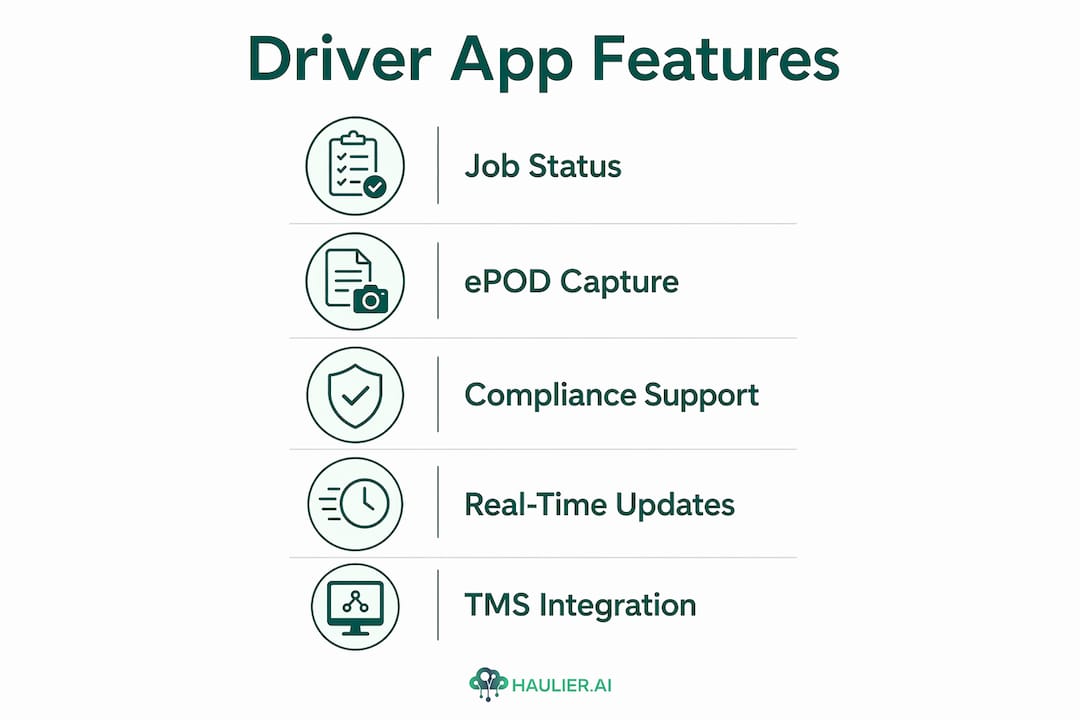
Core features
- Job status with live ETA updates pushed to planners and customers
- ePOD with photo capture, customer signature, and automatic return to the office
- Offline mode with automatic sync when connectivity is restored (critical in port areas with patchy signal)
- Document upload, PDF signing, and attachment of customs or release paperwork
Compliance features
- Driver-hours display and tachograph integration, or clear compatibility with services like Logistics UK Vision
- Digital vehicle walkaround checks aligned to DVSA standards, with photo evidence and defect logging
- Coupling and load security inspections with timestamped digital sign-off
Communication features
- Secure in-app messaging tied to specific jobs, so no personal numbers are shared
- Escalation flags for exceptions (delays, damage, refused entry)
- Configurable notifications for planners and customers at key milestones
Integration expectations
| Integration point | Expected data flow |
|---|---|
| TMS dispatch | Jobs pushed from TMS to driver app; status updates pulled back automatically |
| Booking platform | Port and booking references synchronised; ETAs visible to customers |
| Document repository | PODs and signed documents returned to TMS or document store on completion |
| Port systems | Container reference matching; arrival and departure timestamps shared |
What driver apps can and cannot solve for compliance and driving hours
Apps support compliance. They do not replace it.
The Logistics UK Vision app shows drivers their remaining driving hours, weekly rest totals, and a log of infringements. That kind of real-time visibility helps drivers self-manage under EU 561/2006 rules, which continue to apply in the UK post-Brexit for most HGV operations. The Vision app on Google Play requires a company Tacho contract with Logistics UK, which signals the important boundary: apps are a monitoring layer, not the legal record.
Tachograph data remains the authoritative source for driving-hours compliance. An app can surface a likely infringement early, but the operator must still reconcile that data with tachograph card uploads and maintain records under the relevant retention rules.
- Apps display activity totals and flag potential breaches in near-real time
- They do not replace tachograph data retention obligations
- Operators must still manage formal compliance actions through established tachograph workflows
- Timestamped app records can support, but not substitute for, legal tachograph evidence
Pro Tip: Use app infringement flags as an early-warning system. When a flag appears, apply your standard tachograph review process rather than treating the app alert as the final record.
Compliance note: Driver apps are general information tools for monitoring. Operators should confirm current driving-hours obligations with the DVSA or a qualified transport consultant for their specific operation.
How a driver app should fit into your tech stack
The simplest way to think about integration is a three-node flow: TMS → driver app → port or booking system, with data returning automatically at each stage.
Dispatch creates a job in the TMS. That job is pushed to the driver app, where the driver accepts it and begins updating status milestones: collected, en route, arrived at port, loaded, departed, delivered. Each update returns to the TMS and triggers customer notifications without anyone picking up a phone. The completed POD attaches to the job record automatically.
- TMS job push and pull: the app must accept jobs from the TMS and return status updates without manual re-entry
- Document exchange: PODs, customs documents, and release paperwork should flow back to the TMS or document store on completion
- Booking and port reference sync: container and booking references must be visible in the app so drivers can confirm the right job at the right location
- Connectivity fallbacks: offline mode with queued sync handles port areas and warehouses with poor mobile signal
For high-volume operations, near-real-time webhooks are preferable to batch file transfers. Many UK-based fleet management apps now operate as software-only solutions, using the driver’s smartphone for GPS, ePOD, and checks without any vehicle hardware. That removes a significant integration barrier and makes short pilots far easier to set up. For TMS context, Haulier’s overview of transport management companies covers the main platforms freight teams are likely to connect with.
Pilot and roll-out roadmap: what to expect on timeline and cost
Software-only apps lower the barrier considerably. HauliK, for example, lists plans from £3.50 per vehicle per month and requires no telematics hardware for core workflows. That makes a small pilot genuinely low-risk.
Typical timeline
| Phase | Duration | Focus |
|---|---|---|
| Pilot | 2–6 weeks | 5 drivers, representative routes, POD and job-status workflows only |
| Phased roll-out | 4–12 weeks | Expand by depot or route; integrate with TMS; train dispatchers |
| Operational stabilisation | 3–6 months | Full workflow adoption, KPI baselining, compliance workflow alignment |
Cost factors to budget for
- Per-driver or per-vehicle licence fees (software-only plans start around £3.50/vehicle/month at the entry level)
- Custom integration costs if the TMS requires bespoke API work
- Device provisioning if drivers do not use personal smartphones
- Driver training time (typically 1–2 hours per driver for core workflows)
Pilot go/no-go checklist
- Define two or three measurable KPIs before the pilot starts (POD turnaround, missed-update rate, admin hours)
- Select a representative cohort of routes including at least one port collection
- Confirm TMS integration or agree a manual workaround for the pilot period
- Brief drivers on what the app does and what it does not track
- Set a review date at week three to assess adoption and data quality
How to measure ROI and which KPIs to track after deployment
The metrics that matter most in container haulage are POD turnaround time, missed-update rate, and admin hours per movement. Everything else follows from those three.
Mandata’s data points to up to 60% faster POD processing after digitising customer paperwork. If a team processes 50 movements per week and each POD currently takes 15 minutes of admin to chase, file, and invoice, a 60% reduction saves roughly 450 minutes of admin per week. At a loaded admin cost of £20/hour, that is £150 per week recovered from a single workflow change.
- POD turnaround time: target same-day return within the first month of roll-out
- Missed-update rate: track how often planners have to call drivers for status; aim to reduce by at least half within 6–8 weeks
- Admin hours per movement: baseline before go-live and measure monthly
- Dwell time at port: compare pre- and post-deployment averages; digital documentation speeds release
- On-time delivery percentage: improved visibility tends to surface delays earlier, allowing re-routing
- Invoicing lead time: faster PODs mean faster invoicing cycles
Set realistic targets for the first 3–6 months. Full adoption rarely happens overnight, and KPI improvements typically plateau after the first quarter before stabilising at the new baseline.
Common pitfalls during adoption and how to avoid them
The most common failure mode is not technical. It is driver engagement.
HauliK’s guidance is direct on this: operators report higher adoption when drivers see direct time savings and when apps avoid intrusive continuous tracking. Location captured only at job milestones (arrived, loading, departed) rather than continuously in the background is a meaningful distinction for drivers who are understandably wary of surveillance.
- Poor driver engagement: involve drivers before go-live; show them the ePOD workflow and how it removes the return-to-office paperwork run
- Scope creep in the pilot: limit the pilot to ePOD and job-status updates; adding compliance modules and messaging in week one overloads both drivers and dispatchers
- No TMS integration: running the app as a standalone tool creates double-entry and erodes trust in the data
- Continuous tracking: milestone-based location updates are sufficient for most container operations and far less likely to trigger driver resistance
Pro Tip: Run a 30-minute demo with drivers before the pilot starts. Show the ePOD workflow end-to-end and ask drivers to complete one test delivery. Drivers who have touched the app once are significantly more likely to adopt it consistently.
Key takeaways
Driver apps for logistics deliver the fastest ROI in container haulage when ePOD and job-status workflows are deployed first, compliance monitoring is treated as a support layer rather than a replacement for tachograph records, and driver buy-in is secured before full roll-out.
| Point | Details |
|---|---|
| Start with ePOD and job status | These two workflows deliver measurable admin savings within weeks and build driver buy-in early. |
| Compliance support, not replacement | Apps like Logistics UK Vision display driving hours but do not replace tachograph data retention obligations. |
| Software-only pilots are low-risk | Entry-level plans from around £3.50/vehicle/month mean pilots can start without hardware investment. |
| Track three core KPIs | POD turnaround, missed-update rate, and admin hours per movement give the clearest picture of ROI. |
| Haulier for marketplace visibility | Haulier’s AI-assisted transport desk delivers real-time job updates and document handling for container haulage without the overhead of managing a driver app rollout yourself. |
The gap between what driver apps promise and what actually changes
The industry conversation around driver apps tends to focus on features: ePOD, walkaround checks, tachograph integration. That framing is useful for procurement, but it misses the more important question, which is whether the operational culture will actually use the data the app produces.
Freight teams that get the most from these tools are not the ones with the most sophisticated platforms. They are the ones that changed a specific behaviour: dispatchers stopped phoning drivers for updates and started reading the app instead. That sounds trivial. Getting a team of experienced dispatchers to trust a screen over a phone call takes longer than any technical integration.
The compliance angle is similarly misunderstood. Apps that display remaining driving hours are genuinely useful for drivers managing their own time. But operators who treat an app infringement flag as a compliance action, rather than as a prompt to open the tachograph record, are building on a weak foundation. The app is the early-warning system. The tachograph is the evidence.
For freight forwarders and importers booking container haulage, the practical implication is this: the value of a driver app is not in the app itself. It is in whether the haulier you are working with has actually embedded it into their dispatch and POD workflows. A haulier who has the app installed but still phones you with updates has not changed anything.
Fewer calls, faster PODs, and full visibility with Haulier
Freight forwarders and importers booking container haulage through Haulier get real-time job updates and digital document handling without having to manage a driver app rollout or chase hauliers for status calls.
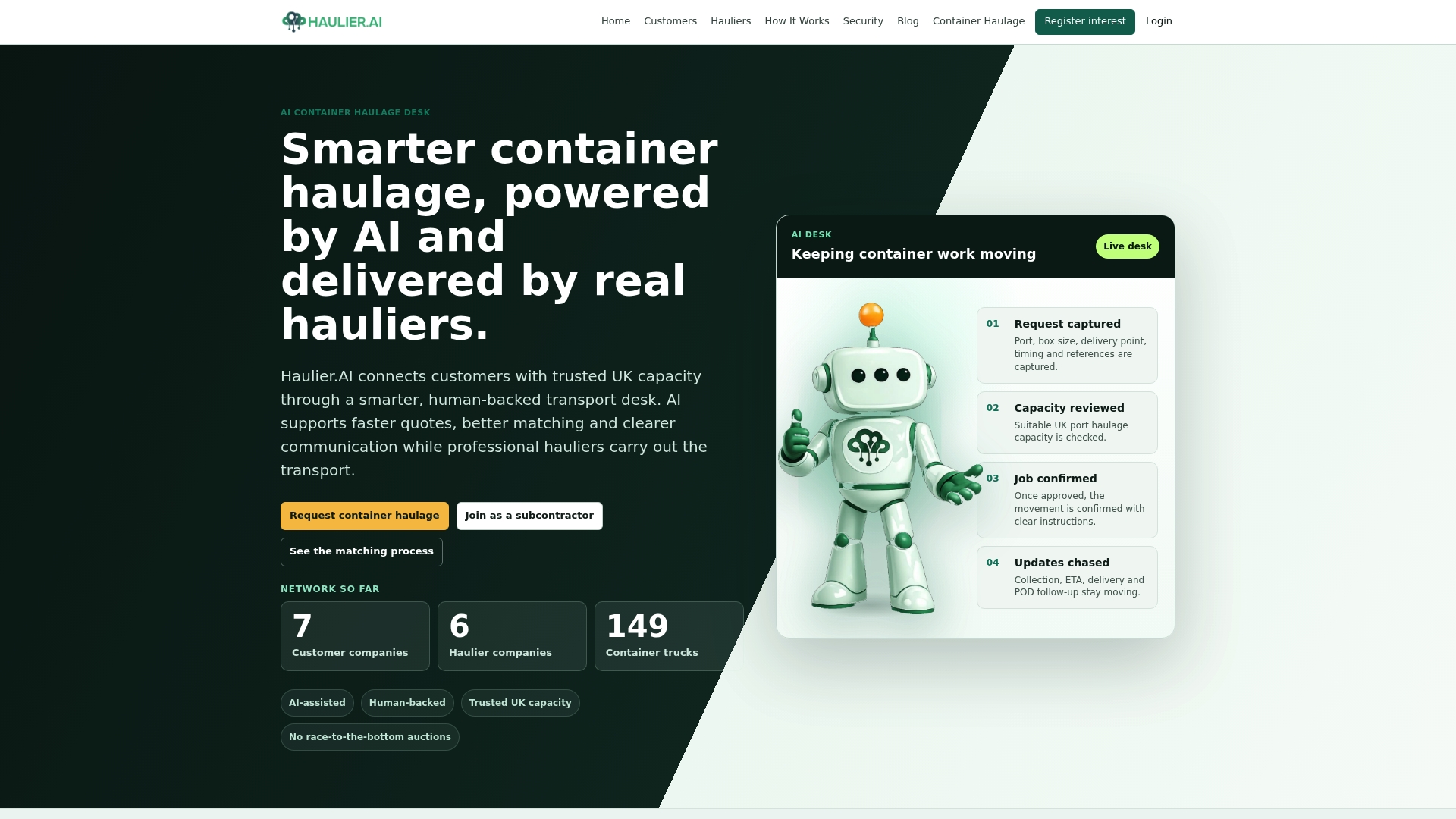
Haulier’s AI-assisted, human-backed transport desk connects you to trusted UK hauliers who operate with transparent job-status updates and paperwork tracking built into the booking process. Hauliers control their own rates and can decline unsuitable jobs, which keeps pricing fair and capacity reliable. The security and oversight model behind the platform means your data and documents are handled with the same rigour the guide above recommends for any driver app deployment.
If you are ready to book container haulage with visibility built in from the start, request a movement through Haulier today.
Useful sources and further reading
- Logistics UK Vision (App Store) — the authoritative UK source for driver-hours monitoring apps; useful for compliance teams reviewing EU 561/2006 obligations.
- Logistics UK Vision (Google Play) — Android download page; confirms contract requirements and feature scope for operators considering the Vision platform.
- RAM Tracking Driver App — practical overview of how a UK fleet app eliminates callbacks and paperwork; useful benchmarking for operational benefits.
- Mandata Manifest App — detailed explanation of digitising customer paperwork with ePOD; includes the 60% faster processing claim referenced in the ROI section.
- HauliK Compliance & Operations Software — entry-level pricing and software-only feature overview; useful for cost benchmarking during procurement.
- HauliK Driver App — driver-facing feature detail including milestone tracking and buy-in guidance; relevant to the pitfalls and change-management sections.
- Haulier — how it works — explains how Haulier’s marketplace delivers real-time updates and document handling for container haulage customers.
“Capture customer signature and photo evidence at delivery. POD is available to your office immediately.” — HauliK Driver App feature description, illustrating the immediate visibility that ePOD delivers to transport offices.
FAQ
What do driver apps actually do in logistics?
Driver apps give drivers a digital job list, ePOD capture, walkaround checks, and secure messaging, replacing phone calls and paper manifests with timestamped digital records that return to the office automatically.
How do driver apps help with driving-hours compliance in the UK?
Apps like Logistics UK Vision display remaining driving hours and weekly rest totals to support EU 561/2006 monitoring, but they do not replace tachograph data retention. Operators must still reconcile app data with tachograph card uploads.
How long does a driver app pilot typically take?
A focused pilot covering ePOD and job-status workflows typically runs 2–6 weeks with a small driver cohort, followed by a phased roll-out of 4–12 weeks before full operational stabilisation.
What is a realistic cost for a driver app in UK haulage?
Software-only platforms start from an affordable entry-level price per vehicle per month, with additional costs for custom TMS integration and device provisioning where required.
How does Haulier deliver driver-app-style visibility for container haulage?
Haulier’s AI-assisted transport desk provides real-time job updates and digital document handling for freight forwarders and importers booking container haulage in the UK, without requiring customers to manage a separate driver app deployment.