
Container haulage article
Logistics managers: stop chasing status with real time haulage updates
Operations first guide for logistics managers to build real time haulage updates. Covers telematics, driver adoption and a Haulier.AI case.
Real-time haulage updates give you a live, shareable view of every load in transit, replacing guesswork and check calls with continuous GPS and telematics feeds, geofenced milestone events and predictive ETAs. The payoff is measurable: carriers running full visibility see roughly 75% fewer check calls and 30% fewer detention disputes. The container haulage sector suffers more than most from this gap between what customers expect and what dispatch boards actually deliver.
TL;DR:
- Full visibility systems reduce check calls by roughly 75 percent and detention disputes by 30 percent when implemented properly.
- Combining telematics, driver apps, IoT sensors, geofencing, and traffic data creates trustworthy, end-to-end container haulage tracking.
- Most successful rollouts require clear KPIs, scope focus on one lane or depot, and driver engagement strategies from the start.
- Real-time updates are typically refreshed every 30 to 120 seconds via telematics, with additional data sources filling in engine-off periods.
- Outsourcing visibility through platforms like Haulier.AI offers cost-effective, reliable tracking without extensive in-house development.
Table of Contents
- What real-time haulage updates actually include
- How real-time updates actually get built: the data behind the dot
- The business case: what visibility actually saves you
- A step-by-step rollout checklist for real-time haulage updates
- How Haulier applies this in container haulage
- Three pitfalls I’d flag before you build anything
- Get real-time visibility without building it yourself
- Sources
- FAQ
What real-time haulage updates actually include
A proper real-time update system is not a single dot on a map. It is a stack of features working together, and most operators only discover the gaps once a customer asks a question the system cannot answer.
Live GPS tracking sits at the base, but the update cadence matters more than the map itself. Telematics feeds from an ELD typically refresh every 30 to 120 seconds while a vehicle is moving, which is tight enough for accurate ETA recalculation but provides no updates once the engine is off. That is where driver apps, geofencing and exception alerts earn their place.
- Predictive ETA: combines live position, traffic and historical transit times rather than a static distance-over-speed guess.
- Geofenced milestone events: automatic arrival, departure and detention-timer triggers, removing the need for a driver to phone in.
- ePOD and document capture: photographs and signatures logged the moment goods are delivered, feeding invoicing directly.
- Exception alerts: off-route deviation, unusually long stops or temperature breaches pushed to dispatch and customer channels.
- Customer-facing tracking links: a shareable portal that answers “where’s my load?” before anyone picks up the phone.
Each of these features solves a specific failure mode. Geofencing alone kills the “has it arrived yet” call. ePOD kills the three-day wait for a signed delivery note. Put together, they turn a haulage desk from reactive to proactive.
How real-time updates actually get built: the data behind the dot
The map view is the easy part. What decides whether it is trustworthy is the plumbing underneath it, and that plumbing has to combine several different data sources because no single feed covers a full container journey end to end.
- ELD and telematics as the backbone. This is the most reliable continuous feed while a vehicle is powered and moving, refreshing every 30 to 120 seconds. It goes quiet the moment the engine switches off, which is precisely when detention disputes tend to happen.
- Driver apps for the gaps telematics leaves. Subcontracted fleets, owner drivers, or any leg without factory-fitted telematics need a driver app for location pings and ePOD capture. Most multi-carrier operations end up running both feeds side by side, because telematics and driver apps cover different parts of the journey.
- IoT sensors for cargo-specific risk. Temperature loggers, door sensors and trailer battery monitors add a second layer of visibility that GPS alone cannot provide, particularly for anything temperature-sensitive or high-value.
- Geofencing, APIs and webhooks for milestone events. Rather than a dispatcher watching a map, a geofence trigger fires a webhook into the TMS or WMS the moment a lorry enters or leaves a defined zone, generating the arrival and departure timestamps that also double as evidence for detention claims.
- ETA engines pulling in traffic, hours-of-service and weather. Good systems recalculate constantly using GPS, tachograph data, traffic conditions and weather together, rather than a straight-line distance calculation that ignores a driver about to hit a mandatory break.
- A visibility layer for multi-carrier aggregation. For container movements specifically, you also need port and GVMS status feeds layered on top, since a GPS dot with no border or gate-in data is operationally close to useless for planning a collection slot.
For container haulage, this last point matters more than most guides admit. A UK-focused visibility guide notes that container tracking needs tachograph-derived driver availability and port event statuses on top of GPS, because a truck can be perfectly visible on a map and still be stuck behind a closed gate with no ETA that means anything.
The business case: what visibility actually saves you
The numbers here are worth sitting with, because they change how a rollout gets funded. 86% of customers now expect real-time delivery updates as a baseline, not a premium feature, and the operators that deliver on that expectation are not just keeping customers happy. They are cutting cost out of their own operation.
The figures: full visibility adoption correlates with 75% fewer check calls, 30% fewer detention disputes, and 30 to 50% fewer inbound customer status calls among carriers that have implemented it properly.
Check calls sound like a minor irritation until you total the dispatcher hours lost to them across a fleet doing dozens of container moves a day, which is why many companies choose to partner with an e-commerce logistics platform to automate tracking and reduce manual calls. AMCS Group frames visibility as a strategic necessity rather than a nice-to-have, and the operational side backs that up: automated ePOD feeds can cut invoicing time by one to two days simply by removing the wait for a paper delivery note to reach the office.
A realistic pilot should aim for:
- 30 to 50% fewer inbound “where’s my load” calls within the first quarter
- Detention claims backed by geofence timestamps rather than driver memory
- Dispatchers spending noticeably less time chasing status by phone
- Fewer empty miles and less idling as ETAs get more accurate and planning improves
None of this requires ripping out an existing TMS. It requires plugging the right feeds into it.
A step-by-step rollout checklist for real-time haulage updates
Most failed rollouts do not fail on technology. They fail on scope, ownership or driver buy-in, usually all three at once.
- Set KPIs and name an owner across ops, dispatch, IT and customer service before choosing any software. Without a shared target, everyone optimises for a different outcome.
- Audit your fleet’s current data sources. Work out who already has telematics, who needs a driver app, and where subcontracted capacity leaves gaps that neither covers.
- Choose your integration path. A native TMS module, a dedicated visibility platform sitting above your existing systems, or an API aggregator pulling multiple carrier feeds into one dashboard, each suits a different scale of operation.
- Design a genuine pilot, not a company-wide switch-on. Pick one lane, one customer group, or one depot, and measure check-call volume, ETA accuracy and POD latency before and after.
- Build a driver engagement plan. Rollouts stall when tracking feels one-sided; drivers accept it faster when it visibly reduces their own admin, such as fewer phone calls from dispatch demanding a status update.
- Define exception thresholds and SLAs before scaling. Decide what counts as an off-route deviation or an unacceptable dwell time before geofences go live everywhere, not after the alerts start flooding in.
Pro Tip: Run the pilot on your worst-performing lane, not your best one. A lane that already runs smoothly won’t show you where check calls, detention disputes, or ETA slippage are actually costing money.
Data privacy needs deciding at the same stage, not retrofitted afterwards. Drivers are entitled to know what is tracked, when, and why, and customer-facing tracking links should only expose the milestone data a customer needs, not a live feed of everything happening in the cab. On accuracy, build in a correction path from day one: geofence boundaries drift, GPS occasionally loses signal in tunnels or dense yards, and someone in dispatch needs the authority to flag and fix a bad ping before it reaches a customer’s screen as fact.
How Haulier applies this in container haulage
An AI-assisted, human-backed transport desk is built to close exactly the gap this article describes: missed updates, heavy admin overhead and slow quoting in container haulage. It targets the same problems most rollouts stumble on.
- Live status updates and managed quoting replace the phone-and-email chase that eats a dispatcher’s day.
- Paperwork tracking reduces the lag between delivery and invoicing that plagues manual ePOD handling.
- Hauliers keep control of their own rates and can reject unsuitable jobs, so visibility does not come at the cost of fair pricing.
- Port coverage matching connects customers to available capacity without the manual searching that usually causes delay.
Readers who want the mechanics in more depth can see Haulier as a working example of the checklist above in practice.
Three pitfalls I’d flag before you build anything
Integration scope creep kills more rollouts than bad software does. Teams start with “track the container” and end up trying to rebuild the entire TMS in month one. Keep the pilot narrow.
Ignoring driver incentives is the second trap. If tracking only serves the office, drivers find ways round it. Give something back, whether that is fewer status calls or genuinely faster paperwork.
Unclear KPIs come third, and they’re the quiet killer. In the first 90 days, watch three numbers: check-call volume, ETA variance against actual arrival, and POD capture time. Everything else is noise until those three move in the right direction.
— Vytautas
Get real-time visibility without building it yourself
There are other ways to chase this: bolt a visibility platform onto your existing TMS, build driver app integrations in house, or aggregate multiple carrier feeds through your own API layer. All of that takes time, budget and an IT team most haulage operators do not have spare.
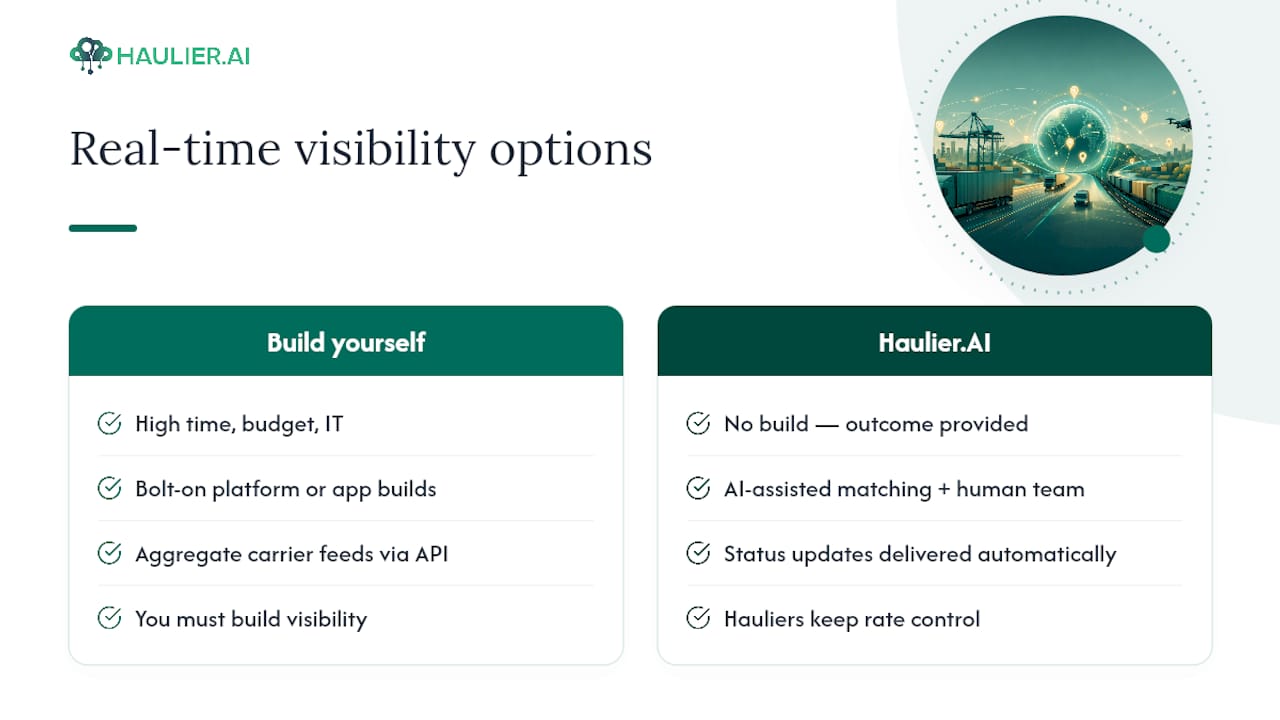
Haulier.AI gives you the outcome without the build. It connects freight forwarders and importers to available UK hauliers through a transport desk that combines AI-assisted matching with a human team behind it, so quoting moves quickly and status updates arrive without anyone having to chase them by phone. Hauliers keep control of their own rates and can turn down jobs that don’t suit them, which keeps pricing fair on both sides. Container coverage runs through named ports including Teesport, with visibility built into the process rather than added as an afterthought. If you’re moving containers and tired of chasing status by phone, request a haulage quote and see how the transport desk handles your next booking.
Sources
- Real-Time Freight Tracking: How Visibility Transforms Trucking Operations | TruckerPro Blog
- Logistics visibility as a competitive advantage | AMCS Group | AMCS
- Real time shipment tracking: advantages & solutions - proLogistik Group
FAQ
What are real-time haulage updates?
They are continuous, live status information about a haulage job, built from GPS and telematics feeds, geofenced milestone events and predictive ETAs, rather than periodic phone check calls.
How often do real-time updates actually refresh?
Telematics typically refreshes every 30 to 120 seconds while a vehicle is moving, while ETA engines commonly recalculate every few minutes using traffic, hours-of-service and weather data.
Do I need telematics and a driver app, or just one?
Most multi-carrier operations need both, since telematics is strongest while a vehicle is powered and moving, and driver apps fill the gaps during engine-off periods or on subcontracted capacity without factory-fitted hardware.
What’s the realistic ROI of implementing real-time visibility?
Carriers running full visibility report 75% fewer check calls, 30% fewer detention disputes, and 30 to 50% fewer inbound customer status calls, alongside faster invoicing from automated ePOD capture.
How does Haulier.AI fit into this?
An AI-assisted, human-backed transport desk for UK container haulage provides customers live status updates and managed quoting while allowing hauliers to control their own rates and job selection.
What’s the biggest mistake operators make when rolling this out?
Trying to integrate everything at once. Narrow scope, clear KPIs, and a driver-facing benefit in the first pilot matter more than any single piece of software.