
Container haulage article
Turn Three Bookings Into One: Quay to Door Haulage for UK Operators
A UK operator checklist to cut demurrage and paperwork delays. See how Haulier.AI turns three bookings into one managed quay to door haulage.
Quay-to-door haulage moves a container from the port gate to your final UK delivery address in one managed journey, combining port drayage, any required transloading, and the final truck delivery. Freight forwarders, importers, and logistics managers use it to cut the number of hand-offs between quay and warehouse, which is where demurrage charges, missed appointments, and paperwork errors usually creep in. Done well, it turns three separate bookings into one accountable movement.
TL;DR:
- Quay-to-door haulage involves container pickup from the port, transloading if needed, and final delivery, with customs clearance handled separately.
- The process’s speed depends heavily on port-specific factors like gate-out times and congestion, which can cause delays and increase costs.
- Secondary charges like demurrage and detention often surpass freight costs during peak congestion periods, especially when dwell times increase.
- Proper documentation, including bills of lading, customs entries, and appointment confirmations, is crucial to avoid delays and extra charges at ports.
- Using AI-assisted platforms like Haulier.AI can reduce administrative delays, improve visibility, and ensure capacity matching for more reliable quay-to-door moves.
Table of Contents
- What does quay-to-door haulage actually include?
- How does the quay-to-door delivery process actually run?
- What drives quay-to-door haulage costs and timelines?
- What paperwork do you need for a quay-to-door job?
- How do you choose a quay-to-door haulage provider?
- How does Haulier.AI reduce friction in quay-to-door moves?
- An operator’s take on what actually goes wrong
- Get your next container moving with Haulier.AI
- Sources
- FAQ
What does quay-to-door haulage actually include?
The term covers more ground than “port-to-port” or plain “haulage” suggests, and the confusion costs money when a quote doesn’t match what you assumed was covered. Drayage is the short first leg: pulling the container off the quay and into a yard or warehouse for unpacking. From there, transloading decides the next step, either the goods stay on the original trailer for a full truckload run, or they get broken down and sent out via pallet networks for smaller, multi-drop deliveries.
Service-level naming matters here. Port-to-door normally covers destination trucking only, leaving customs clearance and duty payment with the shipper or their broker, while a true door-to-door or DDP arrangement bundles both clearances into the price. Quay-to-door sits closer to the first camp, focused on physical movement rather than customs administration.
In practice, this looks like:
- Container release at the terminal, followed by drayage to a bonded or general warehouse
- Transloading and consolidation where needed, particularly for retail or Amazon FBA deliveries with fixed appointment slots
- Onward delivery by FTL or LTL/pallet network depending on volume and urgency
- Customs clearance handled separately, usually by the forwarder or a dedicated broker
How does the quay-to-door delivery process actually run?
Every quay-to-door move follows a similar rhythm, even when the provider or port changes. Knowing each stage helps you spot where a haulier is cutting corners before it costs you.
- Terminal release. The container clears customs and the shipping line issues a release note; terminal cut-off times determine how quickly a haulier can collect it.
- Drayage and gate-out. A driver collects the container, completes condition checks, attaches the correct chassis, and exits the terminal gate. Slot availability at ports such as Felixstowe often dictates how fast this happens.
- Transit to yard or warehouse. The container moves to a consolidation point, where it’s either kept intact or transloaded onto smaller vehicles.
- Onward delivery. FTL runs go straight to the final address; LTL or pallet-network moves add handling steps but reduce cost per unit, a trade worth weighing against delivery urgency and cargo value. Tail-lift requirements and fixed appointment windows, common with retail distribution centres, need confirming before the truck leaves the yard.
- Proof of delivery and invoicing. A signed POD, driver timesheet, and any exception notes close the job and trigger invoicing.
Pro Tip: Ask your haulier for average gate-out times at your specific port before booking, not generic figures. Felixstowe and Southampton behave very differently depending on vessel schedules that week.
What drives quay-to-door haulage costs and timelines?
The freight rate is rarely the number that catches people out. Direct costs, drayage, onward haulage, tail-lift fees, appointment charges, ULEZ and congestion surcharges, and fuel supplements, are visible upfront and easy to compare between quotes.
The indirect costs are the ones that blow budgets. Demurrage (container held at the terminal past its free days) and detention (equipment held past its return date) can dwarf the original freight cost, especially when a terminal is congested and slots are scarce. Analysis of UK port pressure shows the commercial hit from disruption often comes from these secondary charges, plus inventory holding costs, rather than from the transport rate itself.
Port bottlenecks, limited staging acreage, and HGV driver shortages push container dwell times up sharply during peak periods, which is precisely when demurrage clocks are ticking hardest.
Realistic windows for a standard quay-to-door move sit at a few days end to end in normal conditions. During Q4 peak season or when a major hub is congested, that stretches considerably. Every extra day at the terminal is a day of potential demurrage. Understanding how demurrage and detention charges accumulate helps you build realistic buffer into quotes rather than getting caught out mid-move.
What paperwork do you need for a quay-to-door job?
Missing or mismatched documentation is the single biggest cause of avoidable delay at UK ports. Every job needs a clear paper trail, even when the movement itself runs smoothly.
- Bill of lading or manifest confirming the cargo, issued by the shipping line, checked against the container number at collection.
- Consignment note or CMR covering the road leg, issued by the haulier and signed at delivery to form the POD.
- Customs clearance documentation, usually a C88/CDS entry, which must be complete before the terminal will release the box; a wrong commodity code or missing licence is the most common cause of unplanned dwell time.
- Appointment confirmations and terminal cut-off times, plus driver ID and vehicle documentation that match what the terminal or delivery site has on file.
Get any one of these wrong and the container sits, racking up demurrage while someone chases paperwork that should have been sorted days earlier.
How do you choose a quay-to-door haulage provider?
Not every haulier who says they cover “port to door” actually has the coverage or systems to back it up. A short checklist saves you from finding out the hard way.
- Operational reach: does the provider have genuine coverage at your ports, chassis availability, and warehousing or transload partners, or are they subcontracting blind?
- Reliability signals: real-time tracking, consistent POD turnaround, and a defined exception-handling process for damage or delay.
- Commercial clarity: does the quote state upfront who absorbs demurrage or detention risk, and are fuel surcharges and appointment fees itemised rather than buried?
- The right questions: ask for average gate-out times at your specific port, their contingency plan when a terminal closes a gate unexpectedly, and their typical claims response time.
Red flags are usually obvious once you know to look: no POD process, vague answers on documentation handling, or zero visibility once the container leaves the terminal.
Pro Tip: A haulier who can’t quote you a claims response time in days, rather than “it depends”, probably hasn’t had to test their own process recently.
How does Haulier.AI reduce friction in quay-to-door moves?
Most of the delay in quay-to-door haulage isn’t the driving, it’s the admin around it: chasing quotes, chasing updates, chasing paperwork. Haulier runs an AI-assisted, human-backed transport desk that matches freight forwarders and importers with available UK hauliers, handling quoting, real-time status updates, and paperwork tracking in one thread instead of scattered emails and phone calls.
What that changes operationally:
- Faster capacity matching, so you’re not waiting days for a haulier to confirm availability during a congestion spike
- Fewer missed updates, because status changes flow through the same channel rather than getting lost between broker, haulier, and terminal
- Clearer visibility on where a job sits in the process, which makes it easier to flag a demurrage risk before it becomes a charge
The platform’s two-sided model means hauliers set their own rates and can decline jobs that don’t suit their routes or capacity, which keeps pricing honest rather than driven by a race to the bottom that eventually shows up as poor service.
An operator’s take on what actually goes wrong
The same three mistakes recur: booking haulage before customs paperwork is confirmed, treating demurrage as someone else’s problem until the invoice lands, and picking a haulier on rate alone with no visibility on their actual gate-out performance. Fix the sequencing and check track record before price, and most of the delay disappears on its own.
— Vytautas
Get your next container moving with Haulier.AI
Haulier.AI is the practical alternative to chasing quotes across email and phone calls for every single container move. Instead of juggling separate bookings for drayage, transloading, and onward delivery, you get one managed thread: quoting, status updates, and paperwork tracking handled through an AI-assisted, human-backed desk that connects you directly with vetted UK hauliers.
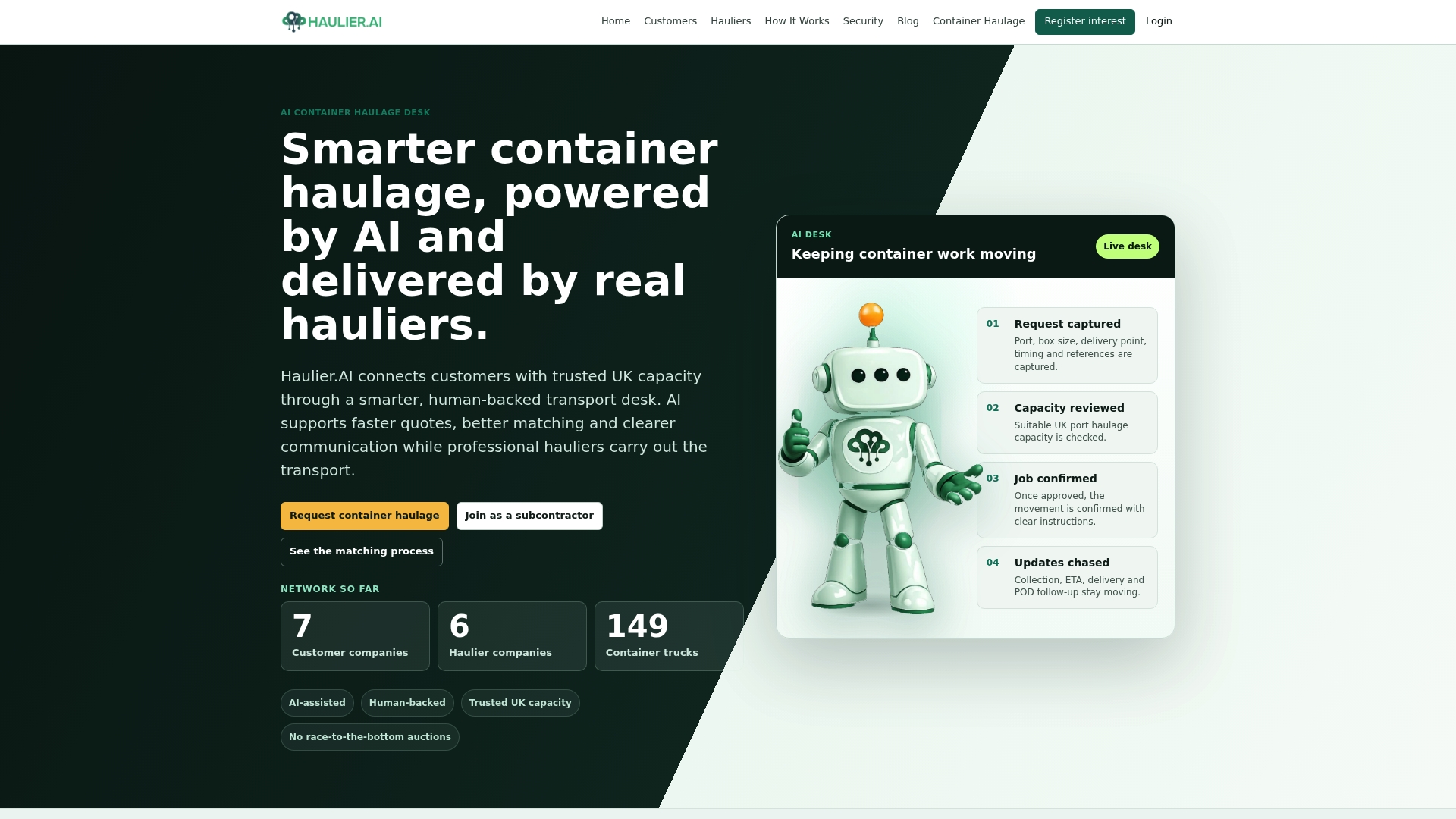
Because hauliers on the platform control their own rates and can turn down jobs outside their capacity, you’re not paying inflated prices to cover someone else’s inefficiency. If you’re importing regularly through Felixstowe, Southampton, or Teesport and tired of demurrage surprises landing after the fact, request a container haulage quote and see how the process compares to your current setup. Hauliers looking to fill capacity can join the network directly.
Sources
For deeper detail beyond this guide, the Department for Transport analysis of UK port pressure covers current disruption trends, while Haulier.AI’s own guides on demurrage and detention and Felixstowe container haulage go further into port-specific operational detail.
- Government Data Reveals Shifting Pressure Across UK Ports As Global Shipping Disruption Continues
- Freight service levels: port-to-port vs door-to-door vs DDP | CargoLinked
- A seller’s guide to UK haulage, drayage & pallet networks - Linktrans
FAQ
What is quay-to-door haulage?
It’s a single managed movement covering the short-haul collection of a container from the port (drayage), any necessary transloading, and final delivery to the consignee’s address, distinct from port-to-port moves that stop at the terminal.
Who is the biggest haulage firm in the UK?
The UK haulage sector has several major players, but no single firm dominates every route and port; capacity, coverage, and pricing vary significantly by region and specialism, which is why matching platforms like Haulier.AI exist.
What does CLDN do?
CLDN (Cobelfret) operates short-sea Roll-on/Roll-off ferry services connecting the UK and Ireland with mainland Europe, a common route for freight moving alongside container traffic through ports such as Dover and Holyhead.
How much does it cost to ship a 40-foot container from China to the UK?
Ocean freight rates for containers from China to the UK fluctuate heavily with demand and season, and the quoted rate rarely reflects the full landed cost once destination haulage, demurrage risk, and customs clearance are added.
Who are the top 10 shipping companies?
Global container shipping is dominated by a small group of major carriers operating on trans-ocean routes into UK ports, though rankings shift year to year based on fleet capacity and alliance structures.
How does port congestion affect quay-to-door delivery timelines?
Congestion extends container dwell time at the terminal, delaying drayage collection and increasing the risk of demurrage charges before the container even reaches the road leg of its journey.