
Container haulage article
Pod tracking haulage: a practical guide for haulage teams
Discover how efficient pod tracking in haulage enhances delivery speed, reduces disputes, and provides live visibility for your team.
If you need reliable proof of delivery for container haulage right now, the fastest route is a platform built around electronic proof of delivery (ePOD) with a human-backed transport desk behind it, and Haulier is built for exactly that job. It pairs an AI-assisted desk with real people who chase paperwork and updates, which matters when a driver’s signature capture fails or a factoring portal rejects a file at 4pm on a Friday.
Three things change once you switch from paper PODs to a proper ePOD workflow:
- Invoicing moves faster because delivery confirmation lands in your system the moment the driver taps done.
- Disputes drop because you have GPS-stamped photos and timestamps, not a smudged signature on a damp piece of paper.
- You get live visibility on every container movement instead of chasing drivers by phone at 5pm.
The sensible next step is a short pilot with a handful of jobs. Haulier and see the workflow on a live booking before rolling it across your fleet.
Key Takeaways
Reliable POD tracking for container haulage depends on offline-capable ePOD capture, factoring integration, and a driver flow simple enough that people actually use it correctly.
| Point | Details |
|---|---|
| Demand offline capture | Any ePOD app must store captures locally and sync automatically once signal returns near ports. |
| Prioritise driver UX | Systems needing two to three touches see far better adoption and fewer entry errors. |
| Expect fast ROI | Digitised POD capture has helped hauliers speed invoice payments by up to 75% in documented cases. |
| Pilot before scaling | Run a small fleet pilot for two to four weeks and test the factoring format before wider rollout. |
| Choose an operationally ready platform | Haulier.AI pairs AI-assisted matching with human oversight and haulier-controlled rates for container haulage. |
Table of Contents
- What is POD tracking in haulage and what does ePOD add?
- What ePOD features should haulage teams demand from any provider?
- What ROI can hauliers realistically expect from ePOD?
- How do you choose and roll out a POD tracking system without disrupting drivers?
- Which integrations actually matter for haulage back-office workflows?
- How does Haulier.AI handle POD capture for container haulage?
- What does the evidence say about ePOD actually working?
- What does ePOD pricing and total cost of ownership actually look like?
- What should you look for when comparing POD tracking providers?
- What does a realistic implementation timeline look like?
- What training and change management do drivers and admin staff need?
- How secure is delivery data in ePOD systems, and who owns it?
- Why we built Haulier.AI’s POD flow around simplicity, not features
- Ready to see POD tracking working on a real container job?
- Sources
- FAQ
What is POD tracking in haulage and what does ePOD add?
A proof of delivery is the record confirming a shipment reached the recipient and was accepted. In container haulage, POD tracking means capturing that record digitally and making it visible in real time rather than waiting for a paper docket to reach the office days later.
Electronic proof of delivery, or ePOD, replaces the paper docket with a mobile capture that uploads instantly. A proof of delivery should capture several fields at minimum:
- Recipient identity (name and, ideally, role)
- Date and time of delivery
- Delivery location, with a GPS stamp where possible
- Quantity or pieces delivered
- Weight, where relevant to the load
- Condition notes, covering any damage or shortage (OS&D)
Worth flagging early: POD sometimes means Port of Discharge in shipping documentation, a separate concept entirely from proof of delivery. This guide uses POD exclusively in the delivery sense. Get these fields right and your POD becomes your invoice trigger and your first line of defence in a claim, not an afterthought filed in a drawer.
What ePOD features should haulage teams demand from any provider?
Not every “digital POD” app does the job properly. Before you sign anything, insist on these capabilities.
Capture quality. On-screen signature capture with metadata attached, GPS and timestamped photos of the load and any damage, and barcode or QR scanning to match the consignment against the booking. Without metadata baked into the photo file itself, a signature or photo is just an image, easy to dispute later.
Driver-side reliability. The app must work offline, storing captures locally and syncing automatically once signal returns, because container runs regularly pass through mobile blackspots near ports and industrial estates. It also needs to work with minimal screen touches. Reviews of driver-facing capture apps consistently point to the same pattern: systems that keep the flow to two or three touches see far fewer entry errors and much better driver uptake than clunkier alternatives.

Back-office connectivity. Real-time status updates and ETA visibility, open API or portal access to your TMS, ERP and factoring provider, and tamper-resistant metadata that holds up if a delivery is disputed months later.
A quick checklist for evaluation meetings:
- [ ] Signature and photo capture with embedded GPS/timestamp
- [ ] Barcode or scan-based consignment matching
- [ ] Full offline mode with automatic sync
- [ ] API or direct integration with your TMS and factoring portal
- [ ] Two-to-three-touch driver flow, tested on an actual phone, not a demo screen
Pro Tip: Before you shortlist anyone, hand a driver your phone and ask them to complete a mock delivery capture in under 30 seconds. If they can’t, your drivers won’t either, and that’s where adoption quietly dies.
What ROI can hauliers realistically expect from ePOD?
The commercial case for ePOD is straightforward: less time spent chasing paperwork means faster payment and fewer arguments over what actually got delivered.
Digitising capture and feeding delivery confirmations straight into your TMS tends to reduce paperwork, speed up invoicing and cut down on disputes almost immediately after go-live. The gains typically show up as:
- Shorter invoice cycles and lower days sales outstanding (DSO)
- Fewer invoice queries landing back on the desk of your admin team
- Admin hours reallocated away from paperwork chasing towards exceptions handling
- Stronger claims defence, because you have photographic and GPS evidence rather than a memory of what happened
One documented case makes the scale of the opportunity concrete: Cross Haulage reported invoice payments speeding up by as much as 75% after digitising POD capture, alongside a drop in admin time and invoice queries.
Most hauliers running a proper pilot see measurable movement in invoice turnaround within a few weeks, not months. That’s the realistic window to hold your provider to.
How do you choose and roll out a POD tracking system without disrupting drivers?
Choosing well matters more than choosing fast. A bad rollout, where drivers resist an unfamiliar app or the system falls over the first time a signal drops, costs you more in goodwill than the delay of doing proper due diligence.
Ask any vendor these questions before you commit:
- Does the app work fully offline, and how does sync behave when connectivity returns?
- Who owns the captured data, and can you export it freely if you switch providers later?
- Does it integrate directly with your factoring company’s portal, or only via manual export?
- What’s the support SLA when a driver’s device fails mid route?
- Can it connect to your existing TMS and ERP without custom development work?
A sensible rollout follows a simple sequence:
- Shortlist two or three providers against the checklist above.
- Run a pilot with a small group, five to ten drivers on a defined route or lane, for two to four weeks.
- Review capture consistency, sync reliability and driver feedback.
- Test the ePOD format directly with your factoring company before scaling.
- Roll out fleet-wide in phases, prioritising your highest-dispute routes first.
Watch for red flags during evaluation: a driver app that needs more than three taps to complete a capture, no genuine offline mode (some vendors quietly mean “works on wifi”), API access that’s an afterthought or paid add-on, and no existing workflow for factoring submission.
Pro Tip: Change management beats technology every time. Brief drivers on why the switch is happening, not just how, and put your most sceptical driver on the pilot group first. If it wins them over, the rest of the fleet follows without a fight.
Which integrations actually matter for haulage back-office workflows?
Capture is only half the job. What happens to that data next determines whether ePOD actually saves you time or just moves the paperwork problem onto a different screen.
Priority integrations to require from any provider:
- TMS, so delivery status feeds straight into your existing operations system
- Factoring portal or API, so PODs trigger funding without manual re-entry
- Customer portals, for forwarders and importers who want their own visibility
- Webhooks or open API, for anything bespoke your back office needs
- CSV or email fallback, for smaller partners who aren’t API-ready yet
| Integration point | What it delivers |
|---|---|
| TMS connection | Live status feeds into ops, reducing phone chasing |
| Factoring API | Faster funding, less manual document submission |
| Customer portal access | Forwarders see status without calling your desk |
| Webhook/API access | Custom workflows without vendor lock-in |
The workflow itself is short: booking confirmed, driver captures ePOD on delivery, data uploads to the cloud, and the confirmation posts automatically to your TMS and factoring provider in the same motion. Digital PODs integrated this way tend to produce faster issue resolution and cleaner reporting, because nobody’s re-typing anything.
How does Haulier.AI handle POD capture for container haulage?
Haulier.AI was built around the reality that container haulage runs on tight port windows and factoring cash flow, not office hours. The transport desk combines AI-assisted matching and quoting with human oversight, so port-aware routing and real-time updates run automatically, but a person is always available when something needs sorting quickly.
The workflow in practice:
- The driver completes the ePOD capture on delivery, signature, GPS-stamped photos, and condition notes, in a flow designed to take seconds, not minutes.
- The confirmation uploads to the cloud immediately and pushes through to the relevant TMS or factoring portal without manual re-keying.
- Hauliers retain control of their own rates and can decline unsuitable jobs, which keeps pricing fair on both sides of the marketplace.
Case studies and detailed performance metrics for Haulier.AI’s own customer base will be published as the platform’s pilot fleet expands. For now, the underlying mechanics mirror the proven ePOD pattern documented across the sector: capture close to the point of delivery, sync instantly, and feed the back office without a human retyping anything.
What does the evidence say about ePOD actually working?
The strongest argument for ePOD isn’t theoretical. It’s in the numbers hauliers report after switching.
Cross Haulage’s experience remains one of the clearest published examples: digitising POD capture across their fleet sped up invoice payments by up to 75%, while cutting the volume of invoice queries reaching the admin desk. That’s not a marginal efficiency gain, it’s the difference between waiting weeks for cash and getting paid within days.
The pattern holds beyond invoicing speed. Consistent capture of GPS-stamped photos, signatures and timestamped logs builds what amounts to forensic-level evidence for claims, according to Transvirtual’s analysis of electronic proof of delivery. When a customer disputes a shortage or damage claim, a haulier holding a timestamped photo and GPS location wins that argument in minutes rather than weeks of back-and-forth.
What ties both examples together is timing. The administrative savings and cash flow improvements show up almost immediately after rollout, not after months of embedding a new system. That’s the real procurement argument here: ePOD isn’t a long-term efficiency project with a distant payback, it’s an operational fix that starts paying for itself in the first billing cycle. Hauliers evaluating a switch should treat any vendor promising a slow, phased “transformation” with suspicion. If the system works, the invoice cycle tells you within weeks.
What does ePOD pricing and total cost of ownership actually look like?
Pricing models across the sector generally fall into three shapes: per-driver or per-seat monthly licensing, per-job or per-consignment transaction fees, and flat platform fees bundled with a wider TMS package. Each suits a different fleet profile.
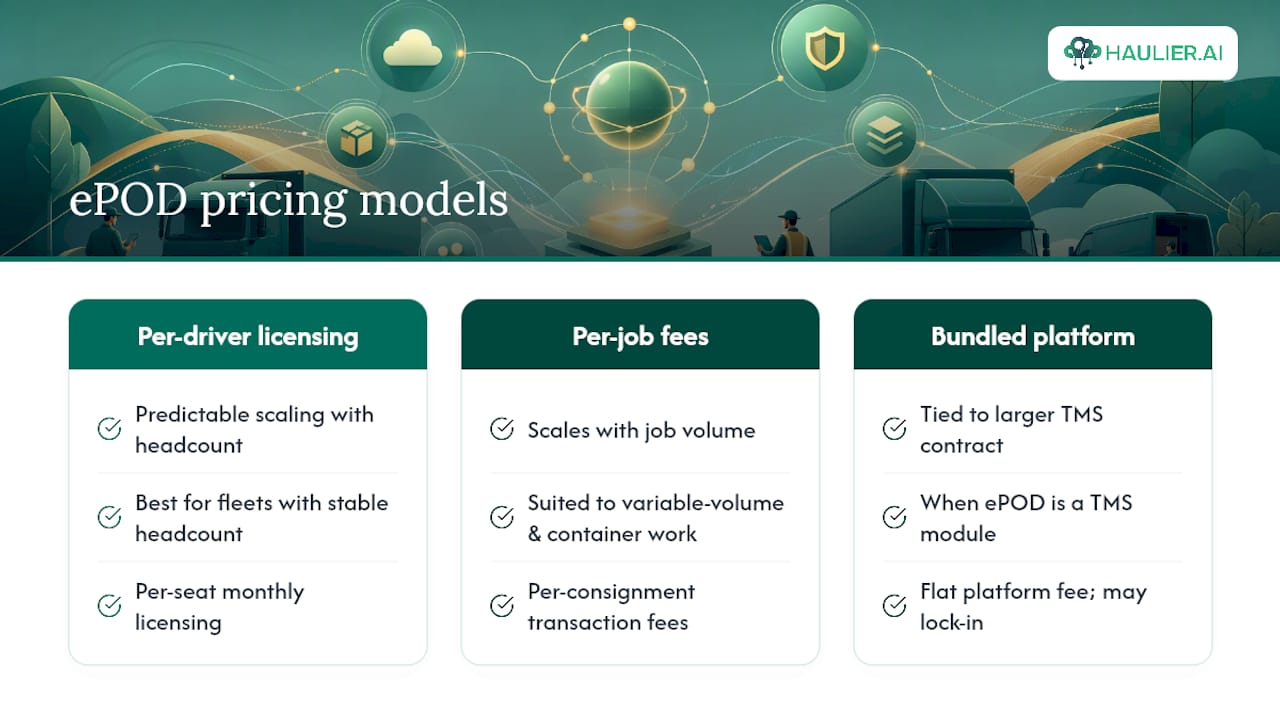
Per-driver licensing suits fleets with stable headcount, since costs scale predictably as you add vehicles. Per-job pricing suits hauliers with variable volume, container work especially, where job counts swing with port throughput and seasonal freight patterns. Bundled platform fees tend to appear when ePOD comes as a module inside a larger TMS, which can simplify billing but often locks you into that provider’s wider ecosystem.
Total cost of ownership goes well beyond the subscription line. Factor in device costs if drivers need dedicated hardware rather than using their own phones, integration or setup fees for connecting to your TMS and factoring portal, ongoing support costs, and the hidden cost of a poor driver UX: retraining time, missed captures, and the admin hours spent chasing incomplete PODs after a bad rollout.
The genuinely useful comparison isn’t the headline subscription price, it’s cost per completed, dispute-free delivery. A slightly pricier system that captures clean ePOD data on the first attempt, every time, usually beats a cheaper one that generates support tickets and re-delivery disputes. Ask any vendor for their all-in cost, licensing, integration, support, hardware, before comparing headline numbers.
What should you look for when comparing POD tracking providers?
Judge providers against operational criteria, not feature lists dressed up as differentiators.
Start with capture reliability: does the app work offline, and how well does it handle poor signal near ports and industrial estates, which is where container haulage spends much of its time? Then check integration depth: genuine API access to your TMS and factoring portal beats a system that only exports CSV files for someone to manually re-upload.
Driver experience deserves as much weight as back-office features, because a system nobody uses correctly generates worse data than paper. The touch-count principle from earlier applies here directly: fewer taps, better adoption, cleaner captures.
Data ownership and portability matter more than most procurement teams initially realise. Can you export your historical POD data if you switch providers in two years? Vendors reluctant to answer that question plainly are worth treating with caution.
Finally, weigh support responsiveness. A driver stuck at a port gate with a failed capture needs a fast answer, not a ticket queue. Ask for the actual SLA in writing, not a vague promise of “priority support.”
Treat these five criteria, capture reliability, integration depth, driver experience, data ownership, and support SLA, as your scoring framework rather than comparing marketing brochures side by side. The provider that scores consistently well across all five, rather than excelling at one and falling short elsewhere, is the safer long-term choice for container haulage operations.
What does a realistic implementation timeline look like?
Most hauliers can move from selection to full deployment in six to ten weeks if the process stays disciplined.
Weeks one and two cover shortlisting and vendor questioning, the checklist covered earlier around offline capability, data ownership, and factoring integration. Weeks three and four run the pilot itself, typically five to ten drivers on a defined lane, tracking capture consistency and sync reliability daily rather than waiting for a monthly review.
Week five is evaluation: does the factoring portal accept the ePOD format cleanly, are drivers completing captures without support calls, is data landing correctly in the TMS? Any friction here needs fixing before scaling, not papering over.
Weeks six through ten cover phased fleet-wide rollout, starting with your highest-dispute or highest-volume routes first, since that’s where the ROI shows up fastest and where early wins build internal confidence in the switch.
Compressing this timeline rarely helps. Rushing past the pilot stage is the single most common reason ePOD rollouts stall, because problems that would have surfaced with ten drivers instead surface with eighty, at a much higher cost to fix.
What training and change management do drivers and admin staff need?
Training for drivers should take minutes, not hours, if the app is genuinely built for the job. Focus sessions on the actual capture sequence: signature, photo, any condition notes, and what to do if the app can’t sync immediately (the answer should always be: nothing, it queues automatically).
Admin staff need a different kind of training, focused on exception handling rather than data entry. Once ePOD captures flow automatically into the TMS and factoring portal, the admin role shifts from typing information to spotting and resolving the exceptions, a missing photo, an unmatched consignment number, a delivery flagged with damage notes.
Change management works best when it starts with your most resistant drivers, not your most enthusiastic ones. If a sceptical driver finds the app faster than paper within the first week, that verdict spreads through the depot faster than any management memo. Pair early adopters with hesitant colleagues informally rather than running a single big-bang training day for the whole fleet.
How secure is delivery data in ePOD systems, and who owns it?
ePOD systems handle sensitive commercial data: delivery addresses, signatures, timestamps, and photographic evidence tied to specific customers and consignments. That data needs the same seriousness applied to it as any other business-critical system, not treated as a convenience app bolted onto a driver’s phone.
Ask providers directly how data is encrypted in transit and at rest, whether captured photos and signatures are tamper-resistant once submitted (critical if a delivery is later disputed in a claim), and who retains ownership of the historical record if you change provider. Haulier reflects the human-backed oversight built into the wider platform, rather than leaving sensitive delivery data to an unmonitored automated pipeline.
GDPR obligations apply directly here too: delivery data often includes personal information about recipients, so any provider handling it needs a clear, documented basis for storage and retention, not a vague privacy policy nobody’s read.
Why we built Haulier.AI’s POD flow around simplicity, not features
We kept the driver flow to a handful of taps deliberately, because every extra screen is a chance for a delivery to go uncaptured. Factoring integrations came early for the same reason: cash flow is the real pain point, not the technology. Human oversight sits behind the automation because container haulage still runs on judgement calls that no algorithm handles cleanly on its own. Get those three right and faster payment and fewer disputes follow naturally.
Ready to see POD tracking working on a real container job?
Haulier.AI gives freight forwarders, importers and hauliers one thing most platforms in this space don’t manage together: an AI-assisted desk that handles quoting and matching at speed, backed by real people who step in when a job needs a human judgement call. Hauliers keep control of their own rates and can turn down jobs that don’t suit them, which keeps pricing honest for everyone booking through the desk.
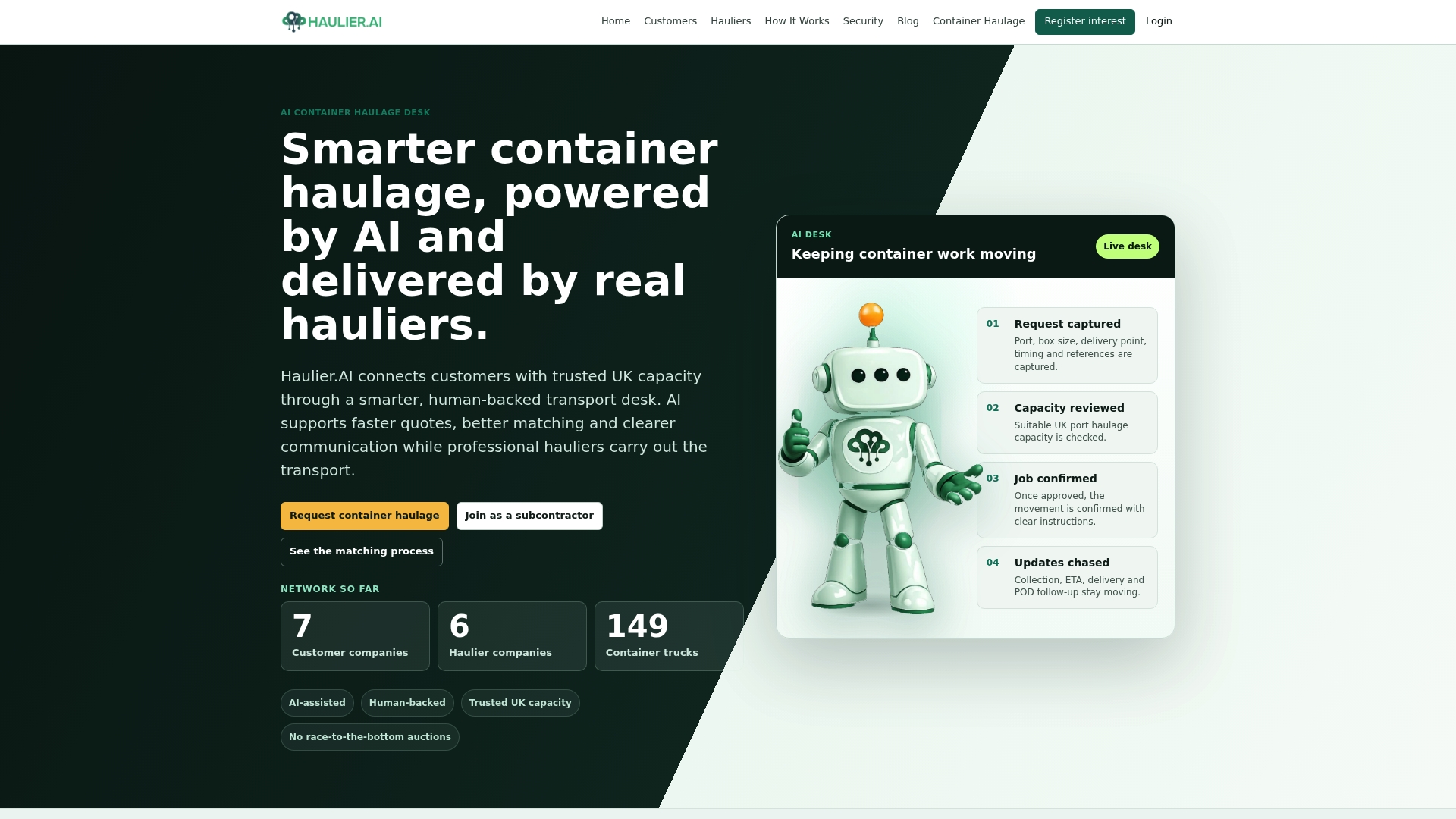
If you’ve read this far because paperwork delays and invoice disputes are costing you time every week, the fix starts with a small pilot, not a fleet-wide rollout. See how the transport desk works or request container haulage on your next booking to watch the ePOD capture and live visibility in action. Hauliers looking to join the network can register through the subcontractor page directly.
Sources
- What is POD in logistics? Proof of Delivery explained — LegalClarity
- Proof of delivery (POD) definition — eCapital
- Cross Haulage speeds up invoice payments by 75% — FleetPoint
- The benefits of electronic proof of delivery (ePOD) in road haulage — Mandata
- Routal product reviews — G2
FAQ
What does POD mean in logistics?
POD stands for proof of delivery, the official record confirming a shipment reached its recipient and was accepted, usually capturing a signature, date, location and condition notes.
How do you track a POD delivery?
Modern haulage tracks POD delivery through an ePOD app that captures a signature, GPS-stamped photos and a timestamp on the driver’s device, then syncs that data instantly to the TMS or factoring portal, which is exactly the workflow Haulier runs for container jobs.
Is digital POD tracking software reliable for haulage?
Well-built ePOD software is reliable when it works fully offline and keeps the driver flow to two or three steps; reviews consistently show that clunky, multi-screen apps produce far more capture errors than simple ones.
What’s the difference between a paper POD and an ePOD?
A paper POD is a physical signed document that has to be scanned or posted back to the office, while an ePOD captures the same evidence digitally, signature, photos and GPS, and uploads it instantly, often shortening payment timelines significantly.
How quickly can a haulier see results after switching to ePOD?
Most hauliers see measurable improvement in invoice turnaround within weeks of a proper pilot; one documented case saw invoice payments speed up by as much as 75% after digitising POD capture.