
Container haulage article
Out of gauge haulage: the UK professional's guide
Master out of gauge haulage in the UK. Learn about legal thresholds, permits, and planning essentials to ensure safe transportation.


Out of gauge haulage is defined as the transport of cargo that exceeds the standard dimensions or weight limits of conventional road vehicles or shipping containers, requiring specialist equipment, regulatory permits, and detailed route planning. In the UK, this category of transport is formally known as abnormal load haulage, governed by the Special Types General Order (STGO) 2003 and the Construction and Use Regulations. Logistics professionals handling oversized freight transport must understand both the legal thresholds and the operational demands before a single wheel turns. Getting either wrong carries serious financial and legal consequences.
What are the legal thresholds for out of gauge haulage in the UK?
Loads exceeding 44,000kg gross vehicle weight, 2.9 metres in width, or 18.65 metres in length are classified as abnormal loads under UK Construction and Use Regulations and STGO 2003. These thresholds are the point at which standard haulage rules no longer apply and specialist compliance begins. Crossing any one of these limits triggers a chain of legal obligations that cannot be skipped.
STGO categories also regulate axle load limits, setting 10,000kg for non-driving axles and 11,500kg for driving axles. These figures directly influence which trailer configuration is legally permissible for a given load. Selecting the wrong trailer is not just a safety risk; it is a criminal offence.
Notification periods vary by load size: two days’ notice for loads up to 80,000kg, five days for loads up to 150,000kg, and eight weeks or more for exceptional loads exceeding 150,000kg or 6.1 metres in width, which require a BE16 Special Order. That eight-week window catches many logistics teams off guard, particularly on projects where procurement and transport planning run in parallel rather than in sequence.
| Load category | Gross weight | Width | Notification period |
|---|---|---|---|
| Standard abnormal | Up to 80,000kg | Up to 3.5m | 2 days |
| Heavy abnormal | Up to 150,000kg | Up to 6.1m | 5 days |
| Exceptional (BE16) | Over 150,000kg | Over 6.1m | 8 weeks+ |
The ESDAL system (Electronic Service Delivery for Abnormal Loads) centralises route planning and notification across UK police forces, highway authorities, and bridge owners. Using ESDAL is not optional for most abnormal load movements; it is the mandated route to regulatory compliance. The system generates automated notifications to all relevant authorities simultaneously, cutting the administrative burden significantly.
Pro Tip: Submit your ESDAL application as early as possible, even before the legal minimum notice period. Authorities can raise objections, and resolving them takes time you may not have.
- Loads must display amber warning lights and “ABNORMAL LOAD” marker boards front and rear.
- Escort vehicles are required for loads wider than 3.0 metres in most circumstances.
- Police escorts are mandatory for loads wider than 5 metres or longer than 30 metres.
- Movement is typically restricted to daylight hours and prohibited on bank holidays and peak traffic periods.
Which specialist equipment does out of gauge haulage require?
Specialist trailers including extendable flatbeds, low loaders, and modular trailers are the foundation of any outsize cargo logistics operation. Each trailer type serves a specific purpose determined by the load’s dimensions, weight distribution, and centre of gravity. Choosing the wrong trailer creates both a safety hazard and a compliance failure.
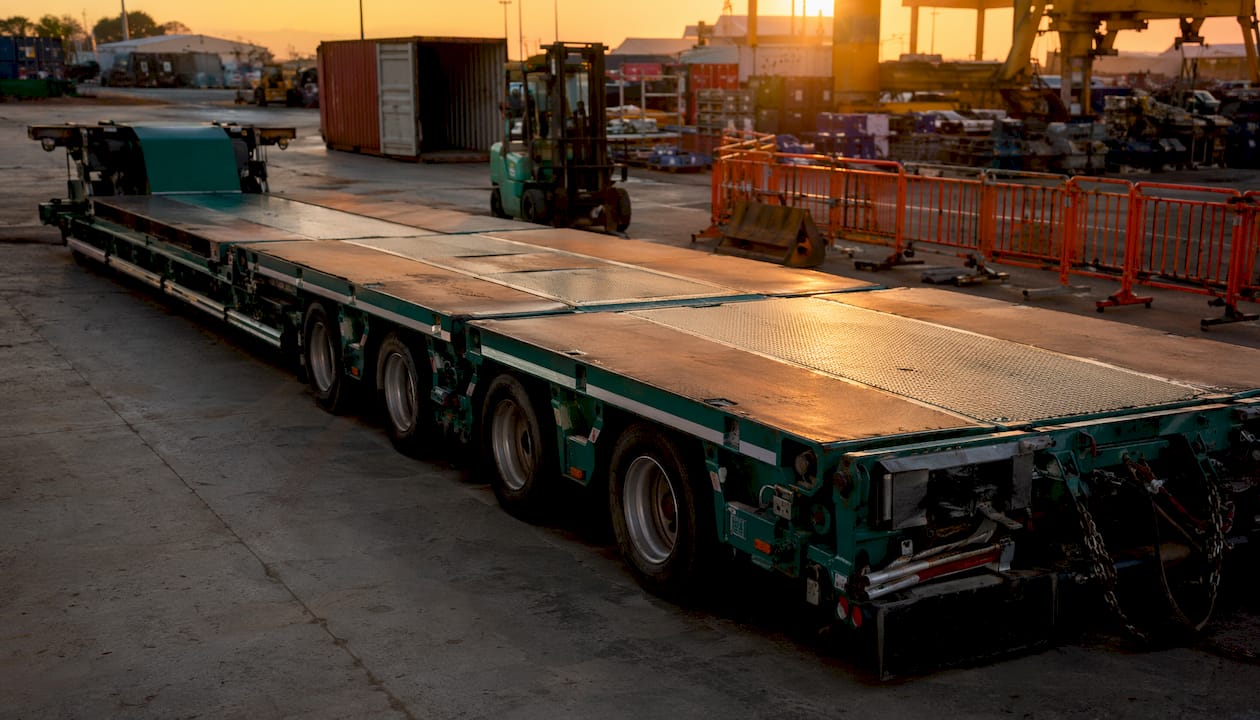
Modular trailers with multiple axles allow precise weight distribution across the road surface, preventing structural damage and keeping axle loads within STGO limits. This matters most for very heavy industrial items such as transformers, pressure vessels, and wind turbine components. A single miscalculation in axle load distribution can render a route legally impassable.
Flat rack containers and extendable trailers serve a different function: they accommodate cargo that is too long or too wide to fit within a standard trailer’s footprint. Extendable trailers can stretch to carry loads well beyond 30 metres, but each extension adds complexity to route planning and escort requirements. The equipment choice must be confirmed before the route survey begins, not after.
- Extendable trailers: suited to long, rigid cargo such as bridge beams, wind turbine blades, and structural steelwork.
- Low loaders: reduce overall transport height for tall machinery, keeping loads within height clearance limits where possible.
- Modular trailers: used for the heaviest loads, with axle configurations tailored to distribute weight legally across the road.
- Flat racks: used in multimodal operations where cargo moves between sea and road transport.
Height above approximately 4.95 metres requires a height notice and a surveyed route to avoid low bridges, even when the load does not technically qualify as an abnormal load by weight or width. This is one of the most frequently overlooked requirements in dimensional cargo delivery. Many first-time shippers discover this only when a low bridge appears on the route.
Pro Tip: Always confirm the load’s height under all conditions, including when it is secured on the trailer and at maximum tyre deflection. A load that clears 4.95 metres in the yard may not clear it on a cambered road.
How should logistics professionals plan routes for out of gauge haulage?
Route planning for heavy haulage services is not a desk exercise. It requires physical surveys, authority consultations, and engineering assessments that can take weeks to complete. Starting this process late is the single most common cause of project delays in outsize cargo logistics.
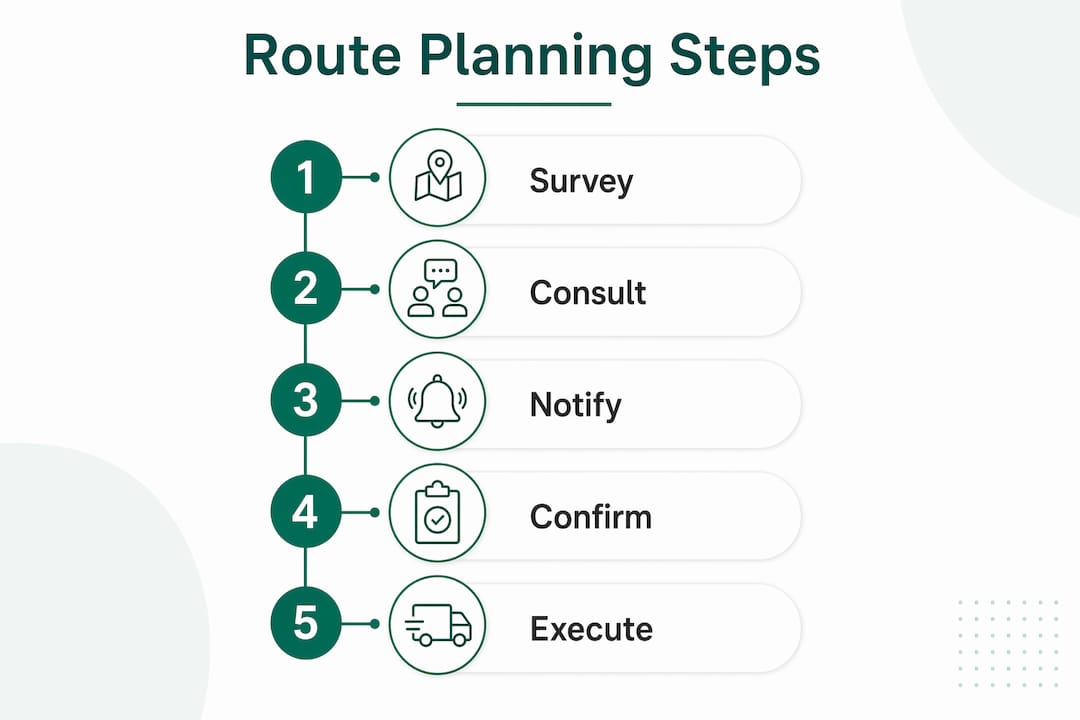
Involving specialist hauliers early in project planning prevents delays caused by statutory notice periods and route clearance requirements. Early involvement means the haulier can flag route problems before they become programme-critical issues. On major infrastructure projects, haulage planning should begin at the same time as procurement.
A structured planning process follows this sequence:
- Confirm load dimensions and weight before any route work begins. Inaccurate figures invalidate every subsequent step.
- Commission a route survey covering bridge clearances, overhead utilities, weight-restricted roads, tight bends, and junction geometry.
- Submit the ESDAL application with the confirmed route, load data, and proposed movement dates.
- Arrange escort vehicles in line with load dimensions. Private escorts for smaller oversized loads; police escorts for loads wider than 5 metres or longer than 30 metres.
- Obtain any temporary traffic management approvals needed for road closures or signal suspensions along the route.
- Confirm movement windows with all authorities, noting restrictions on bank holidays, peak hours, and adverse weather conditions.
- Brief the driver and escort team with a full route pack including contingency plans for unexpected obstructions.
The ESDAL platform handles the notification layer of this process, but it does not replace the physical survey or the engineering judgement required to assess whether a route is genuinely safe. Technology supports compliance; it does not substitute for expertise. Logistics professionals who treat ESDAL as a tick-box exercise rather than a planning tool tend to encounter the most problems.
Pro Tip: Build a minimum of two weeks of contingency into any abnormal load programme. Authority objections, bridge assessments, and utility diversions each have their own timelines and rarely align neatly with project deadlines.
What are the economic challenges unique to out of gauge haulage?
The cost of outsize cargo logistics extends well beyond the day rate for a specialist trailer. Pre-move surveys, permit fees, escort vehicle hire, and potential road reinstatement charges all add to the total. Logistics professionals who budget only for the transport itself routinely face significant cost overruns.
Out-of-gauge sea freight incurs “lost slot” charges because cargo that protrudes beyond standard container dimensions disrupts stacking patterns on the vessel. The shipping line cannot use the space above or beside the OOG unit, so it charges for that lost capacity. In some cases, lost slot costs exceed the direct freight charge for the cargo itself.
Specialist hauliers approach out of gauge haulage as a cradle-to-grave partnership, not a point-to-point delivery. That means route surveys, engineering sign-off, real-time escort coordination, and contingency planning are all part of the service, not optional extras.
Correct dimension declarations and customised securement are critical for avoiding costly accidents and insurance disputes during OOG cargo transport. A load that shifts in transit because of incorrect lashing calculations can cause structural damage to the cargo, the trailer, and the road surface. The financial consequences of a dropped or damaged abnormal load are severe.
Common cost pitfalls in bulk load transport include:
- Inaccurate dimension declarations that trigger reclassification mid-move, requiring additional permits and escorts.
- Late ESDAL submissions that push movement dates back, causing knock-on delays to site programmes.
- Underestimating survey costs for complex routes involving multiple bridge assessments or utility diversions.
- Multimodal coordination gaps where sea freight and road haulage timelines are not synchronised, leading to demurrage charges at port.
OOG cargo logistics depends on detailed load plans and site accessibility assessments because the cargo cannot be stacked or standardised. Every movement is bespoke. That bespoke nature is precisely why viewing the haulier as a transactional supplier rather than a project partner is a false economy.
Key takeaways
Out of gauge haulage demands early planning, precise dimension data, and full regulatory compliance from the outset to avoid costly delays and legal exposure.
| Point | Details |
|---|---|
| Know the legal thresholds | Loads over 44,000kg, 2.9m wide, or 18.65m long require STGO compliance and formal notification. |
| Plan notification timelines early | Exceptional loads over 150,000kg need eight weeks’ notice minimum; late submission causes programme delays. |
| Match equipment to the load | Modular, low loader, and extendable trailers each serve specific weight and dimension profiles. |
| Use ESDAL correctly | Submit route plans and notifications through ESDAL early; treat it as a planning tool, not a formality. |
| Budget for the full cost | Lost slot charges, surveys, escorts, and permits add significantly to the base transport cost. |
Why I think most OOG haulage problems are self-inflicted
Having worked across UK logistics for years, the pattern I see most often is straightforward: projects run into trouble with out of gauge haulage because the transport conversation starts too late. The engineering team finalises the load specification, procurement secures the kit, and then someone calls a haulier two weeks before the delivery date. At that point, the eight-week notice period for a BE16 Special Order is already a crisis.
The second mistake I see consistently is treating height as an afterthought. Width and weight get attention because they appear in the headline legal thresholds. Height sits in a grey area, and that grey area catches people out. A transformer on a low loader that clears the yard gate by half a metre may still hit a railway bridge 40 miles down the route. Surveying the route properly, including every overhead obstruction, is not optional. It is the difference between a successful move and a very expensive incident.
The third issue is the multimodal gap. Sea freight and road haulage are often booked through different teams, and the two timelines rarely align without deliberate coordination. A container arriving at Felixstowe or London Gateway with an OOG load on board needs a road haulage plan that is ready before the vessel berths, not after. That requires the haulage provider involved from the moment the sea freight booking is confirmed.
My honest recommendation: treat your specialist haulier as a project engineer, not a delivery driver. The best OOG moves I have seen run smoothly because the haulier was in the room when the load was still being designed.
— Vytautas
Haulier and the complexity of out of gauge transport
Managing the coordination demands of abnormal load transport is where many logistics operations lose time and money. Haulier connects freight forwarders and importers with trusted UK hauliers through an AI-assisted transport desk that provides clear visibility across the quoting and booking process.

For logistics professionals handling container haulage requirements that include oversized or heavy cargo, Haulier reduces the admin burden and cuts the communication gaps that cause delays. The platform gives hauliers control over their rates while giving customers fast access to verified capacity. If you are coordinating a complex load movement and need reliable haulage support, request haulage through Haulier to get the process moving without the usual back-and-forth.
FAQ
What is out of gauge haulage?
Out of gauge haulage is the transport of cargo that exceeds standard road vehicle or container dimensions, requiring specialist trailers, regulatory permits, and route surveys. In the UK, it is formally classified as abnormal load haulage under STGO 2003.
What are the UK legal limits for abnormal loads?
Loads exceeding 44,000kg gross vehicle weight, 2.9 metres in width, or 18.65 metres in length are classified as abnormal loads and require STGO compliance and formal notification to police and highway authorities.
How much notice is required for an abnormal load movement?
Notice periods range from two days for loads up to 80,000kg to eight weeks or more for exceptional loads exceeding 150,000kg or 6.1 metres in width, which require a BE16 Special Order.
When is a police escort required for out of gauge haulage?
A police escort is mandatory for loads wider than 5 metres or longer than 30 metres. Smaller but still oversized loads typically require private escort vehicles for safety and traffic management.
What is ESDAL and why does it matter?
ESDAL is the UK’s Electronic Service Delivery for Abnormal Loads system, which centralises route planning and automated notifications to police, highway authorities, and bridge owners. Using it correctly and early is the most reliable way to meet statutory compliance requirements for abnormal load movements.