
Container haulage article
Digital proof of delivery for UK container haulage
Discover how digital proof of delivery transforms UK container haulage. Enhance efficiency and compliance with accurate records and instant tracking.
Digital proof of delivery (digital POD) is an electronic record combining GPS coordinates, timestamps, high-resolution photos, e-signatures and an immutable audit trail to confirm a container movement has been completed. For UK freight forwarders and importers, adopting it now is straightforward: the EU’s eFTI regulation requires certified electronic freight platforms from 9 July 2027, EORI and MRN references can be linked directly to each POD event, and platforms such as Haulier already handle the paperwork tracking that makes this practical. The recommended approach is to pilot on two or three lanes with TMS integration in place before scaling.
Table of Contents
- What does a compliant digital POD record actually contain?
- Why digital POD delivers real operational gains
- How digital POD strengthens your insurance and claims position
- How should you integrate digital POD with your TMS?
- Step-by-step checklist for implementing digital POD
- Which KPIs should you track, and what are realistic targets?
- Common pitfalls and how to avoid them
- How to choose a digital POD provider: a procurement scorecard
- What does a UK digital POD rollout typically cost and how long does it take?
- How Haulier supports digital POD and container haulage workflows
- Data security and UK-specific privacy considerations
- Scalability and multi-modal integration
- Key takeaways
- What actually works on UK container lanes
- Haulier’s pilot offer for digital POD and container haulage
- Useful sources
- FAQ
What does a compliant digital POD record actually contain?
A complete digital POD for container haulage goes well beyond a scanned signature. The core technical components are:
- GPS coordinates captured at the point of delivery, not just the driver’s last known location
- Timestamps accurate to the second, tied to the device clock and server-side receipt
- High-resolution photos of the container, seal, and any visible damage before and after handover
- Sign-on-glass e-signature from the consignee, with name and company captured
- Barcode or QR scan of the container number or shipping label to eliminate transcription errors
- Driver notes for exceptions, access issues or partial deliveries
- Immutable audit log recording every field change, user action and system event
Optional but genuinely useful for container work: seal number capture, e-CMR reference linking, MRN association for customs audit readiness, and device metadata (IMEI, OS version) to authenticate the record.
Pro Tip: In port yards and container terminals, mobile signal is often patchy. Choose a driver app with full offline capture that queues all data locally and syncs automatically once connectivity is restored. A POD captured offline is still timestamped at the moment of capture, preserving its evidential value.
Why digital POD delivers real operational gains
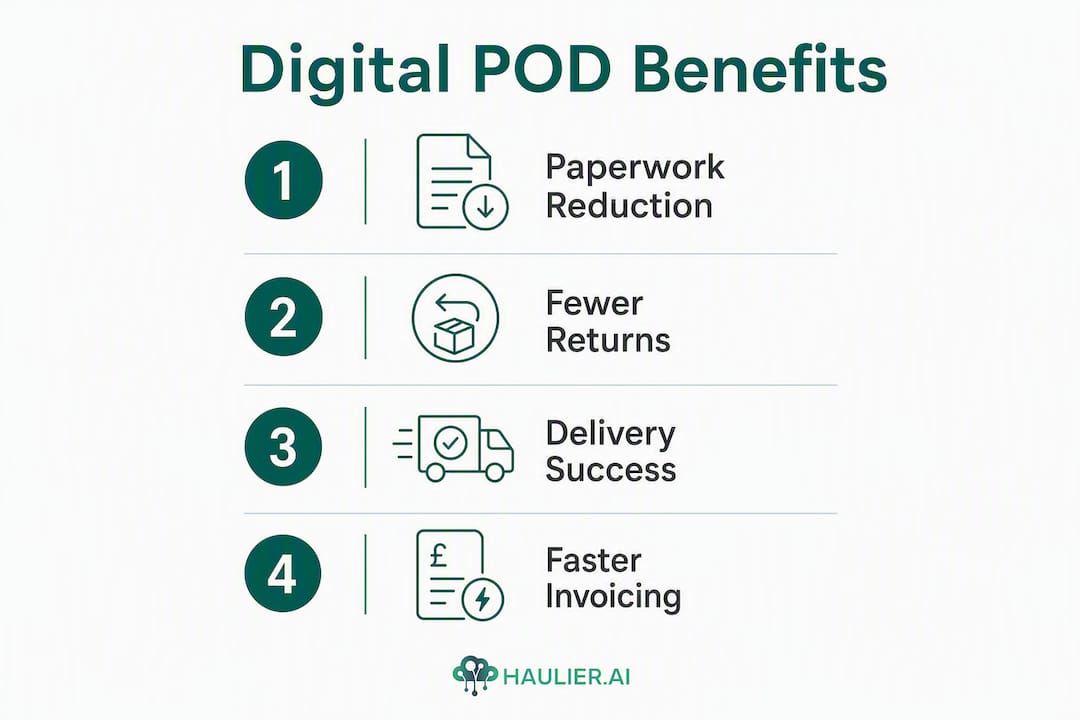
The business case for electronic delivery confirmation is strongest when you look at the three areas where paper processes bleed money: disputes, failed deliveries and invoicing lag.

Paperwork reduction is achievable with digital capture, and some operators report fewer goods returned once discrepancies are flagged at the point of delivery rather than days later.
Failed delivery attempts are expensive. Each failed delivery attempt typically incurs a significant cost, and digital POD reduces them by pushing real-time access instructions to drivers before they arrive. On a busy container lane running dozens of movements a week, that adds up quickly.
Invoicing is the third lever. When POD events post automatically into your TMS and trigger billing, days sales outstanding (DSO) falls. Integrating POD into invoicing workflows is where most teams see the fastest return on their investment.
How digital POD strengthens your insurance and claims position
Freight insurance specialists treat digital POD as a risk-control measure because it replaces subjective witness accounts with verifiable, timestamped evidence. GPS traces, photos and audit logs are harder to dispute than a driver’s recollection or a handwritten note.
For a claims-ready POD record, the following fields are non-negotiable:
- GPS coordinates at delivery, matched to the consignee’s address
- Timestamped photos showing container condition on arrival
- Consignee signature with printed name
- Seal number (intact or broken, with photo)
- MRN or e-CMR reference linked to the same shipment
A short checklist for claims readiness:
- Retain all records for a minimum of six years (aligned with UK limitation periods for contract claims)
- Store metadata alongside the document, not separately
- Link each POD to the corresponding transport document in your TMS
- Confirm your insurer accepts digital records in their preferred format before a claim arises
Pro Tip: A simple emailed PDF of a signature is often insufficient for modern claims. Insurers increasingly require GPS traces, device logs and image EXIF data linked to the shipment entry. Preserve the full metadata package, not just the visible document.
How should you integrate digital POD with your TMS?
The integration principle is simple: POD events must post automatically into the TMS and update job status in real time. A standalone POD app that emails PDFs to an inbox is not integration. It is a slightly better filing cabinet.
The correct data flow runs: TMS creates job → job pushed to driver app → driver captures POD → event posts back to TMS → job status updated → invoicing or ERP triggered. Each step should be automatic, with no manual re-keying.
Key API and webhook requirements to specify with any provider:
- Consignment ID matching (the POD record must reference the TMS job reference, not a free-text field)
- Field validation at capture (mandatory fields cannot be skipped)
- Quantity-change handling (partial deliveries must update the TMS line item, not just flag an exception)
- Synchronous acknowledgement so the driver app confirms the TMS received the event
Pro Tip: When evaluating TMS integration options, ask vendors for a sandbox environment. Test the consignment-ID matching and the partial-delivery workflow before go-live. These two failure points cause the majority of post-launch data quality issues.
| Integration dimension | Minimum requirement | Better practice |
|---|---|---|
| Job creation | Manual import or CSV | Automatic push from TMS via API |
| POD event posting | Webhook on completion | Synchronous API with acknowledgement |
| Status update | End-of-day batch | Real-time update on POD capture |
| Invoicing trigger | Manual release | Automatic on POD receipt |
| Exception handling | Email alert | TMS workflow task with SLA timer |
Step-by-step checklist for implementing digital POD
A structured rollout avoids the most common failure modes. Work through these phases in order.
Phase 1: Prepare (weeks 1–3)
- Define pilot scope: two to three lanes, a fixed set of drivers, and named customer contacts who will accept digital POD
- Agree success criteria: target first-attempt success rate, claims reduction, and invoicing cycle time
- Confirm TMS API readiness and data-retention policy
- Select driver devices (company-issued or BYOD with MDM policy)
Phase 2: Pilot (weeks 4–8)
- Configure mandatory fields: GPS, photo, signature, container number, seal number
- Enable offline mode and test sync behaviour in a port environment
- Run parallel paper process for the first two weeks as a fallback
- Brief drivers: one-hour session covering app use, exception logging and escalation
Phase 3: Review (week 9–10)
- Measure KPIs against baseline
- Identify any consignment-ID matching failures or missing metadata
- Confirm insurer and customer acceptance of digital records
Phase 4: Scale
- Extend to remaining lanes and driver pool
- Retire paper fallback on confirmed lanes
- Schedule quarterly data-quality audits
Pro Tip: Driver adoption is the most common point of failure. Keep the mandatory field count low in the pilot (five to seven fields maximum) and add optional fields only after the core workflow is stable. Complexity at launch kills engagement.
Additional technology requirements:
- Minimum 90-day online data retention with archive to cold storage thereafter
- Security and human oversight controls covering access permissions by role
- GDPR-compliant data processing agreement with the POD provider
Which KPIs should you track, and what are realistic targets?
| KPI | How to measure | Pilot target | Mature target |
|---|---|---|---|
| First-attempt success rate | TMS delivery events | Baseline + 5% | — |
| Claims frequency | Insurance/TMS records | Reduce | Reduce |
| Time-to-resolution (disputes) | Ticket log, days open | Under 5 days | Under 2 days |
| DSO reduction | Finance system | a few days | more significant reduction achievable |
| Admin hours saved per week | Time-tracking or estimate | 3–5 hours | 8–12 hours |
Cost recovery typically arrives within 3–6 months when POD is integrated into billing, driven by faster invoicing and fewer delivery disputes.
Common pitfalls and how to avoid them
Most digital POD projects that stall do so for predictable reasons.
- Assuming all partners are ready. Smaller hauliers may not support structured POD immediately. Maintain a hybrid process for these partners rather than forcing a hard cutover.
- Poor offline handling. A driver who loses signal in a port yard and cannot capture a POD creates a gap in the audit trail. Test offline mode before go-live.
- Weak consignment-ID mapping. If the POD record does not carry the TMS job reference, reconciliation becomes manual. Enforce this at the field-configuration stage.
- Over-customising the pilot. Custom fields and bespoke workflows slow deployment and make it harder to measure results cleanly. Start with the standard configuration.
Pro Tip: Appoint a named exception owner before go-live. When a POD is captured with missing data or a disputed quantity, someone needs authority to log the evidence, approve the exception and close the task. Without a named owner, exceptions accumulate and undermine the audit trail.
How to choose a digital POD provider: a procurement scorecard
Weight these dimensions when scoring vendors:
- TMS/API integration (highest weight): REST API, webhook support, sandbox environment, consignment-ID matching
- Audit trail integrity: immutable logs, metadata retention, tamper-evident storage
- UK port and yard coverage: offline capability tested at major UK ports
- Data protection and retention: UK GDPR compliance, data-sovereignty controls, explicit retention policy
- Reporting and analytics: KPI dashboards, exception reports, export formats
- Cost model: per-movement pricing vs. subscription; implementation and support fees
Sample questions to ask vendors:
- What metadata is retained alongside each POD record, and for how long?
- Does your audit log meet the evidential requirements of the Electronic Trade Documents Act 2023?
- Can you link POD records to e-CMR references and MRNs?
- What format do you provide for insurer evidence packs?
- Where is data stored, and can you confirm UK data sovereignty?
Pro Tip: Ask for a reference from a UK container haulage customer specifically. Port-yard offline behaviour and customs-document linking are specialist requirements that general last-mile POD vendors often handle poorly.
| Scorecard dimension | Weight | Key question |
|---|---|---|
| TMS/API integration | — | Does it post events back to TMS automatically? |
| Audit trail integrity | — | Is metadata immutable and retained with the record? |
| UK coverage and offline | — | Tested at UK ports with offline sync? |
| Data protection | — | UK data sovereignty and GDPR DPA in place? |
| Reporting | 10% | KPI dashboards and exception exports available? |
What does a UK digital POD rollout typically cost and how long does it take?
Timeline
- Weeks 1–3: scoping, TMS API assessment, device procurement or BYOD policy sign-off
- Weeks 4–8: pilot on two to three lanes with parallel paper process
- Weeks 9–12: review, integration refinement, insurer notification
- Months 4–6: full rollout across remaining lanes and driver pool
Primary cost drivers:
- Integration effort (TMS API work is usually the largest single cost)
- Device procurement or MDM licensing for BYOD
- Training (typically one to two days for drivers, half a day for office staff)
- Licence or per-movement subscription fees
- Support SLA tier
The fastest route to ROI is integrating POD directly into the invoicing workflow. Automated billing on POD receipt shortens DSO and delivers measurable savings within the first billing cycle after go-live.
How Haulier supports digital POD and container haulage workflows
Haulier’s AI-assisted transport desk is built around the same closed-loop principle that makes digital POD effective: real-time updates, paperwork tracking and haulier-controlled job selection all feed into a single managed workflow rather than scattered across email threads and spreadsheets.
Key platform capabilities relevant to POD and audit readiness:
- Real-time paperwork tracking across the full container movement
- Managed quoting desk that reduces missed updates and documentation gaps
- Haulier-controlled job selection, so capacity is matched to lanes where the haulier has genuine coverage
- Human oversight layer that catches exceptions before they become disputes
- Trust and security controls covering data governance and platform integrity
Mapped to the procurement scorecard: Haulier addresses TMS integration (real-time status updates), audit trail (paperwork tracking and human oversight), UK coverage (port-matched capacity), and data protection (security and governance controls).
Pro Tip: When scoping a pilot with Haulier, start with a port where you already have volume, such as Southampton or Teesport. Familiar lanes make it easier to measure the baseline and spot improvements quickly.
| Haulier capability | Scorecard dimension |
|---|---|
| Real-time paperwork tracking | Audit trail integrity |
| Managed transport desk | TMS/workflow integration |
| Port-matched haulier capacity | UK coverage |
| Human oversight layer | Exception handling |
| Security and governance controls | Data protection |
Data security and UK-specific privacy considerations
UK GDPR (retained under the UK Data Protection Act 2018) governs how POD data is processed, but container haulage teams face additional considerations beyond the baseline regulation.
Data sovereignty is the most pressing one. POD records containing GPS traces, driver identities and consignee details must be stored on servers within the UK or in a country with an adequacy decision. Since the UK’s own adequacy decisions diverged from the EU’s post-Brexit framework, verify your provider’s storage locations explicitly rather than assuming EU-based storage is sufficient.
The Electronic Trade Documents Act 2023 gives electronic trade documents the same legal effect as paper equivalents, provided a reliable system is used to identify, protect and control the document. This means your POD platform’s system architecture, not just its output, must meet a reliability standard. Ask for evidence of independent audit.
Driver data (GPS traces, working hours implied by timestamps) also falls under the UK GDPR’s employee-data provisions. Include POD data collection in your driver privacy notice and confirm the legal basis for processing before go-live.
Scalability and multi-modal integration
A digital POD system that works well for road haulage today should not become a constraint when your operations expand to rail, short-sea or air freight. The architecture decisions you make at pilot stage determine how easily you can scale.
Prioritise open APIs over proprietary connectors. A REST API with documented endpoints lets you integrate with port community systems, rail operators and customs platforms without rebuilding the integration each time. Proprietary connectors lock you into a single vendor’s roadmap.
eFTI’s implementing acts entered into force in 2025, with EU Member States required to accept electronic freight transport information from certified platforms from 9 July 2027. For UK operators with EU trade lanes, choosing a platform that is building toward eFTI certification now avoids a forced migration later.
Multi-modal readiness also means structured data fields, not free-text notes. A container number captured as a validated field can be queried, matched and forwarded to a rail operator’s system automatically. The same data in a driver’s free-text note cannot.
Key takeaways
Digital POD for UK container haulage delivers measurable gains in claims resilience, invoicing speed and first-attempt success rates when it is integrated directly into the TMS rather than operated as a standalone document store.
| Point | Details |
|---|---|
| TMS integration is the priority | POD events must post automatically to the TMS to trigger invoicing and update job status in real time. |
| Metadata determines claims value | GPS traces, device logs and image EXIF data must be retained alongside the visible document, not separately. |
| Failed deliveries have a measurable cost | Each failed attempt costs between €12 and €20; digital POD reduces them by pushing access instructions to drivers in advance. |
| Cost recovery is fast | Organisations typically recover implementation costs within 3–6 months through faster invoicing and fewer disputes. |
| Haulier as recommended platform | Haulier’s managed transport desk, real-time paperwork tracking and port-matched capacity map directly to the integration and auditability requirements for digital POD. |
What actually works on UK container lanes
The conventional wisdom on digital POD adoption is that the technology is the hard part. It is not. The hard part is the three weeks after go-live when drivers are running dual processes, the TMS team is chasing a consignment-ID mismatch, and a customer is asking why their digital signature looks different from the paper version they are used to.
What works on UK container lanes, in practice, is a tight pilot scope with a named internal champion who has authority to make decisions. Not a steering committee. One person who can approve an exception workflow at 7 AM when a driver is at a port gate.
The lanes that yield the fastest wins are high-frequency, single-customer routes where you already know the access instructions and the consignee’s preferences. These lanes have a clean baseline, predictable exceptions and a customer who is motivated to accept digital records because it speeds up their own goods-in process.
Driver engagement follows the same pattern. Drivers who understand why the GPS capture matters, specifically that it protects them as much as the business in a dispute, adopt the app faster than those who are simply told to use it. A fifteen-minute briefing that explains the insurance angle is worth more than a two-hour training session on app features.
Haulier’s pilot offer for digital POD and container haulage
Freight forwarders and importers who want faster invoicing, fewer disputes and a cleaner audit trail without building a new tech stack from scratch have a direct route: Haulier’s managed transport desk handles the paperwork tracking, real-time updates and haulier matching that make digital POD practical on UK container lanes from day one.
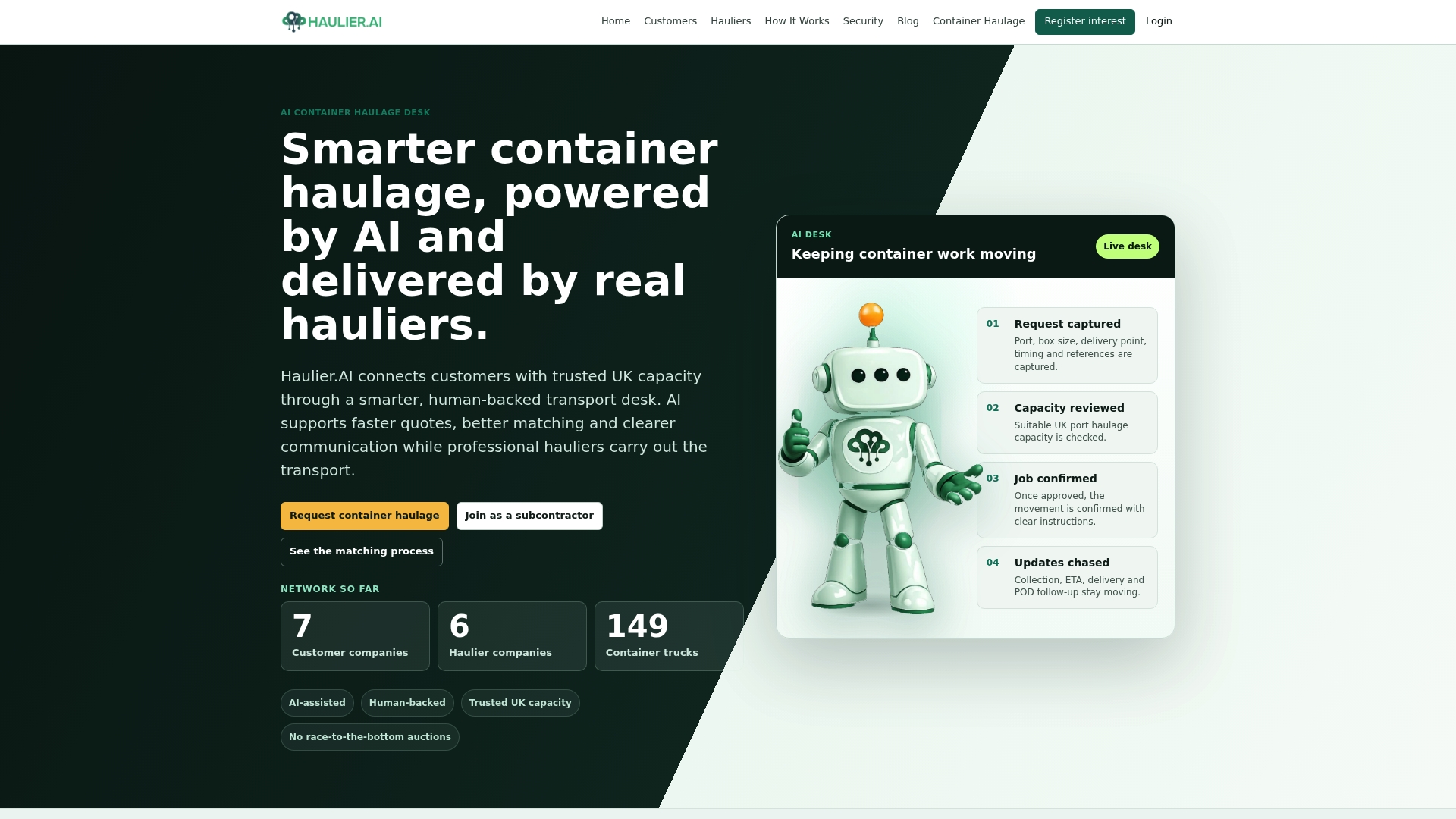
The pilot includes integration support, a managed transport desk covering your chosen lanes, and proof-of-delivery capture built into the workflow. You get visibility across the full movement without the overhead of configuring a standalone system. To scope a pilot for your lanes, request container haulage or review the full container haulage service to confirm port coverage before you book.
Useful sources
- Technology integration in freight insurance: a practical UK guide — insurer perspective on digital POD as risk control
- Digital customs processes and freight insurance — MRN, e-CMR and metadata requirements for UK importers
- Electronic Trade Documents Act 2023 — legal basis for electronic trade documents in the UK
- eFTI and paperless freight in Europe — regulatory timeline and structured-data requirements
- Haulier platform overview — managed transport desk, paperwork tracking and integration model
- Haulier security and governance — data protection and human oversight controls
For customs-specific lane readiness, check HMRC’s Customs Declaration Service (CDS) guidance for EORI and MRN requirements, and consult your port community system operator for port-specific data-exchange formats.
FAQ
What is digital proof of delivery in container haulage?
Digital proof of delivery is an electronic record combining GPS coordinates, timestamps, photos, e-signature and an audit log to confirm a container movement is complete. It replaces paper delivery notes and provides stronger evidence for insurance claims and customs audits.
How does digital POD reduce freight insurance claims?
Freight insurance specialists treat digital POD as a risk-control measure because GPS traces, timestamped photos and immutable audit logs replace subjective witness accounts, making damage and shortage claims faster to resolve and harder to dispute.
Does digital POD comply with UK law?
The Electronic Trade Documents Act 2023 gives electronic trade documents the same legal effect as paper equivalents, provided a reliable system is used to identify and protect the document. Confirm your provider’s system meets this reliability standard.
How long does a UK digital POD implementation take?
A typical pilot on two to three lanes takes several weeks from scoping to review. Full rollout across all lanes usually completes within a few months, with cost recovery often following within months through faster invoicing and fewer disputes.
How does Haulier support digital POD for container haulage?
Haulier’s managed transport desk provides real-time paperwork tracking, port-matched haulier capacity and human oversight controls that map directly to the integration and auditability requirements for digital POD on UK container lanes.