
Container haulage article
Moving boats by road without avoidable delays
A practical guide to boat haulage in the UK, covering permits, route limits, loading, timing, costs and how to organise road moves with fewer delays.
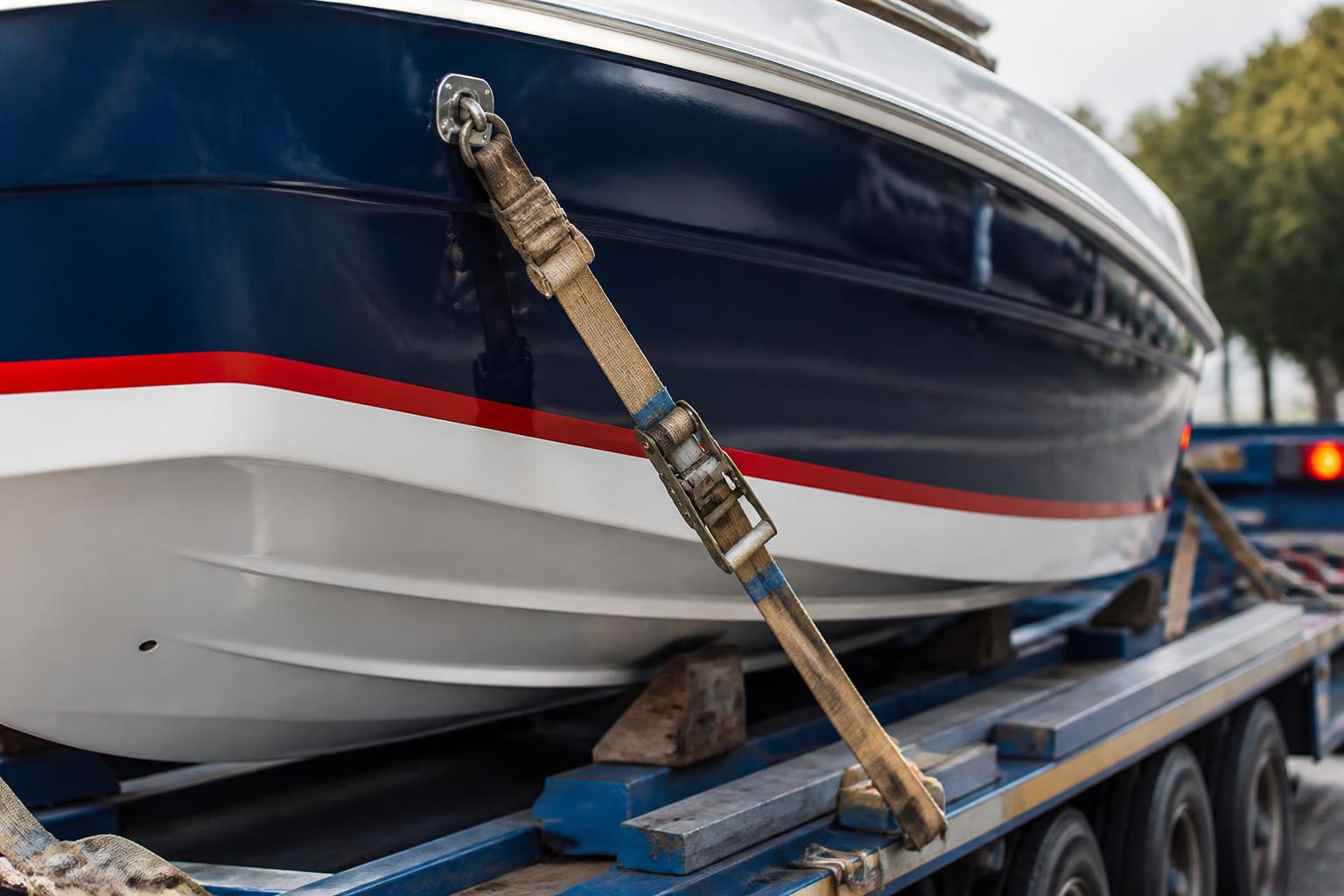
A boat move by road usually runs smoothly when the planning is done before anyone books a crane, sends a driver, or promises an ETA to a marina. Most delays happen for ordinary reasons. The dimensions are wrong, the weight is estimated, the collection yard has poor access, the receiving site cannot unload when the vehicle arrives, or the route turns out to need permits and extra notice.
That is why good boat haulage is less about finding any available vehicle and more about getting the operating detail right at the start. We organise that detail properly, with an AI-assisted, human-backed transport desk that helps buyers and hauliers deal with awkward moves without turning the job into a rushed auction.
What boat haulage usually involves in the UK
In the UK, moving a boat by road can be anything from a straightforward trailer movement to a specialist abnormal load operation. The difference usually comes down to size, weight, access, and whether the vessel can travel on a standard road trailer behind a suitable towing vehicle or needs a commercial haulier with specialist equipment.
For smaller craft, a standard trailer move may be enough. That tends to apply where the boat is already on a roadworthy trailer, the paperwork is in order, the combined dimensions stay within normal road limits, and both collection and delivery sites can load and release the unit without delay. In those cases, the job can look similar to other specialist UK haulage work, even though the cargo is marine.
Once the boat is too wide, too high, too long, too heavy, or not on a suitable trailer, it becomes a specialist job. Then the move often involves a low loader, extending trailer, cradle arrangements, lifting plans, route checks, and permit planning. The parties involved usually include the boat owner or broker, the marina or boatyard at each end, lift operators, the road transport operator, and sometimes escort providers if the load dimensions require them.
A common point of confusion is where responsibility sits. The haulier manages the road movement. The marina or yard usually controls launching, lifting, storage slots, and local site rules. If there is a crane lift, mobile hoist, or forklift handling operation, the lift provider will normally want confirmed dimensions, weight, and approved lift points before committing. If any of that is uncertain, the road plan is uncertain too.
In practice, many marine moves are not routine general haulage jobs. They sit in the awkward middle ground where the vessel is not large enough to be treated like a major project cargo move, but is far too specialist for a standard curtain sider or ordinary trailer. That is where organised request handling matters most.
What information operators need before they can quote
A useful quote starts with accurate dimensions. Operators need the boat's overall length, beam, height, and weight. Not brochure figures, but transport figures. Height is especially important because transport height is measured from road level when the boat is loaded on the intended trailer, not from the waterline or from the yard stands.
Weight also needs care. Many boats carry added equipment over time, such as radar arches, generators, tenders, fuel, water, masts, or aftermarket fittings. If the declared weight is light and the actual weight is higher, the wrong trailer may be sent or the planned route may no longer be suitable.
For pricing and planning, we also need to know:
- Collection postcode and exact site
- Delivery postcode and exact site
- Whether the boat is afloat, ashore, or already on a trailer
- Whether a cradle is supplied, and by whom
- Whether masts, flybridges, arches, screens, or other parts will be removed
- Whether loading and unloading equipment is booked
- Whether there are date restrictions, tide restrictions, or marina slot times
- Whether there are site inductions, PPE rules, or insurance requirements
- Whether the move is one-way or whether equipment must be returned
Access details matter almost as much as dimensions. A quote can change if the collection yard has a narrow entrance, weak surfaces, parked cars, overhanging trees, or no room to position a low loader. The same applies at delivery. A marina may have room to unload a boat from one direction but not the other. Some sites only permit unloading at fixed times or only with their own lifting team.
Lifting arrangements should be confirmed early. If the boat is ashore, is there a travel hoist on site? If there is a crane booking, who is making it and who is paying? If the vessel needs slinging, are the sling positions marked and approved? If a mast has been removed, where will it travel and how will it be secured?
Photos help. Side, front, rear, and access photos often save a round of assumptions. A clear set of images can show whether a flybridge increases transport height, whether a cradle needs repair, or whether the collection lane will be difficult for an artic or rigid unit.
The more complete the request, the better the quote. It is the same principle we apply across UK haulage, whether the load is a boat, a machine, or port-related container haulage. Good information up front reduces re-pricing, failed collections, and arguments about who knew what.
Why size, route and permits change the plan
The route for a boat move is determined by what the loaded vehicle actually measures on the road. Beam is often the first issue. A vessel that is manageable in a yard can become a special movement on the public highway once the trailer width and support arrangement are included.
Height can be even more restrictive. Bridges, overhead cables, tree cover, and local road furniture can rule out what looks like the obvious route. Overall length affects turning circles, roundabout negotiation, and access to marinas, yards, and industrial estates. Weight affects axle loading, bridge restrictions, and trailer choice.
Where a load exceeds normal road limits, the movement may fall into abnormal load procedures. In the UK, that means route planning and notifications are handled under UK rules, not EU-wide rules. Since Brexit, operators and customers should assume UK-specific compliance and notification practice rather than relying on general EU guidance. The exact requirements depend on the load and route, and on which authorities need notice.
Lead times change quickly once permits or notifications are involved. A movement that might have been arranged in a short window as a standard trailer job can need extra days when the dimensions trigger special planning. If escorts are required, that adds another layer of availability and coordination. Some police areas no longer provide escorts for loads that can be handled by private escort arrangements, but the route and load still have to be assessed properly.
Road restrictions also affect timing. Weekend movements may work better on some routes and worse on others. Urban sections can be easier very early in the day. Rural lanes may be impossible after dark if the route needs complex reversing or traffic management. Seasonal traffic around coastal towns can also change a route that looked simple on a map.
This is why a road move for a boat should not be priced as though distance alone decides the job. Two moves of similar mileage can be completely different operationally. One can be a clean run on a standard trailer. The other can involve survey work, route amendments, escort planning, and fixed yard windows.
We see the same planning discipline in port work. If a collection from London Gateway container movements or a delivery from Southampton misses its slot, the knock-on effect is immediate. Marine road moves are no different. The route and timing have to be built around the real constraints, not the hoped-for ones.
How loading, unloading and handover are normally managed
Loading and unloading are where avoidable delays often become expensive. A driver can arrive on time with the right trailer and still lose hours if the yard is not ready, the crane is late, or the boat is not prepared for lifting.
The first point is who is providing the lifting operation. That may be a marina travel hoist, a mobile crane, a forklift arrangement for a small craft, or yard equipment used with a cradle. Each option needs a booked time, a named site contact, and confirmation that the equipment is suitable for the vessel's weight and lifting points.
Before loading, the boat should be prepared for road movement. Loose items should be removed or secured. Covers, canopies, and detachable equipment should be checked. If the mast, radar arch, windscreen sections, or flybridge components need removing to reduce transport height, that should be done before the vehicle is due on site, not while the driver waits.
Securing is not improvised. The haulier will secure the load to the trailer using appropriate restraints and support arrangements, but the vessel itself must be suitable for transport. Cradles need to be sound. Hull supports need to be positioned correctly. If there are manufacturer handling instructions, they should be available. A damaged or makeshift cradle can stop a movement.
Condition checks are standard good practice. Photos at collection and delivery help record the state of the boat, the cradle, and any separate components travelling with it. If the move is part of a commercial transaction, handover records should be clear about what was collected and in what condition. Depending on the job, the receiving party may also want a signed POD once the vessel is delivered and unloaded.
Timing windows should be realistic. If the crane slot is at 10:00, the vehicle should not be booked on the assumption that it can arrive at any point in the morning. If the marina closes its yard gate at a fixed time, unloading needs to be completed before then, not merely started. Named contacts at both ends are essential. A driver arriving to find that the one person with authority to release the boat is off site is a common and avoidable failure.
For imported boats or movements linked to international supply chains, document handling can also matter. If the movement is tied to customs clearance, port release, or proof of ownership transfer, those checks need to be complete before the road leg begins. That is familiar territory in container haulage through Felixstowe, London Gateway, Southampton, Tilbury, Liverpool, Teesport, and Immingham, and the same operational discipline applies when the cargo is marine rather than containerised.
What affects cost and timing on a boat move
Distance matters, but it is only one part of cost. Trailer type, route complexity, loading method, and waiting time often make more difference than mileage alone.
The main cost drivers usually include:
- Actual loaded dimensions and weight
- Whether the move is standard or abnormal
- Trailer type and vehicle availability
- Empty running to reach collection
- Route restrictions and diversions
- Escort or permit requirements
- Crane, hoist, or yard handling arrangements
- Waiting time at collection or delivery
- Storage or stand time if the site is not ready
- Return of cradles or equipment if required
Empty running is often overlooked by customers. A specialist marine-capable trailer may need to position from another region, and the next available suitable operator may not be local. That does not make the quote wrong, it reflects the real fleet position on the day.
Timing is affected by the same factors. A move can be delayed because the vessel is not ready, because a cradle needs alteration, because route restrictions require a different vehicle, or because the receiving site cannot unload in the original slot. Last-minute changes are especially disruptive. If the dimensions change after the quote, or the collection point moves, the plan may need to be rebuilt.
Commercially, clarity saves money. If a buyer asks for a rough price with incomplete information, the result is often a cautious quote or a quote that later needs correction. Neither outcome helps. A proper request lets the operator price the real job.
There can also be tax and document points in the background. For example, if the move is linked to a sale, import, or commercial transfer, the parties may need to consider invoicing, ownership evidence, customs status, and VAT treatment separately from the transport itself. The haulier can move the load, but the transaction documents still need to be in order.
Not every boat move fills a whole vehicle in the same way. Some associated equipment can travel as part-load, while the vessel itself may require a dedicated full-load movement. Separating those elements can sometimes improve the plan, but only if the handling risk stays acceptable.
How Haulier.AI can help organise awkward marine road moves
Awkward transport jobs usually go wrong in the handover between emails, phone calls, and assumptions. One person has the dimensions, another has the yard contact, someone else is waiting for lift confirmation, and the haulier is being asked for an ETA without the full picture. We built Haulier.AI to make that process more organised.
Our role is not to turn specialist work into a race to the bottom. We run an AI-assisted, human-backed transport desk that helps buyers present clearer requests and helps hauliers see relevant subcontract opportunities with the right operational detail attached. That matters on boat haulage because these jobs often sit outside a buyer's routine traffic flow and outside a general haulier's standard work.
When we handle a request, we focus on the practical information that affects whether the move can actually happen. Dimensions, weight, access, lifting, timing windows, route issues, and site contacts are gathered and checked in a structured way. If something is missing, we flag it early rather than letting it become a failed collection.
For buyers, that reduces the manual chasing that usually comes with unusual moves. For hauliers, it improves the quality of the enquiry and helps preserve commercial control. The point is not to flood the market with half-specified jobs. The point is to present workable jobs to suitable operators.
That approach is already familiar in our wider UK haulage work, including container collections through Southampton and other major ports such as Felixstowe, Tilbury, Liverpool, Teesport, and Immingham. In each case, organised information handling makes the difference between a smooth movement and a day lost to avoidable exceptions.
We also keep the human element where it belongs. AI-assisted does not mean unsupervised. Marine road moves often involve exceptions, judgement calls, and site-specific constraints that need experienced review. Our team helps manage those exceptions, keep communication moving, and support the handover from quote to booking to delivery.
If you need a boat moved by road without wasting time on spreadsheet chasing, repeated re-quoting, or unclear ownership of the details, we can help organise the job properly. That is usually what prevents delays in the first place.
Do all boats need an abnormal load movement?
No. Smaller boats on suitable trailers may move as a more standard load. Wider, taller or longer boats can trigger route restrictions, notifications, escorts or specialist equipment.
What measurements matter most for a quote?
Overall length, beam, height on the trailer, weight, and whether the boat travels on its own cradle all matter. Collection and delivery access are just as important as the boat dimensions.
Can boat haulage be arranged at short notice?
Sometimes, but it depends on trailer availability, route complexity, permits, escorts and lifting slots. Short-notice jobs are easier when dimensions, contacts and site details are clear from the start.
Who arranges cranes or marina lifting equipment?
It varies by job. Sometimes the marina or yard provides lifting, and sometimes it must be booked separately. This should be agreed before the vehicle is dispatched to avoid waiting time and failed collections.
Is insurance included in boat haulage?
Cover varies by operator and movement type, so it should be checked case by case. Buyers should confirm what is covered in transit and whether any separate marine or yard-side cover is needed.