
Container haulage article
Merchant haulage vs carrier: a practical guide for UK shippers
Discover the key differences in merchant haulage vs carrier. Learn which option suits your shipping needs in the UK for better control and cost.
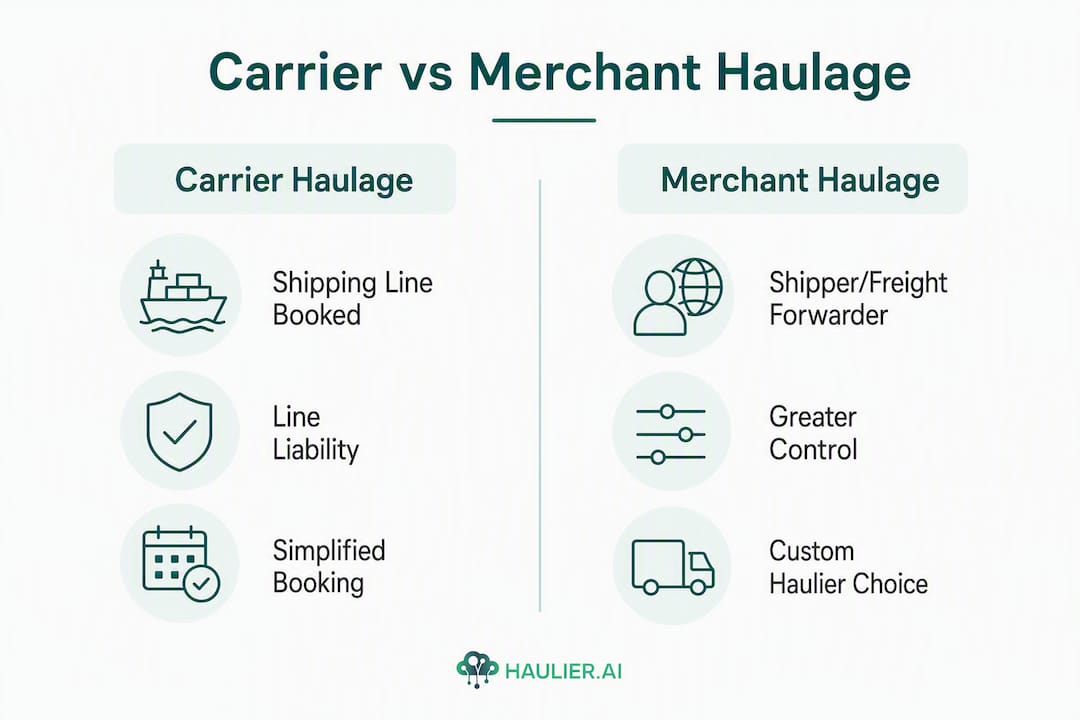
Carrier haulage means the shipping line arranges inland transport on your behalf; merchant haulage means you arrange it yourself, using a haulier of your choosing. For smaller shippers without a dedicated logistics team, carrier haulage is usually the simpler, lower-risk starting point. For freight forwarders, importers with a Transport Management System (TMS), or anyone moving containers regularly within roughly 100 miles of a UK port, merchant haulage often delivers better control and potentially lower cost per move.
The core trade-offs in brief:
- Liability: Under carrier haulage, the shipping line remains liable for the container during inland movement. Under merchant haulage, liability transfers to you at port handover.
- Control: Merchant haulage lets you choose the haulier, negotiate rates, and set routing. Carrier haulage gives you one contact and a packaged service.
- Cost shape: Carrier haulage bundles inland costs into the freight rate. Merchant haulage separates them, which can be cheaper short-haul but adds a handover fee (typically around £70 in the UK), and shifts admin to you.
- Administrative burden: Carrier haulage is lower admin. Merchant haulage requires you to manage gate passes, haulage orders, driver IDs, and empty-container returns.
Table of Contents
- What do carrier haulage and merchant haulage actually mean?
- Who is responsible at each stage, and how do Incoterms affect your choice?
- Pros and cons: carrier haulage versus merchant haulage
- UK scenarios: which haulage type fits your shipment?
- How to book carrier haulage in the UK: step by step
- How merchant haulage works in practice: booking, port handover, and pickup
- Typical charges and how they affect your total landed cost
- How to choose between carrier and merchant haulage
- How Haulier supports merchant haulage operations
- Key takeaways
- The trade-off most shippers underestimate
- Merchant haulage with carrier-level reliability: how Haulier delivers both
- Useful sources
- FAQ
What do carrier haulage and merchant haulage actually mean?
Carrier haulage is the model where the shipping line takes responsibility for the entire transport chain, including the inland leg from port to your warehouse or delivery point. The line books a third-party haulier on your behalf, and you receive a single through-bill of lading covering sea and land. You do not choose the truck or negotiate with the driver; you deal only with the carrier.
Merchant haulage works the other way. Once the container is discharged and released at the port, you or your freight forwarder arrange collection and delivery using a haulier you have contracted directly. The shipping line’s involvement ends at the port gate. Shippers gain more operational control and flexibility — they can choose the haulier, negotiate rates, and customise routing — but they also take on the associated liability and paperwork.

| Dimension | Carrier haulage | Merchant haulage |
|---|---|---|
| Who books the truck | Shipping line | Shipper / freight forwarder |
| Who is liable inland | Shipping line | Shipper / nominated haulier |
| Who pays haulage charges | Included in freight rate | Paid separately to haulier |
| Who handles port paperwork | Carrier | Shipper / agent |
| Contract type | Single through bill of lading | Separate haulage contract |
| Typical best fit | Small shippers, simple routes | TMS-enabled, high-volume, short-haul |
Import example: A container arrives at Felixstowe. Under carrier haulage, the shipping line books a haulier and delivers to your East Midlands DC. You track it through the carrier’s portal. Under merchant haulage, your freight forwarder releases the container, your contracted haulier collects it, and you manage the delivery directly.
Export example: You have a full container load (FCL) leaving Southampton. Under carrier haulage, the line collects from your factory. Under merchant haulage, you book a haulier to bring the container to the port, and the shipping line takes over at the gate.
Who is responsible at each stage, and how do Incoterms affect your choice?
Responsibility does not transfer in one clean moment — it shifts across several handover points, and getting this wrong is where most disputes originate.
Stage-by-stage responsibility map:
- Vessel discharge to container yard: The shipping line is responsible in both models.
- Container release from port: Under carrier haulage, the line retains responsibility. Under merchant haulage, liability transfers to the consignee or their nominated haulier at this point.
- Inland pick-up and transit: Carrier haulage keeps the line liable. Merchant haulage puts the shipper or their haulier in the frame for damage, delay, or loss.
- Delivery and empty-container return: Under merchant haulage, you are responsible for returning the empty container within the free-time window. Miss it, and detention charges accrue.
Incoterms determine who must arrange and pay for haulage, which directly affects which model is appropriate:
- EXW (Ex Works): The buyer arranges everything from the seller’s premises. Merchant haulage is almost always the buyer’s responsibility under this term.
- FCA (Free Carrier): The seller delivers to a named place; the buyer takes over from there. Merchant haulage is common for the buyer’s inland leg.
- DAP / DDP: The seller is responsible for delivery to the named destination. Under these terms, the seller typically uses carrier haulage or arranges merchant haulage and absorbs the cost and risk.
The practical implication: if your Incoterm puts you in charge of the inland leg, you are operating under merchant haulage whether you have consciously chosen it or not. Confirm this with your freight forwarder before booking.
Pro Tip: Empty-container return timing is the single most common source of unexpected charges. When you take on merchant haulage, confirm the free-time window with the shipping line before the container is released — not after it arrives at your warehouse. Missing the return deadline by even one day triggers detention fees that can quickly exceed the haulage saving.
Pros and cons: carrier haulage versus merchant haulage
The honest answer is that neither model is universally cheaper or better. The right choice depends on your shipment profile, your team’s capability, and how much risk you want to carry.
| Dimension | Carrier haulage | Merchant haulage |
|---|---|---|
| Responsibility / liability | Shipping line liable inland | Shipper liable from port handover |
| Control and flexibility | Low — carrier chooses haulier and route | High — shipper selects haulier, route, timing |
| Cost structure | Bundled into freight rate; predictable | Separate haulage invoice; variable; handover fee applies |
| Booking and paperwork | Single contact; carrier handles docs | Shipper manages gate passes, haulage orders, driver IDs |
| Best-use cases | Small shippers; long-haul; no TMS | TMS-enabled; short-haul; high volume; peak-period flexibility |
| Handover / transit points | Port to door under one contract | Liability transfers at port gate |
Carrier haulage offers economies of scale and predictable pricing, which suits smaller shippers or those without a dedicated logistics team. You pay one rate, one contact handles exceptions, and you are not exposed to port-gate paperwork errors.
Merchant haulage’s appeal is real, but so is the trap. Choosing merchant haulage does not automatically mean lower total cost — extra admin fees, handover charges, and shifted liability mean a full cost-of-ownership calculation is necessary before committing. A UK importer moving 20-foot containers from Tilbury to a warehouse 30 miles away will almost certainly save money using merchant haulage. The same importer moving containers 250 miles north may find the carrier’s bundled rate is competitive once handover fees and admin time are factored in.
UK scenarios: which haulage type fits your shipment?
Small importer, single container, Portsmouth to Bristol (roughly 80 miles) Merchant haulage is usually the better call here. The distance falls well within the roughly 100-mile threshold where independent haulage tends to be cost-effective. A local haulier can be booked at a competitive rate, and the shipper retains scheduling flexibility. The handover fee applies, but the overall cost is typically lower than the carrier’s bundled inland rate for this distance.
High-volume retailer, 15 containers per week, Felixstowe to multiple DCs A TMS-enabled logistics team is the deciding factor. Companies with TMS capability commonly prefer merchant haulage for direct haulier relationships, faster exception handling, and better visibility. At this volume, negotiating rates directly with a pool of hauliers and managing collections through a platform like Haulier gives far more responsiveness than relying on the carrier’s allocated haulier.
Palletised FCL, London Gateway to a 3PL in the Midlands (130 miles) At this distance, the cost advantage of merchant haulage narrows. Run the numbers: add the handover fee, the haulage rate, and the admin time cost. If the carrier’s bundled rate is within 10–15% of the merchant total, the simplicity of carrier haulage may be worth it, particularly if your team is stretched.
Peak season or bank-holiday collections Carrier haulage capacity can tighten sharply during peak periods because the shipping line is allocating a fixed pool of contracted hauliers across all its customers. Merchant haulage gives you a capacity buffer — you can call on multiple hauliers and are not competing internally with other shippers on the same carrier’s books.
High-value or fragile cargo Merchant haulage lets you specify the haulier, the equipment, and the handling requirements. Under carrier haulage, you have no say in which truck or driver is assigned. For cargo where handling matters, that control is worth paying for. For same-day or urgent collections, merchant haulage is almost always the only practical option.
Customs transit or oversized loads Both require additional documentation and, in some cases, escort vehicles. Merchant haulage gives you direct control over the haulier’s compliance with customs transit procedures. Under carrier haulage, you are dependent on the carrier’s subcontractor having the right authorisations — worth verifying in advance.
How to book carrier haulage in the UK: step by step
Carrier haulage simplifies operations by offering a single point of contact and packaged inland services. The booking process reflects that simplicity.
Booking steps:
- Confirm with your freight forwarder or shipping line that carrier haulage is selected at the time of booking (it is often the default, but verify).
- Provide the delivery address, contact details, and any access restrictions (height barriers, narrow lanes, appointment windows).
- Confirm the free-time period for delivery and empty-container return.
- Receive the bill of lading, which covers both the sea and inland legs.
- Monitor progress through the carrier’s tracking portal or via your freight forwarder.
- Confirm delivery and obtain proof of delivery (POD) from the carrier.
- Ensure the empty container is returned within the agreed free-time window to avoid detention charges.
Documents the carrier typically handles:
- Bill of lading (through)
- Delivery order / container release note
- Proof of delivery
- Empty-container return confirmation
Information you need to provide:
- Full delivery address and postcode
- Consignee contact name and number
- Any delivery appointment or time-window requirements
- Customs clearance confirmation (the carrier will not move the container until customs entry is accepted)
- Dangerous goods declarations if applicable
One point that catches shippers out: the carrier will not release or move the container until UK customs clearance is confirmed. If your customs entry is delayed, the container sits in the port and free time ticks down regardless of which haulage model you are using.
How merchant haulage works in practice: booking, port handover, and pickup
Under merchant haulage, you or your freight forwarder take direct control of the inland leg from the moment the container is released at the port. The process has more moving parts than carrier haulage, but each step is manageable with the right preparation.
Process flow:
| Stage | Who acts | What happens |
|---|---|---|
| Container released | Shipping line / port | Release note issued; free time begins |
| Haulier booked | Shipper / freight forwarder | Haulage order raised; driver and vehicle confirmed |
| Gate pass issued | Port / terminal | Driver presents ID and gate pass for collection |
| Container collected | Merchant haulier | Liability transfers to shipper at this point |
| Inland delivery | Merchant haulier | Delivery to warehouse / consignee |
| Empty return | Shipper / haulier | Container returned to nominated depot within free time |
Documents the merchant must manage:
- Container release note / delivery order
- Haulage order (raised by shipper or agent)
- Driver ID and vehicle registration (required at port gate)
- Gate pass (port-specific; incorrect paperwork is a frequent cause of port delays)
- Proof of delivery
- Insurance certificate for the haulier
- Empty-container return confirmation
Pro Tip: Always confirm your haulier’s insurance cover before the container is released. The shipping line’s liability ends at the port gate under merchant haulage. If your haulier is uninsured or underinsured and the container is damaged in transit, the loss falls on you. Ask for a copy of the haulier’s goods-in-transit insurance certificate as a standard part of onboarding any new subcontractor.
For port-specific procedures at Southampton, Haulier’s Southampton container haulage guide covers gate procedures and typical local charges in detail.
Typical charges and how they affect your total landed cost
The cost comparison between carrier and merchant haulage is rarely as simple as comparing two line items. Several charges sit underneath the headline rate and can shift the calculation significantly.
Common charges to watch:
- Handover / LoLo fee: Charged by the shipping line when a merchant haulier removes a container from the quay. Industry examples in the UK cite approximately £70 as a typical figure. This applies under merchant haulage only.
- Demurrage: Charged by the shipping line when a container is not collected from the port within the free-time period. Applies under both models, but under merchant haulage you are solely responsible for ensuring timely collection.
- Detention: Charged when the container is not returned empty within the agreed free-time window. Under merchant haulage, this is your liability.
- Driver waiting time: If your warehouse cannot unload within the agreed window, the haulier charges waiting time. More common under merchant haulage where you have direct responsibility for the delivery appointment.
- Gate fees: Some terminals charge a gate-in or gate-out fee per container movement. Check with the specific port.
- Admin / processing fees: Freight forwarders or agents may charge a handling fee for managing merchant haulage paperwork on your behalf.
For a fuller breakdown of what drives container haulage rates in the UK, Haulier’s pricing guide covers the main variables.
Cost-comparison approach: For a single move, add the merchant haulage rate plus the handover fee plus any estimated detention/demurrage exposure, then compare that total against the carrier’s bundled inland rate. If the merchant total is more than 15–20% below the carrier rate, the saving is likely real. If the gap is smaller, factor in your team’s admin time before deciding.
How to choose between carrier and merchant haulage
The decision comes down to six factors. Work through them in order and the right answer usually becomes clear.
| Decision factor | Choose carrier haulage if… | Choose merchant haulage if… |
|---|---|---|
| TMS / logistics capability | No TMS; small team | TMS in place; dedicated logistics resource |
| Shipment distance from port | — | Under 100 miles from port |
| Cargo value / fragility | Standard cargo; handling not critical | High-value or fragile; handling requirements specific |
| Customs complexity | Standard clearance | Complex customs transit; bonded movements |
| Volume and frequency | Occasional shipments | Regular, high-volume movements |
| Peak-season capacity | Carrier manages allocation | Need flexibility across multiple hauliers |
Companies with a TMS and logistics team often prefer merchant haulage for the transparency and responsiveness it provides. Smaller shippers without that infrastructure typically find carrier haulage more practical.
Questions to ask before booking:
- What is the free-time period for collection and empty return at this specific port?
- Does the carrier’s bundled rate include all port charges, or are there add-ons?
- Does your nominated haulier have current goods-in-transit insurance and the correct operator licence?
- Who handles customs clearance, and how does that interact with container release?
- What is the carrier’s process for exceptions (damaged container, late vessel, driver no-show)?
Insurance and risk transfer: Under carrier haulage, the shipping line’s liability covers the inland leg, though it is typically limited by the bill of lading terms (often based on the Hague-Visby Rules, which cap liability per package or kilogram). Under merchant haulage, your haulier’s goods-in-transit insurance is your primary protection. Check the sum insured against your cargo value before every shipment, not just at contract renewal. For a practical guide on selecting UK transport management companies that can support merchant haulage decisions, Haulier’s overview covers the key criteria.
How Haulier supports merchant haulage operations
Merchant haulage’s main drawbacks are admin volume and visibility gaps — knowing where your container is, whether the haulier has the right paperwork, and whether the empty return is on track. Haulier’s platform addresses each of these directly.
What the platform provides for merchant haulage:
- AI-assisted quoting: Matches your container movement to available, vetted UK hauliers quickly, replacing the manual process of calling multiple hauliers for rates.
- Human-backed transport desk: A real operations team monitors bookings and intervenes when exceptions arise, so you are not chasing hauliers yourself when something goes wrong.
- Paperwork tracking: The platform tracks haulage orders, gate passes, and proof of delivery in one place, reducing the risk of port delays caused by missing documentation.
- Haulier-controlled rates: Hauliers on the platform set their own rates and select jobs, which means pricing reflects real market capacity rather than a fixed schedule. During peak periods, this gives shippers access to hauliers who are actively available.
- Port coverage matching: The platform matches shipments to hauliers with coverage at the relevant UK port, avoiding the common problem of booking a haulier who cannot actually collect from that terminal.
- Real-time communication updates: Status updates flow through the platform rather than via phone calls and email chains, giving freight forwarders and importers visibility without the admin overhead.
A typical UK importer using Haulier for merchant haulage collections from Felixstowe reports that the quoting and booking process that previously took several hours of phone calls and emails is handled through the platform in a fraction of the time, with paperwork tracked automatically and fewer missed updates. The platform’s how-it-works page explains the full process and oversight model.
Key takeaways
Merchant haulage gives UK shippers more control and can reduce short-haul costs, but carrier haulage remains the lower-risk, lower-admin choice for shippers without dedicated logistics capability or TMS infrastructure.
| Point | Details |
|---|---|
| Liability transfers at port gate | Under merchant haulage, the shipping line’s liability ends when your haulier collects the container. |
| Distance threshold matters | Merchant haulage tends to be cost-effective for movements of roughly 100 miles or less from the port, based on industry guidance. |
| Handover fee applies | A LoLo / handover fee of approximately £70 applies when a merchant haulier removes a container in the UK, which is the typical industry figure. |
| TMS capability is the key differentiator | Shippers with a TMS and logistics team typically benefit most from merchant haulage’s control and visibility. |
| Haulier reduces merchant haulage admin | Haulier’s AI-assisted platform handles quoting, paperwork tracking, and haulier matching for UK container movements. |
The trade-off most shippers underestimate
The conventional framing of merchant haulage vs carrier haulage treats it as a cost question. It is not, or at least not primarily. The real question is where you want the risk to sit and whether your operation can actually manage it.
Carrier haulage is not just a convenience for small shippers. It is a genuine risk-transfer mechanism. When something goes wrong at 11pm on a bank holiday — a driver no-show, a damaged container, a missed gate slot — carrier haulage means the shipping line’s operations team is your first call. Merchant haulage means you are the operations team.
That is fine if you have the infrastructure. A freight forwarder with a TMS, a pool of vetted hauliers, and a transport desk running during port hours can handle exceptions quickly and turn merchant haulage into a genuine competitive advantage: better rates, faster collections, and direct relationships with hauliers who know your ports. Without that infrastructure, merchant haulage’s cost saving can evaporate in a single detention charge or a half-day of admin chasing a gate pass.
The shippers who get this wrong are usually the ones in the middle: too large to accept the carrier’s bundled rate without questioning it, but not quite resourced enough to manage merchant haulage exceptions reliably. For that group, a managed platform that gives merchant-level control with carrier-level operational support is the practical answer — and that is precisely the gap Haulier fills in the UK market.
Merchant haulage with carrier-level reliability: how Haulier delivers both
Merchant haulage gives you the control and cost advantages of arranging your own inland transport. The problem has always been the admin and the risk exposure when things go wrong. Haulier’s container haulage platform is built specifically for UK freight forwarders and importers who want merchant-level control without building an in-house transport desk from scratch.
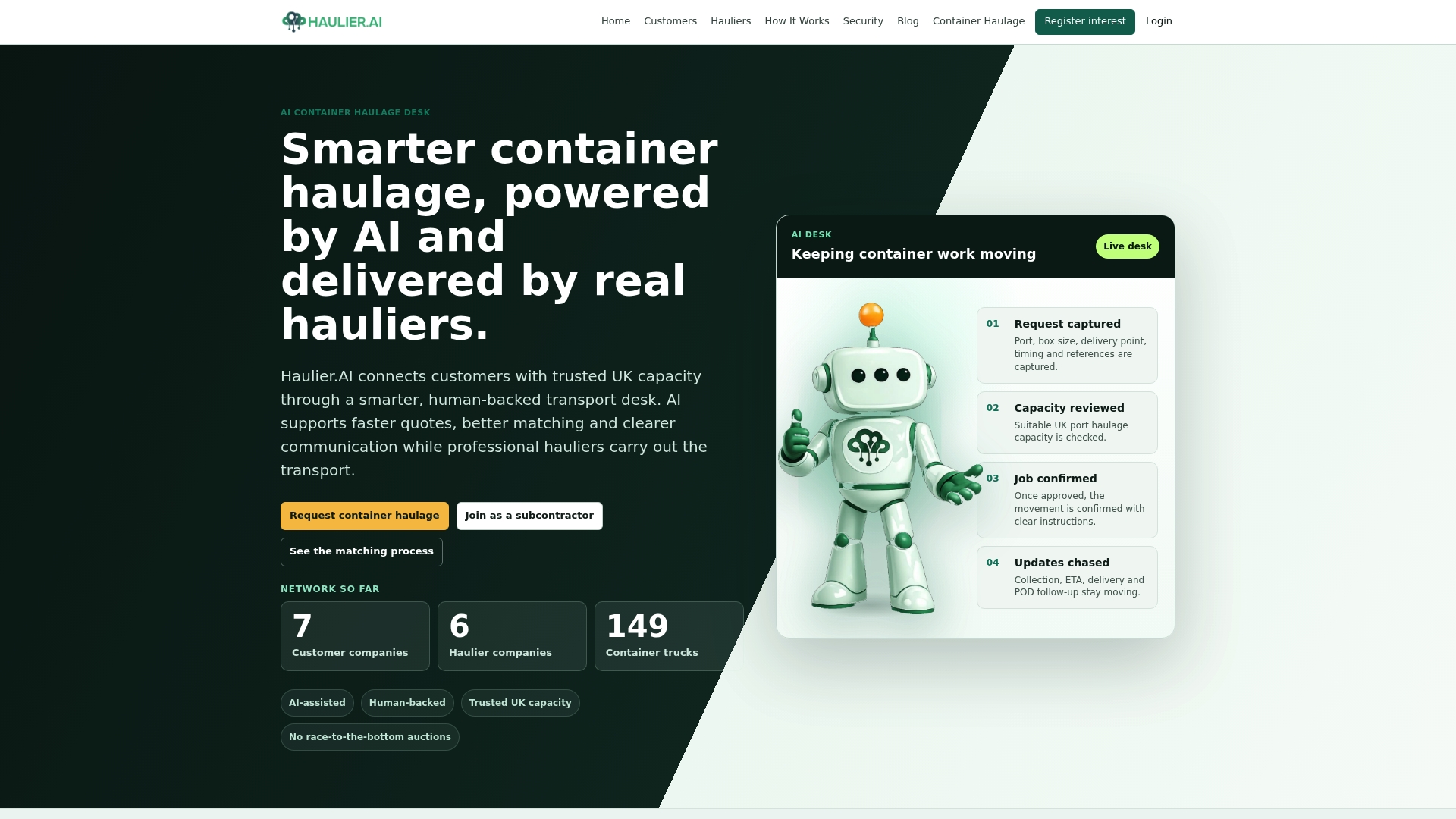
The platform connects you to vetted UK hauliers with real port coverage, handles quoting and paperwork tracking in one place, and keeps a human transport desk in the loop for exceptions. Hauliers set their own rates and choose their jobs, so capacity is genuine and pricing reflects the market. You get visibility, documentation, and responsiveness without the phone calls. Request a quote to see available capacity for your next container movement.
Useful sources
- Carrier and merchant haulage in the hinterland — Port Economics, Management and Policy: academic overview of how hinterland transport is organised under each model.
- Benefits of merchant haulage over carrier haulage — Broadside Customs Clearance Agency: UK-specific guidance on handover fees, liability transfer, and cost considerations.
- Difference between carrier haulage and merchant haulage — Shipping and Freight Resource: industry reference covering the core decision levers: who books, who is liable, who pays.
- GOV.UK customs procedures — UK Government: authoritative source for import/export customs requirements that interact with haulage choice.
FAQ
What is the difference between carrier and merchant haulage?
Carrier haulage means the shipping line arranges and is liable for inland transport under a single through contract. Merchant haulage means the shipper arranges inland transport directly with a haulier of their choice, taking on liability from the port handover point.
What is merchant haulage?
Merchant haulage is when the cargo owner or their freight forwarder books and manages the inland leg of a container movement independently, rather than using the shipping line’s arranged transport. The shipper selects the haulier, negotiates the rate, and is responsible for the container from port collection to empty return.
What does “pick up by merchant haulage” mean?
It means the consignee or their nominated haulier will collect the container from the port terminal directly, rather than the shipping line arranging delivery. The shipper must provide a gate pass, driver ID, and haulage order, and assumes liability for the container from the moment it leaves the terminal.
Container shipping uses three main carrier types: shipping lines (such as Maersk or Hapag-Lloyd, which offer carrier haulage for the inland leg), independent road hauliers (contracted directly under merchant haulage), and intermodal operators (combining rail and road, often for longer distances). The choice between carrier and merchant haulage determines who handles your inland transport.
Is merchant haulage always cheaper than carrier haulage?
Not always. Merchant haulage can reduce costs for short-haul movements of roughly 100 miles or less from a UK port, but the handover fee (typically around £70), detention exposure, and admin costs mean the total saving requires careful calculation before assuming it is the lower-cost option.