
Container haulage article
Loading bay requirements HGV: the compliance guide for managers
Ensure your HGV loading bays meet essential safety requirements with our compliance guide. Protect workers and streamline operations.
A compliant HGV loading bay needs regulated traffic routes, marked bay edges, at least one clear exit or refuge point, engineered vehicle restraints, pedestrian segregation, and a written risk assessment backed by inspection records. These obligations sit under the Workplace (Health, Safety and Welfare) Regulations 1992, PUWER, and LOLER, with HSE’s HSG136 guidance filling in the practical detail statute leaves out.
Before you do anything else, walk the bay and check these five things:
- Bay edges are marked and visible in low light
- At least one exit or refuge point exists at the lower level
- Wheel chocks, dock locks, or interlocked restraints are fitted and working
- Pedestrian routes are physically separated from vehicle movement
- A current risk assessment exists and matches what you actually see on site
HSE guidance treats loading areas as high-hazard zones precisely because vehicles, pedestrians, and lifting equipment converge in a confined footprint. Getting the basics wrong here causes a disproportionate share of serious workplace transport injuries.
Key Takeaways
A compliant HGV loading bay combines HSE-aligned design (marked edges, exits, restraints) with written risk assessments, trained staff, and predictable vehicle scheduling to cut the highest-risk interactions.
| Point | Details |
|---|---|
| Follow the right framework | Comply with the Workplace (Health, Safety and Welfare) Regulations 1992, PUWER, and LOLER, guided by HSG136. |
| Get dimensions right | Aim for a typical platform height, a minimum bay width of several metres, and inter-bay spacing sufficient for adjacent doors to open. |
| Fit proper restraints | Use wheel chocks, dock locks, or interlocked restraints to stop vehicle movement during loading. |
| Separate people from vehicles | Use physical barriers, refuge points, and one-way systems to reduce reversing and pedestrian interaction. |
| Keep records current | Log inspections, maintenance actions, and training so PUWER and LOLER obligations are demonstrable. |
| Coordinate arrivals | Predictable haulage scheduling through platforms like Haulier reduces the queuing and reversing that drive bay incidents. |
Table of Contents
- Which UK regulations and HSE guidance apply to loading bays?
- How should you position bays to reduce reversing and congestion?
- What are the standard dimensions for a UK loading bay?
- What equipment and restraints should a bay have fitted?
- How do you keep pedestrians safe around HGV movement?
- How do you prevent falls from the dock edge?
- What electrical hazards come with dock equipment?
- What operational controls and training keep a bay safe day to day?
- How often should you inspect and what should you record?
- What questions should a loading-bay risk assessment answer?
- How should you manage noise and emissions from HGVs at the bay?
- What emergency procedures does a loading bay need?
- How do traffic management plans reduce bay congestion?
- What should busy warehouse managers prioritise first?
- How managed haulage reduces pressure on your loading bay
- Where to find the primary UK guidance
- Sources
- FAQ
Which UK regulations and HSE guidance apply to loading bays?
Three legal instruments do the heavy lifting. The Workplace (Health, Safety and Welfare) Regulations 1992 set the baseline for safe traffic routes, floor conditions, and pedestrian safety anywhere in the building, loading bays included. PUWER governs the dock leveller, restraint systems, and any powered equipment you operate at the dock. LOLER applies wherever lifting equipment handles loads at height, which covers most tail-lift and crane-assisted unloading.
HSE’s HSG136 classifies loading bays as high-hazard areas and gives the practical detail the regulations leave open: traffic route design, dock leveller safety, and how to stop a vehicle moving mid-load.
- Legal minimums: safe traffic routes, competent equipment maintenance, suitable lifting-equipment inspection.
- HSE guidance (best practice, not statute): marked edges, refuge points, one-way systems, driver briefings
- Priority order: fix legal gaps first, then close the guidance gaps HSE flags as high-risk
Roughly one in five reported workplace transport injuries in the UK involves a loading or unloading task, which is why HSG136 singles bays out rather than treating them as generic yard space.
How should you position bays to reduce reversing and congestion?
Site the bay so drivers approach on a straight run rather than needing a blind reverse from the yard entrance. Where reversing can’t be avoided, a marshalling area gives drivers somewhere to wait and be briefed before they commit to the manoeuvre, which cuts the number of vehicles jockeying near pedestrian routes at once.
HSE guidance on workplace vehicles recommends straight traffic routes of at least 3.5 metres in each direction for road vehicles, though narrower routes can work where speed and volume are both low. Record vertical clearances at every point a trailer might clip an obstruction, and signpost weight restrictions clearly.
- Brief drivers before they reach the bay, not after they’ve started reversing
- Separate visitor and delivery traffic with distinct routes or timed access
- Use one-way systems wherever the yard layout allows it
- Record clearance heights at gates, canopies, and low structures
Pro Tip: Stagger delivery windows across your busiest suppliers rather than accepting whatever slot they offer. A marshalling area only helps if it’s not also full at 9am on a Monday.
What are the standard dimensions for a UK loading bay?
Vehicle floor heights vary enormously across a typical UK fleet, from low-loaders to high-cube trailers, so most facilities design around a single working height rather than chasing every variation. Supplier guidance from BidGroup puts the most common dock leveller platform height at 1,250 mm for modern warehouses, with bay widths of at least 3,700 mm and inter-bay spacing closer to 4,000 mm where lorries need their doors fully open.
The “letterbox” gap beneath the dock leveller and above the trailer bed needs enough depth and height for the tailboard to sit clear. Supplier examples commonly cite around a couple of metres in depth and hundreds of millimetres in height, though this shifts with your chosen platform height.
| Dimension | Typical figure | Notes |
|---|---|---|
| Platform height | Typical height for general warehousing | Most common estimate |
| Bay width | Minimum several metres | Wider for vehicles with side-opening doors |
| Inter-bay spacing | Several metres | Allows adjacent doors to open simultaneously |
| Letterbox depth | Around a couple of metres | Varies with platform height |
| Letterbox height | Several hundred millimetres | Sized to clear the tailboard |
Pro Tip: Don’t average your fleet’s floor heights into one compromise dock. If refrigerated or containerised trailers make up a meaningful share of your traffic, dedicate specific docks to them rather than degrading every bay for the sake of one vehicle type.
What equipment and restraints should a bay have fitted?
A dock leveller bridges the gap between warehouse floor and trailer bed, and it needs a competent operator who understands its slope limits. Steep gradients on a leveller can destabilise pallet trucks and forklifts mid-transfer, so operator training matters as much as the equipment itself.
Vehicle restraints stop the trailer creeping away from the dock while loading is underway. Options range from simple wheel chocks to interlocked hydraulic restraints that lock the trailer to the building and won’t release until the leveller retracts. Dock shelters and seals keep weather out but can trap visibility and communication between driver and warehouse staff, so choose designs that leave a clear sightline or comms point.
- Wheel chocks: low cost, manual, require discipline to use every time
- Dock locks and interlocked restraints: automatic, harder to bypass, higher upfront cost
- Dock seals and shelters: reduce weather ingress and energy loss, but can obscure visibility
A notable share of major workplace transport injuries recorded by HSE stem from a vehicle moving unexpectedly during loading, which is precisely what a fitted restraint system is designed to prevent.
How do you keep pedestrians safe around HGV movement?
Physical barriers and dedicated walkways are the most reliable way to keep people out of a reversing vehicle’s path. Where a route must cross a vehicle lane, a marked crossing point with a refuge area gives pedestrians somewhere safe to pause rather than dash across.
Standard Highway Code signage works for internal routes too, paired with lighting bright enough to show up floor markings and restraint status after dark. Reversing aids, CCTV coverage of blind corners, and a formal banksman procedure for the highest-risk manoeuvres all reduce the chance of a vehicle-pedestrian collision, which HSE’s introduction to workplace transport safety flags as one of the most common causes of serious injury on site.
- Physical barriers and refuge points at every pedestrian crossing near a bay
- Lighting sufficient to read floor markings and restraint indicators at night
- CCTV or a banksman for any manoeuvre with restricted sightlines
Pro Tip: If your busiest delivery slot overlaps with a shift change, move one of them. Pedestrian numbers near the bay spike exactly when vehicle movement does, and that overlap is where most near-misses happen.
How do you prevent falls from the dock edge?
Mark every bay edge clearly, and fit guard rails wherever people work at platform height without a vehicle docked. Removable rail sections let goods pass through safely when a trailer is present, then go back up the moment it pulls away.

Wide bays need refuge points and enough exits that nobody is trapped against a moving vehicle. Fencing becomes necessary wherever a fall risk is constant rather than occasional, and anyone working at edge level needs specific instruction on the hazard, not just a general safety briefing.
What electrical hazards come with dock equipment?
Powered dock levellers, seal motors, and dock heaters all need PUWER-compliant inspection and a proper lock-off procedure before anyone works on them. Static can build up during certain unloading operations, so check earthing and provide bonding points where the risk assessment identifies a need.
Powered seals and shelters carry an entrapment risk if they close on someone during operation, so operators need specific instruction on the mechanism, not just general induction.
- Lock-off procedures before any maintenance on powered equipment
- Earthing checks wherever static build-up is a plausible risk
- Named, trained operators for powered seals and shelters, not ad hoc use
What operational controls and training keep a bay safe day to day?
Design only gets you halfway. The rest comes down to written procedures, briefed drivers, and staff who know the system of work rather than improvising it.
- Write a system of work for loading and unloading that covers every vehicle type using the bay
- Brief every driver on arrival, including visiting drivers who don’t know your site
- Train lift-truck operators and bay staff, with refresher training logged and dated
- Balance loads correctly. HSE’s checklist for unloading activities notes that unbalanced loads can destabilise a trailer mid-unload
- Log every near miss and review whether it points to a layout or procedural fix
Pro Tip: A near-miss log only works if someone actually reads it monthly. Assign that review to a named person, not “the safety team”, or it quietly stops happening.
How often should you inspect and what should you record?
Check dock levellers, restraints, seals, lighting, and floor surfaces on a routine schedule, and increase frequency after any repair, seasonal weather shift, or unusually high-use period. PUWER and LOLER both expect this to be documented, not just done.
- Inspection checklists dated and signed for every leveller, restraint, and seal
- Maintenance actions logged against each fault found
- Training records showing who’s current on refresher training and who isn’t
- Near-miss and incident records kept alongside layout-change decisions they informed
What questions should a loading-bay risk assessment answer?
A risk assessment worth the paper it’s written on answers specific questions, not generic ones. Work through these in order:
- What vehicle types use this bay, and what’s their typical floor height range?
- Do drivers need to reverse to approach, and if so, is a banksman or CCTV in place?
- How many pedestrians cross the vehicle route during a typical shift, and when do they peak?
- Are there enough exits or refuge points for the bay’s width and length?
- Can someone injured at platform height be reached and rescued quickly?
- Are visiting drivers unfamiliar with the site briefed before they approach the bay?
Archived HSE guidance on falls from vehicles specifically flags visiting delivery drivers and infrequent tasks as higher risk than routine in-house operations, so don’t assume your own trained staff are the main hazard.
Sequence your fixes: immediate mitigation (chocks, signage, briefings) this week, design fixes (refuge points, barrier positions) within the quarter, and bigger investment (dedicated docks, powered restraints) on your next capital cycle.
How should you manage noise and emissions from HGVs at the bay?
Idling engines at the dock are the biggest avoidable source of both noise and emissions on most sites. A written policy limiting engine-off time while waiting, combined with predictable arrival scheduling, cuts idling far more effectively than signage alone.
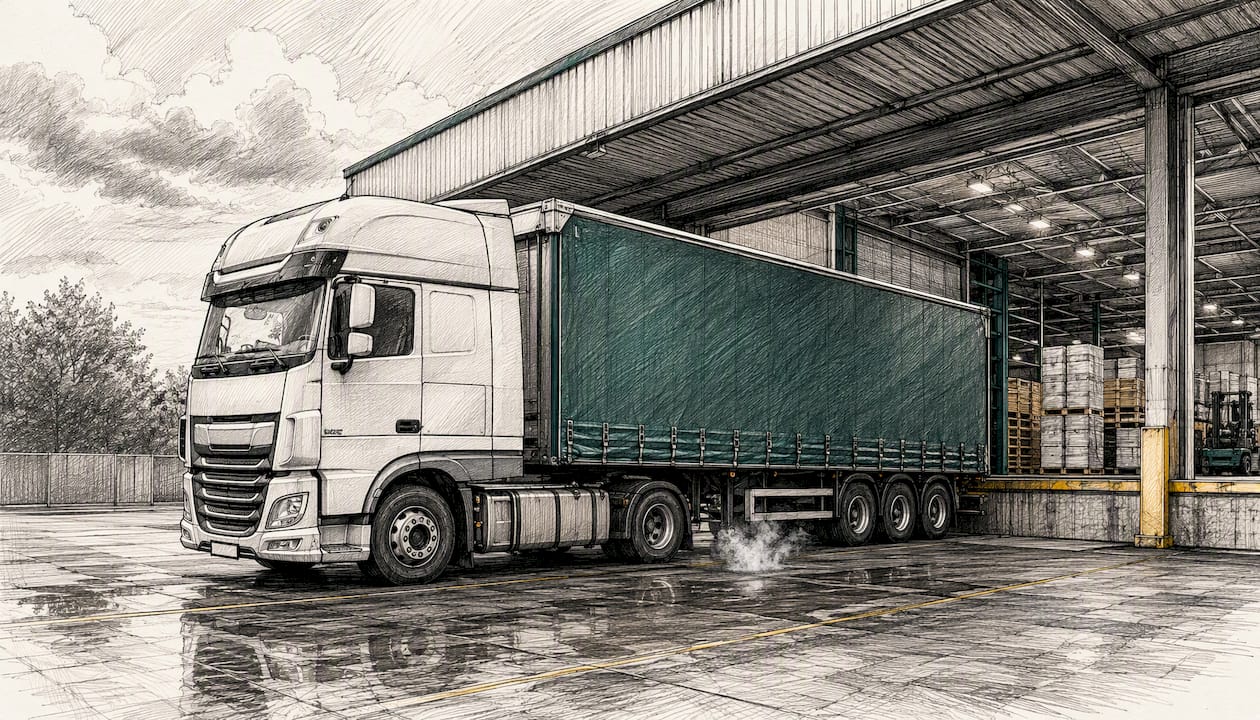
Where bays sit near site boundaries or residential areas, stagger the busiest delivery slots away from early morning and evening hours to avoid noise complaints that can escalate into planning or licensing issues. Reversing alarms are non-negotiable for safety, but positioning bays away from noise-sensitive boundaries where the yard layout allows it reduces the cumulative nuisance.
For emissions, low-emission zone compliance matters increasingly for sites in or near urban centres, and it’s worth checking whether your delivery routes cross any restricted zones before committing to a fixed schedule. Extraction or ventilation isn’t usually required for open-sided bays, but enclosed or partially sheltered docks with regular idling can build up exhaust fumes worth monitoring, particularly where dock shelters seal tightly against the trailer.
Keep a simple log of any noise or emissions complaints alongside your incident records. Patterns often point to a specific supplier’s delivery habits rather than a site-wide problem, and that’s easier to fix with a scheduling conversation than a capital project.
What emergency procedures does a loading bay need?
A loading bay needs its own emergency procedures layered on top of the site’s general plan, because spills, fire, and entrapment risks here differ from office or warehouse-floor incidents.
Spill response needs a kit stationed near the bay itself, not in a store three buildings away, along with drainage awareness. If your bay drains toward a watercourse or surface drain, spill containment becomes an environmental as well as a safety issue. Staff need to know the difference between a fuel spill, a hydraulic fluid leak from the leveller, and a cargo spill, since each calls for different containment materials.
Fire safety around loading bays carries specific risks: fuel-laden vehicles, potentially flammable cargo, and powered equipment all sit in one confined space. Keep extinguishers rated for the fuel types present, not just general-purpose units, and make sure evacuation routes from the bay don’t funnel people past the vehicle itself.
Entrapment is the emergency scenario most sites underplan for. Someone caught between a trailer and the dock, or trapped by a closing dock shelter, needs a rescue procedure that doesn’t rely on moving the vehicle first, since that can make injuries worse. Brief bay staff on this specifically, separate from general first-aid training.
Test these procedures with drills that include a visiting driver scenario, since HSE data consistently shows unfamiliar drivers face higher risk during any bay incident, emergency or otherwise.
How do traffic management plans reduce bay congestion?
Congestion at the bay is rarely a design failure. It’s usually a scheduling failure that design then has to absorb. A traffic management plan that spreads delivery slots across the day, rather than clustering them around convenient windows for suppliers, is the single biggest lever most sites have.
Booking systems that assign specific arrival windows, rather than open “anytime before 5pm” slots, cut the queue length that builds up when three vehicles arrive within the same ten minutes. Where you can’t control supplier scheduling directly, build buffer capacity into the marshalling area so a delayed vehicle doesn’t block the bay for everyone behind it.
Peak-hour analysis is worth doing properly rather than guessing. Pull a month of arrival timestamps if your gatehouse logs them, and you’ll usually find two or three specific time windows account for most of the queuing. Shifting even one regular supplier’s slot by 90 minutes can flatten that peak noticeably.
Queuing off-site matters too. Vehicles backed up onto a public road while waiting for a bay create both a safety hazard and, in some areas, a local authority compliance issue. Build enough on-site holding capacity that queuing stays inside your gates, and make sure drivers know where to wait rather than idling at the entrance.
Review the plan quarterly against actual arrival data, not against what suppliers promised when you set the schedule up.
What should busy warehouse managers prioritise first?
Trade press coverage of loading bay safety keeps returning to the same finding: bays remain one of the most hazardous zones in UK warehousing, and most incidents trace back to a small number of repeat causes.
If your time is limited, fix three things first: fit and check vehicle restraints properly, physically separate pedestrians from vehicle routes, and get pre-arrival driver communication sorted so nobody turns up unbriefed. Everything else in HSG136 builds on those three.
Working with haulage partners who commit to arrival windows removes a good chunk of the scheduling chaos that causes reversing and queuing in the first place. Options like Haulier exist partly to make that kind of predictable arrival the default rather than the exception.
How managed haulage reduces pressure on your loading bay
Haulier is the practical route to fewer unplanned arrivals at your dock. Every extra vehicle that turns up outside its window adds to marshalling pressure, increases reversing, and pushes pedestrians and traffic closer together exactly when you’re trying to keep them apart.
Haulier.AI’s transport desk gives freight forwarders and importers managed quoting and real-time updates on container movements, so arrival windows are agreed in advance rather than left to chance. Hauliers keep control of their own rates and can decline unsuitable jobs, which means the driver who shows up at your bay has already accepted the job on terms that work for them, cutting the friction that causes delays and last-minute changes. Paperwork tracking through the platform also means less time spent chasing documentation at the dock itself.
None of this replaces your statutory duties. Site safety, risk assessments, and equipment maintenance remain entirely yours to run. But if unpredictable arrivals are adding to your marshalling headache, Haulier is a straightforward way to bring more predictability to who turns up, and when.
Where to find the primary UK guidance
Start with HSE’s loading areas guidance for the legal basics, then read HSG136 for the detailed practical rules on traffic routes and dock levellers. BidGroup’s bay sizing guide fills in the dimension examples HSE doesn’t specify. Keep copies of your inspection records alongside these references whenever you update a risk assessment.
Sources
- Introduction to workplace transport safety - HSE
- How to determine the size of loading bay you need - BidGroup
FAQ
Who can use a loading bay in the UK?
Any HGV driver authorised to make a delivery or collection at the site can use a loading bay, but visiting drivers unfamiliar with the layout need a site induction and briefing before approaching, since HSE data shows they carry higher risk than regular staff.
What are the HSE requirements for loading bays?
HSE requires marked bay edges, at least one exit or refuge point at the lower level, measures to prevent vehicle movement during loading such as wheel chocks or interlocked restraints, and a written risk assessment covering pedestrian and vehicle interaction, all set out in HSE’s loading area guidance and HSG136.
What are the loading and unloading rules in the UK?
Loading and unloading must follow a safe system of work covering level firm surfaces, controlled lifting equipment, and correctly balanced loads, since HSE’s unloading checklist notes unbalanced loads can destabilise a trailer mid-operation.