
Container haulage article
HGV weight limits UK: the 2026 compliance guide
Discover essential details on HGV weight limits in the UK for 2026 compliance. Ensure you stay updated with the latest regulations.
What are the current UK HGV weight limits?
UK HGV weight limits are set by two pieces of legislation: the Road Vehicles (Construction and Use) Regulations 1986 and the Road Vehicles (Authorised Weight) Regulations 1998. Together, they define the maximum gross weights a vehicle may carry depending on its type, axle count, and configuration.
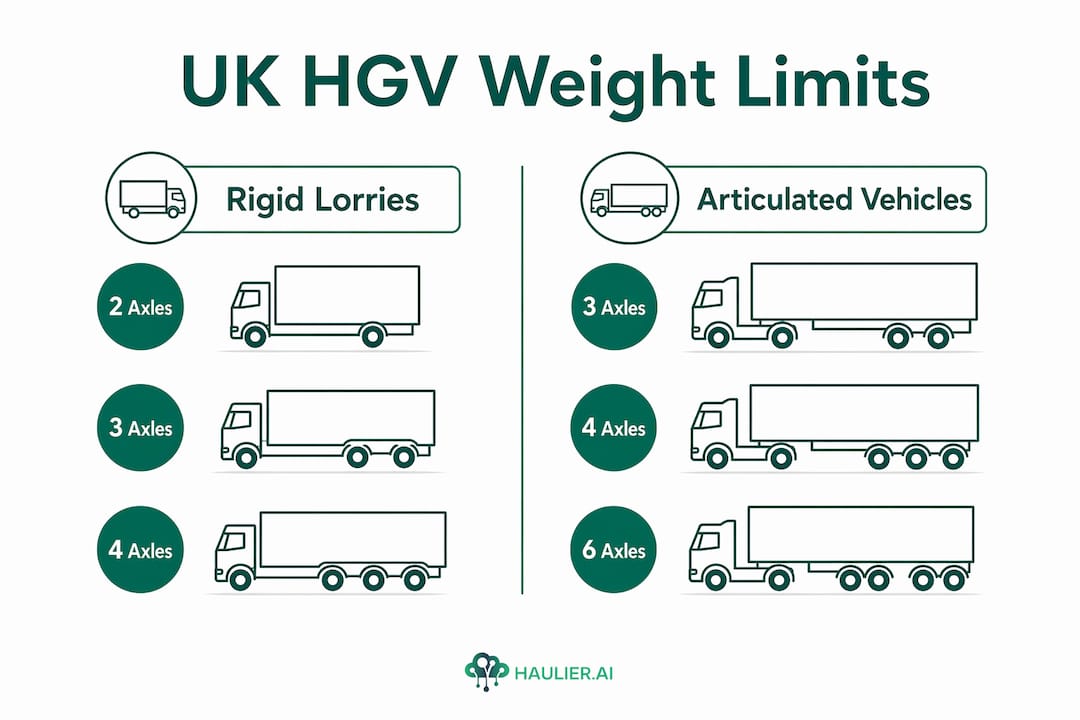
The range is wide. A 2-axle rigid lorry is capped at 18,000 kg. A 6-axle articulated vehicle, fitted with road-friendly suspension, can operate at up to 44,000 kg. Between those two points, every configuration has its own number.
Key limits at a glance:
- 2-axle rigid lorry: 18,000 kg
- 3-axle rigid lorry: 26,000 kg (with road-friendly suspension or twin tyres on the driving axle); 25,000 kg otherwise
- 4-axle rigid lorry: 32,000 kg (with qualifying conditions); 30,000 kg otherwise
- 3-axle articulated vehicle: 26,000 kg
- 4-axle articulated vehicle: 38,000 kg (qualifying conditions); 36,000 kg otherwise
- 5-axle articulated vehicle: 40,000 kg
- 6-axle articulated vehicle: 44,000 kg
Axle limits apply independently of gross weight. A single driving axle is capped at 11,500 kg; a single non-driving axle at 10,000 kg. Tandem axle groups range from 11,000 kg (spacing under 1 metre) up to 20,000 kg for non-driving tandem axles with wider spacing. A triaxle group carries a maximum of 24,000 kg.
The critical point: a vehicle can be fully legal on gross weight yet still committing an offence if one axle is over its individual limit.
Table of Contents
- The legal framework behind UK lorry weight laws
- Penalties and enforcement for weight breaches
- Operational best practices for weight compliance
- Quick reference: UK HGV weight compliance essentials
- When can you exceed standard limits? Exemptions and special permits
- Why weight limits protect roads, bridges, and lives
- How to measure HGV weight accurately
- What’s changing in UK HGV weight regulation?
- Key takeaways
- FAQ
The legal framework behind UK lorry weight laws
The Road Vehicles (Authorised Weight) Regulations 1998 introduced three separate schedules covering individual vehicle weights (Schedule 1), vehicle combination weights (Schedule 2), and axle weights (Schedule 3). No vehicle may be used on a road if it exceeds any of these three limits simultaneously.
Schedule 2 is where combination vehicles get their limits. A 3-axle articulated combination sits at 26,000 kg; a 4-axle combination rises to 38,000 kg where the driving axle weight does not exceed 10,500 kg. The 44,000 kg ceiling for 6-axle combinations requires road-friendly suspension on the driving axle.
The 1986 Regulations remain the overriding framework. Regulation 80 of those rules sets an absolute ceiling that the 1998 Regulations cannot exceed. Both sets of rules work together, not in isolation.
| Vehicle type | Axles | Max gross weight (kg) |
|---|---|---|
| Rigid lorry | 2 | 18,000 |
| Rigid lorry | 3 (standard) | 25,000 |
| Rigid lorry | 3 (road-friendly suspension) | 26,000 |
| Rigid lorry | 4+ (standard) | 30,000 |
| Rigid lorry | 4+ (qualifying conditions) | 32,000 |
| Articulated vehicle | 3 | 26,000 |
| Articulated vehicle | 4 (qualifying) | 38,000 |
| Articulated vehicle | 5+ | 40,000 |
| Articulated vehicle | 6+ | 44,000 |

The plating system is where this becomes personal to each vehicle. Every HGV carries either a manufacturer’s plate or a ministry plate showing its maximum authorised weights for gross, axle, and train configurations. Exceeding any figure on that plate is an offence, regardless of what the regulations might theoretically allow for a similar vehicle.
Penalties and enforcement for weight breaches
The DVSA uses a graduated fixed penalty system tied directly to how far over the limit a vehicle is:
- Fixed penalties start at £100 for smaller overloads, increase with higher percentage overloads, and reach £300 for significant excess weights
Those figures look manageable until you factor in what else follows. Overloading breaches raise an operator’s Operator Compliance Risk Score (OCRS), which directly increases the likelihood of future roadside stops. A pattern of breaches puts the operator’s licence at risk.
DVSA examiners typically allow a 5% discretionary buffer before issuing a fixed penalty or prohibition notice. That leniency disappears entirely when the overload reaches 1 tonne or more, regardless of the percentage.
Serious cases go further. Where an overload exceeds 30% or 5 tonnes, or where vehicle stability is genuinely compromised, DVSA can issue a court summons rather than a fixed penalty. At that point, fines are uncapped by the fixed penalty schedule.
A prohibition notice stops the vehicle moving until the load is reduced to within legal limits. That means delays, reloading costs, and a formal record on the operator’s compliance history.
Pro Tip: Keep a copy of the vehicle’s plate details in the cab alongside any weighbridge tickets. If a DVSA examiner stops you, being able to demonstrate you checked the weight before departure is a meaningful mitigating factor.
Operational best practices for weight compliance
Compliance is an operator responsibility, not just a driver’s. The driver is the last line of defence, but the systems that prevent overloading have to be built before the lorry leaves the yard.
Effective weight management comes down to a few non-negotiable habits:
- Know the plate limits for every vehicle in the fleet, including axle-by-axle figures, not just gross weight.
- Use weighbridges whenever load weight is uncertain or close to the vehicle’s capacity. A weighbridge ticket is evidence; a driver’s estimate is not.
- Control axle distribution at the point of loading. A vehicle can be overloaded on one axle while the total gross weight remains legal. Load placement matters as much as load weight.
- Train loading staff on axle limits, not just total weight. Many overloading offences originate at the loading bay, not on the road.
- Retain records including weighbridge tickets, loading instructions, and any defect follow-ups. These form your compliance audit trail.
For container movements specifically, where declared weights can differ from actual weights, container weight management deserves its own procedure. Verified Gross Mass (VGM) declarations are a starting point, but they do not replace a physical weight check before departure.
Transport managers should monitor repeat issues and investigate any pattern of loads running close to the limit. Building weight checks into pre-departure routines, rather than treating them as optional, is what separates operators with clean compliance records from those who accumulate OCRS points.
Pro Tip: Integrate a weight compliance checklist into your daily vehicle inspection process. Drivers already complete a walkaround check; adding axle weight confirmation takes two minutes and creates a timestamped record.
Quick reference: UK HGV weight compliance essentials
- Maximum gross weight ranges from 18,000 kg (2-axle rigid) to 44,000 kg (6-axle articulated with road-friendly suspension).
- Axle limits apply independently: 11,500 kg for driving axles, 10,000 kg for non-driving axles.
- Fixed penalties start at £100 and rise to £300; court summons applies for overloads of 30%+ or 5 tonnes+.
- The 5% DVSA discretionary buffer does not apply when the overload is 1 tonne or more.
- Overloading breaches raise OCRS scores and can jeopardise operator licences.
- Weighbridge tickets and loading records are your primary compliance evidence.
- Operator responsibility extends beyond the driver to loading staff, transport managers, and documented procedures.
When can you exceed standard limits? Exemptions and special permits
Standard UK road weight limits are not absolute for every vehicle. Certain movements can lawfully exceed the 44,000 kg ceiling, but the process is tightly controlled.
An abnormal load is defined as any vehicle exceeding 44,000 kg gross, a driving axle weight above 11,500 kg, or a non-driving axle weight above 10,000 kg. Operating as an abnormal load requires prior notification to the relevant highway authorities and, depending on weight and route, a police escort. The Special Types General Order (STGO) governs most of these movements, with three categories covering progressively heavier loads.
For the heaviest movements, a Special Order from the Department for Transport is required. These are granted case by case and come with route-specific conditions, speed restrictions, and time-of-travel requirements. Operators must notify Highways England (now National Highways) and relevant local authorities in advance.
Combined transport operations, where a loaded road vehicle forms part of a rail or sea leg, can also attract specific weight provisions under EU-derived rules that the UK retained post-Brexit. These provisions allow slightly higher weights in defined circumstances, but the conditions are specific and operators should verify current rules directly with the DVSA.
Why weight limits protect roads, bridges, and lives
The engineering case for weight limits is straightforward. Road surfaces and bridge structures are designed to handle defined stress loads. When axle weights exceed those thresholds, the damage is cumulative and disproportionate: road wear increases exponentially with axle load, not linearly.
Bridge strike risk is a related concern, though it involves height rather than weight. Low bridge route planning matters for double-deck trailers and high-cube containers, where bridge height restrictions on certain routes can catch operators who rely on default sat-nav routing rather than HGV-specific navigation.
Overloaded vehicles also handle differently. Braking distances increase, tyre blowout risk rises, and stability under cornering deteriorates. The safety case for enforcement is not abstract. Overloaded lorries are a measurable factor in serious road incidents, which is why DVSA treats instability-related overloads as court-summons territory rather than fixed-penalty territory.
How to measure HGV weight accurately
The most reliable method is a static weighbridge, either at a quarry, port, or commercial weighbridge site. A calibrated static weighbridge gives a full axle-by-axle breakdown, not just a gross total, which is what you need to confirm compliance across all three schedules.
DVSA enforcement officers use portable axle weighpads at roadside checks. These are calibrated devices that measure each axle individually. If your load distribution is uneven, the pads will find it even when the gross weight looks fine.
On-board weighing systems are increasingly common in newer HGVs. These use strain gauges or air suspension pressure sensors to give a real-time weight readout from the cab. They are useful for monitoring during loading, though they are not a substitute for a certified weighbridge when precision matters. For safe delivery operations, combining on-board monitoring with periodic weighbridge verification gives the strongest compliance posture.
What’s changing in UK HGV weight regulation?
The core weight limits have been stable for some years, but the regulatory environment around them is shifting. The DVSA has been expanding its use of weigh-in-motion (WIM) technology at fixed enforcement sites, which allows vehicles to be screened at speed without stopping. Vehicles flagged by WIM are then directed to a static check. This increases the effective reach of enforcement without requiring more officers at the roadside.
The UK government has also been consulting on weight provisions for zero-emission HGVs. Battery electric trucks carry significantly heavier powertrains than diesel equivalents, and there is a policy argument for allowing a weight allowance to account for the battery mass without penalising payload capacity. As of 2026, the government has indicated support for a 1-tonne allowance for zero-emission HGVs above the standard limits, though the legislative detail is still being finalised.
For operators running container haulage, the Haulier platform keeps pace with regulatory developments and connects freight forwarders and importers with hauliers who operate compliantly across UK ports.

If you move containers by road and want a transport desk that handles matching, communication, and paperwork without the admin overhead, request a quote through Haulier and see how it works in practice.
Key takeaways
UK HGV weight limits range from 18,000 kg for a 2-axle rigid lorry to 44,000 kg for a 6-axle articulated vehicle, with axle limits enforced independently of gross weight.
| Point | Details |
|---|---|
| Gross weight range | Legal limits run from 18,000 kg (2-axle rigid) to 44,000 kg (6-axle artic with road-friendly suspension). |
| Axle limits are separate | A vehicle can breach axle limits while staying within gross weight; each axle is enforced independently. |
| Graduated penalties | Fixed penalties start at £100 for under 10% overload and rise to £300 for 15%+; court summons applies at 30%+ or 5 tonnes+. |
| DVSA discretionary buffer | DVSA allows 5% leeway before acting, but this does not apply when the overload is 1 tonne or more. |
| Operator responsibility | Compliance requires formal loading procedures, staff training, weighbridge use, and documented records. |
FAQ
What is the maximum weight for a 6-axle HGV in the UK?
A 6-axle articulated vehicle can operate at up to 44,000 kg under the Road Vehicles (Authorised Weight) Regulations 1998, provided it meets conditions including road-friendly suspension on the driving axle.
Can a vehicle be overloaded on an axle even if the gross weight is legal?
Yes. Each axle has its own maximum authorised weight enforced separately. A vehicle with a legal gross weight can still commit an overloading offence if one axle exceeds its individual limit.
What is the DVSA’s discretionary buffer for overloading?
DVSA examiners generally allow a 5% leeway before issuing a fixed penalty or prohibition notice. This buffer does not apply when the overload is 1 tonne or more, regardless of the percentage.
What happens if an HGV is seriously overloaded?
Where an overload exceeds 30% or 5 tonnes, or where vehicle stability is at risk, DVSA can issue a court summons rather than a fixed penalty. A prohibition notice also prevents the vehicle from moving until the load is reduced.
Do zero-emission HGVs get a weight allowance in the UK?
The UK government has indicated support for a 1-tonne weight allowance for zero-emission HGVs to account for battery mass, but as of 2026 the legislative detail has not yet been finalised.