
Container haulage article
How Felixstowe container haulage actually gets organised
A practical guide to Felixstowe container haulage: booking flow, timings, port links, costs, delays and how Haulier.AI helps manage UK haulage.
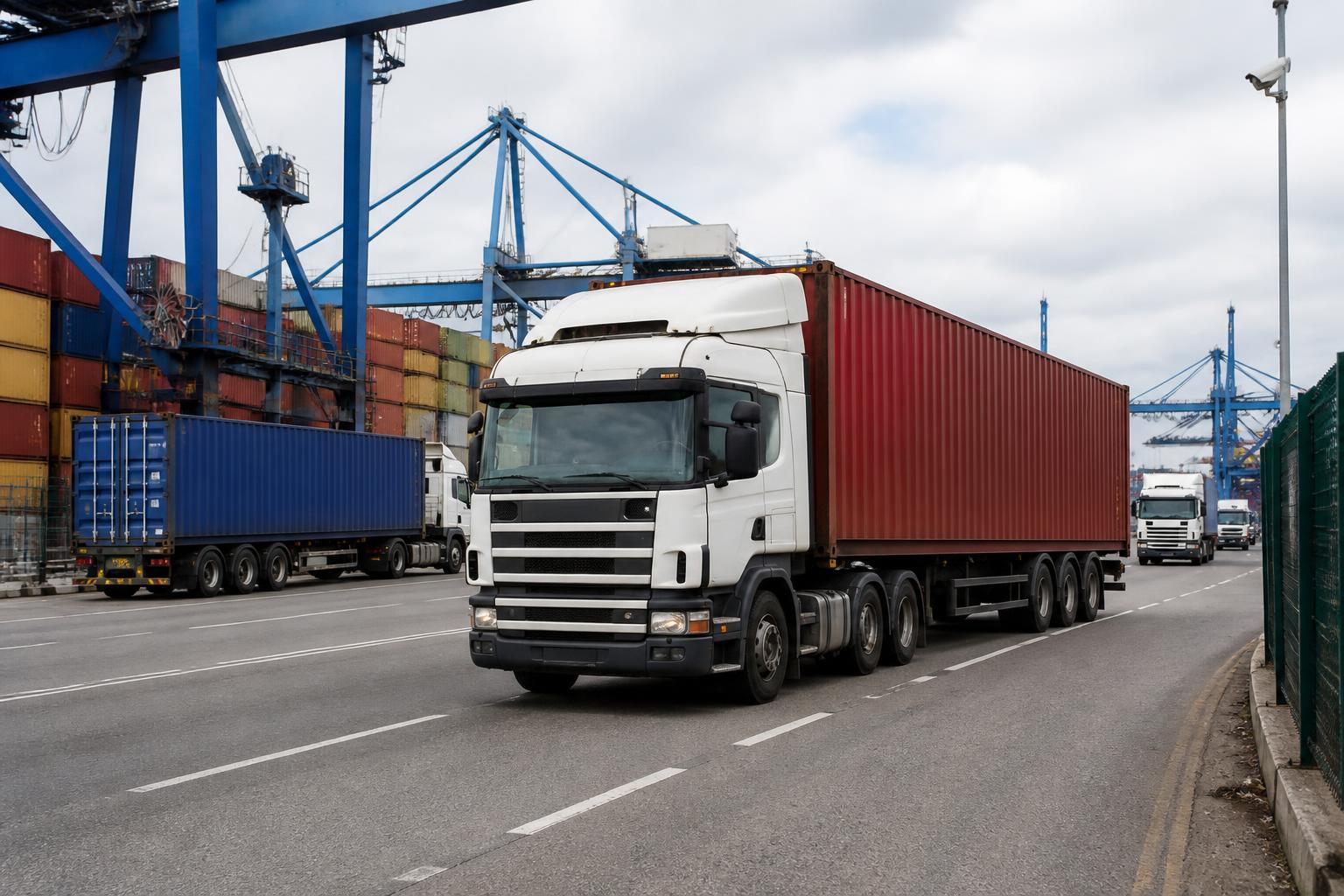
Most Felixstowe work is straightforward on paper. A container is discharged from the vessel, made available by the shipping line, collected from the port by a haulier, and delivered inland to a warehouse, factory, distribution site, railhead, or another port-related location. In practice, the work only runs smoothly when the booking details, release status, timings, equipment, and site restrictions are all clear before the truck is sent.
That is why container haulage in Felixstowe is less about finding any truck and more about organising the move properly. We use an AI-assisted, human-backed transport desk to turn port and delivery information into a workable request, match it with suitable UK haulage operators, and keep the commercial side under control without pushing hauliers into a race to the bottom. If you want a quick route into the service itself, our Felixstowe container haulage support page sets out the scope.
What container haulage from Felixstowe usually involves
A standard import move from Felixstowe starts with the container becoming available for collection. That availability depends on more than vessel arrival. The box needs to be discharged, the line release needs to be in place, customs status needs to allow movement, and any required port or line references need to be ready for the collecting haulier.
The core parties are usually:
- the importer or consignee
- the freight forwarder or shipping agent
- the shipping line
- the port terminal
- the road haulier
- the delivery site
- sometimes a customs agent, warehouse operator, or devanning contractor
For exports, the sequence works the other way round. The container may be collected empty, loaded at the shipper's site, and returned to Felixstowe for the booked vessel cut-off. If the booking is late, the VGM is missing, or the return slot is tight, the risk sits with the inland plan just as much as with the sea booking.
A typical import road movement includes:
- Checking that the container is released and collectable.
- Confirming the container number, size, type, weight, and any special handling needs.
- Allocating a haulier with the right equipment and port access.
- Planning the collection window around terminal conditions and driver hours.
- Delivering to the consignee site, with unloading arranged by the receiving party unless otherwise agreed.
- Returning the empty container to the correct depot if the move includes dehire or empty return.
That final point matters. A lot of people talk about the delivery as though it is the whole job. Often it is not. If the container is merchant haulage or the consignee is responsible for the box after unloading, the empty return can be a separate operational leg with its own depot rules, opening hours, and charges.
Felixstowe also sits within a wider UK port network. Some customers have freight through Felixstowe one week and through London Gateway or Southampton the next, depending on service rotations, shipping line decisions, or congestion. Others need consistent coverage across Tilbury, Liverpool, Teesport, and Immingham as volumes move around. In those cases, the planning method matters as much as the individual move. We treat Felixstowe as part of a wider UK container haulage coverage, not as an isolated lane.
What information needs to be ready before you request a move?
If you want a realistic quote and a workable plan, we need the operational facts up front. Most failed collections and most avoidable extras start with missing or assumed information.
For an import collection from Felixstowe, the basic details should include:
- container number
- size and type, such as 20ft, 40ft, 40ft HC, reefer, or special equipment
- gross weight
- commodity, where relevant to handling or compliance
- collection terminal and release status
- shipping line
- customs status
- delivery postcode and site name
- requested delivery date and time
- whether the container is live unload, drop, or devanning booking
- empty return instructions, if known
- contact details for the delivery site
- any booking references needed for collection or delivery
The delivery point details are often where the real planning starts. A warehouse with a wide yard and flexible booking windows is one thing. A high street site, a farm entrance, a construction project, or a site with strict induction rules is another. We need to know about:
- vehicle access restrictions
- whether a standard artic can enter and turn
- crane, forklift, or dock availability
- booking-in procedures
- waiting time expectations
- whether the site can accept a loaded container on wheels
- whether a side loader, skeletal trailer, or other specific arrangement is required
Weight is another area where vague information causes problems. A 20ft container can be operationally more difficult than a 40ft if it is heavy and going to a site with access issues. Gross vehicle limits, axle loading, route suitability, and delivery site ground conditions all come into play. In the UK, road weight compliance is governed by domestic construction and use rules, not by a single EU-wide standard applied in the same way everywhere. Since Brexit, the practical point for inland operators is not political, it is procedural. UK rules, border processes, and documentary checks must be handled as they apply here.
For customs and paperwork, the request should make clear whether the container is customs cleared, moving under transit, or subject to any hold. If there is an issue with release, no amount of transport planning will turn it into a successful collection. The same goes for line charges, detention exposure, or unresolved paperwork.
Commercially, it also helps to be clear whether you need a one-off move, regular support, part-load alongside other work, or full-load coverage across several ports. Container work is usually a dedicated movement because the unit itself is the load, but the surrounding transport programme still matters. If a customer also needs pallet distribution, trunking, or related UK haulage support, we plan the request in that wider context.
Where delays and extra cost usually come from
The most common source of delay is simple, the container is not actually ready to move when the truck arrives or when the job is booked. That can mean no line release, a customs hold, wrong terminal information, missing collection reference, or a vessel discharge timing that has been assumed rather than confirmed.
After that, the usual causes are operational:
- port congestion or restricted collection windows
- late booking requests against limited capacity
- driver waiting at delivery site
- failed deliveries because the site cannot unload
- incorrect weight information
- wrong empty return depot details
- booking slots missed because earlier stages overran
- delivery addresses that are technically correct but operationally wrong
Waiting time is where cost often starts to drift. A container vehicle held at a delivery point is not just one delayed truck. It can disrupt the driver's legal hours, the next booking, and the empty return plan. If the site says it can unload in 30 minutes and actually takes three hours, the commercial impact is real.
Another regular issue is assuming that all port jobs are interchangeable. They are not. Felixstowe work may look similar to London Gateway, Southampton, or Tilbury on a spreadsheet, but terminal processes, local traffic patterns, depot geography, and inland route options differ. A lane that is routine from one port can be awkward from another.
Charges linked to the container itself also need attention. Storage, detention, demurrage, and futile journey costs are not road haulage inventions. They arise when the box sits too long, cannot be collected, cannot be returned, or is held outside the agreed free time. We do not create those charging structures, but we do organise the movement in a way that reduces the chance of falling into them.
Documentation errors create a different class of problem. Wrong container number, wrong booking reference, wrong delivery instruction, or incomplete customs information can all stop a move. If the job includes cross-docking, devanning, or onward paperwork, POD handling also matters. The road movement may be complete, but if the wrong documents are captured, the administrative tail of the job remains open.
Commercial misunderstandings cause plenty of friction as well. For example:
- who is paying waiting time
- whether the quote includes empty return
- whether a timed delivery was guaranteed or requested
- whether the delivery is ground level only
- whether the haulier is expected to arrange site unloading equipment
- whether the move is merchant or carrier haulage
The cleaner these points are at the start, the fewer arguments there are later.
How planning changes by delivery point and inland route
The same container out of Felixstowe can be a very different job depending on where it is going. A delivery into the Midlands on a flexible warehouse booking is one type of work. A same-day run into Central London, a construction site in East Anglia, or a retail site with strict booking rules is another.
Distance is only one factor. The delivery point changes:
- the route and likely traffic pinch points
- whether the move can be done in one driver shift
- whether timed delivery is realistic
- whether waiting risk is acceptable
- whether the empty can be returned the same day
- whether specialist equipment or a smaller vehicle is needed for final access
Site restrictions are often more important than mileage. Narrow approach roads, low branches, weak yard surfaces, banksman requirements, compulsory PPE, or no unloading after a certain time can turn a simple port collection into a tightly managed operation. If the site cannot handle a loaded artic with container, the plan may need a different approach altogether.
Some customers also run multi-port programmes, so Felixstowe planning has to align with work from other gateways. If one week the import lands at Felixstowe and the next it is switched to London Gateway, the inland delivery point may stay the same while the haulage economics and timing change. The same applies when volumes move through Southampton for deep sea services, or through northern ports such as Liverpool, Teesport, or Immingham.
That is why we avoid treating every request as a blank sheet. If you already have recurring flows, we can organise them in a way that recognises the operational differences between ports. For example, a business importing into the South East might need one plan for Felixstowe and another for container movements via London Gateway. A manufacturer with northern volumes may need parallel arrangements for port haulage through Immingham as shipping patterns change.
Exports also change the planning logic. The important questions are not only where the loaded box starts, but when it must reach the port, when the container can be collected empty, how long loading will take, and what happens if the shipper misses the agreed slot. If the cargo is not ready, the whole chain moves with it.
How Haulier.AI helps organise Felixstowe work
Our role is to make the request and quote process usable for real transport work. We are not a self-serve auction board and we do not pretend that container haulage can be reduced to a postcode pair and a button click.
With Haulier.AI, the process starts by collecting the details that actually affect execution. We structure the request around the port movement itself, the delivery requirement, and the commercial scope. That means we look at the container information, release position, site constraints, timing, and whether the move includes empty return or any linked legs.
Our AI-assisted systems help organise incoming job data, identify missing points, and route requests towards suitable operators. The human-backed part matters just as much. Someone still needs to sanity-check whether the request makes operational sense, whether the timing is credible, whether the delivery site can take the vehicle, and whether the quote basis is clear.
For customers, that means less time spent ringing around, forwarding incomplete emails, and chasing spreadsheets. For hauliers, it means relevant subcontract opportunities presented with enough detail to assess the job properly. We preserve commercial control by allowing operators to quote on work that fits their fleet, geography, and port capability, rather than forcing blind underbidding.
In practical terms, we help by:
- structuring requests so the essentials are not missed
- clarifying whether the move is import, export, empty repositioning, or a linked sequence
- matching work with operators suited to the port, route, and equipment requirement
- keeping human oversight on timing, feasibility, and communication
- reducing wasted quoting on jobs that were never properly specified
- supporting clearer confirmation of collection, delivery, ETA, and POD expectations
We also recognise that not every job is cleanly packaged at the start. Sometimes the customer has an urgent requirement with partial data, or a haulier has a quiet day and wants relevant subcontract work to fill a gap. In those cases, our job is to tighten the information quickly, not to oversell certainty that does not exist.
That matters most on awkward work, late changes, and exception handling. If a release is delayed, a delivery point changes, or a return depot instruction is updated, someone needs to keep the job commercially and operationally coherent. Automation can support that, but it does not replace transport judgement.
For businesses moving containers through Felixstowe, the value is simple. Better organised requests produce better quotes, more realistic planning, and fewer surprises at the gate or on site. For hauliers, better organised requests mean less wasted time and a fairer route to work that suits their operation.
If you need support with container haulage from Felixstowe, we organise the process so the right information reaches the right operators, with AI-assisted handling where it helps and human-backed control where it matters. That is how the work actually gets done.
What is container haulage from Felixstowe?
It is the road movement of import or export containers between Felixstowe and inland sites such as warehouses, factories, depots or other transport hubs.
What details do hauliers need before quoting?
Usually container size, collection point, delivery postcode, booking or release details, weight, commodity, timing, site limits and any special requirements.
Why can a Felixstowe collection miss its planned slot?
Common reasons include missing release information, port congestion, customs or Brexit-related holds, driver timing limits, traffic and delivery site access problems.
Can Haulier.AI guarantee a haulier or a price?
No. Haulier.AI helps organise requests and quotes with human oversight, but availability, timing and price still depend on the actual job and market conditions.
Is Felixstowe work only relevant for import containers?
No. It can cover both import and export container haulage, depending on whether the movement starts at the port or goes there for onward shipping.