
Container haulage article
RHA conditions of carriage: a practical guide for hauliers
Learn the RHA conditions of carriage essential for hauliers. Understand your legal responsibilities and liability limits to safeguard your freight.


The RHA Conditions of Carriage are the industry-standard contractual terms that define carrier liability, responsibilities, and risk allocation for road freight under UK transportation agreements. Published by the Road Haulage Association, they form the legal backbone of most domestic haulage contracts and set the rules on what happens when goods are lost, damaged, or delayed. Only active RHA members can legally use these conditions. Using them without current membership risks invalidating your freight liability insurance entirely.
What are the core liability limits under RHA conditions of carriage?
The standard liability limit under RHA Conditions is £1,300 per tonne of gross weight. That figure applies unless you and your customer agree a higher limit in writing before the job begins.
Higher limits of up to approximately £12,500 per tonne are available by written agreement for specific high-value consignments. This matters because the weight-based model creates a real gap for lightweight but expensive cargo. A pallet of electronics weighing 200kg at the standard rate gives you just £260 of cover. That rarely reflects the actual invoice value.
The conditions also assign clear responsibilities to both parties:
- Carrier obligations: collect and deliver within agreed timescales, care for goods in transit, and report damage or loss promptly
- Consignor obligations: package goods adequately, provide accurate descriptions and weights, and declare any special requirements before collection
- Claims notification: customers must notify the carrier of visible damage at delivery and submit written claims within a defined period, typically seven days for visible damage and 14 days for concealed damage
Pro Tip: Always confirm the agreed liability limit in your booking confirmation email. A verbal agreement is difficult to enforce and will not satisfy your insurer.
The £1,300 per tonne cap is frequently inadequate for high-value, low-weight goods. Hauliers carrying pharmaceuticals, electronics, or luxury goods must arrange explicit additional cover or agree a higher limit in writing before accepting the load.
How do RHA conditions compare with CMR for international freight?
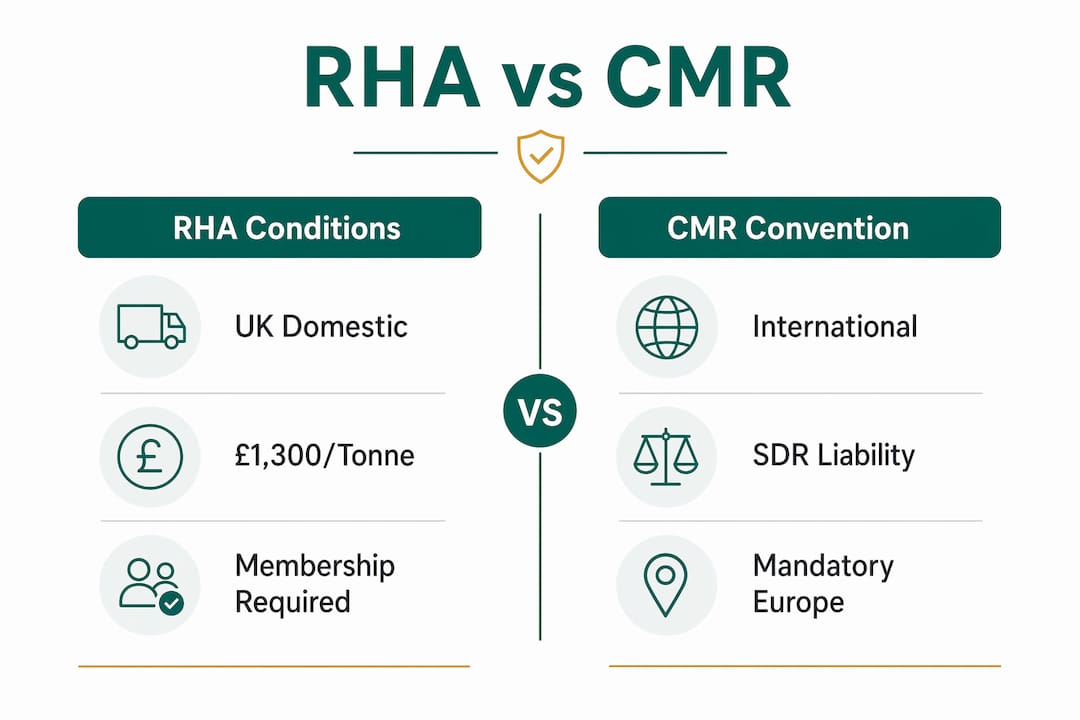
The CMR Convention applies mandatorily to international road carriage across Europe. RHA Conditions apply to domestic UK road freight. The two frameworks are structurally different, and confusing them creates serious contractual risk.
CMR uses Special Drawing Rights (SDRs) as its liability unit, calculated per kilogram of gross weight of the goods lost or damaged. RHA uses a fixed sterling amount per tonne. The practical effect is that CMR liabilities fluctuate with exchange rates, while RHA liabilities are fixed in pounds sterling.
| Feature | RHA Conditions | CMR Convention |
|---|---|---|
| Geographic scope | UK domestic road freight | International road carriage in Europe |
| Liability basis | Fixed £ per tonne gross weight | SDR per kilogram of goods |
| Applicability | Voluntary, members only | Mandatory by law |
| Claims time limit | Defined in contract terms | Generally three years |
| Governing law | English law | International convention |
When a UK haulier subcontracts an international leg to another carrier, the main contract may be governed by CMR while the subcontract defaults to RHA or bespoke terms. That mismatch can leave the primary contractor exposed to CMR liabilities that their subcontractor’s RHA-based insurance does not cover. Hauliers managing subcontractor HGV work across borders must specify which regime governs each leg in writing.
What are the most common legal pitfalls with RHA carriage terms?
The single biggest mistake hauliers make is assuming that printing “RHA Conditions apply” on an invoice or delivery note is enough. It is not. Clear prior incorporation before contract acceptance is the legal requirement. Terms introduced after a contract is formed carry no weight in a dispute.
The “battle of forms” is the second major trap. This legal concept means the last set of terms exchanged before contract acceptance governs the agreement. If your customer sends a purchase order with their own terms after you quote under RHA Conditions, and you accept that order without objecting, their terms win. Customer contract terms with conflicting clauses override RHA if accepted, increasing your risk exposure significantly.
Practical steps to avoid these pitfalls:
- Incorporate RHA Conditions at the quotation stage. State clearly in every quote that work is carried out under RHA Conditions of Carriage 2024 and include a link or copy.
- Reject conflicting customer terms in writing. When a customer sends a purchase order with their own terms, respond in writing to confirm your terms govern.
- Review customer purchase orders for stealth clauses. Watch for clauses that remove liability caps, introduce unlimited indemnities, or require you to hold specific insurance levels.
- Never rely on verbal agreements. Any deviation from standard RHA terms, including higher liability limits, must be confirmed in writing before the job starts.
- Use bespoke terms where your business model requires it. Standard RHA Conditions do not cover every scenario. If you offer storage, handling, or specialist services, your written terms of trade must address those activities explicitly.
Pro Tip: Ask your solicitor to draft a one-page “terms acceptance” form that customers sign before their first booking. This removes ambiguity about which terms govern and is far stronger than a clause buried in a quote footer.
How should hauliers align insurance with their conditions of carriage?
Freight liability insurance and Goods in Transit insurance are not the same product, and confusing them is expensive. Freight liability insurance covers your legal liability under contracts like RHA Conditions. It pays out up to the liability limit you have accepted. Goods in Transit insurance covers the full value of the goods, regardless of your legal liability.

For standard loads where the £1,300 per tonne limit is adequate, freight liability insurance is the appropriate product. For high-value consignments, customers typically need Goods in Transit cover to bridge the gap between your liability cap and the actual goods value. Hauliers should make this distinction clear in their terms and customer communications.
Key insurance alignment points for hauliers:
- Match your insurance to your contractual promises. If you agree a higher liability limit in writing, confirm your insurer will cover that level before accepting the job.
- Subcontractor agreements need back-to-back terms. Subcontract agreements often incorporate main contract terms by reference, which can expose subcontractors to liabilities beyond their own standard terms and insurance.
- Additional services need separate cover. Storage, loading, and handling services carry different risk profiles. Check that your policy extends to these activities if you offer them.
- Document consignor obligations. If a customer provides inadequate packaging or a false weight declaration, your ability to defend a claim depends on having documented their obligations clearly in your terms.
Freight liability cover aligns to RHA liabilities, while Goods in Transit covers full invoice value for high-value goods. Understanding which product applies to each load is a basic risk management requirement, not an optional extra.
What practical steps enforce RHA conditions effectively day to day?
Correct application of RHA Conditions is an operational discipline, not a one-off legal exercise. The terms must appear at every touchpoint where a contract could be formed.
- Quotations: include a clear reference to RHA Conditions of Carriage 2024 and state that all work is carried out under these terms
- Booking confirmations: repeat the reference and confirm any agreed variations, such as higher liability limits, in writing
- Customer account applications: require new customers to sign acceptance of your terms before their first booking
- Subcontractor agreements: specify which terms govern, confirm insurance requirements, and address liability allocation for each leg of the journey
- Staff training: sales and operations teams must understand the basics of RHA Conditions, particularly what triggers a claim and what documentation is required
Pro Tip: Review your standard terms annually. The RHA updates its Conditions periodically. Using an outdated edition in your contracts can create gaps between your terms and your insurer’s expectations.
Hauliers managing container haulage across UK ports face additional complexity because port operators, shipping lines, and freight forwarders each operate under their own terms. Confirming which set of terms governs each handover point prevents disputes about liability when damage occurs at a terminal rather than in transit.
Key takeaways
RHA Conditions of Carriage are only effective when incorporated correctly before contract formation, aligned with the right insurance product, and actively defended against conflicting customer terms.
| Point | Details |
|---|---|
| Liability cap is weight-based | The standard limit of £1,300 per tonne creates gaps for lightweight, high-value cargo requiring extra cover. |
| Membership is mandatory | Only active RHA members can legally use these conditions; non-members risk invalid insurance. |
| Incorporate terms before acceptance | Printing terms on invoices after contract formation is legally insufficient and unenforceable. |
| Battle of forms is a real risk | Customer purchase orders with conflicting terms can override RHA Conditions if accepted without objection. |
| Insurance must match liability | Freight liability insurance covers RHA limits; Goods in Transit covers full value for high-value consignments. |
Why RHA Conditions are a foundation, not a fortress
I have spoken with hauliers who genuinely believe that having RHA Conditions on their paperwork means they are protected from any claim. That belief is wrong, and it is costly.
RHA Conditions are foundational for insurance alignment and risk allocation. They are not a guarantee against large claims, customer disputes, or the consequences of accepting conflicting terms. The standard terms work well when both parties understand them and when they are incorporated correctly. They fail when hauliers treat them as a passive shield rather than an active contractual tool.
The most common misconception I see is that standard terms cover everything. They do not cover storage disputes, handling damage at third-party premises, or liabilities introduced by a customer’s purchase order that nobody read carefully. The hauliers who manage risk well are the ones who review every new customer’s terms before accepting their first booking, not after the first claim arrives.
My recommendation is straightforward. Use RHA Conditions as your starting point. Get legal advice to tailor your terms where your business model requires it. Review your insurance annually against your actual contractual commitments. And train your team to recognise a problematic customer clause before it becomes a problem.
— Vytautas
How Haulier supports compliant container haulage contracts
Managing RHA Conditions correctly requires clear processes at every stage of the freight cycle, from quoting to delivery confirmation. Haulier’s AI-assisted transport desk is built around exactly that kind of operational clarity.
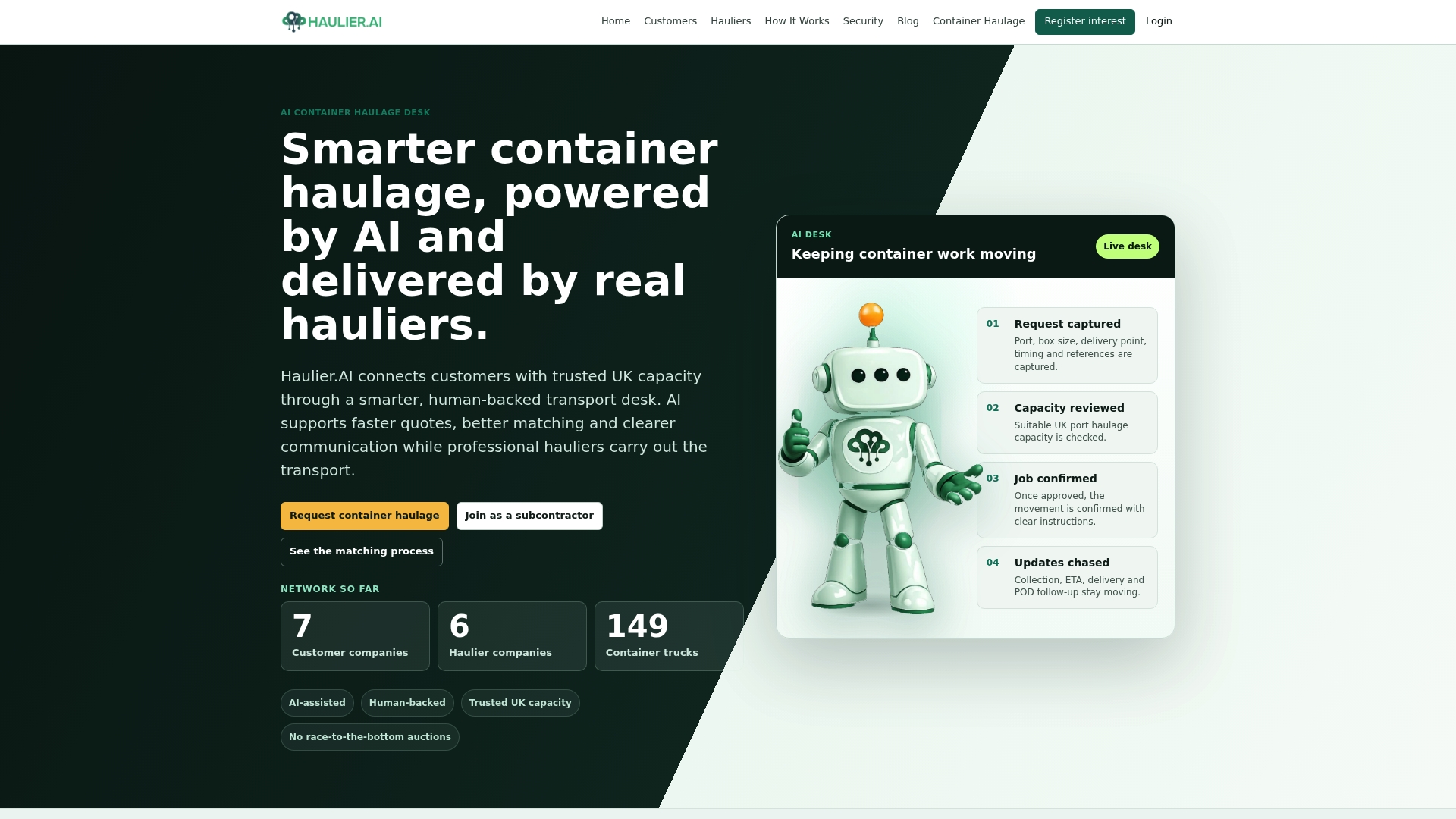
Haulier connects freight forwarders and importers with trusted UK hauliers through a platform that keeps contractual terms, job details, and communications in one place. Hauliers on the network maintain control over their rates and can reject unsuitable jobs, which means the terms governing each movement are agreed upfront rather than disputed after delivery. For operators looking to manage container haulage with cleaner contract workflows and less admin, Haulier provides the structure that standard paperwork alone cannot. Request container haulage or join the haulier network to see how the platform works in practice.
FAQ
Who can legally use RHA Conditions of Carriage?
Only active Road Haulage Association members can legally use RHA Conditions. Using them without current membership risks invalidating your freight liability insurance.
What is the standard liability limit under RHA Conditions?
The standard limit is £1,300 per tonne of gross weight. Higher limits of up to approximately £12,500 per tonne are available by written agreement for high-value consignments.
What is the “battle of forms” and why does it matter?
The battle of forms means the last set of terms exchanged before contract acceptance governs the agreement. If a customer’s purchase order with conflicting terms is accepted without objection, their terms override your RHA Conditions.
How does CMR differ from RHA Conditions?
CMR applies mandatorily to international road carriage across Europe and uses SDR-based liability limits. RHA Conditions are voluntary, UK-focused, and use a fixed sterling amount per tonne.
What is the difference between freight liability and Goods in Transit insurance?
Freight liability insurance covers your legal liability under RHA Conditions up to the agreed cap. Goods in Transit insurance covers the full value of the goods and is appropriate for high-value consignments where the standard cap is insufficient.