
Container haulage article
Freight quote automation: the workflow-first approach that works
Automate freight quote processes effectively by using workflows that include human oversight for accuracy and efficiency. Discover how!
The right way to automate freight quoting is not to script your way around a broken process. It’s to build orchestrated workflows with a human checking the exceptions, not one where a rigid script tries to handle everything and quietly fails on the RFQs that matter most. Real requests for quotes arrive messy: missing dimensions, ambiguous Incoterms, a container size buried in a PDF attachment. Deterministic scripts break on that ambiguity, which is why the forwarders getting genuine value from automation pair AI-driven parsing and rate lookups with a person who signs off on the quote before it goes out.
Here’s what that looks like in practice, and what to do about it this week.
- Time saved: one documented deployment cut average RFQ processing from around 20 minutes to 3 to 5 minutes after adding agentic tooling, browser automation and a memory layer.
- Must-have features: email and PDF parsing, live carrier rate lookups, margin rules you control, and an approval step before a quote leaves your desk.
- Next step: pick one lane, not your whole network, and run a four-to-six-week pilot before touching your full quote volume.
Pro Tip: Don’t pilot your hardest lane first. Choose a high-volume, well-understood corridor where your rate data is already clean. You want a fast, unambiguous win, not a stress test.
For container haulage specifically, Haulier already runs this model: an AI-assisted transport desk that ingests requests, pulls haulier rates, and keeps a human in the loop before a job is confirmed. If you’re evaluating platforms, book a pilot on a single lane before committing to a full rollout.

Key takeaways
Freight quote automation works best as orchestrated workflows with human oversight, not as a rigid script replacing judgement entirely.
| Point | Details |
|---|---|
| Choose orchestration over scripts | Pick platforms that route exceptions to a human rather than failing silently on ambiguous RFQs. |
| Pilot one lane first | Test on a high-volume, clean-data lane for four to six weeks before scaling further. |
| Prioritise integration and rate control | Weigh carrier connectivity and configurable margin rules above interface polish. |
| Monitor quotes per hour and win rate | Track these from week one to justify further integration investment. |
| Haulier.AI fits container haulage specifically | It combines managed RFQ intake, haulier-controlled rates, and human-backed oversight for UK container moves. |
Table of Contents
- What does freight quote automation actually do?
- How much time and money does automated quoting actually save?
- How do you choose the right freight quote automation solution?
- How do you roll out freight quote automation without disrupting operations?
- What goes wrong with quoting automation, and how do you avoid it?
- Why Haulier.AI fits container haulage quoting specifically
- Sources
- FAQ
What does freight quote automation actually do?
Strip away the marketing language and freight quote automation is a chain of specific tasks stitched together, not one magic button. Each piece solves a distinct bottleneck in the quoting process, and understanding the chain matters because most automation failures happen when one link is weak, not because the whole concept doesn’t work.
- RFQ ingestion: pulling requests from email, PDF attachments, web forms or EDI feeds into a single structured format.
- Parsing and validation: extracting container type, weight, dimensions and origin/destination, then flagging anything incomplete or contradictory.
- Rate lookups: querying carrier APIs, scraping portals where no API exists, or checking your own contracted rate tables in parallel.
- Margin and surcharge engines: applying your pricing rules, fuel surcharges and accessorials automatically, consistently, every time.
- Templated outputs: generating a client-ready quote document without anyone retyping numbers into a spreadsheet.
- Approval workflows: routing anything outside normal parameters to a human before it’s sent.
The efficiency gain is concrete. Email parsing removes the copy-paste step that eats ten minutes per RFQ when someone manually keys container specs from an inbound message into a quoting sheet. Querying three or four carrier connections in parallel, rather than checking each one sequentially, is where most of the speed advantage in agentic freight quoting systems actually comes from.
Connectivity is where platforms differ most. Some offer only carrier APIs; others add EDI support for larger shipping lines, browser automation for carrier portals that never built an API, and direct connectors into your TMS or CRM so quotes and bookings sit in one system rather than three.
| Connection type | What it covers | Where it matters most |
|---|---|---|
| Carrier APIs | Real-time rate and capacity data | High-volume lanes with API-enabled carriers |
| EDI | Structured data exchange with larger carriers | Established trade lanes with legacy systems |
| Browser automation | Portal scraping where no API exists | Regional hauliers and smaller carriers |
| TMS/CRM connectors | Syncing quotes, bookings and customer records | Keeping one source of truth across teams |
“The workflow steps themselves, shipment classification, volumetric calculation, carrier portal scraping, become callable tools that an agent can use flexibly, which is a fundamentally different architecture from a rigid if-this-then-that script.” This is roughly the shift described in recent implementation work on RFQ automation, where turning steps into tools lets an operator guide the process in real time rather than watch it fail silently.
How much time and money does automated quoting actually save?
The honest answer depends on your baseline, but the direction is consistent across every documented case: automation compresses quote turnaround from hours to minutes, and in the best-tuned systems, from minutes to under sixty seconds. Agentic AI systems evaluating multiple routing and pricing options in parallel have been reported to bring quote turnaround down from hours to under a minute in a number of implementations, largely because the system checks several carriers and rate scenarios simultaneously instead of one at a time.
Speed matters commercially for a simple reason: the forwarder who quotes first often wins the booking, especially on price-sensitive spot lanes where the shipper is collecting three or four quotes and moving fast. A slow quote isn’t just an internal inefficiency; it’s a lost booking sitting in someone else’s inbox.
- Fewer errors: automated margin and surcharge application removes the manual transcription mistakes that cause billing disputes later.
- Faster booking: a quote that flows straight into a booking workflow avoids the gap where a customer waits for a second email to confirm.
- Better capacity matching: automated systems check availability against live data rather than a haulier’s memory of what’s free that week.
- Lower admin burden per FTE: the same quoting team can handle a higher volume without proportional headcount growth.
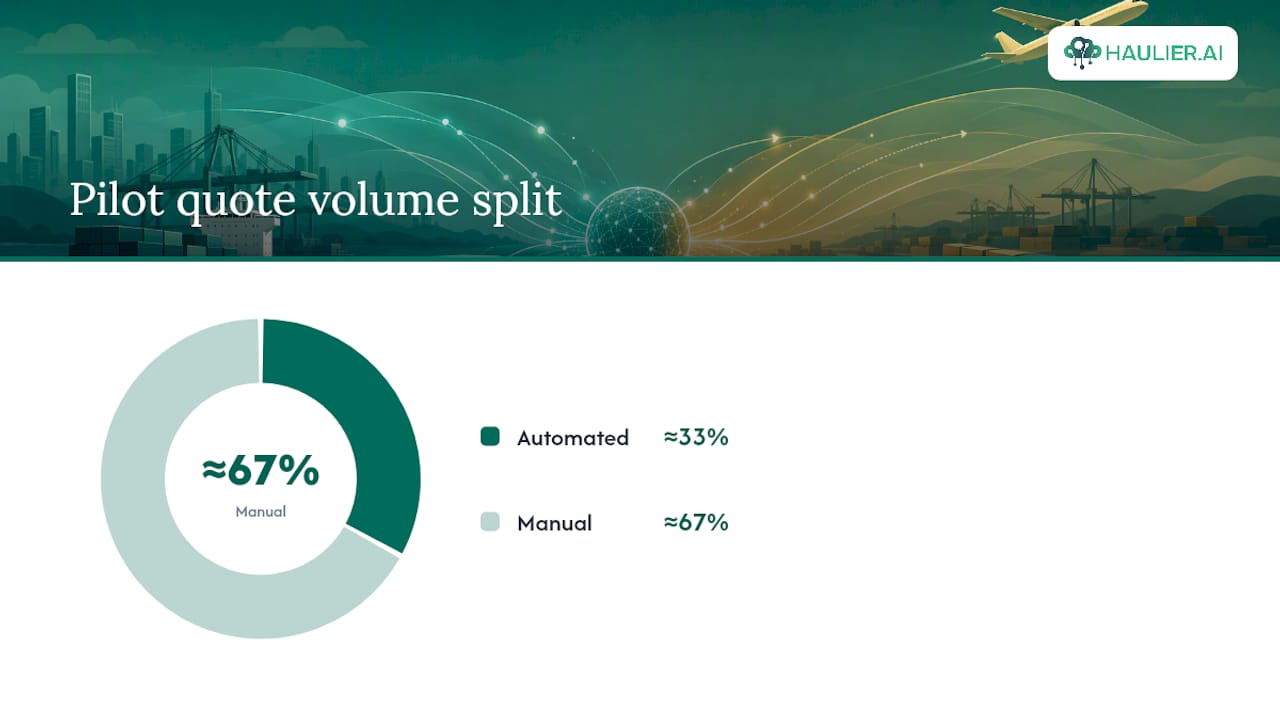
Picture a mid-sized forwarder handling 200 quotes a week manually, each taking 15 to 20 minutes. Over a six-month pilot on one lane, shifting even a third of that volume into an automated, human-reviewed workflow frees up the equivalent of a full working day per quoting agent, per week. That’s not a headcount cut. It’s capacity redirected towards the RFQs that genuinely need judgement: awkward cargo, new customers, exception handling.
The catch is that these gains only show up when the underlying rate data is already clean. Automating a process built on inconsistent or outdated rate tables just produces fast, wrong quotes, which is worse than slow, right ones.
How do you choose the right freight quote automation solution?
Most vendor demos look impressive. The difference between a tool that works and one that becomes shelfware six months in comes down to a handful of specifics that rarely get asked about in the sales call.
- Integration footprint: does it connect to the carriers, TMS and CRM you actually use, or only the ones in the vendor’s case studies?
- Rate management model: are rates stored in validated, versioned tables, or pulled live with no audit trail if something changes?
- Workflow orchestration: can the system route exceptions to a person, or does everything either pass or fail with no middle ground?
- Security and data governance: where is your rate and customer data stored, and who can access it?
- Deployment time: weeks or months? Ask for a realistic figure, not a best-case one.
When you sit down for a demo or send an RFP, these are the questions that separate a genuinely orchestrated platform from a glorified email parser:
- Which carrier connections do you support natively, and which require custom integration work?
- Who owns the rate data once it’s in your system, and can we export it if we leave?
- What’s the SLA for rate updates when a carrier changes pricing?
- Where exactly does a human get inserted into the workflow, and can we adjust that threshold ourselves?
- Is there an audit trail showing who approved or overrode a quote?
- What does onboarding actually involve, and what’s the realistic timeline to first live quote?
- What’s the full cost, including integration and ongoing maintenance, not just the licence fee?
Weigh these unevenly. Integration capability and configurable margin rules matter more than a slick interface. A platform with three solid carrier connections and flexible pricing logic beats one with twenty superficial integrations and a rigid rate engine.
Pro Tip: Ask any vendor for a reference customer running container haulage specifically, not general freight. The rate structures, accessorials and haulier relationships in container transport are different enough that generic freight software often stumbles on the details.
How do you roll out freight quote automation without disrupting operations?
Rushing a full-network rollout is the single most common way these projects fail. A staged approach, starting narrow and expanding only once metrics prove out, gives you room to fix problems before they touch every customer.
Pre-work, before you configure anything:
- Audit your current quoting process end to end, timing each step honestly.
- Pull 50 to 100 sample RFQs from the last quarter to test parsing accuracy before go-live.
- Stabilise your rate data. Rebuilding rate tables as structured, validated records is a necessary precursor, not an afterthought.
- Define your success metrics upfront: quotes per hour, average response time, win rate, margin accuracy.
Pilot phase, numbered for sequencing:
- Choose one or two pilot lanes with high volume and clean, well-understood rate data.
- Configure parsers and margin rules specific to those lanes only.
- Integrate one or two carrier connections rather than your entire carrier list.
- Enable human-in-the-loop review on every quote, even ones that look straightforward, for the first few weeks.
- Measure against your predefined metrics weekly and adjust rules based on what’s actually happening, not what you assumed would happen.
Full rollout, once the pilot proves out:
Scale to additional lanes gradually, automating booking for standard shipments once quote accuracy holds steady. Maintain a regular cadence, monthly is reasonable, for recalibrating pricing rules as carrier rates and market conditions shift. Build a short training checklist so new staff understand where the automation stops and human judgement starts.
Pro Tip: Treat the pilot’s first measurable win, whether that’s minutes saved per quote or quotes handled per person, as the business case for funding the next integration phase. It’s easier to get budget for phase two when you can point to a number from phase one.
| Rollout stage | Primary focus | Signal you’re ready to move on |
|---|---|---|
| Pre-work | Data cleanliness and metric baselines | Rate tables validated, sample RFQs tested |
| Pilot | One or two lanes, human review on every quote | Metrics hit target for four consecutive weeks |
| Scale-up | Additional lanes, standard bookings automated | Error rate stays flat as volume increases |
What goes wrong with quoting automation, and how do you avoid it?
Every failed automation project tends to share the same handful of root causes, and none of them are really about the technology.
- Poor rate data: automating on top of outdated or inconsistent rate tables just produces fast, confident, wrong quotes.
- Over-automation: treating the system as set-and-forget rather than continuously tuning pricing and margin rules as conditions change.
- Brittle rule scripts: rigid if-this-then-that logic that breaks the moment an RFQ deviates from the expected format.
- Carrier onboarding delays: underestimating how long it takes to get API access or portal credentials from smaller hauliers.
- Integration gaps: automation that doesn’t talk to your existing TMS, creating a second system nobody fully trusts.
- Change resistance: staff who’ve been burned by a bad rollout before and quietly work around the new system.
Many vendor case studies promise dramatic reductions in manual effort, but the pattern behind most failures is straightforward: automating a broken or siloed process just magnifies the existing problem faster. The fix isn’t more automation. It’s fixing the process first.
The mitigations are less exciting than the problems but they work: keep a genuine human override on every quote above a value threshold you set, roll out in phases rather than all at once, run automated validation checks on incoming rate data before it ever reaches a customer-facing quote, and keep an audit trail so you can trace exactly why a quote came out the way it did.
Pro Tip: Use browser automation for carrier portals only where an API genuinely doesn’t exist. Portal scraping is fragile, and every layout change on the carrier’s side risks breaking your pipeline overnight. Write a short standard operating procedure for what happens when it does.
Why Haulier.AI fits container haulage quoting specifically
Container haulage has its own quirks: port slot timing, demurrage exposure, and hauliers who want control over which jobs they accept and at what price. Haulier.AI is built around those specifics rather than treating haulage as generic freight.
- Managed RFQ intake: requests come in through the AI-assisted transport desk, which handles the parsing and matching so forwarders aren’t manually chasing haulier availability.
- Haulier-controlled rates: hauliers set and adjust their own pricing and can decline jobs that don’t suit their capacity, which keeps rates realistic rather than artificially depressed.
- Human-backed oversight: the desk combines automated matching with a human team checking updates, which matters when a container is sitting at Southampton with a demurrage clock running.
- Reduced admin load: importers and forwarders get status visibility without chasing hauliers by phone for updates on paperwork or timing.
A few practical scenarios show where this fits: a forwarder with an inbound RFQ for a standard 40-foot container move can get matched to available haulage capacity quickly rather than working the phones. A logistics manager running repeat container moves on a known lane can rely on managed booking rather than re-quoting each time. An importer worried about missed updates gets visibility into where the container actually is, cutting the anxious follow-up calls that eat a coordinator’s morning.
Onboarding support and pilot options exist precisely so you’re not committing to a full rollout blind. Security and human oversight sit underneath the automation, not bolted on afterwards, which is worth checking on the security and oversight page if procurement needs the detail.
When should you actually pull the trigger on this?
The honest signal isn’t a calendar date. It’s volume and lost bookings. If your team is quoting more than roughly 50 to 100 RFQs a week and you can point to specific bookings lost because a competitor quoted faster, that’s the moment a pilot pays for itself quickly rather than sitting as a nice-to-have project. Speed to quote isn’t a vanity metric in container haulage; it’s often the actual difference between winning and losing a booking on a price-sensitive lane.
What doesn’t change, no matter how mature your automation gets, is the need for a person checking exceptions and recalibrating pricing rules as carrier rates and port charges shift. Treat the system as something you tune monthly, not something you switch on and walk away from.
Ready to pilot automated container haulage quoting?
If you’re weighing up building your own rate engine against buying a platform, Haulier.AI gives you a working, human-backed transport desk without the months of integration work a custom build demands. You get haulier-controlled rates, managed RFQ intake and real-time updates from day one, rather than spending a quarter building parsers and carrier connections yourself.
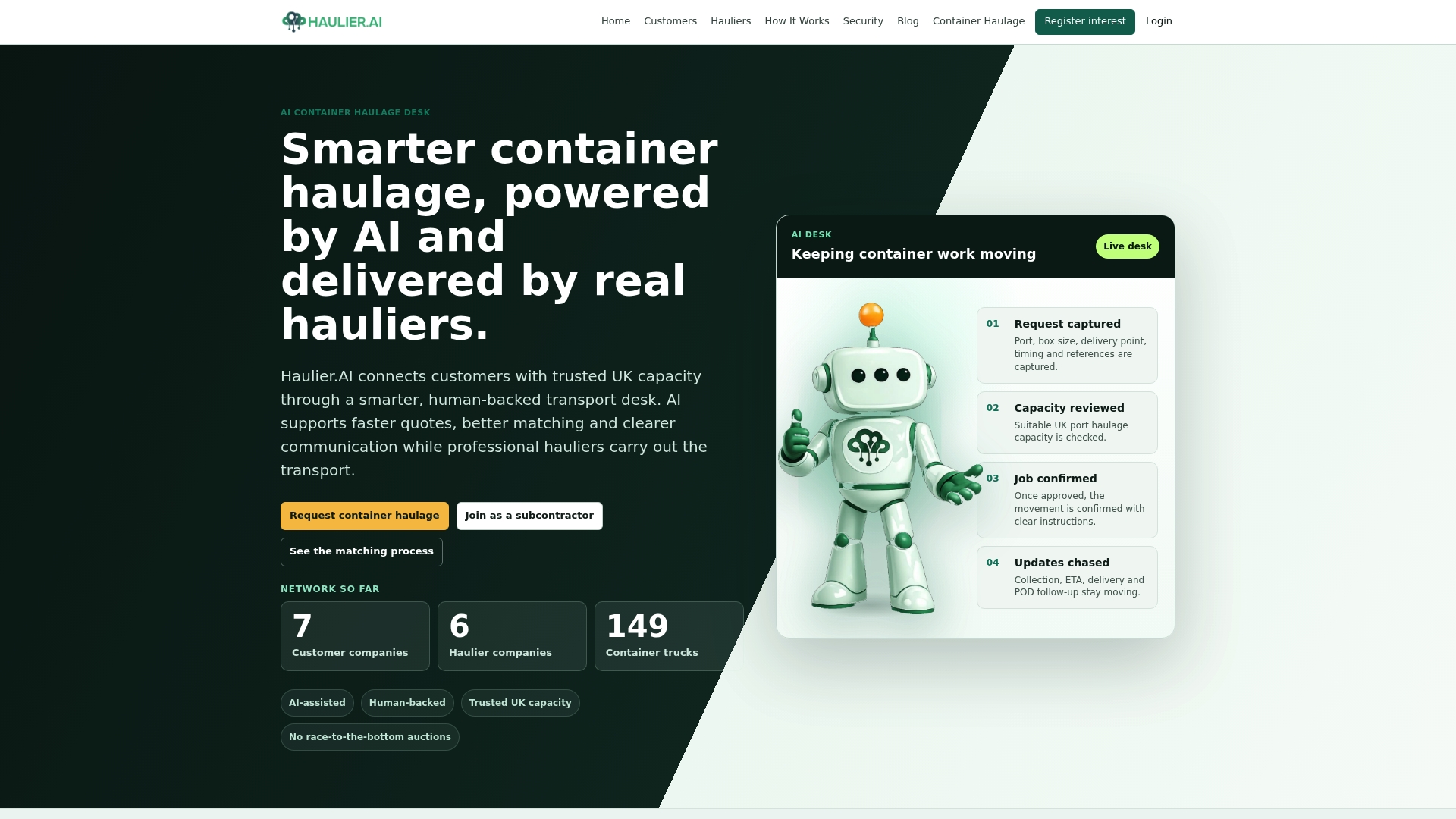
A pilot typically runs on one or two lanes, with visible results, quotes processed, response time, booking accuracy, inside a matter of weeks. Haulier and start with a single lane to see how the matching and quoting workflow performs against your current process.
Sources
- Human‑in‑the‑loop AI transforms freight forwarding
- Time‑consuming logistics task can now be automated thanks to new AI agent
- Implementing AI for freight forwarders (Part 2): RFQ automation
- How agentic AI is transforming freight quote generation in 2026 | CXTMS
FAQ
What is freight quote automation?
It’s the use of software and AI to handle requests for quotes, from parsing inbound RFQs to pulling carrier rates and generating a priced quote, typically with a human checking exceptions before anything is sent.
How long does it take to implement freight quote automation?
A single-lane pilot can go live in four to six weeks if rate data is already clean; a full rollout across a network typically takes several months of phased scaling.
Does freight quote automation replace quoting staff?
No. The strongest deployments keep a person reviewing exceptions and recalibrating pricing rules, freeing staff to handle complex RFQs rather than eliminating the role.
What’s the biggest risk when automating freight quotes?
Automating on top of poor or inconsistent rate data, which produces fast quotes that are confidently wrong rather than solving the underlying problem.
Is Haulier.AI suitable for container haulage quoting specifically?
Yes. Haulier.AI is built around container haulage, combining managed RFQ intake, haulier-controlled rate setting, and human-backed oversight rather than generic freight automation.