
Container haulage article
Dynamic pricing in freight: how it works and how to start
Unlock profit potential with dynamic pricing in freight. Learn how to adapt rates to market changes and boost your margins effectively.
Dynamic pricing in freight means setting rates against live market conditions rather than a fixed annual tariff, so the price moves with capacity, demand and lead time instead of sitting still for twelve months. It works best on volatile spot lanes, LTL and parcel segments with sharp seasonal peaks, and short-notice repeat lanes where yesterday’s rate card is already out of date.
- Spot container lanes where port congestion or vessel delays shift capacity daily
- LTL and parcel surges around seasonal sales, promotions or peak retail periods
- Short-notice repeat lanes where a shipper needs capacity faster than a quarterly rate review can respond
Cloud-based pricing engines using machine learning can lift a logistics provider’s adjusted gross margin by up to 10%, though the actual gain depends heavily on baseline performance, transport mode and business model.
Key Takeaways
Dynamic pricing works when it prices scarcity explicitly and moves in both directions, protecting margin without training customers to expect permanent discounts.
| Point | Details |
|---|---|
| Match model to customer | Use bidirectional dynamic pricing for transactional lanes and pricing corridors for anchor accounts. |
| Price scarcity, not just demand | Failing to price scarcity lets incremental volume erode margin below the cost of serving it. |
| Pilot before scaling | Run two or three lanes in shadow mode before integrating pricing into your TMS. |
| Choose a platform built for rate transparency | Haulier lets hauliers control container haulage rates while giving customers real-time visibility on quotes. |
Table of Contents
- What does dynamic pricing in freight actually mean?
- How does dynamic pricing work in shipping?
- Which pricing models work best for different freight lanes?
- What are the benefits and risks of dynamic pricing?
- How do you implement dynamic pricing step by step?
- What does the research say about dynamic pricing in freight?
- What contracts and change management does dynamic pricing require?
- Sources
- FAQ
What does dynamic pricing in freight actually mean?
Dynamic pricing isn’t a replacement for contract pricing. It’s a layer that sits alongside it. Static contracts still make sense for predictable, high-volume lanes with committed freight. Dynamic pricing handles the rest: the lanes where demand, capacity or fuel costs swing enough that a flat rate either overcharges customers in quiet periods or undercharges you in a crunch.
Pricing engines typically pull in:
- Load-to-truck (or load-to-slot) ratios by lane
- Booking lead time and distance
- Fuel indices and surcharge triggers
- Available carrier or haulier capacity
- Required service level and transit priority
- Seasonality patterns and customer segment
One point gets missed constantly: dynamic pricing runs in both directions. It’s not just surge pricing dressed up in new language. A properly built model drops prices when supply outstrips demand too, which keeps trucks and slots moving rather than sitting idle at a rate nobody will pay.
How does dynamic pricing work in shipping?
The pipeline runs in five stages. Market data comes in first: capacity feeds, fuel indices, historical booking patterns, competitor rate signals where available. That raw data gets turned into features a model can use, things like rolling load-to-truck ratios or rate-of-change in fuel surcharges. A pricing model scores each quote request against those features. Guardrails and human sign-off catch anything that falls outside acceptable bounds. Only then does the price reach the customer, whether through a quoting tool, an API feed into a TMS, or a marketplace interface.
The components behind that pipeline include:
- Real-time and historical market data sources
- Machine learning models trained on lane-level booking and rate history
- Real-time scoring engines that price a quote in seconds
- API integration into TMS platforms and visibility tools, the same pattern project44 describes for surfacing live rates
- Dashboards for pricing teams and audit logs for compliance review
Pro Tip: Treat your pricing model like a PID controller, not a black box. Set a human review checkpoint on any quote that moves more than a defined threshold from the trailing average. That single control catches model drift before it becomes a commercial incident, not after.
Which pricing models work best for different freight lanes?
Six commercial models cover most of the market:
- Spot/dynamic-by-lane: the rate recalculates per lane based on live conditions, common in container spot booking
- Surge-only pricing: rates rise under pressure but don’t fall back symmetrically, simpler but riskier for customer trust
- Bidirectional dynamic pricing: rates move both up and down with real supply and demand
- Pricing corridors: a contract rate that flexes within a band, say plus or minus 15%, blending stability with responsiveness
- Blocked-space agreements: capacity reserved in advance at a fixed price, insulating priority customers from volatility
- Base-plus-volatility surcharge: a stable base rate with a separate, transparent surcharge line for market swings
Match the model to the customer. Transactional LTL shippers suit bidirectional dynamic pricing well. Long-term anchor accounts do better on a pricing corridor. Most freight books end up running two or three models side by side, segmented by customer tier rather than forced into one universal rate structure.
What are the benefits and risks of dynamic pricing?
The upside is real: better margin capture during tight capacity, faster quoting, sharper allocation of scarce trucks or slots, and more transparency than a haggled spot rate. The downside is just as real: customers can push back hard when a rate jumps between two bookings, regulators can flag pricing that looks discriminatory, and a poorly monitored model can misprice a lane badly enough to lose the account entirely.

Pro Tip: Write down your exceptions policy before you launch, not after the first angry email. Define which lanes, customers or volumes are exempt from dynamic adjustment, and who has authority to override the model. Without that, dynamic pricing quietly turns back into ad-hoc negotiation, just with extra software involved.
Large strategic accounts on fixed annual budgets are usually the wrong fit. They need the predictability a corridor or blocked-space deal provides, not a rate that moves week to week.
How do you implement dynamic pricing step by step?
Roll it out in three phases rather than switching the whole book over at once.
- Pilot: pick two or three volatile lanes, start collecting live market data, and run a pricing model in shadow mode against your existing rate card before it touches a live quote.
- Expand: connect the model into your TMS, automate quote generation for the piloted lanes, and build commercial tiers so different customer segments see different pricing logic.
- Scale: extend to a full market view across your network, with continuous monitoring and retraining as conditions shift.
Getting this right needs specific ownership, not a committee:
- A pricing owner who sets guardrails and approves exceptions
- A data engineer to keep market feeds clean and current
- A product owner managing the TMS integration
- A commercial or legal sponsor reviewing contract terms
- An operations champion translating model output into daily bookings
Expect the pilot phase to run a few months before you have enough booking data to trust the model. Cost drivers cluster around three areas: data engineering to get clean market feeds flowing, model development and testing, and the integration work into whatever TMS or booking system you already run. Change management, training commercial teams and rewriting customer-facing contract language, tends to cost more time than the technology itself.
What KPIs actually show whether dynamic pricing is working?
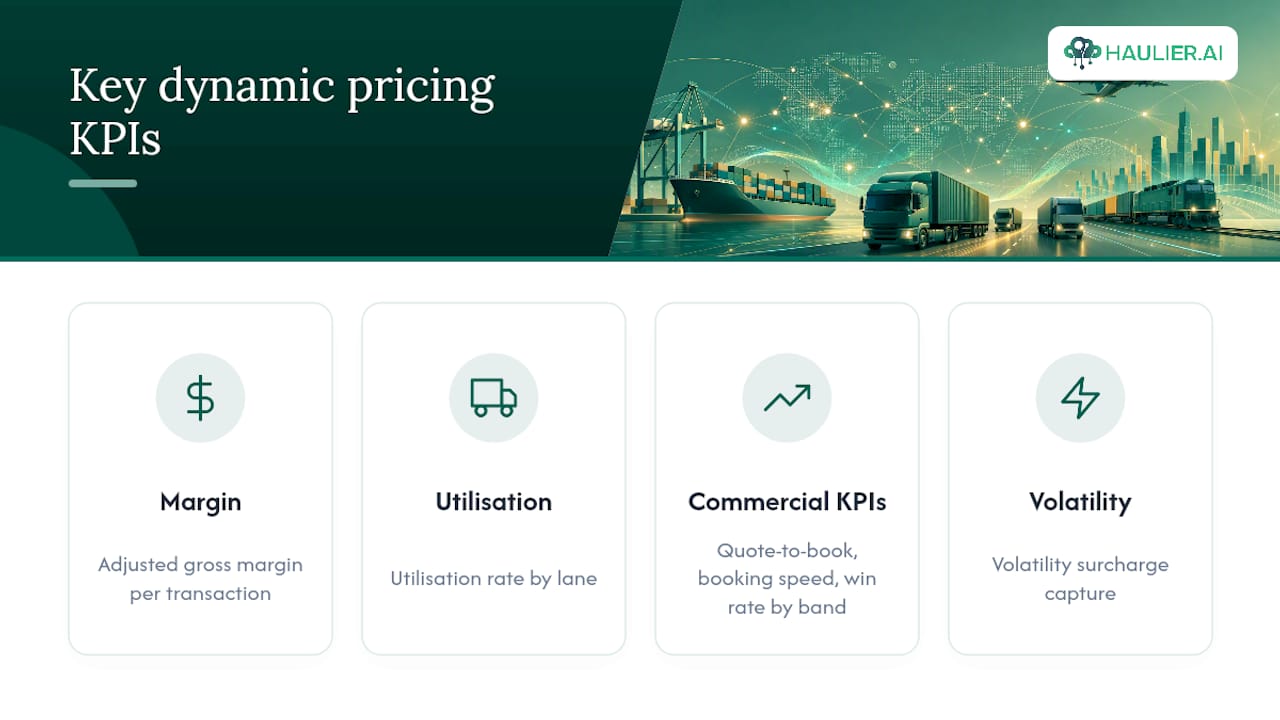
Track a small set of numbers, not a dashboard full of them: adjusted gross margin per transaction, utilisation rate by lane, quote-to-book ratio, booking speed, win rate by price band, and volatility surcharge capture. Check market-signal KPIs daily, review yield and utilisation weekly, and assess retention and corridor performance monthly. Run hold-out lanes without dynamic pricing alongside piloted ones so any margin uplift you claim has something to be measured against, rather than assumed.
What does the research say about dynamic pricing in freight?
The clearest quantified signal comes from AWS’s finding that modernising pricing capability with cloud and ML can lift adjusted gross margin by up to 10%, though that figure swings with baseline performance and business model, it’s a ceiling, not a guarantee.
Simon-Kucher’s research adds a sharper warning: firms that don’t explicitly price for scarcity end up servicing incremental volume at a cost that exceeds the revenue it brings in. Pricing corridors and volatility surcharges are the practical fix.
Separate stable base volume from volatile demand, and monetise the volatility explicitly rather than absorbing it inside a flat annual rate.
That single principle, drawn from Simon-Kucher’s commercial guidance, underpins most of the pricing corridor and blocked-space models freight teams use today. Harvard Business Review has documented the same shift already reshaping parcel shipping rates, where annual rate cards are giving way to continuous recalibration.
What contracts and change management does dynamic pricing require?
Contract language needs to catch up with the pricing model, or the two will contradict each other the first time a rate moves. Pricing corridors and floater clauses, service-tiered contracts, blocked-space commitments and explicit volatility surcharge lines are the four patterns that hold up.
Watch for these red flags before you scale a pilot:
- Any pricing pattern that could look discriminatory between similar customers, get legal review first
- Large strategic accounts with no carve-out from dynamic adjustment
- Missing transparency obligations in customer-facing terms
- SLA commitments that don’t match the service tier the price implies
Internally, run short training sessions with commercial teams before launch, write a one-page playbook for handling price-change conversations, prepare a customer communication template in advance, and build a feedback loop from the pilot lanes back into the pricing owner’s exception list.
Where is dynamic pricing heading next?
Expect dynamic pricing to keep spreading through parcel and LTL, with container spot lanes following as visibility tools mature. The trends worth watching are better AI-driven demand forecasting paired with tighter contract corridors, not one replacing the other. For UK container haulage specifically, that shift is already visible in how Haulier’s platform handles rate transparency.

Managed container haulage with rates hauliers actually control
Haulier is the practical route into fairer container haulage pricing without building a pricing model from scratch. The platform matches freight forwarders and importers to available hauliers through an AI-assisted, human-backed transport desk, where hauliers set and control their own rates rather than being forced into a race to the bottom.

That structure solves the exact problem this article has been describing: opaque, slow-moving rate negotiation that leaves shippers guessing and hauliers underpaid. Real-time communication updates and paperwork tracking cut the admin that normally eats into a logistics manager’s week, and because hauliers can reject unsuitable jobs, the rates you see reflect genuine market appetite rather than desperation pricing. If you’re running container lanes and want quotes that respond to actual capacity rather than a stale rate card, request container haulage through Haulier and see live rates from hauliers ready to move your freight.
Sources
For deeper modelling, the dynamic spatial price equilibrium paper covers the mathematical formulations behind freight pricing under network constraints. For commercial playbooks, Simon-Kucher’s work on logistics pricing under pressure and Harvard Business Review’s parcel pricing analysis are the stronger starting points. Pair either with a live market index or capacity feed before building your own model.
- Dynamic pricing for logistics service providers to maximize profitability | Amazon Supply Chain and Logistics
- Dynamic pricing is changing the parcel shipping industry | Harvard Business Review
- What is dynamic pricing in freight and logistics? | project44
FAQ
Is dynamic pricing illegal in the UK?
No. Dynamic pricing itself is lawful in the UK; the legal risk arises only if pricing becomes discriminatory between similar customers or breaches consumer protection rules, which is why legal review of pricing logic matters before scaling.
What is an example of dynamic pricing in freight?
A container spot rate that rises when port congestion tightens available slots, then falls again once capacity frees up, is a textbook example, the same bidirectional logic used in airline and rideshare pricing.
What is freight pricing?
Freight pricing is the process of setting the cost charged to move goods by road, sea or air, based on factors like distance, weight, service level and, increasingly, real-time market conditions rather than a fixed annual rate alone.
How can shippers respond to dynamic pricing?
Booking earlier, committing to blocked-space agreements, or negotiating a pricing corridor with a set percentage band all reduce exposure to sudden rate spikes, and using a platform like Haulier gives shippers visibility into live rates before they book.