
Container haulage article
Live load vs drop: what logistics managers need to know
Discover the key differences in live load vs drop logistics. Maximize efficiency and effectiveness in your operations with expert insights.
A live load means the driver stays on site while the trailer is loaded or unloaded. A drop trailer (also called drop & hook, drop & collect, or drop & swap) means the driver uncouples and leaves, swapping for a pre-staged unit. The core trade-off is simple: live loading gives you tighter cargo control but burns driver time; drop arrangements protect driver hours and daily mileage but require yard infrastructure and trailer assets.
Three rules of thumb before you read further:
- Favour drop when a site handles regular, predictable volumes, has secure yard space, and your contract supports trailer pooling.
- Favour live load when cargo is high-value, irregular, or the site lacks the security and equipment for unattended trailers.
- Use live load as a fallback, not a default. Drop where you can; live load where you must.
The sections below cover typical timeframes, detention costs, UK compliance constraints, and how Haulier supports drop programmes with real-time visibility and paperwork tracking.
Table of Contents
- What does live load vs drop actually mean?
- How does a live load actually work on site?
- How does a drop trailer arrangement work in practice?
- Live load vs drop: side-by-side comparison
- Pros and cons of live load and drop trailer
- When should you use live load, and when should you use drop?
- UK-specific constraints you need to plan around
- How Haulier supports drop programmes and reduces detention friction
- Key takeaways
- The case for treating drop as the default, not the exception
- Fewer delays, more control: run your drop programme through Haulier
- Useful sources
- FAQ
What does live load vs drop actually mean?
Getting the terminology straight matters, because the same arrangement can appear on paperwork under three or four different names.
Live load / live unload: The driver arrives, waits at the bay while the site loads or unloads the trailer, and departs once the job is complete. The driver is present throughout. This is sometimes called a “live collection” or “live delivery” in UK distribution centre (DC) contexts.

Drop trailer / drop & hook / drop & collect / drop & swap: The driver arrives, uncouples the trailer (loaded or empty), couples to a pre-staged unit, and departs. No waiting for loading. In UK port drayage, “drop & collect” typically means leaving an empty and collecting a laden box; “drop & swap” implies a simultaneous exchange of two units at the same point.
Common synonyms by context:
- Port drayage: drop & collect, drop & pick
- Distribution centre: drop & hook, trailer swap, pre-load
- Container haulage: drop and swap container, ground-level staging
Insurance and liability note: During a live load, the haulier’s driver is present and the carrier retains responsibility for the vehicle throughout. Under a drop arrangement, once the trailer is uncoupled and the driver has departed, site liability for the trailer typically transfers to the shipper or receiver until re-coupling. Contracts should specify who is responsible for trailer security, damage, and seal integrity during on-site storage. Always confirm this in writing before agreeing a drop pool arrangement.
How does a live load actually work on site?
Live loading looks straightforward, but the time it consumes is where operations go wrong.
- Arrival and gate-in: Driver reports to gatehouse, presents booking reference, and is assigned a bay or waiting area.
- Bay allocation: Driver waits for a bay to become free. At busy DCs or ports, this queue alone can consume an hour.
- Loading or unloading: Site staff load or strip the trailer. The driver remains on site, often unable to leave the cab.
- Paperwork: CMR, delivery note, or ePOD is signed. Any discrepancies are noted before departure.
- Departure: Driver exits, gate log records departure time.
Statistic: Live load processes commonly consume 2–4 hours of driver time per stop, significantly reducing productive hours on multi-stop days.
Free time is the grace period before detention charges begin and is commonly around a couple of hours for road shipments, though it varies by shipper and contract. Once that window closes, the clock runs.
Pro Tip: Capture timestamped photographic evidence at gate-in and gate-out using a telematics or mobile app. Telematics-derived gate timestamps eliminate most detention disputes because they produce an objective timeline that is difficult to challenge.

Sites using a Vehicle Booking System (VBS) or slot management reduce bay-queue time significantly. If your operation includes sites without VBS, build a minimum two-hour buffer into your driver’s schedule and price detention recovery into the rate from the outset.
How does a drop trailer arrangement work in practice?
Drop programmes require more upfront planning than live loads, but the operational payoff is substantial.
- Pre-staging: A loaded trailer is positioned in the yard before the driver arrives. For drop & collect at a port, an empty is pre-positioned for exchange.
- Arrival and gate-in: Driver arrives, confirms trailer ID and seal number at the gate.
- Uncoupling: Driver drops the inbound trailer in the designated bay or yard slot.
- Coupling: Driver couples to the pre-staged outbound unit, checks trailer ID, seal, and lights.
- ePOD and departure: Electronic proof of delivery or trailer exchange receipt is signed. Driver departs.
The whole process typically takes 15–45 minutes per exchange, compared with 2–4 hours for a live load.
Types of drop arrangement
- Drop & hook: Driver drops a loaded trailer and hooks a pre-loaded outbound unit. Common at high-volume retail DCs.
- Drop & collect: Driver drops an empty container and collects a laden one. Standard for port drayage.
- Drop & swap: Simultaneous exchange of two units, often at a shared yard or relay point.
- Ground-level / side-lifter staging: For sites without permanent docks, ground-level loading and drop-and-collect options reduce infrastructure costs and enable faster cycle times.
Yard and security checklist
- Unique trailer tags or RFID seals on every unit entering the pool
- Gate log records: trailer ID, seal number, arrival and departure timestamps
- Designated yard slots with clear signage to prevent misplacement
- Named site contact responsible for trailer security during on-site storage
- Insurance confirmation covering third-party trailers on site
- Written agreement on who authorises trailer release
Documentation discipline is what separates a smooth drop programme from a dispute-heavy one. Every exchange needs a trailer ID, a seal number, and a timestamp. Without those three, a damaged or missing trailer becomes a protracted liability argument.
Live load vs drop: side-by-side comparison
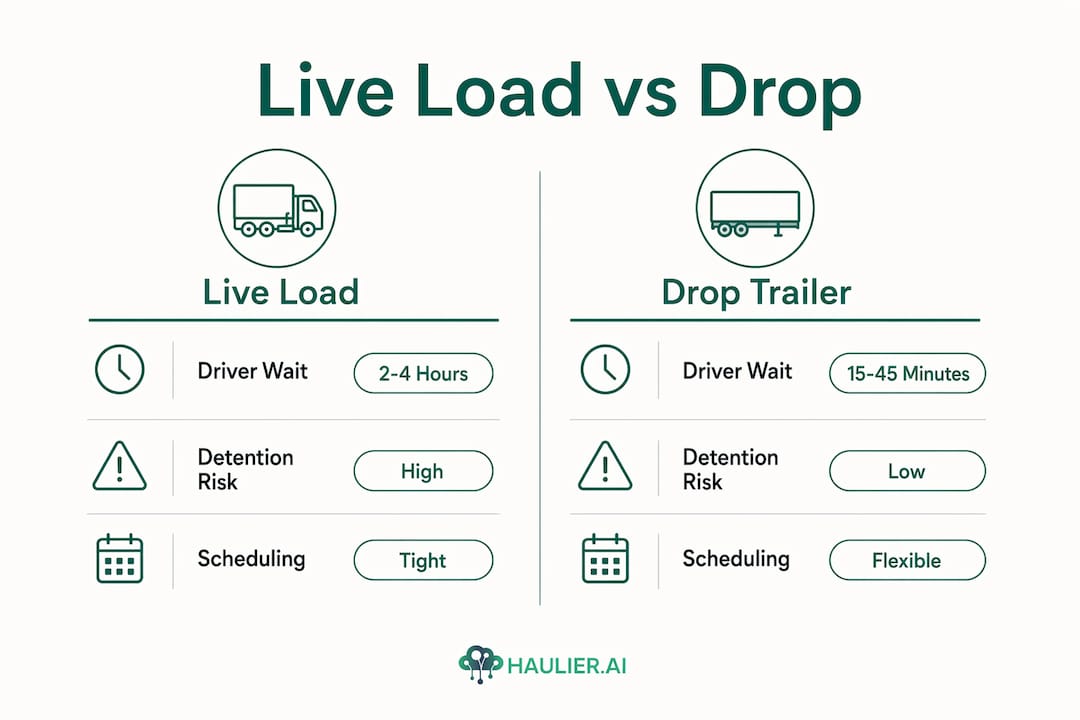
Drop & Swap logistics can reduce average on-site cycles by around 40–60 minutes per trip in busy locations, improving trailer throughput and reducing idle queues. The table below translates that into operational terms across the dimensions that matter most.
| Dimension | Live load | Drop trailer |
|---|---|---|
| Driver wait time per stop | 2–4 hours | 15–45 minutes |
| Detention / demurrage exposure | High (free time often exceeded) | Low (driver departs before loading begins) |
| Driver daily mileage potential | Reduced (time lost waiting) | Higher (more stops per shift possible) |
| Dock / yard infrastructure | Minimal (just a bay) | Requires secure yard, trailer pool, staging space |
| Staffing and equipment | Site staff load/unload while driver waits | Site staff work independently; yard manager needed |
| Operational risk / HGV hours compliance | Higher (waiting erodes legal driving window) | Lower (driver hours preserved for productive movement) |
For hauliers: Drop arrangements protect driver hours and increase daily mileage, directly improving vehicle utilisation and revenue per shift.
For shippers: Drop programmes require trailer pool investment but reduce detention liability and give the warehouse team control over loading pace.
For receivers: Live loads create scheduling pressure; drop arrangements let the goods-in team work at their own pace without a driver waiting at the bay.
Pros and cons of live load and drop trailer
Live load
Pros:
- Cargo remains under driver supervision throughout
- No trailer pool or yard infrastructure required
- Suitable for irregular, ad hoc, or high-value shipments
- Simpler contractually (no trailer exchange agreements needed)
Cons:
- Driver time consumed waiting: 2–4 hours per stop is common
- Detention charges accrue quickly once free time expires; UK haulage pricing commonly blends distance with time allowances, and waiting charges can easily outweigh mileage costs in urban or port lanes
- HGV driver hours eroded by waiting, reducing legal driving window
- Scheduling unpredictability: one delayed bay affects the rest of the day
Example: A driver arrives at a busy retail DC at 08:00 for a live unload. The bay is occupied until 09:30. Unloading takes 90 minutes. The driver departs at 11:00, three hours after arrival. Free time was two hours; one hour of detention accrues at the contracted rate.
Drop trailer
Pros:
- Driver on-site time reduced to 15–45 minutes
- Driver hours preserved for productive driving
- Detention and demurrage exposure minimised because the driver is not waiting for loading
- Yard pooling can reduce the total number of vehicles needed for a lane
Cons:
- Requires secure yard space and a trailer pool
- Higher upfront asset cost (trailers sitting on site)
- Insurance and liability during on-site storage must be contractually defined
- Not suitable for irregular sites or high-value cargo without enhanced security
Example: A haulier running a daily lane to a high-turnover grocery DC switches from live loads to a drop & hook programme. Drivers drop a laden trailer and hook a pre-loaded outbound unit in 15–45 minutes. The same driver completes two additional stops per shift that were previously impossible.
When should you use live load, and when should you use drop?
The decision comes down to site characteristics and lane regularity. Work through this checklist:
- Free time policy: Does the site offer at least two hours of free time? If not, live loading will generate detention on almost every visit.
- Bay availability: Is there a VBS or slot system? Without one, live load queues are unpredictable.
- Security: Can the site store unattended trailers securely with gate control and CCTV?
- Trailer pool: Does the operation have sufficient trailer assets to stage units in advance?
- Driver hours: Are drivers regularly running close to their legal limit? Drop arrangements preserve the driving window.
- Cost recovery: Is detention contractually recoverable? If not, live loading on a slow site is a margin drain.
- Cargo type: Is the cargo high-value, temperature-sensitive, or irregular? Live loading keeps the driver present.
- Volume regularity: Is the lane daily or near-daily? Drop programmes only pay off on regular, predictable routes.
Three UK use-case examples
Port drayage (e.g. Southampton): Container free time at UK ports can run 3–7 days, but securing haulage ahead of vessel arrival is the decisive control. A drop & collect arrangement, where the haulier drops an empty and collects a laden box, keeps driver time at the terminal to a minimum and avoids demurrage on the container. See the Southampton container haulage guide for port-specific operational detail.
High-turnover retail DC: A distribution centre processing 40+ trailer movements per day is the natural home for drop & hook. Pre-staged trailers mean drivers spend under 30 minutes on site. The warehouse team loads and unloads on their own schedule, and the haulier’s fleet turns more stops per day.
Intermittent rural site without docks: A manufacturing site receiving two deliveries per week, with no loading dock and limited yard space, is a poor candidate for drop. Ground-level or side-lifter options exist, but the irregular volume rarely justifies a trailer pool. Live loading, with a clear free time clause in the contract, is the pragmatic choice.
Hybrid strategy: Run drop where volume and infrastructure support it; default to live load for irregular lanes or sites that cannot meet the security requirements. Never treat live loading as the standard, and drop as the exception.
UK-specific constraints you need to plan around
UK operations face a specific combination of regulatory and market pressures that make the live load vs drop decision more consequential than it might appear on a rate sheet.
Statistic: Free time is typically around two hours for road shipments, but varies by shipper, commodity, and contract. A carrier charging £45 per hour after free time expires will bill £90 on a four-hour live load where two hours were free.
Driver hours and the Mobility Package: Under the EU Mobility Package rules, which the UK retained post-Brexit for international operations, and under domestic GB drivers’ hours rules, waiting time counts against a driver’s available duty period. A two-hour live load wait at a DC is two hours that cannot be used for driving. On a tight schedule, that can force a rest break mid-route or cut the day’s mileage entirely.
Practical controls to implement:
- Telematics geofence gate logs to timestamp arrivals and departures automatically
- Site slot management or VBS to reduce bay-queue time
- Contractual free time clauses that specify the exact window and the hourly rate thereafter
- Written detention recovery procedures so drivers know when and how to log waiting time
Industry bodies: Logistics UK and the Road Haulage Association (RHA) both publish template clauses and guidance on detention and demurrage for UK road freight. Their materials are worth reviewing before drafting or renegotiating contracts that include live loading on high-volume lanes.
Detention recovery is increasingly treated as an operational margin lever rather than a billing nuisance. Firms that automate arrival and departure evidence win disputes and recover more costs. The technology to do this is not expensive; the discipline to deploy it consistently is where most operations fall short.
How Haulier supports drop programmes and reduces detention friction
Running a drop programme without visibility is where the wheels come off. Trailers go missing, seal numbers get disputed, and detention charges arrive without the timestamps to challenge them.
Haulier is an AI-assisted, human-backed transport desk that connects freight forwarders and importers with UK hauliers. For drop programme management, the platform’s relevant features are:
- Real-time visibility: Live status updates on trailer movements, gate-in and gate-out events, and paperwork milestones
- Paperwork tracking: Digital trail for CMRs, ePODs, trailer exchange receipts, and seal numbers
- Haulier-controlled rate quoting: Hauliers set their own rates and accept jobs that fit their fleet and route, which means the right vehicle for a drop lane is matched efficiently
- Managed quoting desk: Freight forwarders and importers access capacity quickly without manual phone rounds
Implementation pro tip for piloting a drop pool:
- Select one regular lane with a site that has secure yard space and a VBS or slot system.
- Agree trailer tagging and seal protocols with the site before the first drop.
- Activate telematics gate logs on every vehicle running the lane.
- Run the pilot for two weeks, tracking gate-to-gate dwell time per stop.
- Review detention recovery against the live load baseline before expanding.
Pro Tip: The minimum viable drop pilot needs three things: a designated trailer pool (even two units on a single lane), telematics timestamps at gate-in and gate-out, and a written free time clause in the contract. Without all three, the efficiency gains are real but unrecoverable if disputed.
Haulier’s platform is built for container haulage in the UK, where the combination of port drayage, drop & collect, and live unload decisions happens on every booking. The visibility layer means planners can see where a trailer is, whether it has been collected, and whether a detention clock is running, without chasing drivers by phone.
Key takeaways
Drop trailer arrangements reduce driver on-site time from 2–4 hours to 15–45 minutes per stop, making them the operationally superior choice for regular, high-volume UK lanes with secure yard infrastructure.
| Point | Details |
|---|---|
| Driver time difference | Live loads consume 2–4 hours per stop; drop exchanges take 15–45 minutes. |
| Detention trigger | Free time is typically around two hours; every hour beyond that is a billable cost. |
| Drop programme prerequisites | Secure yard, trailer pool, telematics gate logs, and a written free time clause are all required. |
| When live load wins | Irregular lanes, high-value cargo, or sites without secure yard space favour live loading. |
| Haulier for drop management | Haulier’s AI-assisted transport desk provides real-time visibility and paperwork tracking to support drop programmes and evidence detention. |
The case for treating drop as the default, not the exception
Most UK logistics operations still treat live loading as the baseline and drop as a premium arrangement reserved for the biggest retail accounts. That framing is back to front.
Live loading is the expensive option. It ties up a driver, erodes their legal hours, and generates detention charges that are often absorbed rather than recovered. Drop arrangements require upfront investment in trailers and yard controls, but those costs are fixed and predictable. Detention charges on live loads are variable and, in busy periods, can be substantial.
The objection I hear most often is that drop programmes are too complex to manage. That is usually a data problem, not an operational one. When you cannot see where your trailers are, who has them, and whether a detention clock is running, the complexity is real. When you have telematics timestamps and a platform that tracks paperwork in real time, the complexity largely disappears.
The KPI worth tracking during any pilot is average gate-to-gate dwell time per stop. Not detention charges billed, not driver hours used, but dwell time. It is the single number that tells you whether your operation is absorbing time it should not be, and it is the baseline against which every improvement is measured.
Fewer delays, more control: run your drop programme through Haulier
Live load detention is one of the most consistent margin drains in UK container haulage, and most of it is preventable. Haulier connects freight forwarders and importers directly with vetted UK hauliers through an AI-assisted transport desk that tracks every movement, paperwork milestone, and gate event in real time.
For drop programme pilots, that means you get the visibility to evidence detention, the capacity to match the right haulier to a drop lane, and the paperwork trail to resolve disputes before they become write-offs. Hauliers retain full control over their rates and can accept or decline jobs, so the capacity you access is genuinely available.
Request container haulage through Haulier to start a drop programme pilot, or visit the container haulage service page to see how the platform works for your lanes.
Useful sources
- Logistics UK: Freight Accessorial Charges Explained — Covers detention fees, free time, and waiting time charges in UK road freight. Useful for drafting contract clauses and understanding how accessorial charges are calculated.
- CO3: Demurrage & Detention in Road Freight — Clear explanation of the distinction between detention (truck/driver) and demurrage (equipment), with practical guidance on telematics evidence and recovery.
- Barrington Freight: Detention and Demurrage Explained — UK importer and exporter focus; explains port free time windows and how to avoid avoidable charges by securing haulage ahead of vessel arrival.
- LDA Transport: Maximising Efficiency with Drop & Swap Logistics — Operational case for drop & swap, including cycle time reductions and throughput improvements.
- Haulier: How It Works — Platform explainer covering AI-assisted quoting, real-time visibility, and paperwork tracking for UK container haulage.
- Haulier: Container Haulage UK — Service landing page for teams ready to pilot a drop programme or request container haulage capacity.
FAQ
What is the difference between a live load and a drop trailer?
A live load requires the driver to wait on site while the trailer is loaded or unloaded, typically taking 2–4 hours per stop. A drop trailer arrangement means the driver uncouples and departs immediately, with the exchange taking 15–45 minutes.
What is a live unload, and how does it differ from a drop & collect?
A live unload is a live load in reverse: the driver waits while the site strips the trailer. A drop & collect means the driver leaves an empty trailer and collects a pre-loaded unit, with no waiting for unloading.
How does detention work in UK road freight?
Detention is the charge applied when a truck and driver are held beyond the agreed free time, which is typically around two hours for road shipments. After free time expires, the carrier bills an hourly rate; a four-hour live load with two hours of free time generates two billable hours of detention.
Is there still an HGV driver shortage in the UK?
The UK haulage sector has faced persistent HGV driver shortages in recent years, making driver time a scarce resource. Drop trailer arrangements help by reducing on-site dwell time and allowing drivers to complete more stops per shift within their legal hours.
How does Haulier help with live load and drop operations?
Haulier’s AI-assisted transport desk provides real-time visibility, paperwork tracking, and telematics-linked gate event records, giving planners the evidence needed to recover detention charges and manage drop programmes without manual phone rounds.