
Container haulage article
Driver waiting time: what it costs and how to cut it
Learn how to effectively reduce driver waiting time and avoid costly delays. Implement simple strategies to streamline loading and unloading.
Driver waiting time is the minutes a driver spends parked up waiting to be loaded, unloaded or cleared to leave site. It is not the same thing as container demurrage (charges for a box sitting inside a terminal past its free time) or carrier detention (charges for the container itself once it is outside the terminal). Waiting time is the site-level delay that sits underneath both, and it is the one you can actually fix this week.
The single most useful thing you can do today is start timestamping every event at the point of loading or unloading, and issue drivers a one-page checklist for the worst-offending site.
- Record arrival, gate-in, load start, load end, gate-out and empty-ready as separate timestamps
- Give every driver the same checklist: paperwork required, contact name, bay number
Pro Tip: If you only fix one site this month, fix the site with the longest average wait, not the one with the loudest complaints. The two are rarely the same.
Key Takeaways
Driver waiting time is a measurable, manageable cost, and the fastest reduction comes from timestamping every site event and making empty-ready a formal, triggered status.
| Point | Details |
|---|---|
| Timestamp six events | Capture arrival, gate-in, load start, load end, gate-out and empty-ready separately. |
| Watch the rounding rules | A 20-minute overrun can be billed as a full hour, so get rounding terms written into contracts. |
| Fix the worst site first | Rank sites by average wait, not by complaint volume, and start there. |
| Build your evidence before you dispute | Signed timestamps, EDI receipts, photos and spotter logs settle charge disputes. |
| Use a managed transport desk | Haulier’s AI-assisted, human-backed desk reduces missed updates and paperwork delays that cause waiting. |
Table of Contents
- How do you measure driver wait duration accurately?
- Why do drivers wait, and what does it actually cost?
- What operational changes cut wait time fastest?
- How do you build a contract that protects you on waiting time?
- Which technology actually reduces time spent waiting for a driver?
- Where can you request haulage that’s built to cut waiting time?
- Sources
- FAQ
How do you measure driver wait duration accurately?
You cannot manage what you do not timestamp, and most disputes over waiting-time charges are won or lost on the strength of that timestamp trail rather than on argument. Gate receipts, driver app logs, photos and spotter logs are what actually settle a dispute, not a verbal account of what happened.
Set up capture at six points in the journey:
- Arrival at the gate or site perimeter
- Gate-in (the moment the vehicle is logged onto site)
- Load or unload start
- Load or unload end
- Gate-out
- Empty-ready (the container confirmed empty and available for return)
Driver apps handle the first and last of these well because the driver is already there with a phone. Gate systems and yard management platforms are better for the middle four, and EDI confirmations tie the whole chain back to your planning system. Once you have the raw timestamps, four KPIs turn them into something you can act on: average wait per stop, the percentage of stops exceeding free time, cost per hour lost, and how each site trends month-to-month against the others.
Pro Tip: Track cost per hour lost by site, not by driver. Drivers rotate; sites don’t. A recurring site problem gets buried if you’re only looking at driver-level averages.
Why do drivers wait, and what does it actually cost?
Most waiting time traces back to a small set of repeat offenders: missing or incorrect paperwork, customs holds that nobody flagged in advance, yard or bay congestion, spotters who are stretched across too many jobs, and time spent physically searching for the right container or trailer in a disorganised yard. Terminal and yard inefficiencies like these are consistently cited as the primary driver of detention and waiting charges, well ahead of anything happening on the road.

Free time is where the commercial exposure starts. A typical arrangement allows roughly two hours of free time for loading or unloading, with any excess chargeable, and carriers often round up to the next 30 or 60 minutes rather than billing to the minute. That rounding detail matters more than it looks: a 20-minute overrun can be billed as a full hour depending on the contract.
Here is an example to illustrate charges: free time may be two hours, with a rate charged per hour thereafter. If a driver waits longer than the free time, the excess is multiplied by the hourly rate to calculate the charge. Multiply that across a fleet doing several drops a day and a badly run site can add thousands of pounds a month in charges that were entirely avoidable.
- Missing or incorrect paperwork on arrival
- Customs holds not flagged before the driver set off
- Yard or bay congestion at peak arrival windows
- Spotter delays when one spotter covers multiple bays
- Time lost searching for the right asset in the yard
What operational changes cut wait time fastest?
Fix the controllable things first, then work outward to systems that need longer to bed in. Preparation, confirmed paperwork and a named receiving contact are consistently the cheapest way to keep turnaround tight, and none of it requires new software.
Immediate (this week):
- Issue a loading checklist covering required documents, the named site contact and bay allocation before the driver leaves
- Confirm paperwork is complete before dispatch, not on arrival
- Brief yard staff on expected arrivals for the day, with rough windows
Short-term (this quarter):
- Set yard orchestration rules: priority lanes for time-critical loads, a clear sequencing order for the rest
- Define “empty-ready” as a formal status with its own timestamp, not a vague end-of-day assumption
- Track the gap between gate-out and empty-ready confirmation as its own metric
Medium-term (two to six months):
- Integrate gate capture systems with your planning platform so timestamps flow automatically rather than being re-keyed
- Set explicit spotter coverage ratios so no single spotter is responsible for more bays than they can realistically clear
- Review KPIs monthly against site benchmarks, not just against last month’s own numbers
Making empty-ready a genuine milestone rather than an assumption is the single change with the biggest payoff. Timestamping the moment a container is confirmed empty and triggering an immediate return workflow closes the gap that causes a large share of avoidable detention. It converts a fuzzy end-of-day state into an event someone is accountable for.
Pro Tip: Give the empty-ready timestamp its own field in your system, separate from gate-out. Teams that lump the two together lose the exact data point that proves a container sat idle after unloading.
How do you build a contract that protects you on waiting time?
Detailed contracts on the front operational things — paperwork, staffing, staging — are usually not matched by equally detailed contracts on the billing side, which is exactly where disputes come from. Push for specificity on these points before you sign or renew:
- A clear, numeric definition of free time, stated in hours, not “reasonable time”
- Explicit rounding rules (does 20 minutes over become a full hour, or is it billed to the minute?)
- Escalation bands showing how the hourly or daily rate changes the longer a container sits, since demurrage day rates typically escalate to force movement and can jump sharply after the first week
- A defined dispute window, so you know exactly how long you have to challenge a charge after it lands
- Combined demurrage-and-detention tariff terms, since carriers increasingly bundle the two and a contract that only addresses one leaves you exposed on the other
Before disputing any charge, assemble your evidence in advance rather than scrambling once the invoice arrives: signed driver timestamps, EDI gate receipts, site photos showing arrival and departure conditions, and spotter logs covering the relevant window. Regular importers on the same lanes have room to negotiate combined free-time concessions of 14, 21 or 28 days as part of the wider commercial contract, which is worth raising at renewal rather than waiting for a dispute to force the conversation.
Which technology actually reduces time spent waiting for a driver?
Three categories of technology cover most of what matters here, and they solve different parts of the problem. Driver apps capture arrival and departure timestamps at the point they happen, which beats reconstructing a timeline from memory after the fact. Yard and gate capture systems automate the event log across a site and cut down the “asset search” time that eats into detention windows when nobody can immediately locate the right container. Integrated visibility platforms and managed transport desks sit above both, reducing missed updates and paperwork delays that would otherwise slow collections.
Haulier’s AI-assisted, human-backed transport desk fits into this last category. It gives freight forwarders and importers live visibility on a booking’s status, tracks the paperwork that normally causes hold-ups at the gate, and matches jobs against hauliers who control their own rates and can decline unsuitable work rather than accept it and delay everyone downstream.
The gap between a good driver app and a good outcome is usually the system that sits behind it. A timestamp nobody acts on is just data. A timestamp that triggers a return booking or flags a missing document automatically is what actually shortens the wait.
- Driver apps: best for capturing arrival and departure at source
- Yard/gate systems: best for automating the middle events and cutting search time
- Managed transport desks: best for reducing missed updates and paperwork delays across the whole booking
What I’d fix in 30, 90 and 180 days
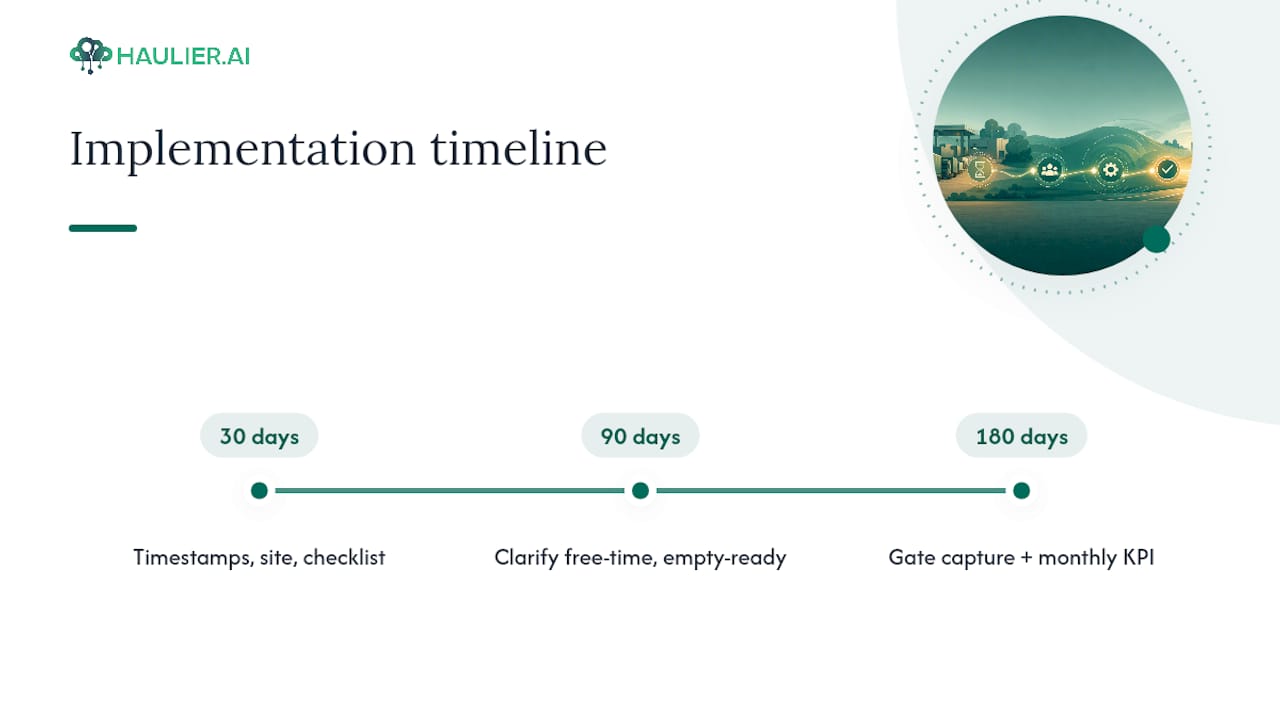
Thirty days: get timestamps running properly, fix the single worst site, and get the loading checklist into every driver’s hands. Ninety days: renegotiate free-time clarity into your contracts and make empty-ready a standard, timestamped status everywhere. One hundred and eighty days: integrate gate capture with your planning system and put a KPI review on a fixed monthly cadence, because the sites that slip are the ones nobody is watching.
Where can you request haulage that’s built to cut waiting time?
Haulier is the alternative to chasing updates across email, WhatsApp and phone calls for every container movement. It gives freight forwarders and importers one place to see a booking’s status, the paperwork attached to it, and the haulier assigned to it, rather than piecing that picture together after something has already gone wrong.
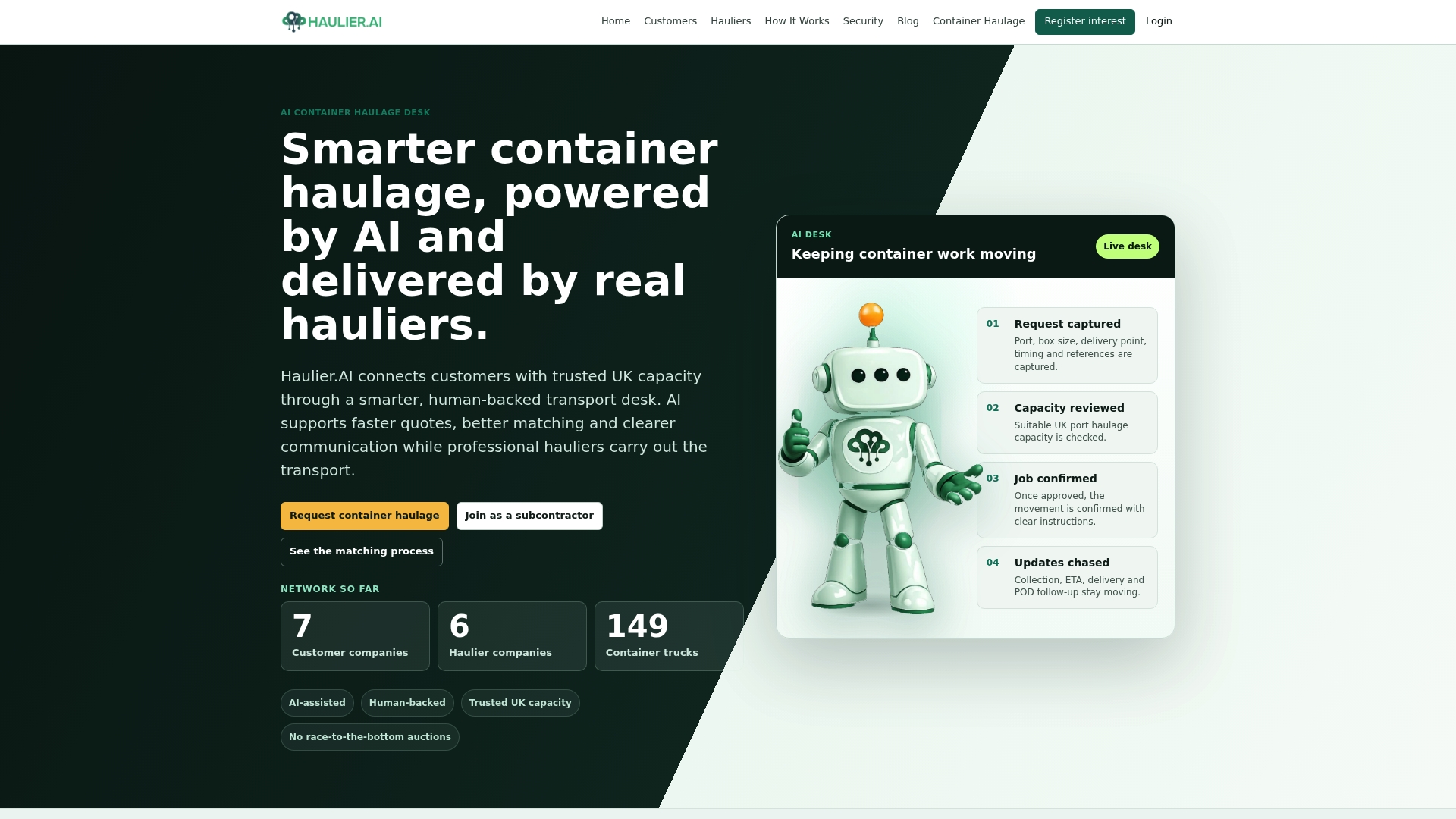
Because hauliers on the platform control their own rates and can turn down jobs that do not suit them, the jobs that get accepted tend to run smoother, with fewer last-minute substitutions that cause a driver to turn up without the right paperwork. Clients typically see faster confirmations on bookings, fewer missed status updates, and clearer timestamps around gate-in and gate-out, which is exactly the evidence trail you need if a waiting-time charge ever needs disputing. You can read more about how the AI-assisted transport desk works, check what the container haulage service covers, or go straight to request container haulage for your next movement.
Sources
- Freight accessorial charges explained: fuel, waiting time, tail lift and storage fees
- What is demurrage and detention in shipping for buyers?
- Freightterms
FAQ
What is driver waiting time?
Driver waiting time is the period a driver spends waiting to be loaded, unloaded or cleared to leave a site, measured from arrival to gate-out.
How is driver waiting time different from demurrage and detention?
Waiting time happens at the loading or unloading site itself, while demurrage covers a container sitting inside a terminal past free time and detention covers the container once it leaves the terminal.
How much free time is normal before charges apply?
A typical arrangement allows a certain amount of free time for loading or unloading, with excess time billed hourly and often rounded up.
What is the fastest way to reduce driver wait duration?
Start timestamping every site event and issue a loading checklist covering paperwork, site contact and bay allocation before the driver arrives.
How can Haulier help with driver delay issues?
Haulier’s AI-assisted transport desk tracks paperwork and booking status in one place, which reduces the missed updates and delays that commonly cause drivers to wait.