
Container haulage article
33–52 Day Container Haulage Lead Times: Size Buffers Using GOV.UK Data
Use GOV.UK port stats to size buffers and write SLA dates. Plan realistic 33 to 52 day door to door windows and a 48 hour buffer for UK imports in 2026.
Plan for several working days door-to-door on most UK import moves, with ocean transit added on top of that for anything arriving from overseas. Build a buffer of at least 48 hours around your target delivery date, and always confirm the terminal’s Vehicle Booking System (VBS) slot before you commit a schedule to a customer. Port dwell, customs holds and driver-hour limits are the three things most likely to break that estimate, so check them first.
TL;DR:
- Port dwell time during congestion can extend wait periods by up to a week, significantly impacting overall import lead times.
- The most variable delays often stem from customs inspections, vessel schedules, and vehicle booking system constraints, which require proactive management.
- Building buffer times should match the risk level, with at least five days added during peak seasons or when port congestion is likely.
- UK import door-to-door transit, including ocean voyage and inland delivery, typically takes 33 to 52 days, depending on routing and seasonality.
- Using real-time data from sources like GOV.UK and adopting AI platforms can prevent schedule slips and improve capacity booking accuracy.
Table of Contents
- How long does container haulage actually take?
- What causes container haulage lead times to stretch?
- What does a typical import timeline look like stage by stage?
- Do lead times differ between Felixstowe, London Gateway and Southampton?
- How much buffer should you build into a container haulage schedule?
- Where does Haulier.AI fit into reducing this uncertainty?
- Why 2026 is the year to take port volatility seriously
- Get quotes without chasing a haulier for updates
- Sources
- FAQ
How long does container haulage actually take?
The honest answer depends on which leg of the journey you mean, and that distinction trips up more planners than anything else. Port-to-port transit, the time a vessel spends at sea, is not the same as door-to-door lead time, which includes origin haulage, terminal handling, customs clearance and final delivery. Confusing the two is the single most common reason import schedules slip.
For domestic UK moves, port-to-door haulage on a short lane, say Felixstowe to a distribution centre in Ipswich, typically runs same-day to next-day once the container is released. Regional moves, from a Southampton terminal to the Midlands, usually need 1 to 2 days including collection slot booking. Long-haul UK moves, such as Teesport to South Wales, can stretch to 2 to 3 days when driver-hour rules force an overnight break.
Door-to-door figures look very different once ocean transit enters the picture. Industry guidance for UK importers recommends adding 3 to 7 days on top of the quoted port-to-port transit time to account for origin haulage, customs processing and inland delivery. For a typical China to UK sailing, that means:
- Port-to-port ocean transit: roughly 30 to 45 days depending on routing and transhipment.
- Door-to-door addition: 3 to 7 days for clearance, release and final-mile haulage.
- Total realistic door-to-door window: 33 to 52 days from origin factory to UK warehouse.
Expect longer lead times during peak seasons, around major holidays, or whenever a terminal reports congestion. Outside those windows, the lower bound is a reasonable planning assumption.
What causes container haulage lead times to stretch?
Most delays trace back to a handful of operational choke points, and once you know what to watch, they become predictable rather than mysterious.
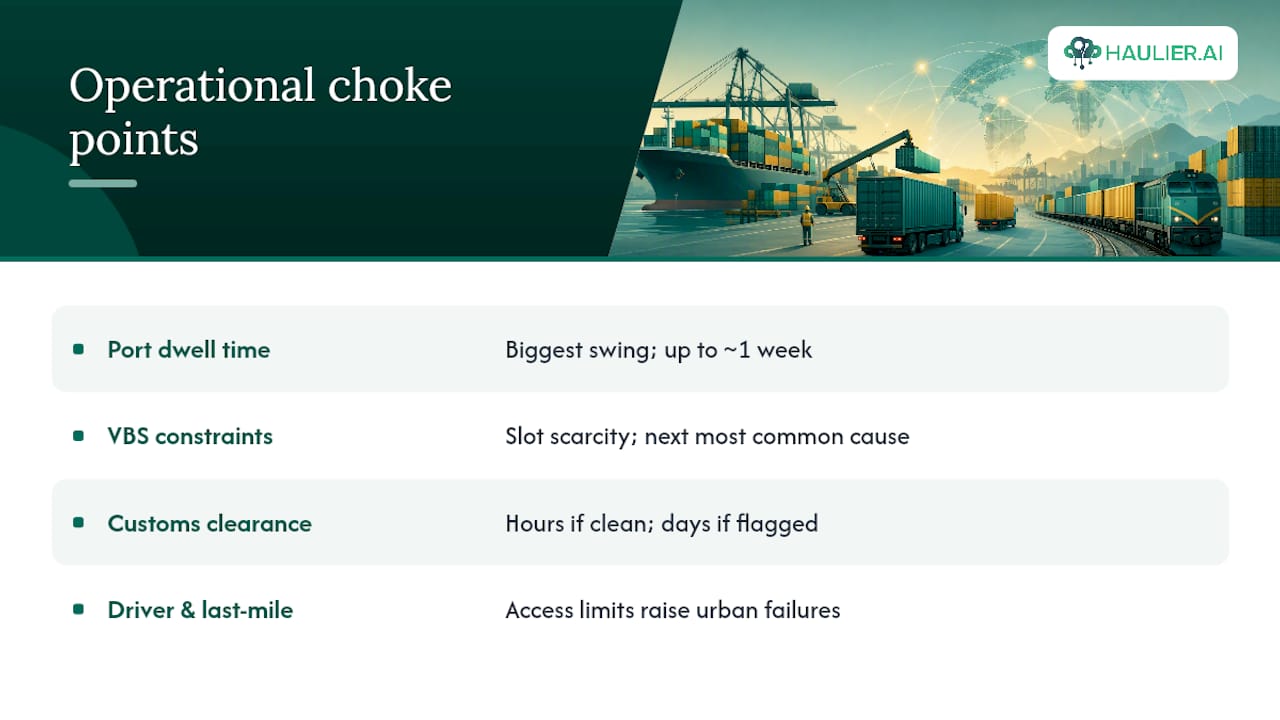
Port dwell time is the gap between a container being discharged from the vessel and being physically released for collection. It varies by terminal, volume and customs activity, and it is the single biggest swing factor in any haulage schedule. Dwell time can increase significantly during congestion, sometimes reaching about a week, though precise averages vary by source.

Vehicle Booking System (VBS) constraints are the next most common culprit. Terminals allocate collection slots in fixed windows, and when demand outstrips capacity, hauliers simply cannot get a truck in to collect. Slot scarcity is an everyday operational reality rather than an occasional glitch, and it is worth building slack around rather than fighting.
Customs clearance adds time whenever documentation is incomplete, a consignment is selected for physical examination, or tariff classification is disputed. A clean, pre-lodged entry clears in hours; a flagged one can add several days.
Driver hours and last-mile access matter more than most planners assume. HGV drivers face statutory rest requirements, and urban delivery restrictions, low-emission zones, restricted access windows, can force a collected container to wait for the next available run. The Department for Transport’s own review of urban freight found that access restrictions and traffic delays raise delivery failure rates in city centres specifically.

Pro Tip: Ask your haulier for the terminal’s current average dwell time before you quote a delivery date to your customer, not after. Terminals will usually share this on request, and it is the single most predictive number you can get.
What does a typical import timeline look like stage by stage?
A useful way to plan is to treat door-to-door as five discrete stages, each with its own confirmation point:
- Origin pickup and inland haulage (0 to 2 days): container is collected from the supplier and moved to the origin port. Confirm the booking reference and vessel cut-off date at this stage.
- Port arrival and terminal handling (variable, typically 1 to 5 days at destination): the container is unloaded and processed for release. This is where dwell time bites hardest.
- Vessel transit, port-to-port (roughly 30 to 45 days on major Far East to UK lanes): treat the carrier’s quoted transit time as a midpoint, not a guarantee, since schedule reliability fluctuates with congestion and weather.
- UK import clearance (hours to several days): customs and any physical or documentary checks happen here. Pre-lodging documentation before vessel arrival shaves real time off this stage.
- Collection and inland delivery (0 to 2 days): a VBS slot is booked, a driver is allocated, and the container moves to final destination, subject to driver-hour limits.
Copy this sequence into your own SLA template and attach a realistic day-range to each stage rather than a single number. That alone will make your quoted delivery windows far more defensible when something slips.
Do lead times differ between Felixstowe, London Gateway and Southampton?
Yes, and the gap has widened recently. GOV.UK’s own port freight statistics show container traffic redistributing across UK gateways, with container units at London rising while Felixstowe recorded declines in the same quarter. The previous quarter told a similar story: container tonnage at London Gateway rose 19% year on year, largely on the back of new berth capacity.
That kind of volume shift matters because local haulage capacity, drivers, trailers, yard space, moves more slowly than vessel schedules do. A port gaining volume fast can outstrip the local haulier pool before capacity catches up.
- Felixstowe: still the UK’s busiest container port, but recent volume declines have eased some pressure on VBS slots.
- London Gateway: growing fast, which means booking further ahead is increasingly sensible as local demand rises.
- Southampton: steadier volumes, but tidal access windows can constrain vessel and terminal timing.
When one gateway is visibly under pressure, staging at an off-dock depot or routing through an alternative port is often cheaper than absorbing repeated dwell penalties.
How much buffer should you build into a container haulage schedule?
Buffer sizing should match risk, not habit. A low-risk domestic lane with a reliable haulier needs less padding than a peak-season import through a congested gateway.
- Low risk (established lane, off-peak, reliable partner): add 1 working day.
- Medium risk (new lane, moderate port congestion): add 2 to 3 working days.
- High risk (peak season, known VBS pressure, new customs requirements): add 5 or more working days.
Your SLA with carriers and freight forwarders should specify a VBS slot confirmation deadline, a named escalation contact for delays, and a defined trigger point for switching to an alternative gateway or expediting collection. Demand a same-day update commitment on any missed slot, not a next-day one.
Pro Tip: Build your contingency playbook before you need it: agree in advance who authorises a reroute, a split load, or an off-dock staging decision, so nobody is making that call under pressure at 4pm on a Friday.
Underestimating any of this carries a real commercial cost. Industry commentary has linked extended port dwell to higher demurrage charges and longer cash conversion cycles for importers who fail to plan around it. A practical framework for improving visibility across container logistics operations is worth reviewing if your current planning tools cannot flag a slipping schedule early enough to act on it.
Where does Haulier.AI fit into reducing this uncertainty?
Most of the lead-time variability described above sits in the admin layer, not the road itself: chasing a quote, waiting on a paperwork update, or discovering a VBS slot has gone after a phone call went unanswered. Haulier.AI’s AI-assisted, human-backed transport desk shortens exactly those stages, matching capacity quickly, tracking paperwork automatically, and pushing real-time status updates instead of leaving planners to chase them. Because hauliers on the platform control their own rates and can decline unsuitable jobs, the capacity offered tends to be genuinely available rather than optimistic, which cuts out one of the more common causes of missed collection windows.
Why 2026 is the year to take port volatility seriously
Port volumes are moving faster between gateways than local haulage capacity can follow, and that gap is where most schedule failures start. The practical response isn’t heroics; it’s discipline: check VBS availability before you promise a date, stage inventory off-dock when a gateway is under pressure, and size your buffer to the lane’s actual risk rather than a company-wide default. Planners who treat GOV.UK’s quarterly port data as a live input, not background reading, will spot capacity shifts weeks before their haulier does.
— Vytautas
Get quotes without chasing a haulier for updates
Haulier.AI gets you booked capacity faster than the phone-and-email cycle most freight forwarders still rely on, because hauliers see and accept jobs directly through the platform rather than waiting for a broker to relay a quote back and forth. That matters most in exactly the scenario this article has covered: a port under pressure, a tight VBS window, and a customer who needs a firm delivery date today, not tomorrow.
The platform covers major UK gateways including Felixstowe, London Gateway, Southampton and Tilbury, with paperwork tracking and real-time updates built into every booking rather than bolted on afterwards. If you’re planning imports or exports through any of these ports, Haulier and see actual available capacity before you commit a delivery date to anyone downstream.
Sources
For verified figures, consult GOV.UK’s port freight quarterly statistics and the DfT’s last-mile urban freight review.
- Port freight quarterly statistics: January to March 2026
- How Long Does Sea Freight Take? A UK Business Guide
- Future of mobility: last mile urban freight in the UK
- Government data reveals shifting pressure across UK ports as global shipping disruption continues
FAQ
What are current container haulage rates in the UK?
Rates vary significantly by lane, distance, fuel costs and haulier availability, and no single national figure applies across all UK routes. Get a live quote for your specific lane rather than relying on a published average, since local capacity shifts at gateways like London Gateway can move pricing quickly.
Who is the biggest haulage company in Britain?
The UK haulage sector is fragmented, with thousands of independent operators alongside a handful of larger fleet operators, rather than one dominant single company. This fragmentation is part of why platforms matching demand to available capacity have become useful for planners trying to secure reliable slots.
How long does it take to unload a 20,000-container ship?
Unloading time depends on terminal crane capacity, berth allocation and how many containers are destined for onward rail versus road haulage, typically taking one to several days for a large vessel call. Dwell time before release for collection is a separate, often longer, process on top of physical unloading.
How long does it take for a container to arrive in the UK from China?
Port-to-port ocean transit typically runs 30 to 45 days depending on routing, with an additional 3 to 7 days commonly needed for door-to-door completion, covering customs clearance and final inland delivery. That gives a realistic total window of roughly 33 to 52 days from origin to UK warehouse, longer during peak season or port congestion.