
Container haulage article
Zencargo alternatives for UK container haulage
Explore top Zencargo alternatives for UK container haulage. Discover Haulier.AI and others for enhanced control and efficiency in shipping.
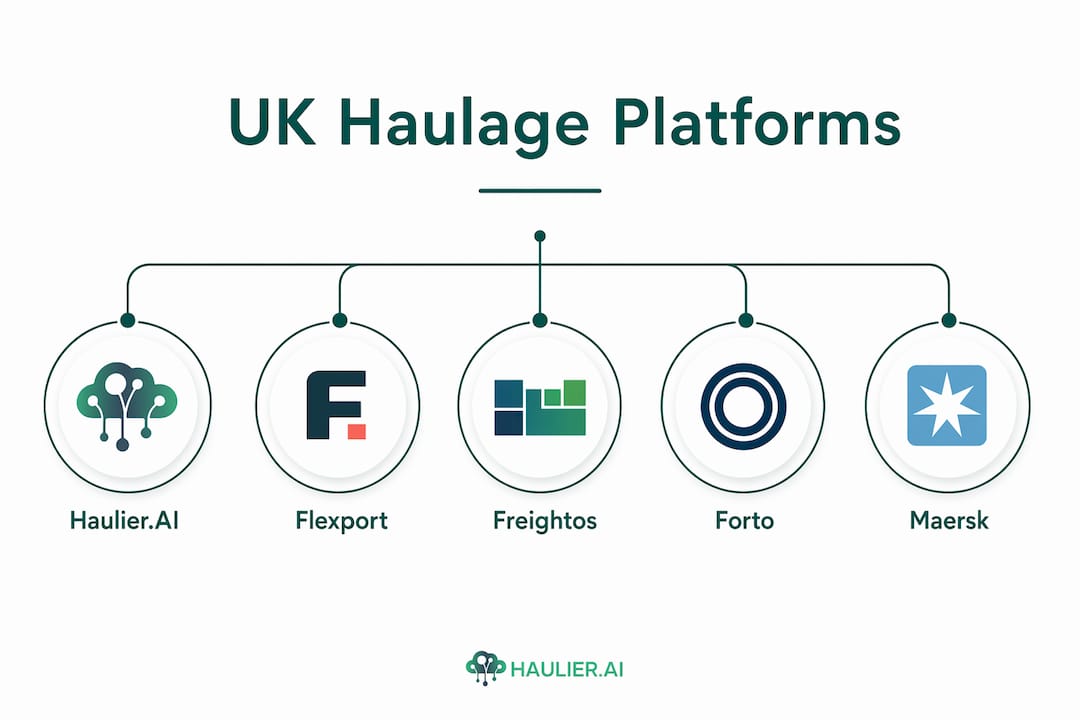
For UK container haulage, the strongest alternatives to Zencargo are Haulier.AI, Flexport, Freightos, Forto, and Maersk’s digital booking service. Of these, Haulier.AI is the recommended pick for freight forwarders and importers who need haulier-controlled quoting, a human-backed transport desk, and coverage across UK ports including Felixstowe, London Gateway, and Southampton.
Quick shortlist:
- Haulier.AI — best for UK-focused container haulage with haulier rate control and a human-backed desk
- Flexport — best for global multimodal visibility with strong analytics
- Freightos — best for instant rate comparison across carriers (self-serve marketplace)
- Forto — best for European trade lanes with digital-first managed forwarding
- Maersk — best for shippers who move high volumes directly with a single carrier
The decisive criteria for UK container haulage are port coverage (Felixstowe, London Gateway, Southampton, Teesport, Liverpool), demurrage mitigation, haulier acceptance workflows, and whether the platform has a human desk for edge cases. Platforms without local port presence risk higher quay dwell time and demurrage exposure.
Table of Contents
- Which Zencargo alternatives compare best for UK haulage?
- Short profiles: what each platform actually delivers
- How do you choose between these options for UK container haulage?
- How Haulier.AI differs from Zencargo and other alternatives in practice
- Final verdict and a 48–72 hour trial plan
- Key takeaways
- Why digital-first is no longer optional for UK container haulage
- Haulier.AI: built specifically for UK container haulage
- Useful sources and further reading
- FAQ
Which Zencargo alternatives compare best for UK haulage?
| Dimension | Haulier.AI | Flexport | Freightos | Forto | Maersk |
|---|---|---|---|---|---|
| Best for | UK container haulage, port-to-depot | Global multimodal, analytics | Instant rate shopping | EU/UK managed forwarding | High-volume direct shipper |
| Service model | Managed marketplace | Managed forwarder | Self-serve marketplace | Managed forwarder | Carrier + digital booking |
| Pricing model | Commission per move | Service fee + freight | Commission on booking | Service fee + freight | Spot + contract rates |
| UK port coverage | Felixstowe, London Gateway, Southampton, Teesport, Liverpool | Major UK ports via agents | Carrier-dependent | Major UK ports | Own terminals + agents |
| Haulier control | Hauliers set rates, accept/reject jobs | Carrier-managed | Carrier-managed | Carrier-managed | Carrier-managed |
| AI/automation | Predictive ETAs, paperwork tracking, job matching | Predictive ETAs, analytics | Rate comparison engine | ETA alerts, document automation | Vessel tracking, booking automation |
| Onboarding time | Fast (days) | Weeks | Same day | Days to weeks | Same day (basic) |
| Support/SLAs | Human-backed transport desk | Account manager | Online support | Dedicated account manager | Online + phone |
| Integrations/API | API available | Extensive API/EDI | API available | API/EDI | API available |
| Transparency | Real-time tracking, paperwork visibility | Full shipment visibility | Rate and booking visibility | Shipment tracking | Vessel and booking tracking |

The main trade-off is between speed and control. Freightos and Maersk’s self-serve tools get you a rate in minutes but hand paperwork and haulier coordination back to you. Flexport and Forto manage more of the process but are built around global forwarding rather than UK domestic haulage. Haulier.AI sits in a different lane: it focuses specifically on the port-to-depot leg, where haulier availability, gate delays, and surcharge risk are the real operational problems.
Short profiles: what each platform actually delivers
Haulier.AI
Haulier.AI connects freight forwarders and importers with UK hauliers through an AI-assisted, human-backed transport desk. Hauliers set their own rates and can reject unsuitable jobs, which keeps pricing honest and capacity genuine.
- Strengths: UK port and depot matching (Felixstowe, London Gateway, Southampton, Teesport, Liverpool); real-time paperwork tracking; human desk for gate changes and driver hours issues; fast onboarding
- Limitations: Focused on UK container haulage rather than end-to-end global forwarding
- Best for: Freight forwarders and importers who need reliable port-to-depot haulage with full visibility and a human fallback
Pro Tip: Book your haulage the moment vessel ETA is confirmed. Operators with local port presence at Felixstowe report measurably lower quay dwell time — and Haulier.AI’s matching logic prioritises hauliers already positioned near your port.
Flexport
Flexport is a managed freight forwarder with strong analytics and multimodal coverage. Its platform gives shippers detailed shipment visibility across ocean, air, and road.
- Strengths: Rich data dashboards; predictive ETAs; global carrier network
- Limitations: Expensive for smaller volumes; UK haulage is a secondary capability, not a core product
- Best for: Mid-to-large importers with complex global supply chains who need consolidated visibility
Freightos
Freightos is a self-serve rate marketplace. You get instant quotes from multiple carriers and book online without a sales call.
- Strengths: Speed; transparent rate comparison; no minimum volumes
- Limitations: No managed desk; paperwork and haulier coordination are your responsibility
- Best for: Experienced logistics managers who know exactly what they need and want to compare rates fast
Forto
Forto is a digital-first managed forwarder strong on European trade lanes, with growing UK coverage.
- Strengths: Clean digital interface; document automation; account management
- Limitations: Less depth on UK domestic haulage than on continental moves
- Best for: Importers with regular EU-UK freight who want a managed service with a digital interface
Maersk
Maersk’s digital booking tools let shippers book directly with the world’s largest container line, with vessel tracking built in.
- Strengths: Massive global network; own terminals at Felixstowe and elsewhere; competitive rates at volume
- Limitations: Carrier-centric; inland haulage is arranged separately; limited flexibility on smaller or ad-hoc moves
- Best for: High-volume shippers with established Maersk relationships who want to consolidate carrier and booking management
How do you choose between these options for UK container haulage?
The single most important question is whether the platform can actually move your container from the port gate to the depot or customer — not just track the vessel. Many logistics platforms like Zencargo excel at ocean visibility but leave the final haulage leg to chance.
Questions to ask every vendor:
- Which UK ports do you cover with local haulier capacity (not just agent relationships)?
- How do you handle surcharges at congested terminals, such as the £150 London Gateway surcharge that hauliers introduced for gate delays?
- What is your SLA for responding to paperwork exceptions or gate changes?
- Can hauliers accept or reject individual jobs, or are they allocated automatically?
- Do you support API or EDI integration with our TMS or ERP?
- What security and compliance certifications does the platform hold?
- How long does onboarding take before we can place a live job?
Red flags to watch:
- No named port coverage — “we cover all UK ports” without specifics usually means agent relationships with no local capacity
- Opaque pricing with surcharges disclosed only after booking
- No human support for edge cases; purely automated escalation
- Onboarding timelines measured in months rather than days
Pro Tip: In the first 48–72 hours of any trial, measure three things: ETA accuracy against actual gate release, the percentage of jobs accepted by hauliers on first offer, and admin time spent chasing paperwork. Relying on legacy email chains risks customs delays and higher admin costs — these three metrics will tell you whether the platform actually replaces that workflow.
How Haulier.AI differs from Zencargo and other alternatives in practice
Most platforms in this category are built around ocean freight visibility first, with haulage as an afterthought. Haulier.AI inverts that: the platform is built specifically for the UK port-to-depot leg, with AI matching hauliers to jobs based on location, availability, and equipment type.
Three operational differences stand out:
- Haulier-controlled rates: Hauliers set their own prices and can decline jobs that do not work for them. This produces genuine market pricing rather than algorithmically suppressed rates that erode haulier quality over time.
- Human-backed desk: When a gate time changes, a driver runs out of hours, or paperwork is missing, a human transport desk intervenes. Automated triggers alone are not enough for complex paperwork and terminal exceptions — practitioners need human escalation.
- Port-specific matching: Coverage at Felixstowe, London Gateway, Southampton, Teesport, and Liverpool means the platform can match hauliers already positioned near your port, reducing response time and quay dwell.
AI-driven route optimisation and matching can reduce empty running by 14–19% in operational deployments. Separately, logistics operators focusing AI on administrative workflows — timesheets, dispatch, invoicing — have reported savings of up to £900,000 per year. The RHA Future Forum has consistently highlighted that the biggest gains come from automating everyday admin, not exotic AI use-cases.
Pro Tip: Check Haulier.AI’s security and compliance page before your procurement sign-off. Human oversight and data security are increasingly scrutinised in logistics platform tenders.
Final verdict and a 48–72 hour trial plan
Haulier.AI is the sensible choice when your priority is reliable UK port-to-depot haulage with haulier rate control, a human desk, and fast onboarding. If you need global multimodal forwarding, Flexport or Forto are worth evaluating alongside it.
48–72 hour trial checklist:
- Register and create a test job for a real or representative container movement
- Confirm the haulier acceptance workflow: did a haulier accept on first offer, and how quickly?
- Check ETA accuracy against the actual gate release time
- Test a paperwork query: how fast does the human desk respond?
- Measure admin time spent on the move versus your current process
Three immediate next steps:
- Create a test job on Haulier.AI using a live or upcoming container movement
- Invite a haulier from your existing network to register, or let the platform match one
- Review the job results at 72 hours against the three trial metrics above
Key takeaways
Haulier.AI is the strongest Zencargo alternative for UK container haulage when port coverage, haulier control, and a human-backed desk are your top criteria.
| Point | Details |
|---|---|
| Haulier control matters | Platforms where hauliers set rates and accept/reject jobs produce more reliable capacity than algorithmically allocated ones. |
| Port coverage is specific | Ask for named ports and local depot presence — not just “all UK ports.” Felixstowe, London Gateway, and Southampton are the minimum for most importers. |
| Trial metrics to use | Measure ETA accuracy, haulier first-offer acceptance rate, and admin time saved within 48–72 hours. |
| Red flags to avoid | Opaque surcharge disclosure, no human desk for edge cases, and onboarding timelines over a few weeks are all warning signs. |
| Recommended pick | Haulier.AI covers UK ports, gives hauliers rate control, and pairs AI matching with a human transport desk for edge cases. |
Why digital-first is no longer optional for UK container haulage
Port volatility in 2026 has made just-in-time models genuinely fragile. The congestion at London Gateway that prompted a £150 collection surcharge is not an anomaly — it is a recurring pattern at major UK terminals. Inland buffer depots and predictive AI are now practical tools, not aspirational ones, for decoupling quayside unpredictability from last-mile timing. Platforms that surface issues before they escalate — predictive ETAs, paperwork alerts, automated driver-hours flags — are what separate resilient supply chains from reactive ones. The choice of platform is, in practice, a choice about how much demurrage risk you are willing to absorb.
Haulier.AI: built specifically for UK container haulage
Freight forwarders and importers who move containers through UK ports regularly face the same problem: ocean visibility tools stop at the port gate, leaving the haulage leg to phone calls and email chains. Haulier.AI closes that gap with an AI-assisted, human-backed transport desk that matches you to available UK hauliers, tracks paperwork in real time, and keeps a human in the loop when things go sideways at the terminal.
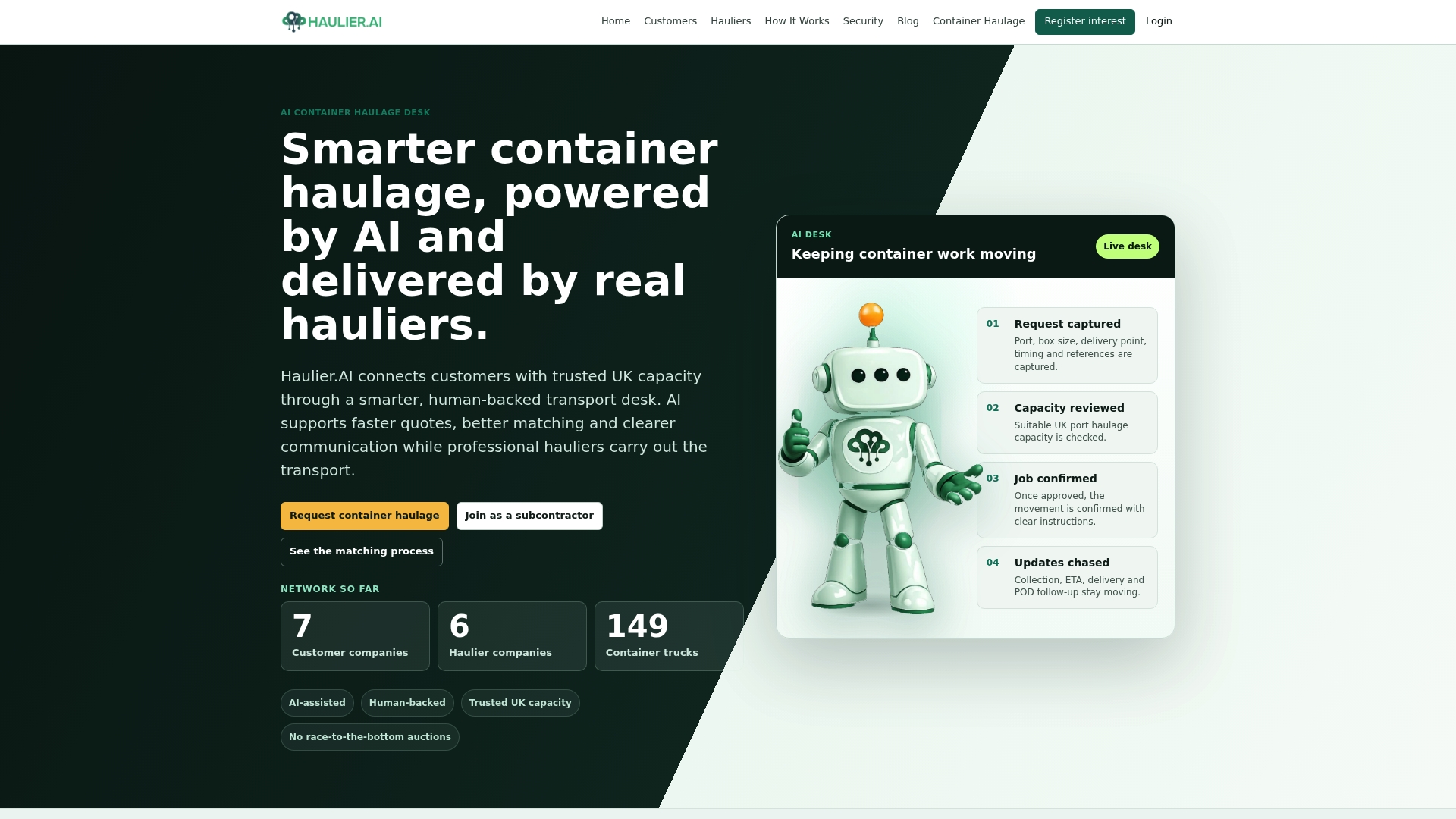
Coverage spans Felixstowe, London Gateway, Southampton, Teesport, and Liverpool. Hauliers control their own rates and can decline jobs, so the capacity you book is capacity that will actually show up. Onboarding takes days, not months.
Request your first container haulage quote or see how the platform works before you commit.
Useful sources and further reading
- UK port congestion 2026: demurrage and detention guidance (Insignia Shipping) — supports demurrage mitigation claims and the advance booking recommendation
- Hauliers add surcharge for collections from London Gateway (The Loadstar) — source for the £150 London Gateway surcharge figure
- AI now essential for hauliers to survive (Motor Transport) — source for 14–19% empty-mile reduction through match-loading
- How one logistics client saves £900k a year with AI (Motor Transport) — source for admin and operational savings from AI automation
- How to choose a freight forwarder: a strategic guide for 2026 (Freightamigo) — supports digital-first urgency and human-backed desk value
- Navigating the 2026 UK container haulage landscape (JHayward) — supports inland depot buffering and predictive AI resilience
- Why your business needs a Felixstowe container haulage partner (Prologic Services) — supports local port presence and quay dwell reduction claims
- Haulier.AI container haulage service — platform service page for port coverage and feature details
For port-specific surcharge notices and demurrage tariffs, consult the operator pages for Felixstowe (Hutchison Ports), London Gateway (DP World), and Southampton (ABP) directly, as rates change with terminal congestion levels.
FAQ
What are the best Zencargo alternatives for UK container haulage?
Haulier.AI, Flexport, Freightos, Forto, and Maersk are the strongest options. Haulier.AI is the recommended pick for port-to-depot haulage with haulier rate control and a human-backed desk.
How does Haulier.AI differ from Zencargo?
Haulier.AI focuses specifically on UK container haulage, giving hauliers control over their rates and pairing AI job matching with a human transport desk for paperwork and gate exceptions.
What should I measure in a platform trial?
Track ETA accuracy against actual gate release, the percentage of jobs accepted by hauliers on first offer, and admin time saved per move over 48–72 hours.
How do I reduce demurrage risk when switching platforms?
Book haulage as soon as vessel ETA is confirmed, file customs declarations before vessel arrival, and use a platform with named local port coverage rather than agent-only relationships.
Is Flexport a direct Zencargo competitor?
Flexport and Zencargo both offer managed digital forwarding, but Flexport’s strength is global multimodal analytics rather than UK domestic haulage. For the port-to-depot leg specifically, Haulier.AI is more focused.