
Container haulage article
Best Transporeon alternatives for UK container haulage
Discover top Transporeon alternatives for UK container haulage. Explore AI-assisted quoting, real-time updates, and multimodal visibility.


For UK container haulage, the strongest Transporeon alternatives fall into four categories: marketplace-led container haulage desks, multimodal visibility platforms, TMS with container workflows, and enterprise visibility networks. Of these, Haulier is the recommended first port of call for freight forwarders and importers moving containers through UK ports, combining AI-assisted quoting with a human-backed transport desk, real-time communication updates, and port-specific coverage at Felixstowe, Teesport, and Tilbury.
Three reasons to prioritise this category over the others: container release visibility is built in rather than bolted on; POD capture and invoicing happen in the same workflow rather than across separate systems; and Customs Declaration Service (CDS) compatibility is a practical requirement, not an afterthought, for any platform operating in the post-Brexit UK freight environment. The Road Haulage Association (RHA) has consistently flagged disconnected systems as the primary productivity drag on UK hauliers.
Shortlist at a glance:
- Marketplace-led container haulage (Haulier as the UK-first exemplar)
- Multimodal visibility platforms (FourKites, project44, Shippeo)
- TMS with container workflows (CargoWise / WiseTech, Forto)
- Enterprise visibility networks (project44, FourKites at scale)
Table of Contents
- Which Transporeon alternatives work best for UK container needs?
- Profiles of each shortlisted alternative
- How do you choose and validate the right platform?
- What does implementation actually cost and how long does it take?
- What proof should you ask for before signing?
- Which platform should you choose for UK container haulage?
- How good is UK customer support across these platforms?
- How well do these platforms scale for different business sizes?
- Which integrations matter most for UK freight and container software?
- What do UK-based users report about these platforms?
- What contract terms should you expect and watch for?
- Key takeaways
- The case for port-aware platforms over generic TMS
- Ready to pilot a UK-first alternative to Transporeon?
- Useful sources
- FAQ
Which Transporeon alternatives work best for UK container needs?
| Category | Best for | Real-time visibility | POD & invoicing | Multimodal | Integrations & APIs | CDS/customs | Haulier controls | Pricing shape | UK port coverage | Onboarding |
|---|---|---|---|---|---|---|---|---|---|---|
| Marketplace container haulage | Forwarders, importers, SME operators | Container release & ETA per job | Integrated POD-to-invoice | Road-focused, port-aware | Accounting, TMS, EDI | CDS-aware workflows | Rate control, job rejection | Transaction/commission | Felixstowe, Teesport, Tilbury | Days to weeks |
| Multimodal visibility platform | Mid-market to enterprise shippers | Carrier-agnostic, event-based | Visibility only; ERP needed for invoicing | Road, rail, sea, air | Deep API, EDI, ERP | Varies by vendor | No haulier-side controls | SaaS subscription | Major ports via carrier feeds | Weeks to months |
| TMS with container workflows | Operators running multi-leg moves | Planning-led; real-time varies | TMS-native invoicing | Road, multi-leg container | Strong ERP/WMS APIs | CargoWise has customs module | Limited marketplace controls | Licence + implementation | Port integrations via modules | Months |
| Enterprise visibility network | Large 3PLs, global shippers | Network-wide, predictive ETAs | Reporting only | All modes | Enterprise APIs | Indirect; requires customs TMS | None | Enterprise contract | Global; UK coverage via network | Months |
Reading the table: “Haulier controls” refers to whether hauliers on the platform can set their own rates and decline unsuitable jobs. For UK container haulage, this matters because fair pricing and capacity availability are directly linked. “CDS/customs” indicates whether the platform has native or documented support for the UK’s Customs Declaration Service rather than relying on a separate customs broker system.
- Small to mid-size forwarders and importers: marketplace-led haulage
- Mid-market operators needing carrier-agnostic tracking: multimodal visibility
- Operators managing complex multi-leg container moves in-house: TMS with container workflows
- Global 3PLs with enterprise IT budgets: enterprise visibility networks
Profiles of each shortlisted alternative
Marketplace-led container haulage: Haulier
Haulier’s container haulage desk connects freight forwarders and importers to vetted UK hauliers through a managed quoting process backed by both AI and human operators. Hauliers set their own rates and can decline jobs that do not fit their capacity, which keeps pricing competitive and avoids the race-to-the-bottom dynamic common on open tender boards. Port coverage spans Felixstowe, Teesport, Tilbury, and other major UK terminals. Container release status and ETA updates flow through the platform rather than arriving by email, cutting the manual chasing that container operators cite as their biggest daily friction.

Multimodal visibility platforms: FourKites, project44, Shippeo
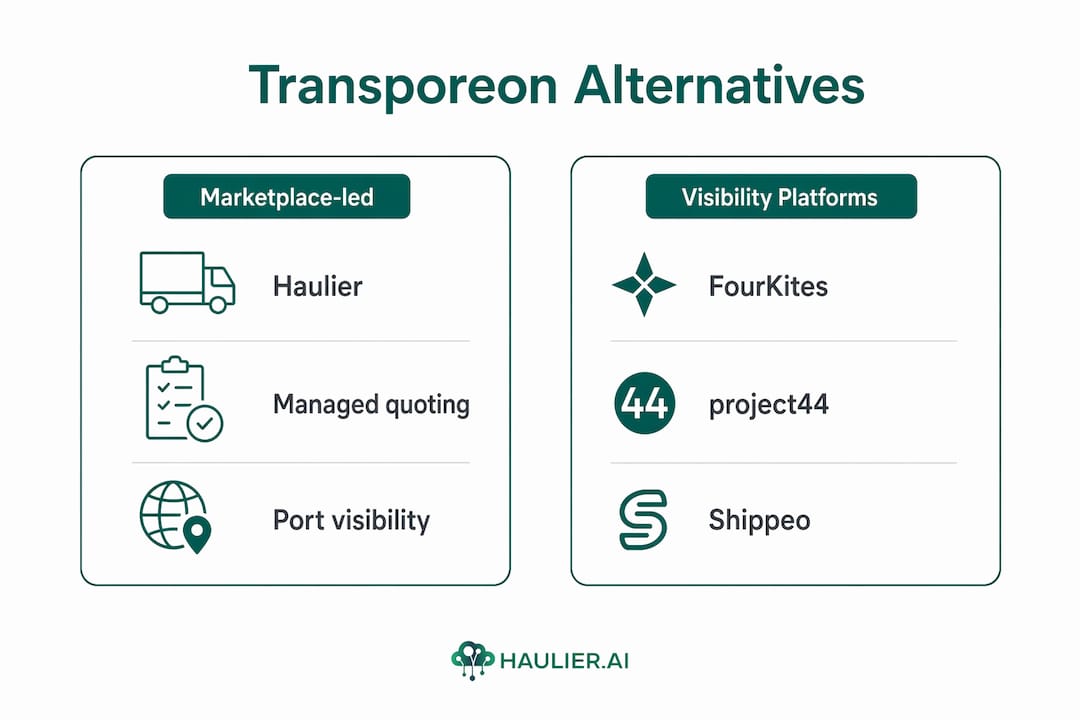
These platforms track shipments across road, rail, sea, and air using carrier API feeds and telematics. They excel at carrier-agnostic ETAs and exception alerting across large shipment volumes. The trade-off: they are visibility layers, not execution platforms. POD capture and invoicing still require a connected TMS or ERP. Integration effort is significant, and UK port-level granularity depends on whether the carrier or terminal feeds data into the network.
TMS with container workflows: CargoWise, Forto
CargoWise (WiseTech) is the most complete option for operators who need customs, warehousing, and transport management in a single system. Its customs module covers CDS declarations natively, which is a genuine differentiator. Forto sits closer to the digital freight forwarding model, with strong sea freight visibility and booking tools. Both require meaningful implementation time and, for smaller operators, the licence and consultancy costs can outweigh the operational gains.
Enterprise visibility networks
Platforms like project44 and FourKites at enterprise tier offer predictive ETAs, network-wide benchmarking, and deep ERP integrations. For a UK freight forwarder moving a few hundred containers a month, the cost-to-value ratio rarely stacks up. These are built for global 3PLs with dedicated IT teams and multi-year transformation budgets.
When to pick each category:
- Pick marketplace-led haulage if you book container moves through UK ports and want managed quoting without building a carrier network yourself.
- Pick a multimodal visibility platform if you already have a TMS and need carrier-agnostic tracking across modes.
- Pick a TMS with container workflows if you run multi-leg moves in-house and need planning, customs, and invoicing in one system.
- Pick an enterprise visibility network only if you have the IT budget and integration resource to match.
Pro Tip: Before any demo, ask the vendor to show a live container release update from Felixstowe or Teesport. If they cannot, their “UK port coverage” is a marketing claim, not an operational one.
How do you choose and validate the right platform?
The most reliable validation method is running a pilot against your own historical jobs, not a vendor-curated demo dataset. TMS selection guidance consistently points to this: your edge cases, your port flows, your CDS test cases.
Evaluation checklist (prioritised):
- Real-time container release and ETA visibility at your specific ports
- POD capture integrated with invoicing (not a separate upload step)
- CDS support: native module or documented API to your customs broker
- Accounting and TMS integrations (EDI, REST API, sandbox access)
- Role-based dashboards that reduce clicks for ops, finance, and compliance teams
- Haulier-side controls: can carriers set rates and decline jobs?
- UK customer references and a named support contact
Pilot testing steps:
- Export 30–60 historical container jobs including port, haulier, and invoice data.
- Run them through the platform’s demo environment and measure re-keying events.
- Test a CDS declaration scenario with your customs broker’s test credentials.
- Track time from POD capture to invoice ready.
- Log missed update events versus your current baseline.
Questions to ask vendors during demos: Does your CDS integration cover both import and export declarations? Which UK port terminals feed live slot data into your system? What is your SLA for UK business-hours support? Can you provide API documentation and sandbox access before contract signature?
What does implementation actually cost and how long does it take?
| Phase | Typical duration | Key activities |
|---|---|---|
| Pilot (historical data) | 1–2 weeks | Data export, environment setup, KPI baseline |
| Onboarding | 2–6 weeks | Port integrations, haulier/carrier onboarding, CDS config |
| Full roll-out | 1–3 months | Training, workflow sign-off, live monitoring |
Cost components to budget for:
- Licence or transaction fees (subscription SaaS or per-job commission)
- Integration and consultancy (API connections to your TMS, ERP, or customs system)
- Data migration (historical jobs, haulier rate cards, port slot configurations)
- Custom workflow development (bespoke POD forms, multi-leg trip templates)
- Training and change management (ops team, finance, compliance)
Common integration pitfalls:
- CDS misconfiguration: customs fields mapped incorrectly at go-live, causing declaration failures
- Siloed telematics: vehicle tracking data not connected to the visibility layer, creating blind spots
- Manual document flows surviving digitisation: PDF PODs still emailed outside the platform
Pro Tip: Map your current document flow before any vendor conversation. If you cannot draw it on one page, the integration will cost more than the vendor quotes.
Research with RHA members found that 91% of hauliers operate below seamless integration, which means most UK operators are starting from a fragmented baseline. Budget for integration time accordingly.
What proof should you ask for before signing?
Trust signals to request:
- ISO 27001 or equivalent security attestation (data residency in UK/EEA)
- API documentation and sandbox access before contract signature
- Documented CDS compliance evidence or a live customs broker reference
- Named UK port or terminal integrations with evidence of live data feeds
- UK customer references willing to take a 15-minute call
- Uptime SLA and UK business-hours support commitment in writing
Sample pilot KPIs:
- Time from POD capture to invoice ready (target: same day)
- Re-keying events per job (target: zero for standard moves)
- Percentage of container release updates received before driver arrival
- Days from job completion to first invoice issued
A survey of UK haulage operators found that 59% prioritise smart document processing as their top AI use case, which makes POD automation a concrete pilot success criterion rather than a nice-to-have.
To validate reference claims, ask the vendor to run a short anonymised historical dataset through their environment while you watch. Any platform confident in its capabilities will agree.
Which platform should you choose for UK container haulage?
For UK container haulage, Haulier is the tier-one recommendation for freight forwarders, importers, and logistics managers who book container moves through UK ports and want managed quoting, real-time updates, and POD-to-invoice workflows without building their own carrier network.
Decision rules:
- Choose a marketplace-led approach (Haulier) if you need port-aware quoting, haulier rate control, and CDS-compatible workflows without a six-month implementation.
- Prioritise an enterprise visibility platform if you manage multi-carrier, multi-mode shipments at scale and already have a TMS handling execution.
- Insist on a TMS with container workflows (CargoWise) if you run customs declarations in-house and need a single system for planning, customs, and invoicing.
One caveat: always validate with a short pilot using your own historical data before signing any contract, regardless of category.
How good is UK customer support across these platforms?
Support quality varies sharply by platform size and business model. Marketplace platforms like Haulier combine AI-assisted workflows with a human transport desk, meaning a UK-based operator handles escalations rather than a global support queue. Enterprise platforms typically offer tiered SLAs with named account managers at higher contract values, but response times for smaller accounts can stretch to 24–48 hours.
For UK container operations, the practical test is simple: call the support line at 7:30 AM on a Monday when a container is held at Felixstowe. If you reach a person who understands port slot constraints, the support model works. If you reach a chatbot that escalates to a ticket, it does not.
How well do these platforms scale for different business sizes?
Marketplace platforms scale by transaction volume with no upfront infrastructure cost, making them accessible for operators booking ten containers a month or a thousand. Enterprise visibility networks require IT resource and integration budget that only makes sense above a certain shipment threshold.
Mid-market operators often find the best fit in a TMS with container workflows or a marketplace platform, depending on whether they run customs in-house. The UK logistics software market is significant and expected to grow substantially over the coming years, reflecting strong demand for scalable, integrated solutions across all operator sizes.
Customisation depth also differs: marketplace platforms offer configuration (port preferences, haulier whitelists, notification rules) rather than code-level customisation; TMS platforms offer deeper workflow engineering at proportionally higher cost.
Which integrations matter most for UK freight and container software?
The integrations that generate the most operational value in UK container haulage are: accounting systems (Sage, Xero, QuickBooks) for invoice reconciliation; customs platforms for CDS declarations; port community systems for slot booking and release notifications; and telematics feeds for live vehicle position.
UK freight software buyers consistently rank multimodal coverage, accounting integrations, CDS support, and role-based dashboards as their top four requirements. EDI connectivity remains important for larger shipper relationships. REST API access with sandbox documentation is the baseline expectation for any platform evaluated in 2026.
What do UK-based users report about these platforms?
No fabricated testimonials are included here. What the published research does show: RHA-affiliated operators consistently report that disconnected systems stifle productivity, with 76% prioritising compliance and cashflow protection over other technology risks. The platforms that earn strong references in the UK container sector are those that reduce daily admin friction rather than add new complexity.
When requesting references from vendors, ask specifically for UK container haulage customers at ports you use. RHA-affiliated operators consistently report that disconnected systems stifle productivity, with 76% prioritising compliance and cashflow protection over other technology risks. The platforms that earn strong references in the UK container sector are those that reduce daily admin friction rather than add new complexity.
What contract terms should you expect and watch for?
Most enterprise visibility platforms and TMS vendors require annual or multi-year contracts with termination penalties that can equal three to six months of remaining licence fees. Marketplace platforms typically operate on shorter commitments or per-transaction models with no minimum volume lock-in.
Key clauses to scrutinise: data portability on exit (can you export your historical jobs and haulier rate cards?); SLA remedies (what happens if uptime falls below the committed threshold?); price escalation terms (is the annual increase capped?); and CDS compliance liability (who is responsible if a declaration fails due to a platform misconfiguration?).
A short pilot before contract signature is the single most effective way to surface integration problems before they become contractual disputes.
Key takeaways
For UK container haulage, marketplace-led platforms offer the fastest path to reduced admin and port-aware visibility, with Haulier as the recommended starting point for most freight forwarders and importers.
| Point | Details |
|---|---|
| Top pick for UK container haulage | Haulier combines managed quoting, real-time port updates, and POD-to-invoice workflows for UK operators. |
| Validate with historical data | Run 30–60 of your own historical jobs through any platform before signing a contract. |
| CDS support is non-negotiable | Ask every vendor for documented CDS compliance evidence and a live customs broker reference. |
| 91% integration gap | RHA research shows 91% of UK hauliers operate below seamless integration; budget for integration time. |
| Enterprise platforms suit large 3PLs | FourKites, project44, and Shippeo deliver most value at scale with existing TMS and IT resource. |
The case for port-aware platforms over generic TMS
The conventional wisdom in logistics technology procurement is to buy the biggest, most feature-complete platform you can afford and configure it to your needs. In UK container haulage, that logic consistently fails smaller and mid-market operators.
The problem is not feature depth. It is that general-purpose TMS platforms treat container moves as single-leg A-to-B jobs. A container move is not that. It is an empty pickup, a full drop, a return, a port slot, a customs declaration, and a release notification, all with different parties involved at each stage. When a platform does not model that reality natively, the gaps get filled with emails, spreadsheets, and phone calls, which is exactly the friction operators are trying to escape.
What the RHA research makes clear is that UK hauliers do not want futuristic complexity. They want technology that removes the daily friction of chasing container releases, re-keying POD data, and reconciling invoices. A platform built specifically for UK port workflows, with hauliers who control their own rates and a human desk that handles exceptions, solves a real problem. A platform built for global multimodal visibility at enterprise scale solves a different one.
The right question is not “which platform has the most features?” It is “which platform removes the most friction from the jobs I actually run?”
Ready to pilot a UK-first alternative to Transporeon?
Freight forwarders and importers who move containers through UK ports spend too much time chasing updates that should arrive automatically. Haulier offers a practical alternative: an AI-assisted, human-backed transport desk that handles quoting, haulier matching, real-time container release updates, and POD-to-invoice tracking in a single workflow.
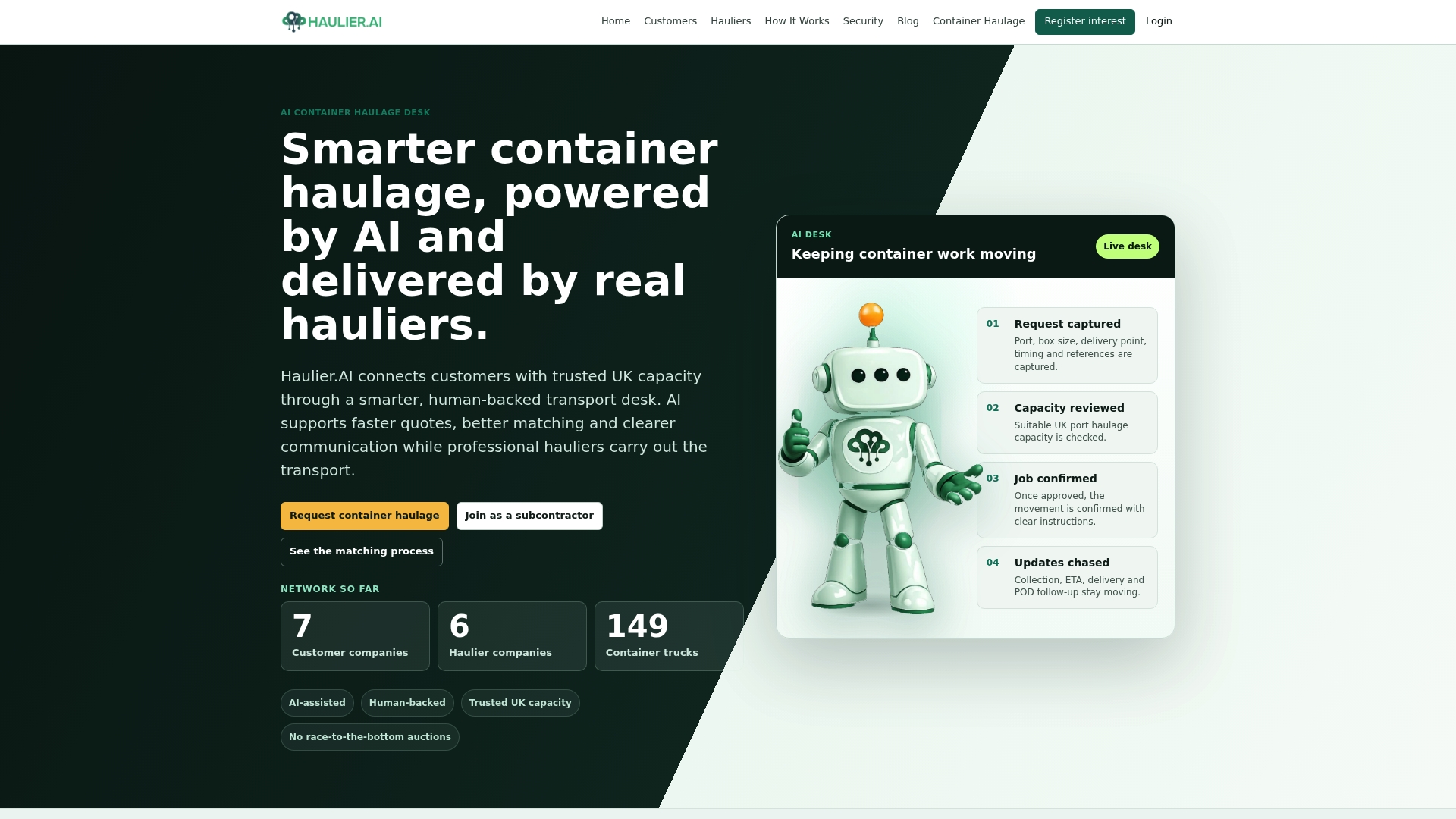
A pilot with Haulier includes historical-data validation against your own jobs, port setup for your specific terminals (Felixstowe, Teesport, Tilbury, and others), and a CDS compatibility check before you commit to anything. No six-month implementation, no enterprise IT budget required.
Request a pilot or explore how the platform works to see port coverage and operational details before your first conversation.
Useful sources
The sources below back the claims in this article and are worth consulting when validating vendor CDS support, port integrations, and industry benchmarks during your own evaluation.
| Source | What it covers | Why it matters for your pilot |
|---|---|---|
| RHA / Transport Operator: disconnected systems research | 91% of UK hauliers below seamless integration; 76% prioritise compliance and cashflow | Sets the baseline for integration expectations and vendor questions |
| FleetPoint: integration ceiling | Industry analysis of the integration ceiling problem in UK haulage | Use to frame integration budget conversations with vendors |
| Qargo: container operator challenges | Container release visibility, manual data entry, and POD chasing as primary bottlenecks | Confirms the pilot KPIs worth measuring |
| Logisticore: freight software buyers guide 2026 | UK buyer priorities: multimodal, CDS, accounting integrations, role-based dashboards | Use as a checklist framework when scoring vendor demos |
| Assured Velocity: TMS selection guide | Guidance on validating platforms with your own historical data | Supports the pilot-with-historical-data methodology |
| Transport Engineer: haulage technology survey | 59% of operators prioritise smart document processing; 54% predictive maintenance | Confirms POD automation as a measurable pilot success criterion |
| Straits Research: UK logistics software market | Market valued at USD 1,270.73 million in 2024; projected USD 3,369.41 million by 2033 | Market context for vendor stability and investment decisions |
Ask vendors to demonstrate their platform against the specific scenarios these sources describe: container release visibility, CDS declaration flows, and POD-to-invoice automation. Any vendor who cannot map their features to these real-world problems is not ready for UK container operations.
FAQ
What is the best Transporeon alternative for UK container haulage?
For most freight forwarders and importers, Haulier is the strongest starting point: it offers managed quoting, real-time container release updates, and POD-to-invoice workflows built specifically for UK ports including Felixstowe, Teesport, and Tilbury.
Do these platforms support the UK Customs Declaration Service?
CDS support varies significantly. CargoWise has a native customs module covering CDS declarations; marketplace platforms like Haulier are designed to work alongside your customs broker with CDS-compatible workflows. Always ask vendors for documented evidence and a live broker reference before signing.
How long does it take to switch from Transporeon to an alternative?
A marketplace-led platform like Haulier can be operational within days to a few weeks. A TMS with container workflows typically requires one to three months for full roll-out, depending on integration complexity and the number of ports and hauliers involved.
How do I validate a platform before committing?
Export 30–60 historical container jobs and run them through the vendor’s demo environment. Measure re-keying events, time from POD to invoice, and whether container release updates arrive before the driver does. This approach, rather than a vendor-curated demo, surfaces real integration gaps.
What contract terms should I watch for?
Watch for termination penalties equivalent to three to six months of remaining fees, data portability restrictions on exit, uncapped annual price escalation, and unclear CDS compliance liability. Marketplace platforms on transaction or short-term models carry lower lock-in risk than multi-year enterprise licences.