
Container haulage article
Managed transport service for UK container haulage
Experience seamless logistics with our managed transport service. Save time, gain visibility, and focus on your clients. Request a quote today!
If you are a freight forwarder or importer booking container movements and you are spending more time chasing hauliers than managing your clients, a managed transport service is the right next step. Request a quote with Haulier and run a 30-day pilot to see the difference in visibility and admin time.
Table of Contents
- What does a managed transport service actually include?
- Why UK freight forwarders and importers benefit from managed transport
- How a managed service handles a container movement end to end
- When should you switch to a managed service versus booking in-house?
- What does managed transport cost, and how long does booking take?
- How to choose and trial a managed transport provider
- Practical steps to cut demurrage and detention costs right now
- Key takeaways
- The gap between “managed” and actually managed
- Haulier: a managed desk built for UK container haulage
- FAQ
What does a managed transport service actually include?
A managed transport service is a single, accountable arrangement where a provider takes end-to-end responsibility for your freight programme, from quoting through to invoice verification, rather than simply connecting you with a driver and stepping back. The distinction matters: a broker finds you a rate; a managed logistics service owns the outcome.
Expect these components as standard:
- Quoting: structured rate requests sent to a vetted carrier pool, with responses consolidated for your review
- Haulier matching: capacity sourced against your lane, container type, and port requirements
- Booking and tendering: confirmed job instructions issued to the selected haulier
- Tracking and visibility: real-time status updates from collection through to container return
- Paperwork handling: PODs, interchange receipts, and customs documents tracked and chased on your behalf
- Invoice audit: freight bills checked against agreed rates before payment is approved
The difference from ad-hoc spot booking is accountability. With spot booking, each movement is a fresh negotiation with no single party responsible for the whole picture. A managed provider holds that picture together.
Why UK freight forwarders and importers benefit from managed transport

The 2026 UK haulage market is under genuine pressure. Driver shortages and rising operating costs are compressing spare capacity, particularly for regional operators. That means a freight forwarder relying on a handful of informal haulier relationships will feel the squeeze first when volumes spike or a vessel arrives early.
A managed service addresses this directly. The provider spreads utilisation across multiple customers, so volume fluctuations that would force you to increase internal resources temporarily or scramble on the spot market are managed more efficiently by the provider’s wider network.
Proactive scheduling around vessel ETAs, rather than waiting for container availability notices, is the single most effective way to reduce demurrage exposure at congested UK ports in 2026.
Visibility is the other major gain. Missed updates, late paperwork, and surprise detention charges are symptoms of fragmented communication, not bad luck. A managed desk consolidates that communication into one channel, with invoice auditing that catches billing errors before they become disputes.
Pro Tip: Ask a prospective provider how they handle a vessel that arrives 48 hours early. A genuine managed service will have a pre-agreed escalation path; a glorified broker will ask you to call back.
How a managed service handles a container movement end to end
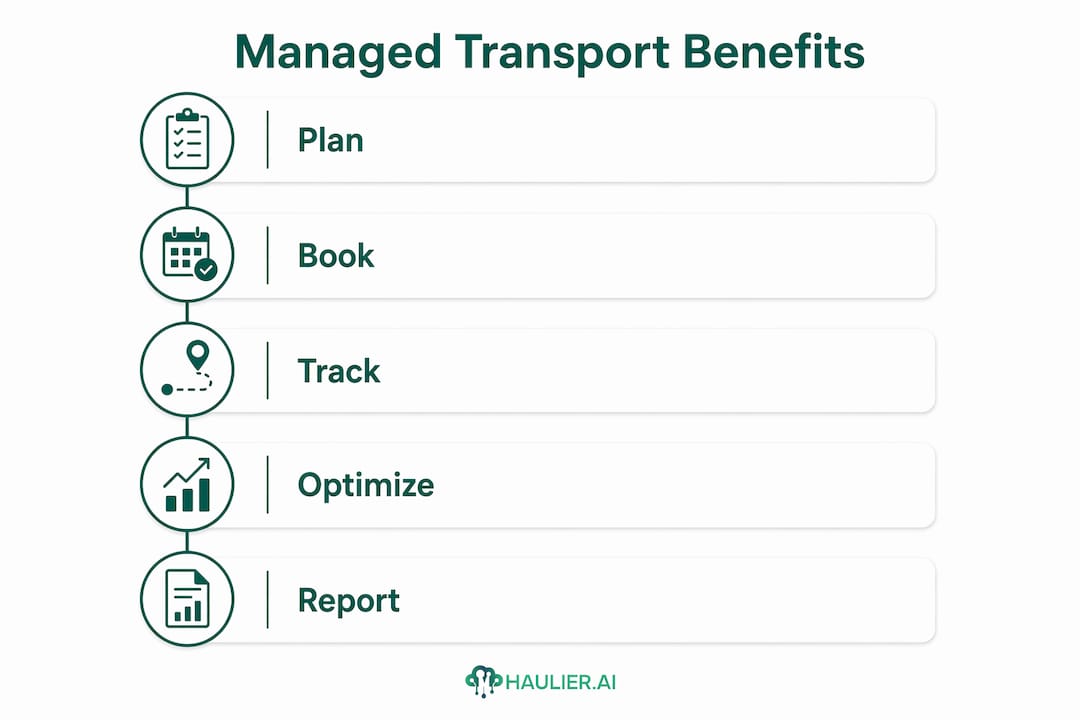
A managed transport service takes a container movement from your initial request through to confirmed return of the empty, with every exception handled by the desk rather than escalated back to you.
- Request and quoting: you submit shipment details (port, container type, delivery address, required date). The desk generates quotes from matched hauliers within an agreed turnaround window.
- Haulier matching: the provider’s system, whether AI-assisted or manual, surfaces hauliers with the right equipment, port access, and availability. On a platform like Haulier, hauliers set their own rates and can decline unsuitable jobs, which keeps the carrier pool engaged and pricing honest.
- Booking and confirmation: the selected haulier receives a confirmed job instruction. You receive booking confirmation with reference numbers and expected collection window.
- Execution and monitoring: the desk tracks the movement in real time. Status updates are pushed to you without you needing to chase. If a vessel is delayed, the desk adjusts the collection booking proactively.
- Exception handling: port delays, driver no-shows, or documentation queries are resolved by the human desk, not forwarded to you as a problem to solve.
- Invoicing and audit: the freight bill is checked against the agreed rate and any accessorial charges before it reaches your accounts team.
You retain strategic control throughout: your routing rules, service-level priorities, and approved carrier list are set at the start and respected at every step. The AI-assisted matching speeds up steps one and two; the human desk owns steps four and five.
When should you switch to a managed service versus booking in-house?
The clearest signal is this: if you are managing five or more haulier relationships without a consolidated view of performance, cost, or status, the fragmentation is already costing you more than a managed service would.
Use a managed service when:
- Volume fluctuates month to month and internal staffing cannot scale with it
- You are covering multiple ports or lanes and no single haulier covers all of them
- Demurrage and detention charges are appearing regularly on your invoices
- Admin time spent chasing updates, PODs, or invoices is measurable and growing
Keep in-house when you have a stable, predictable volume on a single lane, a long-standing haulier relationship with proven performance, and the internal resource to manage it properly. That combination is rarer than it sounds. Fragmented broker relationships across five or more providers are a reliable indicator that the in-house model has already broken down.
What does managed transport cost, and how long does booking take?
Pricing for a managed transport service typically takes one of two shapes: a transaction or commission fee per completed movement, or a margin built into the haulage rate with pass-through of carrier costs. Flexible pricing models that move with your activity are preferable to fixed annual contracts, particularly if your volumes are seasonal.
Primary cost drivers for UK container haulage:
- Distance and zone: port-to-door mileage and any congestion zone or ULEZ charges
- Container type: 20ft, 40ft, high-cube, or reefer each carry different rate profiles
- Port access charges: terminal handling, gate fees, and pre-gate booking requirements
- Waiting and detention risk: time at port beyond free time is charged by the terminal; the haulier may also charge waiting time
- Accessorials: tail-lift, timed delivery, overweight surcharges
On lead times: in a congested 2026 UK port environment, booking haulage on vessel ETA rather than waiting for container availability is the standard practice that reduces demurrage exposure. Aim to have haulage confirmed at least 48–72 hours before expected availability. Invoice audit typically identifies billing variances on accessorial charges and waiting time, where errors are most common.
How to choose and trial a managed transport provider
Run a 30–90 day pilot against this checklist before committing to a full programme.
| Evaluation criterion | What to look for | How Haulier addresses it |
|---|---|---|
| Port coverage | Confirmed access to your primary UK ports | Matched hauliers with port-specific access and equipment |
| Real-time visibility | Live status updates without manual chasing | Platform pushes updates at each movement milestone |
| Haulier control | Carriers set own rates; can decline unsuitable jobs | Two-sided marketplace: hauliers control rates and job acceptance |
| Paperwork handling | PODs, interchanges, and customs docs tracked by the desk | Paperwork tracking built into the platform workflow |
| Exception SLA | Defined response time for delays, no-shows, port issues | Human desk handles exceptions; escalation path agreed upfront |
| Pricing transparency | Rate breakdown visible before booking confirmation | Quotes itemised before acceptance |
| Invoice audit | Bills checked against agreed rates before payment | Audit step included in the invoicing workflow |
Trust signals to request during procurement: ask for case studies from freight forwarders on similar lanes, platform uptime figures, and a description of the carrier vetting process. A provider that cannot answer those questions clearly is not yet operating as a genuine managed service. The 2026 recommendations for UK transport management companies are a useful reference point for benchmarking providers.
Practical steps to cut demurrage and detention costs right now
Proactive scheduling is the primary lever. Filing customs declarations before vessel arrival and booking haulage on ETA rather than availability notice materially improves the chance of collection within free time.
Four actions your managed desk should be executing on every movement:
- Pre-advise early: submit container pre-advise and customs entries before vessel arrival, not after
- Book on ETA: confirm haulage the moment the vessel ETA is reliable, not when the container is released
- Use inland depots: moving containers to off-dock storage immediately on discharge reduces quayside congestion risk and terminal storage charges
- Automate free-time alerts: set notifications for free-time expiry so the desk can act before charges accrue
KPIs to track during a pilot: pickup lead time from container availability, on-time collection rate, demurrage days per TEU, and invoice variance rate. These four metrics will tell you within 30 days whether the managed service is performing.
Key takeaways
A managed transport service reduces port-related cost and admin overhead by placing a single accountable desk between you and the complexity of UK container haulage.
| Point | Details |
|---|---|
| Core decision signal | Managing five or more haulier relationships without consolidated visibility is the clearest trigger to switch. |
| Proactive scheduling | Book haulage on vessel ETA, not container availability, to stay within free time at congested UK ports. |
| Pilot metrics | Track pickup lead time, on-time collection rate, demurrage days per TEU, and invoice variance rate. |
| Cost model | Prefer transaction-based or activity-linked pricing over fixed annual contracts for seasonal volumes. |
| Haulier as next step | Haulier’s AI-assisted, human-backed desk covers quoting, matching, tracking, and paperwork for UK container haulage. |
The gap between “managed” and actually managed
There is a version of managed transport that is little more than a broker with a dashboard bolted on. You still chase updates. You still receive surprise invoices. The desk is there for the easy movements and absent for the hard ones.
The 2026 UK market makes that distinction consequential. Port congestion, driver shortages, and tighter free-time windows mean that exception handling is not the edge case; it is the normal operating condition. A managed service that cannot handle exceptions proactively is not managing anything.
What actually separates a genuine managed transport operation from a rebranded broker is the human desk’s willingness to own the problem at 6 AM on a Tuesday when a vessel has berthed early and the haulier has not confirmed. Container allocation planning and AI-assisted matching are genuinely useful tools, but they are inputs to a decision that still requires a person to make the call and communicate it clearly. The platforms that combine both, and are honest about where each one applies, are the ones worth trialling.
Haulier: a managed desk built for UK container haulage
Freight forwarders and importers who need predictable capacity, real-time updates, and fewer invoice surprises have a direct alternative to managing a fragmented haulier list themselves.
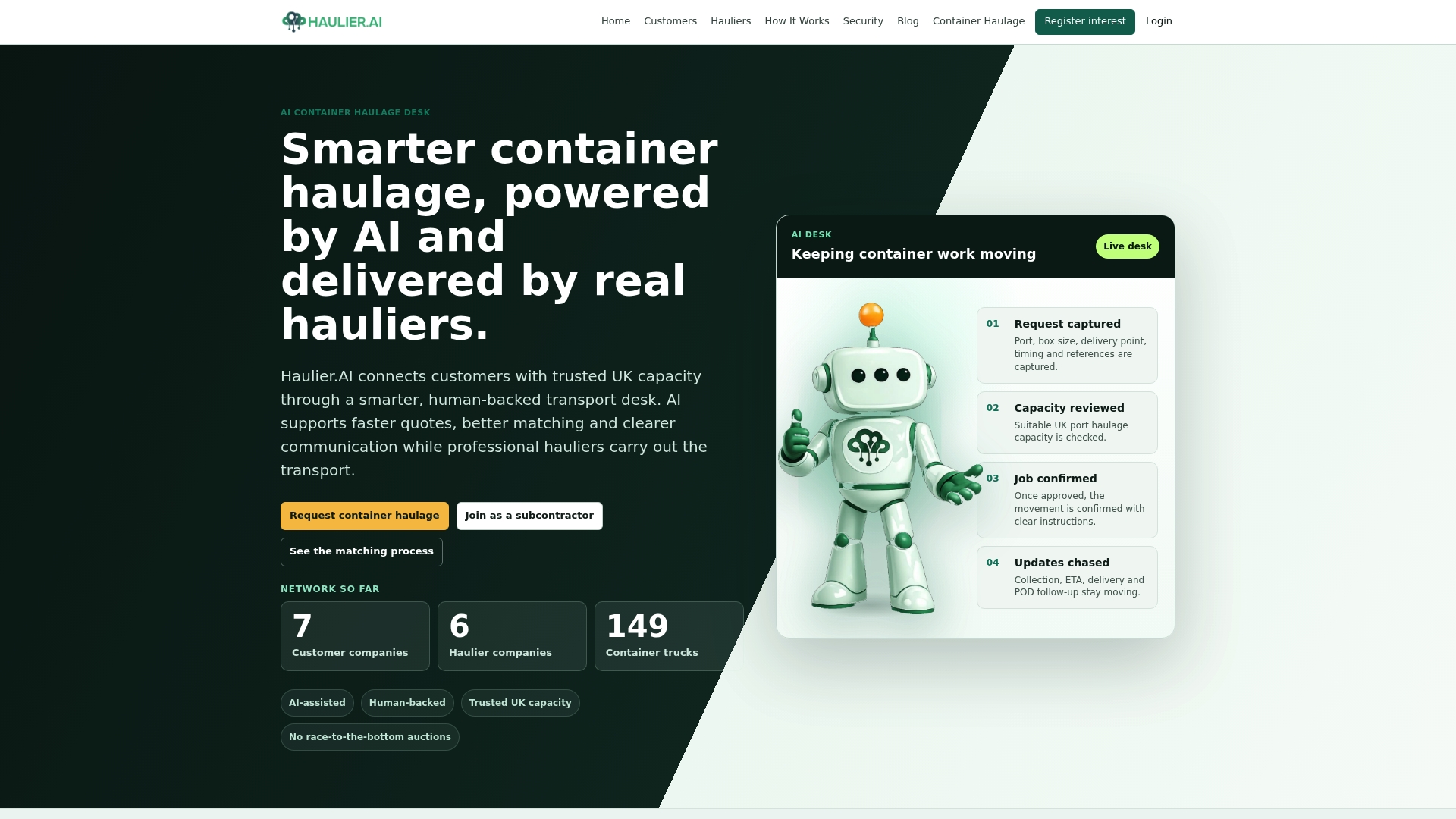
Haulier connects you to a vetted network of UK hauliers through an AI-assisted matching engine backed by a human transport desk. Hauliers set their own rates and accept jobs on their terms, which keeps the carrier pool competitive and reliable. The desk handles quoting, booking, tracking, paperwork, and invoice audit in one place.
In a trial, expect:
- Quotes returned within an agreed turnaround window
- Live status updates at each movement milestone, without chasing
- Paperwork and PODs tracked by the desk, not by you
- Invoice audit before charges reach your accounts team
Request container haulage or see how the platform works before committing to a full programme.
FAQ
What is a managed transport service in container haulage?
A managed transport service is a single-provider arrangement that handles quoting, haulier matching, booking, tracking, paperwork, and invoice audit for your container movements, placing accountability with the provider rather than splitting it across multiple brokers.
When does a managed service make more sense than spot booking?
When you are managing five or more haulier relationships without a consolidated view of cost or status, or when demurrage charges are appearing regularly, a managed service will typically reduce both admin time and port-related costs.
How does Haulier’s platform reduce demurrage exposure?
Haulier’s desk books haulage on vessel ETA rather than waiting for container availability, and tracks free-time expiry with automated alerts, so collection is confirmed before terminal storage charges accrue.
What pricing model should I expect from a managed transport provider?
Most providers charge either a transaction fee per completed movement or a margin built into the haulage rate. Activity-linked pricing that flexes with your volumes is preferable to a fixed annual contract, particularly for seasonal freight programmes.
How long does a pilot typically take to show results?
A 30-day pilot is sufficient to measure pickup lead time, on-time collection rate, demurrage days per TEU, and invoice variance rate, giving you a clear performance baseline before committing to a full programme.