
Container haulage article
How maritime haulage works once cargo hits the UK
A practical guide to maritime haulage in the UK, from port release and container haulage to timing, costs, documents and operational handover.
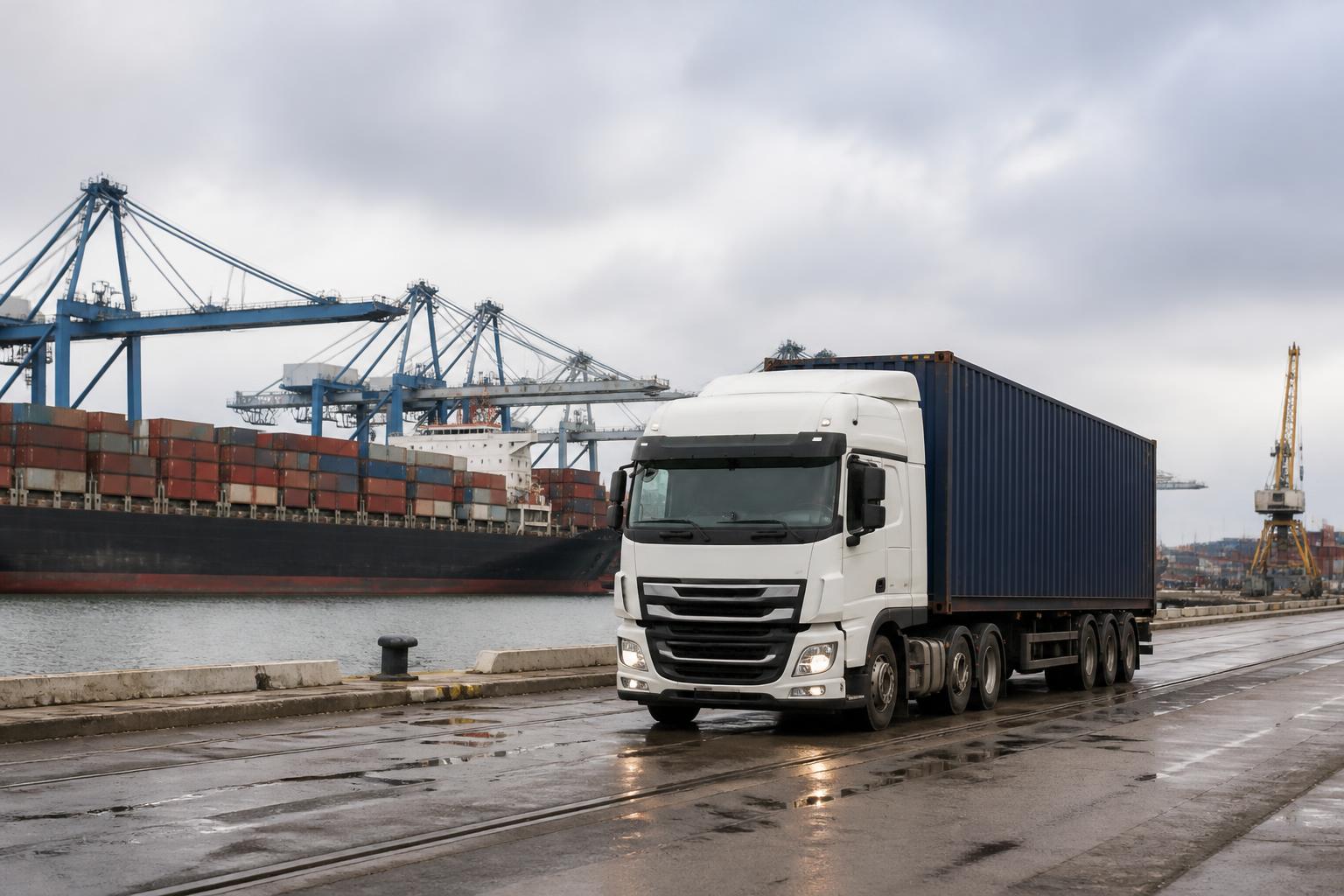
When cargo lands at a UK port, the sea leg is only part of the job. The next stage is getting the container released, booked, collected from the terminal, moved inland, and delivered to a site that can actually receive it. In practical terms, that is where maritime haulage starts to matter. It is the handover point between shipping line, port systems, customs status, and UK road transport.
For buyers, the biggest mistake is treating a port collection like a normal pallet delivery. It is not. A container move depends on release status, terminal booking rules, equipment, customs clearance, driver access, site constraints, and empty return instructions. If one of those is missing, the truck may still be available but the container will not move. That is why we run these jobs through an AI-assisted, human-backed transport desk, with organised request handling and operator oversight rather than a blind auction process.
Where maritime haulage starts and what it includes
In UK terms, maritime haulage usually starts once the container is ready to leave the port or terminal and move by road to its next point. That next point might be a warehouse, factory, distribution centre, devanning site, temporary storage facility, or another transport handover point inland.
The key point is that this is not vessel movement. It is not the sea freight booking itself. It is the UK road leg that begins after discharge, once the container has a valid release path and can be physically collected. In day to day operations, that means container haulage from ports such as Felixstowe, London Gateway, Southampton, Tilbury, Liverpool, Teesport, or Immingham into the wider UK haulage network.
What the movement includes depends on the job, but usually covers:
- collection from the port or terminal
- transport by road on a skeletal trailer or suitable equipment
- delivery to the consignee or nominated site
- waiting time management at port and delivery point
- communication of collection and delivery progress
- return of the empty container to the instructed depot, where required
Sometimes the road move is a simple import delivery. Sometimes it is more involved. A container may need to go to a devanning warehouse, then the goods continue onward as part-load or full-load distribution. In other cases, the container itself is repositioned between sites, or an export box is collected empty, loaded inland, and returned to port for sailing.
This is why maritime haulage sits between several parties at once. The shipping line controls release and empty return instructions. The terminal controls access and booking. Customs status affects whether the container can leave. The haulier controls road execution. The delivery site controls whether unloading can happen smoothly. If any part is unclear, the job becomes slower and more expensive very quickly.
What has to be ready before a container can move
Before we can line up a realistic collection, several basics need to be confirmed. A container is not ready just because the vessel has arrived.
First, the release must be in place. Depending on the line and terminal, that may mean line release, terminal release, or both. If shipping charges, detention issues, or documentation queries are still open, the container may show as present in the port but not collectable.
Second, we need the container details. At minimum, that usually means:
- container number
- container size and type, such as 20ft, 40ft, 40ft HC, reefer, or open top
- gross weight
- collection location and terminal
- delivery address
- any booking or reference numbers needed for collection
If the gross weight is wrong or missing, planning becomes unreliable. Weight affects routing, axle compliance, equipment choice, and whether the delivery site can unload safely.
Third, customs status must be clear. Since Brexit, UK import movements involve different customs treatment from EU internal movements before the change. In the UK, goods arriving from outside the relevant customs territory may need import declarations completed and customs clearance granted before release, depending on the procedure used. Where postponed accounting or other import arrangements apply, the customs side and VAT handling need to be understood before road collection is booked as though the box is free to move.
That does not mean every buyer has to become a customs specialist. It does mean someone in the chain must confirm whether the container is customs cleared, held for inspection, moving under transit, or subject to another control. A truck arriving at the port cannot solve a customs hold.
Fourth, the collection reference must be usable in the port system. Different terminals have different methods, but if the booking reference, PIN, or release code is wrong, the driver will not get through the gate process cleanly.
Fifth, the delivery site must be checked properly. We need to know:
- opening hours
- booking in rules
- whether the site can accept a full length artic and trailer
- whether there is space to reverse and unload
- whether the container will be live unloaded or grounded
- whether forklift, clamp, crane, or other unloading equipment is available
- whether there are height, weight, or access restrictions
This matters because a container delivery can fail at the final mile even after a successful port collection. Narrow lanes, low bridges, soft yards, strict booking slots, and sites without suitable unloading equipment all change the plan.
If you are moving goods onward after devanning, it is also worth deciding early whether the inland leg after unloading is better handled as part-load or full-load. That choice can affect where the container is delivered first and how quickly the goods can be turned around.
Why port moves do not run like standard UK haulage
Port work looks similar to ordinary road transport on paper, but operationally it behaves differently. A standard UK haulage job might be a straightforward collection and delivery with known loading times and normal depot access. Port container work adds layers of control that sit outside the haulier’s direct control.
The first difference is booking windows. Many terminals require pre-booked collection slots, and those slots are not always available at the ideal time. A truck may be ready, the delivery site may be ready, and the container may still not move until a workable terminal slot can be secured.
The second difference is queueing and turn times. Even with a valid booking, drivers can be delayed by traffic approaching the port, gate processing, stack operations, equipment availability, or congestion inside the terminal. That is why waiting time on container haulage needs to be treated realistically. It is not the same as a clean industrial estate collection.
The third difference is process dependency. Each major port has its own operating rhythm. Collection planning for Felixstowe is not identical to London Gateway. Southampton and Tilbury have their own booking patterns and delivery catchments. Liverpool, Teesport, and Immingham can involve very different trunk distances, depot networks, and empty return implications. A plan that works well from one port may be inefficient or impossible from another.
The fourth difference is empty return control. Once the import box has been unloaded, it often has to go back to a specific depot nominated by the shipping line. That empty return point may not be close to the delivery address. It may also change. So the job is not complete at the consignee gate. The transport plan has to account for the empty leg, the depot opening hours, and whether the return can be made on the same day.
The fifth difference is equipment and compliance. Heavy containers, reefers, hazardous cargo, or out of gauge units can require different planning from a standard curtainsider movement. Driver instructions, PPE requirements, terminal rules, and vehicle suitability all matter.
This is why we do not treat port work as generic spot haulage. We plan it as port-linked container haulage, with the terminal process built into the job from the start. For businesses moving regularly through major ports, our container haulage support across UK ports is designed around those realities, not around a spreadsheet assumption that every collection behaves like a simple depot pickup.
What changes the quote and the delivery plan
A realistic quote for maritime haulage depends on more than mileage. Distance matters, but it is only one part of feasibility and cost.
Timing is usually the first variable. Same day, next day, or timed delivery requests narrow the available options. A container that must be collected urgently may require a different operator, a different slot strategy, or a different delivery sequence from a flexible movement planned a day or two ahead.
Port of collection matters too. A move from Felixstowe into the Midlands is not costed in the same way as a move from Liverpool into the North West, or from Southampton into the South East. The inland route, likely congestion, terminal access pattern, and empty return path all affect the plan.
Container type also changes the job. A standard dry box is one thing. Reefers, overweight units, tank containers, and specialist equipment can require different handling and different haulier capability. Weight can be as important as distance. A short heavy move may be harder to place than a longer standard one.
Site restrictions are another common factor. If the delivery point has tight access, limited unloading time, compulsory booking slots, or no ability to accept a full artic, we may need a different vehicle plan or a different delivery method. In some cases, the container should not go direct to the final consignee at all. It may be better to deliver to a suitable unload point and then distribute onward.
That is where part-load and full-load alternatives come in. If the consignee only needs the cargo, not the container itself, devanning near the port or at an inland warehouse may be more practical. From there, the goods can move on as part-load if the shipment is smaller or split across several drops, or as full-load if it fills a dedicated vehicle. That can improve flexibility, but it adds another handling stage, so the right answer depends on urgency, product type, and delivery pattern.
Urgency always has a commercial effect. If the container is close to storage or detention exposure, the cheapest road option may not be the cheapest overall. Equally, paying for a rushed collection before customs or release status is fully ready can create wasted cost. The right plan is the one that matches the true operational deadline, not the one that only looks fast on an email chain.
Empty returns often change the quote more than buyers expect. If the line instructs the empty back to a depot well away from the delivery point, that leg has to be built into the movement. It affects time, route, and vehicle utilisation.
For port specific planning, we also break out local considerations. For example, if you are regularly collecting in Suffolk, our planning for container collections through Felixstowe reflects the terminal and inland routing realities there. The same applies if your flows are centred on the Humber, where our container movements linked to Immingham are planned around the port’s own operating pattern and onward road coverage.
How buyers and hauliers keep maritime haulage under control
The best way to keep these jobs under control is to stop treating them as a string of disconnected phone calls. Port transport works better when requests, status, and handovers are structured from the start.
For buyers, that means sending a request with the operational facts in one place. The more complete the request, the faster we can turn it into realistic options. A good request includes the container number, size, weight, port, terminal, release status, customs position, delivery address, delivery constraints, and target timing. If there is uncertainty, we would rather see that flagged early than hidden until a truck is already being chased.
From there, we compare realistic haulage options rather than flooding the job to everyone. That matters because container work is not improved by a race-to-the-bottom auction. The right operator is the one with suitable coverage, suitable equipment, and a workable plan for the terminal and delivery site, while keeping commercial control in their own hands.
For hauliers, control also means receiving subcontract opportunities that are usable, not vague. A job request should tell the operator what they are actually taking on, including port, timing, box type, delivery conditions, and whether the empty return is part of the movement. That is one of the reasons we use an AI-assisted, human-backed desk. The technology helps organise requests, route them sensibly, and keep status moving, but people still check whether the job makes operational sense.
During execution, ETA management matters more than generic tracking promises. Port jobs move through several uncertainty points, so the useful question is not only where the vehicle is, but whether the collection has cleared the gate, whether the terminal delay has changed the delivery slot, and whether the receiving site needs to be updated. A realistic ETA is operationally valuable. A guessed ETA is not.
The same applies to proof of completion. Buyers need POD, but on container work they often also need confirmation of unload timing, seal issues if relevant, and clarity on whether the empty has been returned. We keep that information tied to the job record so it is easier to close out the movement and deal with any follow up.
Most importantly, good control does not mean removing judgement. It means supporting it. Our role at Haulier.AI is to reduce the manual chasing, scattered emails, and avoidable gaps that make UK haulage harder than it needs to be, while keeping decisions with the people who actually run and buy transport. Buyers keep visibility and choice. Hauliers keep commercial control. The system helps structure the work, but operators still decide what is viable, what is priced correctly, and what can genuinely be delivered.
That is the practical shape of maritime haulage once cargo hits the UK. It starts when the container can move, not when the vessel berths. It succeeds when release, customs, terminal access, road planning, and delivery conditions are lined up in the right order. When they are not, the delays are predictable. When they are, port transport becomes far more manageable, even under pressure.
Is maritime haulage the same as sea freight?
No. Sea freight covers the ocean leg. Maritime haulage usually refers to the inland movement linked to that sea shipment, especially container haulage from a UK port to a warehouse, factory or onward site.
What information is needed to quote maritime haulage?
Usually container size, port, collection timing, delivery postcode, cargo type, weight, release status, any booking references and site restrictions. Missing details often slow quoting more than the transport itself.
Why can a short port delivery still be difficult?
Because the road leg is only one part of the job. Port booking windows, release timing, queueing, driver hours, empty return rules and delivery site access can all make a short move operationally tight.
Can maritime haulage be arranged for urgent work?
Yes, if the container is actually ready to move and the key details are clear. Urgent requests still depend on release status, port access, available operators and whether the delivery site can receive the load.
Does Haulier.AI replace the haulier on port work?
No. Haulier.AI is an AI-assisted, human-backed transport desk that helps organise requests, quotes and updates. The transport operator still carries out the movement and keeps commercial control of whether to price and accept it.